

TES-LOK Union Elbow Tube Fittings — 90° (and 45°) direction change with central union nut for in-line disconnection without cutting tube. Double-ferrule compression both ends. SS 316 · Brass · Monel · Inconel · Equal & Reducing · Cone-face metal seal · Up to 6,000 PSI · ISO 9001:2015 certified.
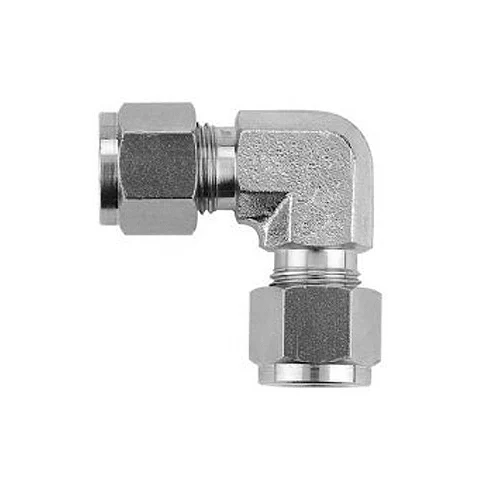
Union Elbow — 90° Equal Bore
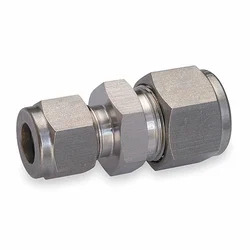
Reducing Union Fittings Range
A union elbow tube fitting combines two functions in a single compact body: a 90° (or 45°) change of tube direction and a separable union joint. Two compression tube ends — each with PTFE front and back ferrules — grip the tube OD. A central union nut joins the two body halves in a cone-face-to-cone-face metal seal that can be broken and remade without replacing any fitting component.
The union elbow is the go-to fitting wherever tubing must turn a corner and an in-line disconnection point is needed at that corner — for instrument removal, loop testing, or scheduled maintenance without disturbing the rest of the tubing run.
| Variant | Angle | Tube Ends | Union Nut | Use Case |
|---|---|---|---|---|
| Equal 90° Union Elbow | 90° | Same OD both ends | Central union nut | Standard 90° direction change with in-line service access |
| Equal 45° Union Elbow | 45° | Same OD both ends | Central union nut | Gradual 45° offset routing; lower pressure drop than 90° |
| Reducing 90° Union Elbow | 90° | Different ODs — one each end | Central union nut | 90° direction change while changing tube OD simultaneously |
| Feature | Union Elbow (TES-LOK) | Standard Elbow | Street Elbow |
|---|---|---|---|
| Direction Change | 90° or 45° | 90° or 45° | 90° |
| End 1 | Compression tube | Compression tube | Compression tube |
| End 2 | Compression tube | Compression tube | Male or female thread |
| In-line Disconnection | Yes — union nut separates | No — tube must be cut | No — tube must be cut |
| Seal at union joint | Cone-face metal seal | N/A (one-piece body) | N/A (one-piece body) |
| Best For | Corners where instrument removal is needed | Fixed routing, low part count | Tube run to threaded equipment at a corner |
| TES-LOK Union Elbow Tube Fitting — Specifications | |
|---|---|
| Brand | TES-LOK (by Tesco Steel & Engineering) |
| End connections | Double-ferrule compression tube — both ends (TES-LOK bite-type) |
| Union seal | Cone-face-to-cone-face metal seal (60° precision-machined cones) |
| Angles available | 90°, 45° |
| Tube OD range | 1/8" – 1" (imperial) · 3 mm – 25 mm (metric) |
| Configurations | Equal · Reducing |
| Body materials | SS 316 / 316L (standard) · SS 304 · Brass · Monel 400 · Inconel 625 · Hastelloy C-276 · Carbon Steel |
| Max. working pressure | 6,000 PSI (SS 316) · 3,000 PSI (Brass) |
| Temperature range | −196°C to +400°C (SS) · −29°C to +232°C (PTFE ferrule limit) |
| Ferrule material | PTFE (ASTM D1710 / D3294); optional SS or Monel ferrules |
| Certifications | ISO 9001:2015 · EN 10204 3.1 MTC available |
| Compatible systems | TES-LOK · Swagelok · Parker A-LOK · Ham-Let |
Union elbow at the instrument inlet allows transmitter removal for calibration without disturbing the process impulse line — no tube cutting, no re-ferrulling.
90° bends at the analyzer cabinet entry point with in-line disconnection for sample conditioning unit servicing and filter replacement.
Compact 90° routing in congested spaces with service access built into the fitting — one union nut disconnects the corner without panel disassembly.
Repeated disconnection/reconnection at test points without tube fatigue from cutting and re-flaring. Union nut handles hundreds of remake cycles.
Frequent reconfigurations without generating tube off-cuts — the union nut separates cleanly and the ferrule-set tube can be reconnected to the same fitting.
▶ What is a union elbow tube fitting?
A union elbow tube fitting combines a 90° (or 45°) direction change with a separable union nut. Both ends accept compression tubes via twin PTFE ferrules. The union nut allows the elbow to be disassembled in-line for service or instrument removal without cutting the tubing.
▶ What is the difference between a union elbow and a standard elbow?
A standard elbow is a fixed fitting — the tube must be cut to remove the instrument. A union elbow has a separable body joined by a union nut, so either tube end can be disconnected and reconnected without cutting. Critical for instrument loops requiring periodic calibration removal.
▶ What is the pressure rating?
TES-LOK union elbow tube fittings in 316 SS are rated to 6,000 PSI at room temperature for standard tube sizes. Pressure ratings derate with increasing temperature and larger tube diameters.
▶ What tube sizes are available?
TES-LOK union elbows are available in tube OD from 1/8" to 1" (imperial) and 3 mm to 25 mm (metric) in equal and reducing configurations.
▶ What materials are available?
316/316L stainless steel, 304 SS, duplex 2205/2507, monel 400, inconel 625, hastelloy C-276, and carbon steel.
▶ How do I install a union elbow tube fitting?
Insert tube fully into each compression end, hand-tighten nuts, then tighten 1-1/4 turns from finger-tight for first make-up. For the union nut, hand-tighten then wrench-tighten to seat the cone-face seal. On remake, tighten only to the original mark — do not add turns.
▶ What is a reducing union elbow?
A reducing union elbow connects two tubes of different ODs at a 90° angle with a union nut for in-line disconnection — for example, 1/2" OD on one end and 3/8" OD on the other.
▶ Are TES-LOK union elbows compatible with Swagelok and Parker?
TES-LOK union elbow compression ends are dimensionally compatible with Swagelok and Parker A-LOK fittings of the same tube OD. Verify compatibility before mixing brands in critical service.
90° and 45° union elbows — equal and reducing — in 316 SS, duplex, monel, inconel, and more. ISO 9001:2015 certified. Mill test reports supplied as standard.
✉ Email Quote 📞 WhatsApp Full Tube Fittings Range