

TES-LOK Union Connector Tube Fittings — double-ferrule compression tube on both ends with a central union nut for in-line disconnection without cutting the tube. SS 316 · Brass · Monel · Inconel · Equal & Reducing · Bulkhead Union · Up to 6,000 PSI · ISO 9001:2015 certified.
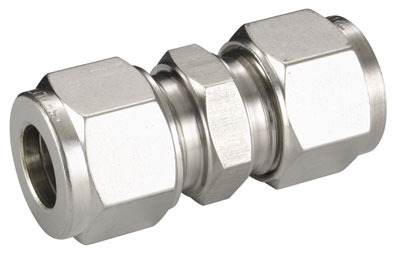
Union Connector (Equal & Reducing)
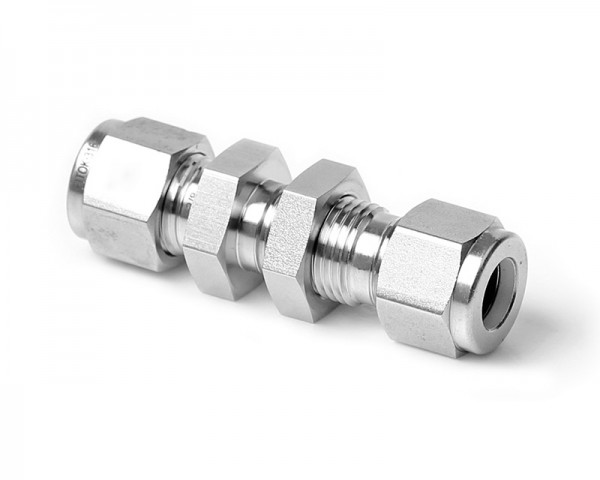
Bulkhead Union (Panel-Mount)
A union connector tube fitting (also called a union or union coupling) is a straight two-port fitting that joins two tube runs using double-ferrule compression ends on both sides and a separable central union nut. Unlike a standard compression fitting — where once the ferrules are swaged the tube is permanently committed — a union connector allows the connection to be broken and remade in the same fitting body without cutting either tube or displacing the pre-swaged ferrules.
The fitting consists of three components: two body halves (each with a compression end and internal cone seat) and a union nut that threads over one body half and tightens against the other, drawing the two cone faces together to form the tube-to-tube pressure seal. Loosening the union nut separates the two body halves instantly — disconnecting the tube run while both tube ends remain swaged in their respective body halves, ready to reconnect.
| Port | Connection Type | Function |
|---|---|---|
| Port 1 (Body Half A) | Double-ferrule compression tube (TES-LOK) | Connects to one tube run end — ferrules swaged on first make-up |
| Port 2 (Body Half B) | Double-ferrule compression tube (TES-LOK) | Connects to opposite tube run end — ferrules swaged on first make-up |
| Union nut | Threaded collar on Body Half A | Tightens Body Half B cone against Body Half A cone — forms the tube-to-tube pressure seal; loosening separates the two halves |
| Criterion | Union Connector | Standard Compression Fitting |
|---|---|---|
| In-line disconnection | Yes — loosen union nut, two halves separate; no tube cutting required | No — once ferrules are swaged, tube must be cut to disconnect |
| Remake capability | Yes — reconnect by threading union nut back to original position | Limited — each remake swages further into the tube; tube must be re-cut |
| Use at maintenance break points | Yes — specifically designed for this purpose | No — not suitable for regular disconnection |
| Number of components | 3: Body Half A, Body Half B, union nut | 2: body + nut (single compression nut) |
| Installed length | Slightly longer than standard fitting — union nut adds body length | More compact |
| Cost | Higher — premium for disconnection functionality | Lower — standard fitting price |
Equal union connector: Both compression ends accept the same tube OD — the standard choice for joining two runs of the same tube size. The most common configuration in instrument tube systems.
Reducing union connector: Each compression end accepts a different tube OD — for example 3/8" tube on one side and 1/4" tube on the other. Used when two tube runs of different OD must be joined with a disconnectable union. Eliminates the need for a separate equal union plus a reducing fitting in the tube run.
The bulkhead union connector is a union connector with a hex body sized to pass through a panel hole, secured by a locknut from the inside face. Both ends are compression tube — the inside-panel tube and the outside-panel tube connect with the same union body. The union nut allows the inside-panel tube connection to be broken and remade without removing the fitting from the panel. Used for tube-to-tube panel feedthroughs in instrument enclosures and junction boxes.
| Tube OD (Port 1) | Tube OD (Port 2 — Equal) | Reducing Combinations | Max. Pressure (SS 316) |
|---|---|---|---|
| 1/16" | 1/16" | — | 6,000 PSI |
| 1/8" | 1/8" | 1/8" × 1/16" | 6,000 PSI |
| 1/4" | 1/4" | 1/4" × 3/16" · 1/4" × 1/8" | 6,000 PSI |
| 3/8" | 3/8" | 3/8" × 1/4" · 3/8" × 3/16" | 6,000 PSI |
| 1/2" | 1/2" | 1/2" × 3/8" · 1/2" × 1/4" | 6,000 PSI |
| 3/4" | 3/4" | 3/4" × 1/2" | 6,000 PSI |
| 1" | 1" | 1" × 3/4" | 6,000 PSI |
Metric tube OD (3 mm–25 mm) and further reducing combinations available. Contact Tesco Steel for full equal and reducing size matrix.
| TES-LOK Union Connector Tube Fitting — Specifications | |
|---|---|
| Brand | TES-LOK (by Tesco Steel & Engineering) |
| End connection — both ports | Double-ferrule compression tube (TES-LOK bite-type) |
| Union mechanism | Separable two-piece body with central union nut; cone-face-to-cone-face tube-to-tube seal |
| Tube OD range | 1/16" – 1" (imperial) · 3 mm – 25 mm (metric) |
| Configurations | Equal · Reducing · Bulkhead Union (panel-mount) |
| Body materials | SS 316 / 316L (standard) · SS 304 · Brass · Monel 400 · Inconel 600 · Hastelloy C-276 |
| Ferrule & union nut material | Matching body material grade |
| Max. working pressure | 6,000 PSI (SS 316) · 3,000 PSI (Brass) |
| Temperature range | −196°C to +400°C (SS) · −29°C to +260°C (Brass) |
| Standards | ASTM D1710 · ASTM D3294 |
| Certifications | ISO 9001:2015 · EN 10204 3.1 MTC available |
| Compatible systems | TES-LOK · Swagelok · Parker A-LOK · Ham-Let (interchangeable ferrules) |
Loosen the union nut — the two body halves separate instantly. The pre-swaged ferrules remain embedded in each body half; both tube ends stay connected to their half-bodies. Reconnect by threading the union nut back to the original mark. No tube cutting, no pipe wrenches, no replacement ferrules needed for routine disconnections. Critical for maintenance break points and removable instrument connections.
The TES-LOK union connector seals on the mating cone faces of the two body halves — a metal-to-metal contact seal that does not rely on gaskets, O-rings, or PTFE. The seal re-establishes every time the union nut is tightened to the original mark, making the union connector suitable for high-cycle maintenance environments without seal replacement.
Reducing union connectors provide the same in-line disconnection functionality as equal unions, while also joining tube runs of different OD. One fitting replaces a standard equal union plus a separate reducing union — simplifying the tube circuit and reducing the total fitting count at the break point.
The bulkhead union variant creates a tube-to-tube panel feedthrough in which the inside-panel connection is still a union — allowing the inside tube to be disconnected without removing the fitting from the panel. Used in instrument enclosures where the internal tube run must be disconnectable for equipment removal or maintenance while the outside connection remains undisturbed.
TES-LOK union connectors are dimensionally compatible with Swagelok, Parker A-LOK, and Ham-Let double-ferrule tube fitting systems. On multi-vendor sites, TES-LOK union connectors can be used as the disconnection point in an otherwise mixed-brand tube system, providing the union functionality without replacing all fittings.
Available in SS 316 through Hastelloy C-276, with matching CRA ferrules and union nuts. ISO 9001:2015 quality system. EN 10204 3.1 material test certificates and PMI available — meeting the documentation requirements of major oil and gas operator and EPC contractor specifications.
▶ What is a union connector tube fitting?
A union connector tube fitting joins two tube runs with compression ends on both sides and a central union nut that allows the connection to be broken and remade in-line without cutting the tube. It is the standard solution at maintenance break points and upstream of removable instruments or equipment.
▶ What is the difference between a union connector and a standard compression fitting?
A standard compression fitting is permanent once the ferrules are swaged — the tube must be cut to disconnect. A union connector has a separable two-piece body with a union nut; it can be disconnected and reconnected multiple times without cutting the tube. Use a union wherever the tube run must be breakable.
▶ What is a reducing union connector?
A reducing union connector has different tube OD on each end — it joins two tube runs of different OD with the same in-line disconnection capability as an equal union. Eliminates a separate reducing fitting at the break point.
▶ What is a bulkhead union tube fitting?
A bulkhead union tube fitting is a union connector with a hex body for panel mounting — both ends are compression tube. The union nut allows the inside-panel tube to be disconnected without removing the fitting from the panel. Used for disconnectable tube-to-tube panel feedthroughs in instrument enclosures.
▶ How many times can a union connector be remade?
Multiple times, provided the tube OD and ferrule are undamaged. On remakes, tighten the union nut only to the original position mark — do not add turns. If the tube end is damaged, cut past the old bite mark and make up as a fresh connection.
▶ What tube OD sizes are available?
1/16" to 1" imperial and 3 mm to 25 mm metric. Equal and reducing configurations both available. Contact Tesco Steel for the full equal and reducing size matrix.
▶ What is the maximum pressure rating?
Up to 6,000 PSI in SS 316 at ambient temperature. Brass to 3,000 PSI. Pressure ratings derate at elevated temperature.
▶ What materials are available?
SS 316 (standard), SS 316L, SS 304, Brass, Monel 400, Inconel 600, and Hastelloy C-276. Ferrules and union nuts supplied in matching material. EN 10204 3.1 MTCs and PMI available.
Equal & Reducing · Bulkhead Union · SS 316 · Brass · CRA Alloys · 1/16"–1" Tube OD · Up to 6,000 PSI
ISO 9001:2015 · EN 10204 3.1 MTC · Fast delivery worldwide