

TES-LOK brand | Male Thread on Run | Compression Tube on Run & Branch | SS 304 / SS 316 / Brass | 6000 PSI | ISO 9001:2015
Request a Quote WhatsApp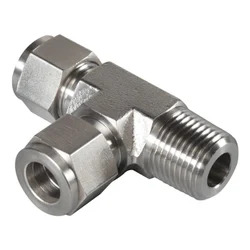
A male run tee tube fitting is a three-port instrumentation tee fitting with a specific end configuration: one run end carries a male NPT, BSP, or BSPT thread that screws directly into a female-threaded valve body, manifold, or instrument port; the opposite run end carries a double-ferrule compression tube connection; and the perpendicular branch port also carries a double-ferrule compression tube connection. The two compression ends allow independent re-make; the male thread end seals directly into the process connection point.
Tesco Steel manufactures male run tee tube fittings under the TES-LOK brand. They are used wherever a tube line must originate at a female-threaded block valve, manifold port, or instrument body and simultaneously continue as a tube run while also branching to a second instrument — all from a single fitting with no additional adapters or unions. TES-LOK male run tees are dimensionally compatible with Swagelok, Parker A-LOK, and Ham-Let equivalents.
| Male Run Tee — Port Layout | ||
|---|---|---|
| Run End 1 (inline) | Male thread — NPT / BSP / BSPT / UNF / ISO / SAE | → Screws into female-threaded port |
| Run End 2 (inline, opposite) | Compression tube — double-ferrule nut & ferrule set | → Connects to outgoing tube run |
| Branch End (perpendicular) | Compression tube — double-ferrule nut & ferrule set | → Connects to branch instrument tube |
| TES-LOK Male Run Tee Tube Fitting — Technical Data | |
|---|---|
| Brand | TES-LOK (Tesco Steel & Engineering) |
| Configuration | Male thread (run) × Compression tube (run) × Compression tube (branch) |
| Male Thread End | NPT / BSP / BSPT / UNF / ISO / SAE — one run end |
| Compression Ends | Double-ferrule (front ferrule + back ferrule) — run end 2 and branch |
| Fractional Tube OD | 1/16" to 2" OD |
| Metric Tube OD | 2 mm to 50 mm OD |
| Material Grades | SS 304 (1.4301), SS 316 (1.4401), Brass, Monel 400, Inconel 600, Hastelloy C-276, Titanium Gr. 2 |
| Pressure Rating — SS | Up to 6000 PSI (413 bar) |
| Pressure Rating — Brass | 300 PSI / 1000 PSI / 3000 PSI (size-dependent) |
| Temperature Range | 150 °C to 400 °C |
| Standards | ASTM D1710, ASTM D3294 |
| Surface Finish | Electropolished / Passivated / As-machined |
| Certifications | ISO 9001:2015; NABL-traceable MTRs available |
Connects directly to a female-threaded port, continues the tube run, and branches to a second tube — eliminating a separate male connector plus union tee combination.
Each port seals independently: tapered thread (NPT/BSPT) or face seal (BSP) on the male end; metal-to-metal double-ferrule compression on each tube end.
Both compression tube ends can be disconnected and re-made multiple times — initial make-up 1¼ turns; re-make ¼ turn — without disturbing the male thread seal.
Replaces a male connector + union tee + extra tube section with a single body — reducing leak points, installation time, and system footprint.
Dimensionally interchangeable with Swagelok, Parker A-LOK, and Ham-Let male run tees — direct drop-in replacement with no system modification required.
SS 316 for chloride and marine service; Hastelloy C-276 and Monel 400 for H₂S, strong acids, and aggressive process media in chemical and offshore plants.
| Fitting Type | Run End 1 | Run End 2 | Branch End | Best Use |
|---|---|---|---|---|
| Male Run Tee | Male thread | Compression tube | Compression tube | Tube line originates at a female-threaded port; branch to second tube instrument |
| Male Branch Tee | Compression tube | Compression tube | Male thread | Inline tube run with male-threaded branch to female-threaded instrument port |
| Union Tee | Compression tube | Compression tube | Compression tube | All-tube T junction; all three connections re-makeable, no threaded ports |
| Female Run Tee | Female thread | Compression tube | Compression tube | Tube line originates at a male-threaded stud or nipple; branch to second tube |
| Male Tee | Compression tube | Compression tube | Male thread | Same as Male Branch Tee — tube run through, male thread on branch (naming varies by standard) |
| Tube OD (compression ends) | Male Thread (run end) | Typical Application |
|---|---|---|
| 1/4" | 1/8" NPT / 1/8" BSP | Pressure gauge valve body to transmitter; branch to gauge instrument |
| 1/4" | 1/4" NPT / 1/4" BSP | Manifold port to impulse line run and branch gauge connection |
| 3/8" | 1/4" NPT / 1/4" BSP | Flow transmitter tapping block to dual-instrument distribution |
| 3/8" | 3/8" NPT / 3/8" BSP | Larger gauge valve or control valve port; dual tube branching |
| 1/2" | 1/2" NPT / 1/2" BSP | High-flow process tapping block; dual instrument feed |
| 6 mm (metric) | 1/8" BSP | European panel instrument port to dual metric-tube instruments |
| 10 mm (metric) | 1/4" BSP / 1/4" BSPT | Metric tube distribution from BSP manifold port |
| 12 mm (metric) | 1/2" BSP / 1/2" BSPT | Larger metric-tube dual feed from BSP block valve body |
Step 1 — Male thread end: Apply 2–3 PTFE tape wraps clockwise to NPT or BSPT threads. Thread into the female port hand-tight, then add 1.5–2 wrench turns. For BSP parallel (BSPP) threads, use a bonded seal washer — no PTFE tape. Tighten the male thread end first, before making up the compression ends, so you can apply wrench torque to the fitting body freely without twisting into the tube.
Step 2 — Compression tube ends (run and branch): Cut each tube square and deburr. Insert fully through the nut and ferrules until the tube bottoms in the body. Hand-tighten the nut. Mark the nut and turn an additional 1¼ turns for initial make-up — this swages both ferrules onto the tube OD. Both compression ends can be made up simultaneously or in sequence. Re-make: On subsequent disconnections, tighten only ¼ turn from hand-tight; the ferrules are already set.
| Industry | Application | Preferred Material |
|---|---|---|
| Oil & Gas | Tapping a pressure transmitter impulse line directly from a gauge valve body while branching to a local pressure gauge; wellhead dual-instrument distribution from a single tapping point | SS 316, Monel, Inconel |
| Chemical & Petrochemical | Splitting an analyzer sample line originating from a block valve; dual-instrument feed from reactor and column instrument bodies | SS 316L, Hastelloy C-276 |
| Power Generation | Boiler water chemistry dual-instrument connections from threaded tapping points; steam gauge and transmitter shared feeds | SS 316, Carbon Steel |
| Semiconductor | Gas panel dual-instrument distribution from manifold port — mass flow controller run plus pressure transducer branch from a single port connection | SS 316L EP (electropolished) |
| Food & Beverage | Hygienic dual-instrument branching from threaded valve connections on CIP-compatible process lines | SS 316L (3-A certified) |
| Shipbuilding & Offshore | Hydraulic and pneumatic panel dual-gauge distribution from threaded block manifold ports; deck instrument branching | SS 316, Copper-Nickel |
ISO 9001:2015 certified | Male thread on run & compression tube branch | SS 304 · SS 316 · Brass · Alloys | NPT · BSP · BSPT | Fast global shipment
Send Inquiry WhatsApp Us