

TES-LOK Female Elbow Tube Fittings — double-ferrule compression tube one end, female internal NPT / BSP thread other end, 90° direction change in one fitting. Eliminates a separate adapter plus a union elbow. SS 316 · Brass · Monel · Inconel · Equal & Reducing · Up to 6,000 PSI · ISO 9001:2015 certified.
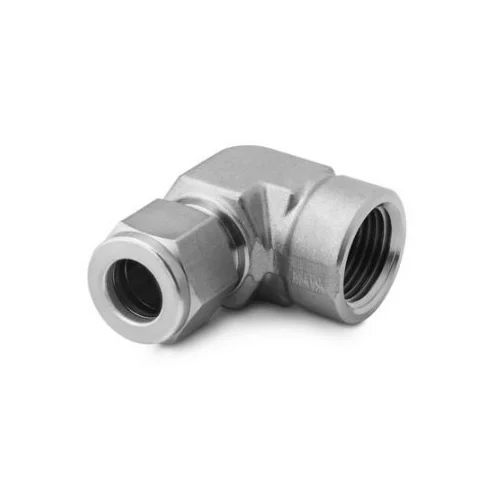
Female Elbow (90° — Equal)
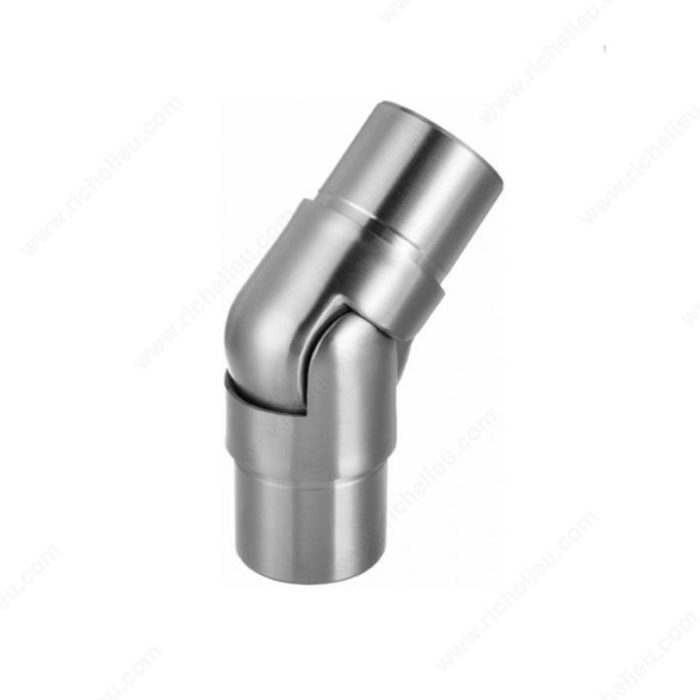
Adjustable Female Elbow (Swivel variant)
A female elbow tube fitting is a 90° angle fitting that connects a compression tube run to a female-threaded port on a valve body, instrument inlet, manifold block, or pressure transmitter. One end makes the tube connection via TES-LOK's double-ferrule bite-type compression mechanism — the same reliable seal used across the full TES-LOK range. The other end is a female internal thread — NPT, BSPT, or BSPP — that receives a male-threaded stud or nipple on the equipment.
The 90° body geometry allows the tube run to arrive at the equipment port from a perpendicular direction, eliminating forced bends in the tube itself. This is especially important in high-pressure systems where tube bending introduces stress concentrations and work-hardening at the bend. It also replaces two separate fittings — a female adapter (tube-to-thread transition) and a union elbow (direction change) — with a single, compact body, reducing the number of potential leak points in the assembly.
| Port | Connection Type | Function |
|---|---|---|
| Tube End | Double-ferrule compression tube (TES-LOK bite-type) | Connects to the instrument or process tube run. Tube OD 1/16"–1" imperial or 3–25 mm metric. |
| Thread End | Female internal thread — NPT, BSPT, or BSPP | Receives a male-threaded stud or nipple on a valve body, instrument port, or manifold. Thread 1/16"–3/4" NPT / BSP equivalent. |
| Body Angle | 90° between tube axis and thread axis | Redirects the tube run perpendicular to the equipment port face — no tube bending required at the connection point. |
| Fitting | Tube End | Other End | Use When |
|---|---|---|---|
| Female Elbow | Compression tube | Female internal thread | Tube run arrives 90° to a male-threaded stud or nipple on equipment |
| Male Elbow | Compression tube | Male external thread | Tube run arrives 90° to a female-threaded port (socket) on equipment |
| Union Elbow | Compression tube | Compression tube | 90° direction change mid-run in an all-tube system — no thread connection at either end |
| Street Elbow (Reducing) | Compression tube (small OD) | Male or female thread (larger size) | Direction change combined with OD-to-thread size reduction at equipment interface |
| Female Branch Tee | Compression tube (run) | Female thread (branch) + compression tube (run) | Branch off from a tube run to a female-threaded port — adds a branch without interrupting the main run |
| Variant | Tube OD End | Thread End | Typical Application |
|---|---|---|---|
| Equal Female Elbow | Standard OD (e.g. 1/4") | Matching thread (e.g. 1/4" NPT) | Standard right-angle tube-to-instrument connection where OD and thread sizes correspond |
| Reducing Female Elbow | Smaller tube OD | Larger thread size | Connecting a smaller-bore tube run to a larger-bore instrument or valve port at 90° |
| NPT Female Elbow | Any tube OD | Female NPT (tapered) | US-standard instrument equipment; oil & gas, petrochemical, American process plant |
| BSPT Female Elbow | Any tube OD | Female BSPT (tapered) | UK/European standard tapered BSP equipment ports; hydraulic systems |
| BSPP Female Elbow | Any tube OD | Female BSPP (parallel) | Hydraulic and pneumatic equipment with parallel BSP ports; requires Dowty seal on male stud |
| Tube OD Range | 1/16" to 1" (imperial); 3 mm to 25 mm (metric) |
| Thread End | Female NPT (ASME B1.20.1); Female BSPT (BS EN 10226); Female BSPP (BS EN ISO 228-1) |
| Thread Size Range | 1/16" NPT to 3/4" NPT; 1/16" BSP to 3/4" BSP (equivalent) |
| Body Angle | 90° |
| Working Pressure | Up to 6,000 PSI (SS 316, ambient); 3,000 PSI (Brass) |
| Standard Material | SS 316 (ASTM A276 / A479) |
| Optional Materials | SS 316L, SS 304, Brass (CW617N), Monel 400, Inconel 600, Hastelloy C-276 |
| Ferrule Material | Matching body material; PTFE ferrules available (ASTM D1710/D3294) for chemical compatibility |
| Temperature Range | -196°C to +450°C (SS 316); -10°C to +120°C (Brass) |
| Tube Compatibility | Compatible with Swagelok, Parker A-LOK, Ham-Let double-ferrule compression fittings |
| Quality Certification | ISO 9001:2015; EN 10204 3.1 MTCs available; PMI testing on request |
The female elbow receives a male-threaded stud. Apply sealant to the male stud being inserted — never apply sealant inside the female socket of the fitting.
| Thread End Type | Sealant on Mating Male Stud | Method |
|---|---|---|
| Female NPT | PTFE tape or anaerobic sealant | 2–3 wraps PTFE tape clockwise on male stud; seal achieved by taper engagement |
| Female BSPT | PTFE tape or anaerobic sealant | 2–3 wraps PTFE tape on male stud; do not mix BSPT and NPT threads |
| Female BSPP | Dowty bonded seal (bonded washer) | Fit Dowty seal on male stud shoulder; no PTFE tape |
A female elbow replaces two fittings — a female adapter (tube-to-thread transition) plus a union elbow (direction change) — with a single machined body. This reduces assembly length, eliminates one additional potential leak point, and lowers the fitting count in space-constrained instrument panels and manifold assemblies.
When a tube arrives perpendicular to an equipment port, the only alternatives are to bend the tube or use an elbow fitting. Forcing a tube bend close to a compression fitting generates bending stress at the ferrule bite, reducing fatigue life in vibration-prone installations. The female elbow absorbs the direction change in the fitting body, leaving the tube straight throughout its run.
Standard SS 316 construction provides resistance to chloride environments, sour gas (H2S), process chemicals, and offshore atmospheric corrosion. The female socket is machined with a smooth bore to prevent crevice corrosion initiation. PTFE ferrules are available for highly corrosive media requiring inert wetted surfaces.
The TES-LOK double-ferrule mechanism delivers a proven leak-tight tube seal — the front ferrule bites into the tube OD to create the primary seal and provide pull-out resistance; the back ferrule provides spring-back and vibration dampening. The same ferrule geometry is compatible with Swagelok and Parker A-LOK systems, simplifying replacement in mixed-brand installations.
Available in NPT, BSPT, and BSPP across 1/16" to 3/4" thread sizes, TES-LOK female elbows cover the full range of instrument and process equipment port standards worldwide. Reducing configurations (smaller tube OD on a larger thread size) handle size mismatches between the tube system and the equipment port in a single fitting.
EN 10204 3.1 material test certificates are available on request for all SS 316 and exotic alloy female elbows. PMI (positive material identification) testing available. Full heat/lot traceability supports documentation requirements for oil & gas, offshore, pharmaceutical, and nuclear instrument tubing systems.
TES-LOK Female Elbow Tube Fittings are specified wherever a tube run must terminate at a right angle to a male-threaded equipment port:
▶ What is a female elbow tube fitting?
A female elbow tube fitting makes a 90° direction change from a compression tube run to a female-threaded port. One end accepts the tube via double-ferrule bite-type compression. The other end is a female internal thread — NPT, BSPT, or BSPP — that receives a male-threaded stud or nipple on a valve body, instrument port, or manifold block. It combines the thread-to-tube transition and the 90° turn in one fitting.
▶ What is the difference between a female elbow and a male elbow?
A female elbow has a female (internal) thread — it connects to a male-threaded stud on the equipment. A male elbow has a male (external) thread — it screws into a female-threaded port (socket) on the equipment. Choose female elbow when the equipment presents a male stud; choose male elbow when the equipment presents a female socket.
▶ What is the difference between a female elbow and a union elbow?
A union elbow has compression tube connections on both ends — it changes direction within an all-tube run. A female elbow has a compression tube on one end and a female thread on the other — it is used at the termination point where a tube run meets a threaded equipment port at 90°. Union elbows are used mid-run; female elbows are used at equipment interface points.
▶ What thread sealant should I use with a female elbow?
Apply sealant to the male stud going into the female socket — not inside the socket. For NPT/BSPT male studs: 2–3 wraps of PTFE tape. For BSPP male studs: Dowty bonded seal on the stud shoulder — no PTFE tape. Never apply PTFE tape to BSPP threads; parallel threads do not seal by taper, and PTFE tape gives a false torque sensation without sealing.
▶ How do I install a female elbow tube fitting?
Apply appropriate sealant to the male equipment stud. Thread the female elbow socket onto the stud, aligning the tube end in the required direction. Tighten with a wrench on the hex flats using a back-up wrench on the stud. Then make the compression tube connection: insert tube fully into the body, finger-tighten the nut, then tighten 1-1/4 turns (initial make-up). Pressure-test before service.
▶ What tube OD sizes are available?
TES-LOK Female Elbows are available for tube OD 1/16" to 1" imperial and 3 mm to 25 mm metric, with female thread 1/16" to 3/4" NPT and equivalent BSP sizes. Equal and reducing configurations are both available.
▶ What is the pressure rating?
Up to 6,000 PSI in SS 316 at ambient temperature. Brass versions rated to 3,000 PSI. The 90° elbow body does not reduce the pressure rating vs a straight fitting of the same size and material.
▶ What materials are available?
SS 316 (standard), SS 316L, SS 304, Brass, Monel 400, Inconel 600, and Hastelloy C-276. Ferrules supplied in matching material; PTFE ferrules available for chemical compatibility. EN 10204 3.1 MTCs and PMI available on request.
SS 316 · Brass · Monel · Inconel · NPT · BSPT · BSPP · 1/16"–1" OD · Equal & Reducing · ISO 9001:2015 · EN 10204 3.1 MTCs available
✉ Email Quote 📞 WhatsApp