

TES-LOK Female Cap Tube Fittings (Hex Caps) — solid closed body with female internal thread and hexagonal exterior head, caps and seals open male-threaded nipples, pipe stubs, and instrument connections completely. Dead-end capping, spare nipple sealing, construction blanking, and test connection closure. SS 316 · Brass · Monel · Inconel · NPT · BSPT · BSPP · 1/8"–2" · Up to 6,000 PSI · ISO 9001:2015 certified.
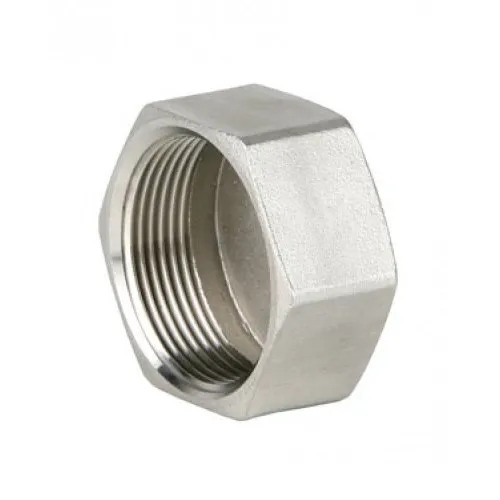
A female cap (also called a hex cap or pipe cap) is a solid fitting with a female internal thread and a closed solid end encased in a hexagonal exterior head. It screws onto a male-threaded nipple, pipe stub, or instrument connection, capping it completely and preventing any fluid flow through the capped end. The solid closed end of the cap acts as a blind — there is no bore, no passage, and no opening through the fitting body beyond the internal thread socket.
The hexagonal exterior allows the cap to be gripped and driven by an open-end or combination wrench, enabling controlled installation torque without body damage. Unlike a pipe cap with a round or square head that requires a pipe wrench, the TES-LOK hex cap can be installed and removed in tight spaces with a standard spanner. Female caps are precision-machined to ASME B1.20.1 (NPT), BS EN 10226 (BSPT), and BS EN ISO 228-1 (BSPP) thread standards for consistent, leak-free engagement on all standard male-threaded pipe components.
| Fitting | Thread | Body | Seals | Use When |
|---|---|---|---|---|
| Female Cap (Hex Cap) | Female internal | Solid closed end, hex exterior | Male-threaded nipple or stub (screws onto it) | The component to be capped is a male-threaded nipple or stud protruding outward |
| Hex Plug | Male external | Solid hex head | Female-threaded port (screws into it) | The port to be sealed is a female-threaded socket — the plug fills the socket from inside |
| Tube Cap | None — compression | Solid body with compression socket | Open tube end (bites onto tube OD) | The end to be sealed is an open, unthreaded tube end — no male thread present |
| Blind Flange | None — bolted | Solid disc | Flanged pipe end (bolted) | Large-bore flanged pipe end; high-pressure class; removable for periodic inspection |
| Thread Form | Standard | Seal Method on Mating Male | Common Nipple / Stub Type |
|---|---|---|---|
| NPT Female Cap | ASME B1.20.1 | PTFE tape (2–3 wraps) on male NPT nipple thread | US-standard instrument stubs, hex nipples, male adapters on US process equipment |
| BSPT Female Cap | BS EN 10226 | PTFE tape (2–3 wraps) on male BSPT nipple thread | UK/European instrument stubs and hex nipples with tapered BSP male threads |
| BSPP Female Cap | BS EN ISO 228-1 | Dowty bonded seal on male BSPP nipple shoulder | Hydraulic and pneumatic male studs and nipples with parallel BSP threads |
| Thread Form | Female NPT (ASME B1.20.1); Female BSPT (BS EN 10226); Female BSPP (BS EN ISO 228-1) |
| Thread Size Range | 1/8" to 2" — all standard instrument and process pipe sizes |
| Head / Exterior Form | Hexagonal — full hex exterior for open-end wrench engagement |
| Body End | Solid closed — no bore, no through-hole; complete male nipple capping |
| Working Pressure | Up to 6,000 PSI (SS 316, ambient); 3,000 PSI (Brass) |
| Standard Material | SS 316 (ASTM A276 / A479) |
| Optional Materials | SS 316L, SS 304, Brass (CW617N), Monel 400, Inconel 600, Hastelloy C-276 |
| Surface Finish | Bright annealed or passivated (SS); natural (Brass); electroless nickel plating on request |
| Temperature Range | -196°C to +450°C (SS 316); -10°C to +120°C (Brass) |
| Thread Gauging | GO/NO-GO thread gauge check per applicable standard before despatch |
| Quality Certification | ISO 9001:2015; EN 10204 3.1 MTCs available; PMI testing on request |
| Thread Size | NPT | BSPT | BSPP | Typical Capping Application |
|---|---|---|---|---|
| 1/8" | ✓ | ✓ | ✓ | Miniature instrument nipple stubs; small gauge and transducer male connections |
| 1/4" | ✓ | ✓ | ✓ | Instrument manifold nipple stubs; pressure gauge male connections; analyser sample nipples |
| 3/8" | ✓ | ✓ | ✓ | Flow meter male stubs; valve outlet nipples during construction; hydraulic signal nipples |
| 1/2" | ✓ | ✓ | ✓ | Process manifold nipple stubs; condensate pot male connections; valve body outlet nipples |
| 3/4" | ✓ | ✓ | ✓ | Valve body outlet nipples; pump casing instrument nipple stubs; heat exchanger drain nipples |
| 1" | ✓ | ✓ | ✓ | Main process valve outlet nipples; large manifold block nipple stubs; pipe end nipple caps |
| 1-1/4" | ✓ | ✓ | ✓ | Industrial valve body nipple stubs; large-bore instrument nozzle nipple caps |
| 1-1/2" | ✓ | ✓ | ✓ | Tank drain nipple caps; large valve body nipple stubs; industrial pipe end nipples |
| 2" | ✓ | ✓ | ✓ | Main process line nipple caps; large industrial valve and pump outlet nipple stubs |
Sealant is applied to the male nipple or stud being capped — not inside the female cap's socket. The correct sealant depends on the thread form of the male nipple.
| Male Nipple Thread Form | Sealant Required on Male Nipple | Application Notes |
|---|---|---|
| NPT Male Nipple | PTFE tape (2–3 wraps clockwise) or anaerobic sealant | Taper seal — thread deforms as cap advances onto nipple. Hand-tight plus 2–3 full turns. Do not over-torque; can crack cap on brittle male nipple body. |
| BSPT Male Nipple | PTFE tape (2–3 wraps clockwise) | Same taper-seal principle as NPT. BSPT and NPT are NOT interchangeable — different pitch and flank angle. Do not mix NPT caps on BSPT nipples. |
| BSPP Male Nipple | Dowty bonded seal on nipple shoulder | Parallel thread — no taper seal. Dowty washer between nipple shoulder and cap entry face. No PTFE tape. Tighten until Dowty washer is fully compressed flat. |
The solid closed end of the female cap leaves no residual cavity or pocket at the end of the capped nipple. Once the cap is installed and sealed, the connection is as fluid-tight as the surrounding pipe body — there is no trapped dead-leg volume that could accumulate sediment, corrode internally, or cause measurement errors if the nipple is part of an instrument impulse line during testing.
The hexagonal exterior allows precise torque application with a standard open-end or combination wrench — the same tools already on-site for tube fitting work. Unlike round or square pipe caps that require a separate pipe wrench with teeth that mar the surface, hex caps can be installed and removed cleanly in tight instrument panel clearances where a pipe wrench jaw cannot fit.
During plant construction, instrument nipples are often installed at process taps before the instruments themselves are delivered or ready for installation. Female caps provide a rated, pressure-tested closure on these nipples throughout the construction and pre-commissioning phase — the cap is simply removed and the instrument connected when commissioning begins, with no nipple thread damage or re-work required.
Standard SS 316 construction resists chloride environments, sour gas (H2S), steam condensate, process chemicals, and offshore atmospheric corrosion. SS 316 caps resist seizing onto SS 316 nipples in storage and service conditions — passivated surfaces minimise thread galling, and the cap remains removable after years of service without drilling or stud-extraction operations.
Unlike disposable plastic caps or single-use thread protectors, TES-LOK female caps can be removed, re-sealed with fresh PTFE tape (NPT/BSPT) or a new Dowty seal (BSPP), and reinstalled multiple times. This makes them practical for test nipple caps that are accessed during pressure testing cycles, annual PSV tests, and scheduled maintenance shutdowns — the cap itself is not replaced each time, only the sealant.
EN 10204 3.1 material test certificates are available for all SS 316 and exotic alloy female caps. PMI (positive material identification) testing available on request. Full heat and lot traceability supports documentation requirements for oil & gas, offshore, pharmaceutical, and nuclear applications where every pressure-boundary component must be certified — including caps on spare nozzles.
▶ What is a female cap tube fitting?
A female cap (hex cap) is a solid fitting with a female internal thread and a closed solid end encased in a hexagonal exterior head. It screws onto a male-threaded nipple or stub, capping it completely and preventing any fluid flow. The hex exterior allows installation and removal with an open-end wrench. Used for construction blanking, spare nipple sealing, test connection closure, and dead-end capping on instrument and process assemblies.
▶ What is the difference between a female cap and a hex plug?
A female cap has a female (internal) thread and screws onto a male-threaded nipple — it caps from the outside. A hex plug has a male (external) thread and screws into a female-threaded port (socket) — it plugs from the inside. Use a female cap when the component to be sealed is a male nipple; use a hex plug when the port to be sealed is a female socket.
▶ What is the difference between a female cap and a tube cap?
A female cap (hex cap) seals a male-threaded nipple via thread engagement — it requires a threaded nipple. A tube cap seals an open tube end via compression bite-type grip — it requires an unthreaded tube end. Use a female cap when the end to be sealed has a male thread; use a tube cap when the end to be sealed is an open tube without threads.
▶ What sealant is needed for a BSPP female cap?
Apply a Dowty bonded seal to the BSPP male nipple shoulder — not PTFE tape. BSPP is a parallel thread and does not seal by taper. The Dowty seal compresses between the male shoulder and the cap entry face to create the seal. PTFE tape on a BSPP nipple creates a false torque feel without sealing and will leak under pressure.
▶ Can a female cap be reused?
Yes — typically 3–5 times on NPT/BSPT, provided the internal thread is undamaged. Apply fresh PTFE tape to the male nipple each re-installation. For BSPP, fit a new Dowty seal each time — do not re-use the compressed washer. Inspect the cap internal thread and the male nipple thread for galling, corrosion, or cross-thread damage before re-use.
▶ Are NPT and BSPT female caps interchangeable?
No. NPT (60° flank) and BSPT (55° flank) have different thread pitches and included angles. Threading an NPT cap onto a BSPT nipple (or vice versa) causes cross-threading that appears to engage but will leak or fail under pressure. Always match cap thread standard to nipple thread standard.
▶ What sizes are available?
1/8" to 2" in NPT, BSPT, and BSPP — all standard instrument and process pipe sizes available from stock. Non-standard sizes manufactured on request.
▶ What is the pressure rating?
Up to 6,000 PSI in SS 316 at ambient temperature. Brass: up to 3,000 PSI. The solid closed end of the cap is inherently stronger than a hollow tube or nipple — the pressure rating is governed by thread engagement depth onto the male nipple. EN 10204 3.1 MTCs and PMI available on request.
SS 316 · Brass · Monel · Inconel · NPT · BSPT · BSPP · 1/8"–2" · Solid Closed End · ISO 9001:2015 · EN 10204 3.1 MTCs available
✉ Email Quote 📞 WhatsApp