

TES-LOK Male Connectors for Bonded Seal — BSPP (G) parallel-thread tube fittings with a precision-machined Dowty seal recess on the thread shoulder, providing instant leak-free port connections without PTFE tape, thread compounds, or sealant paste. ISO 9001:2015 certified. Made in India.
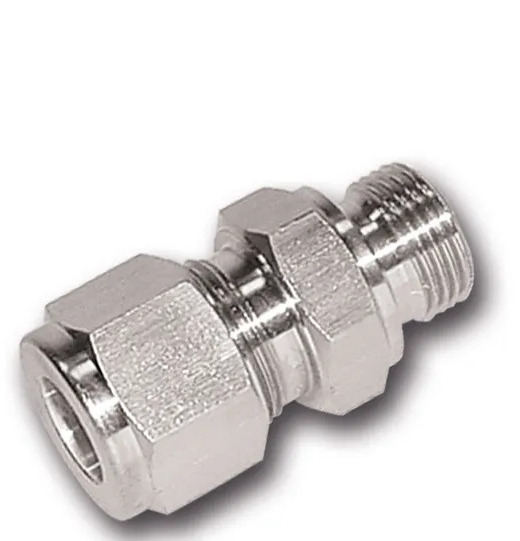
TES-LOK Male Connector — Bonded Seal
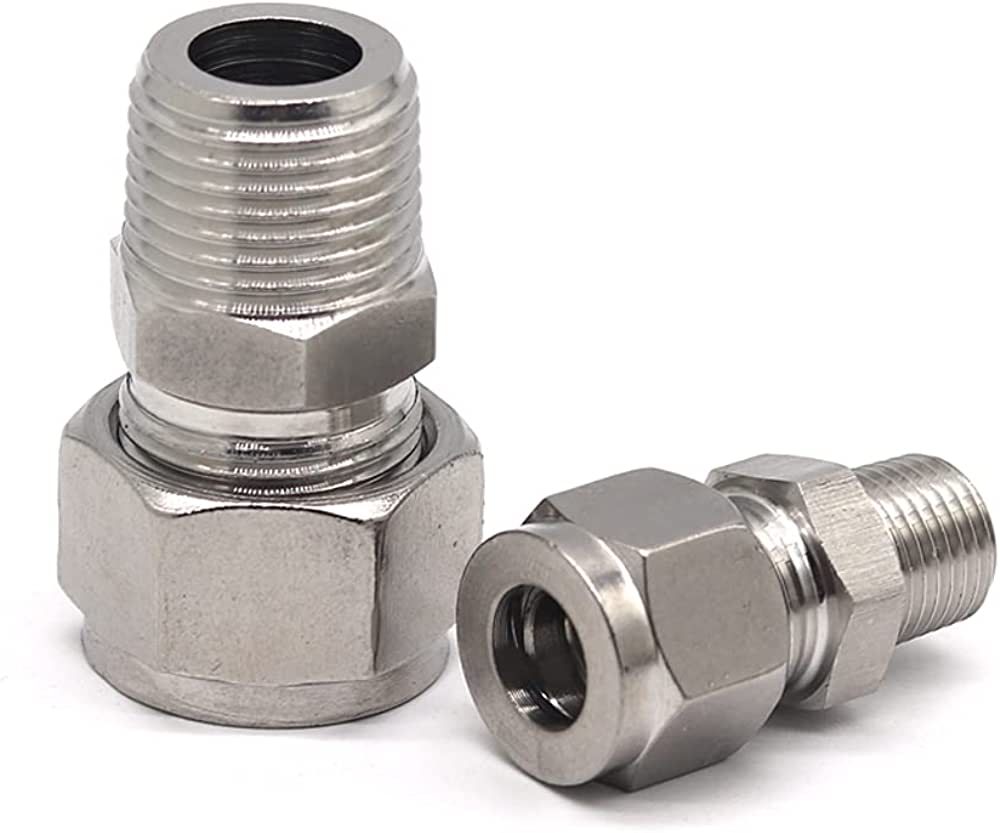
Male Connector — Standard Series
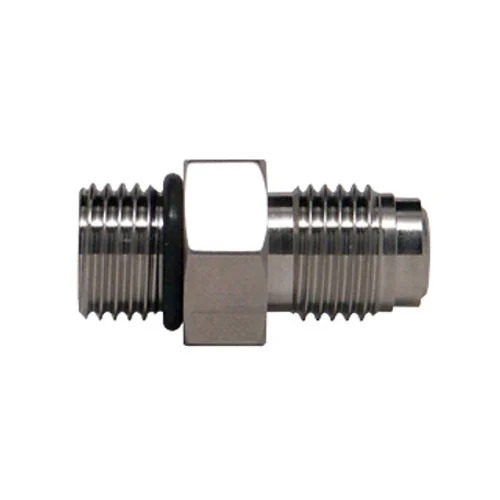
O-Seal Male Adaptor (Related)
The tube end of the connector can be a compression (ferrule) end for instrument tubing, a socket-weld end, or a butt-weld end — depending on the application. The defining feature of this fitting is the BSPP male thread with the integrated bonded seal housing on the process-connection side.
| Thread Type | Profile | Sealing Mechanism | Requires Sealant? |
|---|---|---|---|
| NPT (Tapered) | 60° taper, ASME B1.20.1 | Thread flanks wedge together under tightening — thread interference seals | PTFE tape or pipe compound recommended |
| BSPT / Rc (Tapered) | 55° taper, BS 21 / ISO 7-1 | Thread flanks wedge together under tightening | PTFE tape recommended |
| BSPP / G (Parallel) | 55° parallel, BS 2779 / ISO 228 | No taper — thread flanks do not seal; sealing must be achieved at the thread face / shoulder | Bonded seal, O-ring, or sealant mandatory |
| Metric (Parallel) | 60° parallel, DIN 13 | No taper — requires face seal or O-ring | O-ring face seal mandatory |
| Type | Process End | Tube / Pipe End | Best For |
|---|---|---|---|
| Compression Male Connector | BSPP male + bonded seal recess | Compression (double ferrule) for tube OD | Instrument tube to BSPP port — most common instrumentation use |
| Socket-Weld Male Connector | BSPP male + bonded seal recess | Socket weld (SW) bore for pipe end | Small-bore piping to BSPP-ported valve or manifold |
| Butt-Weld Male Connector | BSPP male + bonded seal recess | Butt-weld (BW) plain bore for pipe end | Sanitary / pharma lines with BSPP valve bodies |
| Hex-Nipple Male Connector | BSPP male + bonded seal one end | BSPP male + bonded seal other end | Port-to-port extension / offset between two BSPP female ports |
| Reducing Male Connector | Larger BSPP + bonded seal | Smaller compression tube end | 1/4" tube into a 1/2" G BSPP port |
| Elastomer | Temperature Range | Compatible Fluids | Not Suitable For |
|---|---|---|---|
| NBR (Nitrile) | −40°C to +100°C | Mineral oils, hydraulic fluids, diesel, compressed air, water | Ketones, esters, ozone, strong acids |
| Viton® (FKM) | −20°C to +200°C | Aromatic hydrocarbons, fuels, hot oils, chlorinated solvents, steam (limited) | MEK, acetone, low-molecular-weight esters |
| EPDM | −40°C to +150°C | Hot water, steam, phosphate ester hydraulic fluids, ozone, UV exposure | Mineral oils, petroleum-based fluids |
| Silicone | −55°C to +200°C | Dry air, inert gases, food-grade applications | Steam, fuels, concentrated acids/bases |
| PTFE-encapsulated | −70°C to +260°C | Aggressive chemicals, strong acids/bases, solvents | Extreme mechanical cycling (poor resilience) |
Standard TES-LOK Male Connectors for Bonded Seal are supplied with NBR bonded seals as default. Viton, EPDM, or PTFE-encapsulated seals are available on request at the time of ordering — specify elastomer grade and temperature requirement.
| Parameter | Details |
|---|---|
| Brand | TES-LOK (Tesco Steel & Engineering) |
| Tube OD Range (Compression End) | 1/8", 3/16", 1/4", 3/8", 1/2", 5/8", 3/4" | Metric: 3 mm, 4 mm, 6 mm, 8 mm, 10 mm, 12 mm, 14 mm, 16 mm |
| BSPP Thread Sizes (Process End) | 1/8" G, 1/4" G, 3/8" G, 1/2" G, 3/4" G, 1" G |
| Pressure Rating | SS 316: up to 6 000 PSI | Brass: 300 / 1 000 / 3 000 PSI depending on size |
| Temperature Range | Fitting body (SS 316): −196°C to 450°C | Limited by elastomer (see elastomer table above) |
| Body Material | SS 304, SS 316 / 316L, Brass (CW617N) |
| Bonded Seal Outer Ring | Carbon steel (zinc plated) — standard | SS 304 or SS 316 outer ring — on request |
| Bonded Seal Elastomer | NBR (standard), Viton, EPDM, Silicone, PTFE-encapsulated — on request |
| Bonded Seal Standard | DIN 7603 | BS 3381 |
| Thread Standard | BSPP (G) — BS 2779 / ISO 228-1 |
| Surface Finish | Bright annealed and passivated (SS); bright zinc or nickel plated (Brass) |
| Certifications | ISO 9001:2015 | EN 10204 3.1 MTC on request | Hydrostatic test certification available |
| Sealing Method | How It Seals | Pressure Limit | Re-usability | Cleanliness |
|---|---|---|---|---|
| Bonded (Dowty) Seal | Metal-backed rubber compressed axially at thread shoulder | Up to 6 000 PSI | 1–2 assemblies | Excellent — no sealant residue |
| PTFE Tape (incorrect) | Fills thread gaps — no face seal | Unreliable above 300 PSI on BSPP | Single use | Tape fragments in system |
| Sealant Paste / Anaerobic | Fills thread and face gaps on cure | Moderate — set-time dependent | Difficult — requires cleaning | Residue enters system if over-applied |
| O-Ring Face Seal (ORFS) | O-ring in groove compressed axially | Up to 6 000 PSI | Multiple — replace O-ring only | Excellent — no sealant |
| Copper Crush Washer | Soft copper deforms to fill micro-gaps | Moderate — suitable for hydraulics | Single use only | Good |
| Tube OD | BSPP Thread (G) | Bonded Seal OD (mm) | Max Pressure — SS 316 |
|---|---|---|---|
| 1/8" (3.18 mm) | 1/8" G | 13.0 mm | 6 000 PSI |
| 1/4" (6.35 mm) | 1/4" G | 17.0 mm | 6 000 PSI |
| 3/8" (9.5 mm) | 3/8" G | 21.0 mm | 5 500 PSI |
| 1/2" (12.7 mm) | 1/2" G | 25.0 mm | 5 000 PSI |
| 5/8" (15.9 mm) | 3/4" G | 30.0 mm | 4 500 PSI |
| 3/4" (19.0 mm) | 1" G | 36.0 mm | 4 000 PSI |
The Dowty seal recess is CNC-machined to ±0.02 mm depth tolerance. An under-depth recess under-compresses the rubber and allows leakage; an over-depth recess prevents full metal contact and causes extrusion. TES-LOK's controlled recess geometry ensures correct rubber compression every time.
All bonded seals supplied with TES-LOK connectors comply with DIN 7603 dimensional standards, ensuring interchangeability with BSPP ports from any valve, manifold, or instrument body — whether European, British, or Asian origin.
Eliminates PTFE tape fragments, anaerobic sealant residue, and thread compound contamination from process fluid paths — critical in pharmaceutical, semiconductor, food processing, and ultra-clean instrumentation applications.
NBR (standard), Viton (high-temp hydrocarbons), EPDM (steam and phosphate esters), Silicone (food-grade, inert gas), and PTFE-encapsulated (aggressive chemicals) — all available ex-stock or to order with the same body fitting, simplifying spare parts inventory.
Eliminates the need for a separate tube adapter and a port fitting. The compression tube end and BSPP male bonded seal end are machined in a single body, reducing joint count, assembly time, and potential leak paths on instrument tubing runs.
EN 10204 3.1 material test certificates available for all SS grades. Batch hydrostatic test certificates issued on request. Suitable for projects with third-party inspection and document control requirements.
| Industry | Typical Use Point | Why Bonded Seal Preferred |
|---|---|---|
| Oil & Gas / Subsea | Instrument manifold ports, gauge isolation valve bodies, BSPP-ported ball valves | Vibration-resistant; no tape debris in process fluid |
| Hydraulics & Offshore | CETOP / ISO 4401 valve port connections, hydraulic power unit manifolds | High-pressure face seal without anaerobic compound cure time |
| Petrochemical | Analyser sample conditioning systems with BSPP-ported blocks | Zero contamination risk; quick connect/disconnect for maintenance |
| Pharmaceutical / Biotech | CIP/SIP instrument tapping points; process transmitter connections | No sealant residue in sterile flow paths |
| Food & Beverage | BSPP-ported sanitary pressure gauges, temperature transmitter connections | Silicone or EPDM bonded seal — FDA-compliant elastomer options |
| Power Generation | Turbine lube oil system instrument connections | Viton seal tolerates synthetic lube oils at elevated temperature |
| HVAC & Compressed Air | Pressure gauge ports, flow transmitter tapping points with G-thread ports | Quick installation without mess; port can be reused multiple times |
| Marine & Naval | Seawater cooling system instrumentation, BSPP-ported sea chest valves | Reliable vibration-proof seal; SS 316 body resists salt atmosphere |
| BSPP Thread Size | Torque — SS 316 Body (Nm) | Torque — Brass Body (Nm) | Hex Size (AF) |
|---|---|---|---|
| 1/8" G | 12–16 Nm | 10–14 Nm | 14 mm AF |
| 1/4" G | 20–26 Nm | 16–20 Nm | 19 mm AF |
| 3/8" G | 30–38 Nm | 24–30 Nm | 22 mm AF |
| 1/2" G | 45–55 Nm | 36–44 Nm | 27 mm AF |
| 3/4" G | 60–75 Nm | 50–62 Nm | 32 mm AF |
| 1" G | 80–100 Nm | 65–80 Nm | 41 mm AF |
Q1. What is the difference between a bonded seal (Dowty seal) and an O-ring face seal (ORFS)?
Both provide an axial face seal for parallel threads, but they are not interchangeable. A bonded seal has a metal outer ring that sits in a recess on the fitting shoulder — it requires a machined recess on the fitting, and seals against a flat port face. An ORFS uses an O-ring in a groove machined in the fitting face and seals against the matching ORFS female port (which has a specific machined cone or face seat). Bonded seals are used with standard BSPP ports; ORFS is a dedicated system with its own port geometry specified under SAE J1453 or ISO 8434-3.
Q2. Can I use a male connector for bonded seal on an NPT or BSPT tapered thread port?
No. This fitting has a BSPP (G) parallel male thread. BSPP and BSPT/NPT are different thread forms and are not interchangeable. Forcing a BSPP fitting into a tapered port will appear to tighten but will not seal correctly and risks damaging the port. Always verify the port thread form before selecting a connector.
Q3. How many times can a bonded seal be re-used?
A bonded seal can typically be assembled and disassembled once (i.e., used a second time total) without replacement, provided the rubber element shows no permanent deformation, cracking, or extrusion. For safety-critical or high-pressure applications, TES-LOK recommends replacing the bonded seal on every reassembly. Replacement seal kits are available matched to every fitting size.
Q4. Is the bonded seal included with the fitting, or ordered separately?
TES-LOK Male Connectors for Bonded Seal are supplied as a complete kit: fitting body, compression nut, ferrule(s), and one bonded seal (NBR standard) — all in a single part number. Spare bonded seals (NBR, Viton, EPDM) are also available separately as spares. Specify elastomer grade at the time of order if you need Viton or EPDM instead of standard NBR.
Q5. My BSPP port face is slightly damaged — can I still use a bonded seal?
Minor surface rust or light scoring can sometimes be overcome by the rubber element's ability to conform to small irregularities. However, deep scoring, cross-hatch machining marks, or pitting exceeding 0.1 mm depth will prevent a reliable seal. In those cases, the port face should be re-faced with a spot-face cutter before fitting a bonded seal. TES-LOK's technical team can advise on port face refacing specifications.
Q6. What elastomer should I specify for steam or hot water service?
For steam up to 150°C, specify EPDM. NBR degrades rapidly in steam — it swells and loses tensile strength, leading to extrusion failure within hours of contact with live steam. Viton is generally not recommended for steam either (it is better for dry heat and hydrocarbons). For superheated steam above 150°C, consult TES-LOK for a PTFE-encapsulated or metallic seal option.
Q7. Are TES-LOK bonded seal connectors compatible with Swagelok or Parker compression fittings?
The compression tube end of TES-LOK fittings uses the same double-ferrule geometry as industry-standard 37° and 24° compression fittings. Ferrules and nuts from TES-LOK are dimensionally interchangeable with Swagelok, Parker CPI, and similar double-ferrule systems in the same tube OD and material grade. However, TES-LOK recommends using TES-LOK ferrules with TES-LOK bodies for certified leak-tight performance.
Q8. Do you supply male connectors for bonded seal in Hastelloy or Inconel?
Yes, on a made-to-order basis. Hastelloy C-276 and Inconel 625 bodies with matching ferrules are available for aggressive chemical service. Lead time is typically 3–5 weeks with full EN 10204 3.1 MTC documentation. Minimum order quantity is 10 pieces per size. Contact TES-LOK's sales team with your fluid, pressure, temperature, and thread requirements for a formal quotation.