

TES-LOK brand | Male Thread Both Ends | Hex Body for Wrench Grip | SS 304 / SS 316 / Brass | 6000 PSI | ISO 9001:2015
Request a Quote WhatsAppA hex nipple tube fitting is a short all-threaded instrumentation fitting with male NPT, BSP, or BSPT threads on both ends and a hexagonal mid-body that provides a flat for wrench engagement during installation. Unlike a male connector (which combines a compression tube end with a male thread end), a hex nipple has no tube compression end — both ends thread directly into female-threaded ports. It is the most compact way to join two female-threaded instrument components — valve to gauge, manifold port to transmitter inlet, adapter to equipment body — without requiring any intermediate tube section.
Tesco Steel manufactures hex nipple tube fittings under the TES-LOK brand in both equal configurations (same thread size both ends) and reducing configurations (different thread sizes each end). They are dimensionally compatible with Swagelok, Parker A-LOK, and Ham-Let equivalents, enabling direct drop-in replacement in existing systems. Equal hex nipples extend or join identical-size female ports; reducing hex nipples transition between two different port sizes in a single fitting.
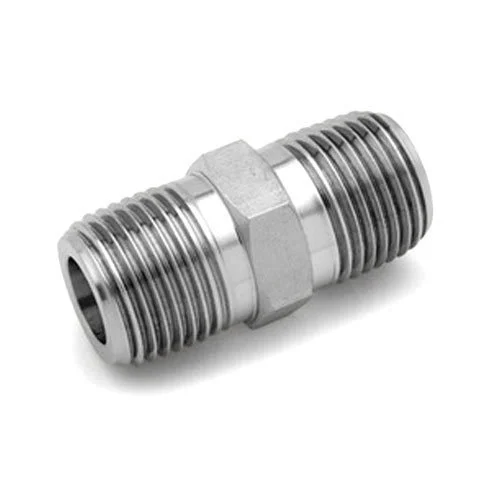
| TES-LOK Hex Nipple Tube Fitting — Technical Data | |
|---|---|
| Brand | TES-LOK (Tesco Steel & Engineering) |
| Configuration | Equal (same thread both ends) or Reducing (different thread each end) |
| End 1 | Male NPT / BSP / BSPT / UNF / ISO / SAE thread |
| End 2 | Male NPT / BSP / BSPT / UNF / ISO / SAE thread |
| Body | Hex mid-section for wrench/spanner grip |
| Thread Size Range | 1/16" to 2" (NPT / BSP / BSPT) |
| Material Grades | SS 304 (1.4301), SS 316 (1.4401), Brass, Monel 400, Inconel 600, Hastelloy C-276, Titanium Gr. 2 |
| Pressure Rating — SS | Up to 6000 PSI (413 bar) |
| Pressure Rating — Brass | 300 PSI / 1000 PSI / 3000 PSI (size-dependent) |
| Temperature Range | 150 °C to 400 °C |
| Thread Standards | ASME B1.20.1 (NPT), ISO 228 (BSP), ISO 7 (BSPT), ANSI/ASME B1.1 (UNF) |
| Surface Finish | Electropolished / Passivated / As-machined |
| Certifications | ISO 9001:2015; NABL-traceable MTRs available |
Joins two female-threaded components directly — no tube segment, no additional adapter. Minimum stack height; ideal for tight panel and manifold spaces.
Flat hex mid-section allows a standard open-end wrench or spanner to grip and torque both threaded ends without slipping — faster, more reliable installation than round-body nipples.
Equal hex nipples join identical port sizes; reducing hex nipples transition between two different sizes — eliminating a separate adapter in many installations.
NPT and BSPT tapered threads with PTFE tape provide a reliable metal-to-metal taper seal rated up to 6000 PSI. BSP parallel threads use a bonded face seal for leak-free performance.
NPT, BSP, BSPT, UNF, ISO, SAE — one source for all regional instrument port thread requirements, covering North American, European, and Asian standards.
SS 316 for chloride and marine service; Hastelloy C-276 and Monel 400 for strong acids, H₂S, and aggressive process media in chemical and offshore applications.
| Fitting Type | End 1 | End 2 | Body | Best Use |
|---|---|---|---|---|
| Hex Nipple | Male thread | Male thread (same size) | Hex mid-section | Join two female ports of same size directly; compact, wrench-friendly |
| Reducing Hex Nipple | Male thread (large) | Male thread (small) | Hex mid-section | Transition between two different female port sizes in one fitting |
| Hex Bushing | Male thread (small) | Female thread (large) | Hex body | Reduce a larger female port to accept a smaller male fitting |
| Male Connector | Compression tube | Male thread | Body + nut | Connect a tube run to a female-threaded instrument port |
| Close Nipple | Male thread | Male thread | No hex — threads meet at centre | Minimum-length thread-to-thread extension; not wrench-grippable at centre |
| End 1 Thread | End 2 Thread | Type | Typical Application |
|---|---|---|---|
| 1/8" NPT | 1/8" NPT | Equal | Pressure gauge port extension, small instrument connections |
| 1/4" NPT | 1/4" NPT | Equal | Transmitter inlet to gauge valve body; most common size |
| 3/8" NPT | 3/8" NPT | Equal | Flow transmitter impulse connections, larger instrument ports |
| 1/2" NPT | 1/2" NPT | Equal | High-flow process connections, control valve instrument ports |
| 1/4" BSP | 1/4" BSP | Equal | European instrument panel connections, manifold extensions |
| 1/2" BSP | 1/2" BSP | Equal | Larger BSP instrument and valve connections |
| 1/2" NPT | 1/4" NPT | Reducing | Manifold port (1/2") to small transmitter inlet (1/4") |
| 3/4" NPT | 1/2" NPT | Reducing | Valve body (3/4") to gauge or transmitter connection (1/2") |
NPT / BSPT tapered threads: Apply 2–3 wraps of PTFE tape clockwise on each male thread end before installation. Thread the first end into the female port by hand until snug, then tighten 1.5–2 turns using the hex body for wrench grip. Repeat for the second end. Do not over-tighten — tapered threads seal on the taper interference, not on a shoulder. Excessive torque can crack the hex body or damage the female port threads.
BSP parallel (BSPP) threads: Use a bonded seal washer or an O-ring face seal on each end — no PTFE tape is required or recommended for parallel BSP threads. Tighten to the manufacturer's specified torque for the thread size. Use two wrenches (one on each component) when making up both ends simultaneously to avoid transferring torque through the hex nipple body into an already-tightened end.
| Industry | Application | Preferred Material |
|---|---|---|
| Oil & Gas | Gauge valve to transmitter inlet connections; tapping point adapter extensions at wellheads and process headers | SS 316, Monel, Inconel |
| Chemical & Petrochemical | Analyzer panel instrument port adapters; reactor and column instrument body connections | SS 316L, Hastelloy C-276 |
| Power Generation | Boiler gauge connections; steam system instrument port extensions; turbine oil system fittings | SS 316, Carbon Steel |
| Semiconductor | Gas panel manifold port extensions; pressure transducer and MFC instrument connections on process gas panels | SS 316L EP (electropolished) |
| Food & Beverage | Hygienic instrument port adapters on CIP-compatible process lines; pressure and temperature instrument hook-ups | SS 316L (3-A certified) |
| Shipbuilding & Offshore | Hydraulic and pneumatic panel instrument port adapters; deck-level manifold gauge connections | SS 316, Copper-Nickel |
ISO 9001:2015 certified | Male thread both ends | Equal & Reducing | SS 304 · SS 316 · Brass · Alloys | NPT · BSP · BSPT | Fast global shipment
Send Inquiry WhatsApp Us