

TES-LOK Reducing Hex Coupling Tube Fittings — female internal threads of different sizes on both ends, short precision-machined hex body. The standard inline size reducer for joining two male-threaded pipes, nipples, or studs of different thread sizes in one compact fitting. SS 316 · Brass · Monel · Inconel · NPT · BSP · BSPT · BSPP · 1/8"–2" · Up to 6,000 PSI · ISO 9001:2015 certified.
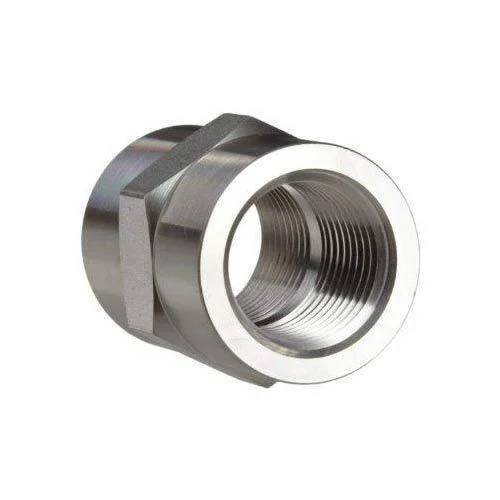
Reducing Hex Coupling
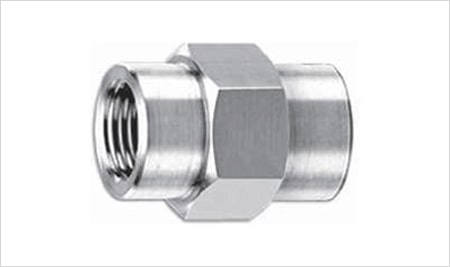
Equal Hex Coupling (same-size variant)
A reducing hex coupling is a short inline fitting with female internal threads on both ends at different sizes, machined from a single hexagonal body. The large-end socket receives the larger male-threaded pipe, nipple, or stud; the small-end socket receives the smaller male-threaded component. The result is a compact inline size change in a threaded assembly — achieved in one fitting without extra adapters or intermediate nipples.
The hexagonal body cross-section provides wrench flats that allow the coupling to be gripped by an open-end or combination wrench for installation and removal without slipping. Because the body is machined from solid bar stock, the internal bore steps smoothly from the larger socket to the smaller socket — there are no sharp-edged internal projections that could obstruct flow or create crevice corrosion initiation sites. In instrument and process piping assemblies, reducing hex couplings are used wherever two male-threaded components of different sizes must be joined inline without a separate reducer and coupling.
| Fitting | End 1 | End 2 | Choose When |
|---|---|---|---|
| Reducing Hex Coupling | Female thread (large) | Female thread (small) | Joining two male-threaded nipples or studs of different sizes inline — one fitting handles the full size change |
| Equal Hex Coupling | Female thread (same size) | Female thread (same size) | Joining two male-threaded components of the same size — no size change needed |
| Reducing Hex Nipple | Male thread (large) | Male thread (small) | Bridging two female-threaded sockets or ports of different sizes — male-both-ends size reducer |
| Equal Hex Nipple | Male thread (same size) | Male thread (same size) | Bridging two female-threaded ports of the same size inline |
| Female Adapter (Reducing) | Compression tube (small OD) | Female thread (large) | Transitioning from a smaller compression tube to a larger female-threaded equipment port |
| Reducing Union | Compression tube (large OD) | Compression tube (small OD) | Inline OD size change within a tube run — no threads on either end |
| Thread Form | Standard | Seal Method on Mating Male | Common Application |
|---|---|---|---|
| NPT × NPT (Reducing) | ASME B1.20.1 both ends | PTFE tape on each male NPT thread | US-standard instrument equipment; oil & gas; petrochemical; American process plant |
| BSPT × BSPT (Reducing) | BS EN 10226 both ends | PTFE tape on each male BSPT thread | UK/European tapered BSP equipment; hydraulic panels |
| BSPP × BSPP (Reducing) | BS EN ISO 228-1 both ends | Dowty bonded seal on each male BSPP shoulder | Hydraulic and pneumatic equipment with parallel BSP ports |
| NPT × BSPT Mixed | ASME B1.20.1 large end; BS EN 10226 small end | PTFE tape on each respective male thread | Cross-standard assemblies: US process equipment to European instruments |
| BSPP × NPT Mixed | BS EN ISO 228-1 large end; ASME B1.20.1 small end | Dowty seal on BSPP male; PTFE tape on NPT male | Hydraulic BSPP manifold to NPT instrument connections |
| Thread Form | Female NPT (ASME B1.20.1); Female BSPT (BS EN 10226); Female BSPP (BS EN ISO 228-1); mixed on request |
| Thread Size Range | Large end: 1/4" to 2"; Small end: 1/8" to 1-1/2" (large end always larger than small end) |
| Body Form | Hexagonal — full hex body length for maximum wrench engagement on both ends |
| Working Pressure | Up to 6,000 PSI (SS 316, ambient); 3,000 PSI (Brass); governed by the smaller end thread size |
| Standard Material | SS 316 (ASTM A276 / A479) |
| Optional Materials | SS 316L, SS 304, Brass (CW617N), Monel 400, Inconel 600, Hastelloy C-276 |
| Surface Finish | Bright annealed or passivated (SS); natural (Brass); electroless nickel plating on request |
| Temperature Range | -196°C to +450°C (SS 316); -10°C to +120°C (Brass) |
| Thread Gauging | Each coupling gauged with GO/NO-GO thread gauges per applicable standard before despatch |
| Quality Certification | ISO 9001:2015; EN 10204 3.1 MTCs available; PMI testing on request |
| Compatibility | Compatible with all standard NPT/BSP male-threaded nipples, pipes, and studs |
Specify as Large End (female) × Small End (female). For example: 1/2" × 1/4" NPT means the large-end female socket is 1/2" NPT and the small-end female socket is 1/4" NPT.
| Large End (Female) | Small End (Female) | Thread Form | Typical Application |
|---|---|---|---|
| 1/4" | 1/8" | NPT or BSPT | Small instrument port to miniature gauge or transducer connection |
| 3/8" | 1/4" | NPT or BSPT | Valve outlet nipple to instrument manifold inlet connection |
| 1/2" | 1/4" | NPT or BSPT | Process line nipple to instrument impulse line — most common instrument size change |
| 1/2" | 3/8" | NPT or BSPT | Pump outlet nipple to medium-bore instrument supply line |
| 3/4" | 1/2" | NPT, BSPT, or BSPP | Manifold block outlet to instrument valve inlet; heat exchanger nozzle to impulse line |
| 1" | 1/2" | NPT or BSPT | Main process line nipple to branch instrument connection |
| 1" | 3/4" | NPT, BSPT, or BSPP | Large valve body outlet to medium-bore instrument or gauge assembly |
| 1-1/4" | 1" | NPT or BSPP | Industrial pipeline branch connection to standard process instrument port |
| 1-1/2" | 1" | NPT or BSPP | Large valve or tank outlet nipple to standard-bore instrument line |
| 2" | 1-1/2" | NPT or BSPP | Main process pipe connection to large-bore control valve or instrument header |
Apply sealant to the male-threaded components going into the coupling — never inside the coupling sockets. Each end is treated independently, especially important for mixed-standard couplings where the two ends require different sealant types.
| Socket Thread Form | Sealant Required on Mating Male | Application Notes |
|---|---|---|
| Female NPT Socket | PTFE tape (2–3 wraps) or anaerobic sealant on male NPT thread | Taper seal — thread deforms as it advances. Hand-tight plus 2–3 full turns. Do not over-torque. |
| Female BSPT Socket | PTFE tape (2–3 wraps) on male BSPT thread | Same taper-seal principle as NPT. NPT and BSPT are NOT interchangeable — different pitch and flank angle. |
| Female BSPP Socket | Dowty bonded seal on male BSPP stud shoulder | Parallel threads — no taper seal. Dowty washer compresses against coupling face. No PTFE tape. |
| Mixed NPT × BSPP | PTFE tape on NPT male; Dowty seal on BSPP male | Apply the appropriate sealant to each end independently. Do not use a single sealant type for both ends. |
Without a reducing hex coupling, achieving an inline size change between two male-threaded components requires an equal coupling plus a reducing nipple — two fittings, two sealed joints, additional assembly length. A reducing hex coupling performs the same function in one precision-machined body, eliminating one potential leak point and significantly reducing assembly length in dense instrument panels and manifold installations.
The hexagonal body runs the full fitting length, providing maximum wrench flat area on both ends simultaneously. A back-up wrench can be applied to either end while tightening the other — preventing body rotation and ensuring accurate torque transmission to each thread joint independently.
Standard SS 316 construction resists chloride environments, sour gas (H2S), boiler condensate chemistry, and offshore atmospheric corrosion. All-SS 316 assemblies (coupling, nipples, valves) avoid the galvanic corrosion that occurs when carbon steel couplings are used in stainless instrument piping systems.
Available in NPT, BSPT, BSPP, and mixed-standard combinations, TES-LOK reducing hex couplings solve cross-standard thread mismatches that arise at the interface between US-specification equipment and European instruments — without requiring an additional pure adapter fitting. Mixed NPT × BSPT and BSPP × NPT are manufactured from stock.
Every reducing hex coupling is thread-gauged with calibrated GO/NO-GO gauges on both sockets per ASME B1.20.1, BS EN 10226, or BS EN ISO 228-1. Consistent thread geometry across the production batch ensures predictable make-up torque, full thread engagement, and repeatable leak-free joints from the first assembly on site.
EN 10204 3.1 material test certificates are available for all SS 316 and exotic alloy reducing hex couplings. PMI (positive material identification) testing available on request. Full heat and lot traceability supports documentation requirements for oil & gas, offshore, petrochemical, and pharmaceutical instrument piping systems.
▶ What is a reducing hex coupling tube fitting?
A reducing hex coupling has female internal threads of different sizes on both ends, machined from a hexagonal body. It joins two male-threaded pipes, nipples, or studs of different thread sizes inline, creating a compact size change in one fitting. The hex body provides wrench flats for wrench installation without body damage.
▶ What is the difference between a reducing hex coupling and an equal hex coupling?
An equal hex coupling has the same thread size on both ends — it joins two male-threaded components of identical size. A reducing hex coupling has different thread sizes — large socket one end, small socket the other — joining two male components of different sizes with an inline size change. Specify equal coupling when both components are the same size; specify reducing coupling when they differ.
▶ What is the difference between a reducing hex coupling and a reducing hex nipple?
A reducing hex coupling has female (internal) threads on both ends — it receives two male-threaded components of different sizes. A reducing hex nipple has male (external) threads on both ends — it fits into two female-threaded sockets of different sizes. They are complementary: use a reducing hex coupling to join two male studs of different sizes; use a reducing hex nipple to bridge two female ports of different sizes.
▶ How do I specify a reducing hex coupling?
Specify as Large End × Small End with thread form. For example: "3/4" × 1/2" NPT reducing hex coupling" means the large-end female socket is 3/4" NPT and the small-end socket is 1/2" NPT. Also specify material (SS 316, Brass, etc.) and any mixed thread form requirements when ordering.
▶ Can I use PTFE tape with a BSPP reducing hex coupling?
No. Never apply PTFE tape to a male stud entering a BSPP (parallel BSP) socket. Parallel threads require a Dowty bonded seal on the male stud shoulder — PTFE tape creates a false torque feel without sealing. For mixed couplings (e.g. NPT large end, BSPP small end), apply PTFE tape to the NPT male and a Dowty seal to the BSPP male — each end independently.
▶ What size combinations are available?
Common combinations: 1/4" × 1/8", 3/8" × 1/4", 1/2" × 1/4", 1/2" × 3/8", 3/4" × 1/2", 1" × 1/2", 1" × 3/4", 1-1/4" × 1", 1-1/2" × 1", 2" × 1-1/2" — in NPT, BSPT, and BSPP. Non-standard size combinations and mixed thread-form couplings manufactured on request.
▶ What materials are available?
SS 316 (standard), SS 316L, SS 304, Brass, Monel 400, Inconel 600, and Hastelloy C-276. EN 10204 3.1 MTCs and PMI available on request.
▶ What is the pressure rating of a reducing hex coupling?
Up to 6,000 PSI in SS 316 at ambient temperature. Brass: 3,000 PSI. The rating is governed by the smaller thread end — always size the assembly pressure class against the smallest thread in the run. Consult the de-rating curve for elevated-temperature service.
SS 316 · Brass · Monel · Inconel · NPT · BSPT · BSPP · Mixed Standards · 1/8"–2" · Custom Size Combinations · ISO 9001:2015 · EN 10204 3.1 MTCs available
✉ Email Quote 📞 WhatsApp