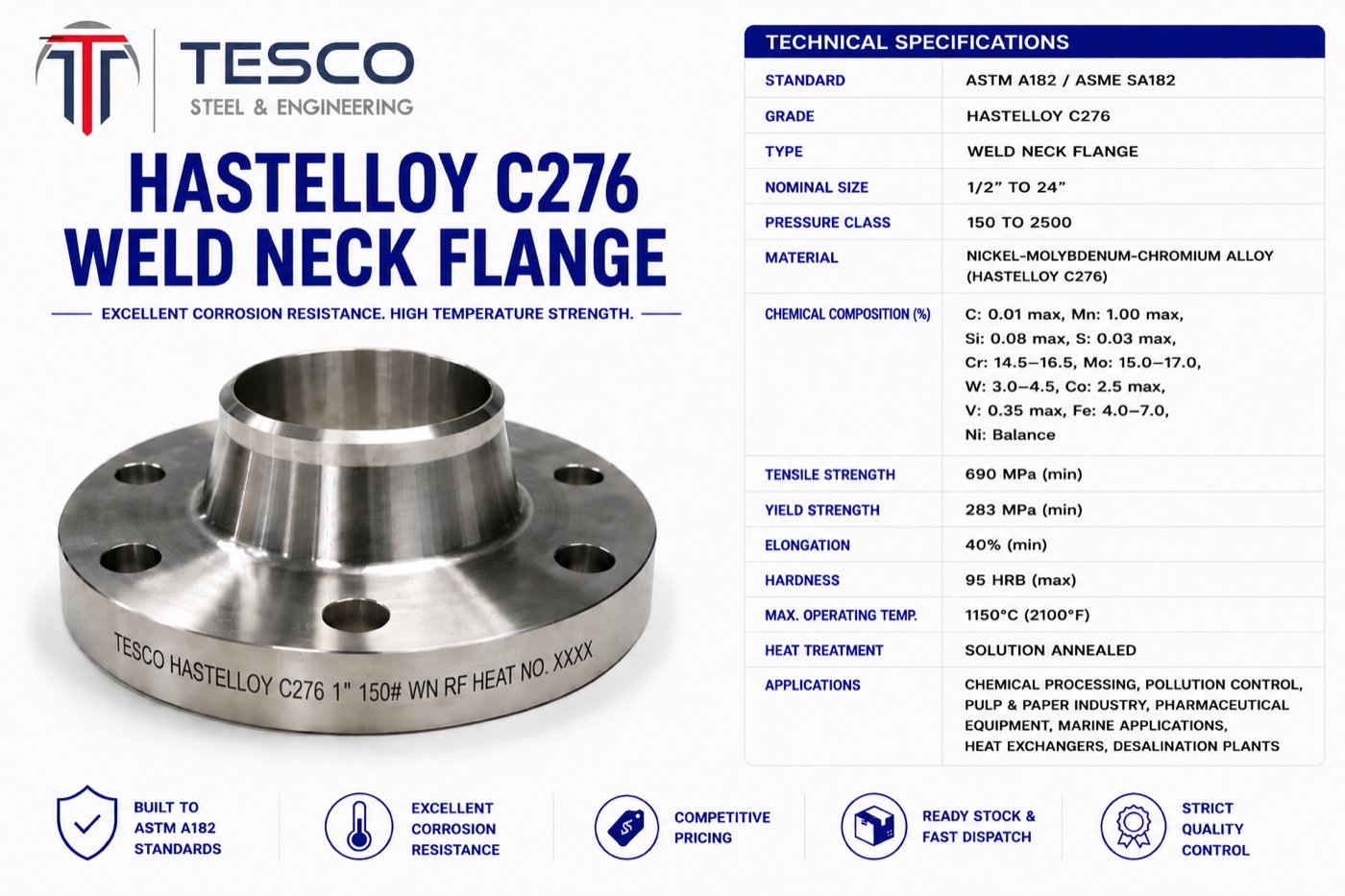
Tesco Steel & Engineering forges Hastelloy C-276 weld neck flanges — UNS N10276, Werkstoff Nr. 2.4819 — to ASTM B564, from 1/2″ NB to 56″ NB in ASME B16.5 Class 150–2500 and European PN patterns. The chemistry is the chemical industry's benchmark: a nickel base carrying 15–17% molybdenum plus 3–4.5% tungsten — near-immunity to pitting and crevice attack — with ~15% chromium covering oxidizing media, and carbon and silicon refined to 0.010%/0.08% so joints stay resistant as-welded. Built for wet chlorine, hot contaminated acids, FGD scrubbers, bleach plants and sour gas — the alloy specified when everything else has failed. Mating B622 pipe, welded with ERNiCrMo-4. Supplied with PMI, ASTM G28 and EN 10204 3.1/3.2 on request. ISO 9001:2015, made in Mumbai, India — exported worldwide.
Hastelloy C-276 · UNS N10276 · 2.4819Mo 15–17% · W 3–4.5% · Cr ~15%ASTM B564 / ASME SB-564As-Welded Corrosion ResistanceWet Chlorine · FGD · Hot Acids1/2″ – 56″ NB · Class 150–2500ISO 9001:2015 · Exported Worldwide
Hastelloy C-276 (UNS N10276 / 2.4819) is the universal severe-corrosion alloy: a nickel base with an enormous 15–17% molybdenum + 3–4.5% tungsten load that makes chloride pitting and crevice attack a practical non-issue, 14.5–16.5% chromium for the oxidizing side, and carbon/silicon refined to 0.010%/0.08% — the fix that lets welded joints keep full resistance with no post-weld treatment. A Hastelloy C276 weld neck flange pairs that chemistry with a long tapered hub butt-welded to the pipe, forged to ASTM B564.
The C-family logic: C-276 is the molybdenum-heavy incumbent with fifty years of case history; C-22 trades some Mo for more chromium (oxidizing edge); C-2000 adds copper; and the chromium-free B-2/B-3 branch is the pure-HCl specialist that tolerates no oxidizers. Below the family sit Inconel 625 and Incoloy 825 with progressively less molybdenum — and less price.
The commercial shorthand: when the stream is mixed, contaminated or unknown — acid plus chlorides plus oxidizers, the reality of most upset conditions — C-276 is the default that survives. That is why FGD scrubbers, bleach plants and hot-acid reactors specify it by name.
Also searched as: Alloy C-276 flange, UNS N10276 flange, 2.4819 flange, NiMo16Cr15W flange, C276 WNRF flange, FGD flange — all refer to the product on this page.
Chemical Composition of Hastelloy C276
C
Mn
Si
S
Co
Ni
Cr
Fe
Mo
W
P
0.010 max
1.00 max
0.08 max
0.03 max
2.50 max
50.99 min
14.50-16.50
4.00-7.00
15.00-17.00
3.00-4.50
0.04 max
Values in weight %; nickel is the balance. The story is in two places: the Mo+W load (localized-corrosion immunity) and the ultra-low C and Si — the refinement that solved the old alloy C's weld-decay problem and made C-276 usable in the as-welded condition.
Mechanical Properties of Hastelloy C276
Tensile Strength, MPa [psi]
Yield Strength, Min, MPa [psi]
Elongation % min.
690 [100000]
283 [41000]
40
Minimums per ASTM B564 in the solution-annealed condition, demonstrated on every certificate — typical production runs well above (≈790/355 MPa). The alloy stays tough from cryogenic temperatures upward and work-hardens strongly in machining.
Equivalent Grades of Hastelloy C276
Standard
Werkstoff Nr.
UNS
JIS
GOST
EN
OR
Hastelloy C276
2.4819
N10276
NW 0276
ХН65МВУ
NiMo16Cr15W
ЭП760
System partners: ASTM B622 seamless pipe, B366 butt-weld fittings, B575 plate, B574 bar and B564 forgings. Family: C-22 (N06022), C-2000 (N06200), B-2/B-3 and heat-service Hastelloy X.
Hastelloy C276 Weld Neck Flange Specifications
Hastelloy C276 Weld Neck Flanges are available in the following specifications:
Size
1/2"NB to 56"NB
Class
150#, 300#, 400#, 600#, 900#, 1500#, 2500#
Sch (Schedule)
XS, XXS, STD & Schedule 20, 40, 80, 160
Pressure Ratings
PN 2.5 - PN 400
Standards
ASTM B564 / ASME SB-564; ASME B16.5, ASME B16.47, EN 1092-1, DIN 2631–2635, BS 4504
Condition
Solution annealed; NACE MR0175 / ISO 15156 compliant supply on request
15–17% Mo plus tungsten put C-276's localized-corrosion resistance in a class where hot brines, wet chlorine and hypochlorite stop being design problems.
Both Halves of the Corrosion Map
Molybdenum covers reducing acids; chromium covers oxidizing media — mixed and contaminated streams, where specialists fail, are C-276's home turf.
Resistant As-Welded
Carbon at 0.010% and silicon at 0.08% mean no sensitization, no post-weld anneal — fabricate and put it in service.
Fifty Years of Case History
FGD scrubbers, bleach plants, hot-acid reactors and sour wells have documented C-276 since the 1960s — the reference alloy others are measured against.
Full C-Family In-House
C-276, C-22, C-2000 and the B-series from one forge — the medium picks the member, the certificates arrive matched.
Welding Hastelloy C276 — ERNiCrMo-4, As-Welded
C-276 welds with matching ERNiCrMo-4 wire or ENiCrMo-4 electrodes and nickel-alloy discipline: scrupulous sulphur-free cleanliness, moderate heat input, interpass control, no preheat and no PWHT — the ultra-low carbon and silicon keep the heat-affected zone resistant as-welded, which is precisely what the alloy was designed for.
Grade-selection note: strongly oxidizing acids favour C-22; clean hot hydrochloric favours B-2/B-3; moderate duty may be covered economically by 625 or 825. State the medium, concentration and temperature in the enquiry and the grade follows.
Where Hastelloy C276 Weld Neck Flanges Are Used
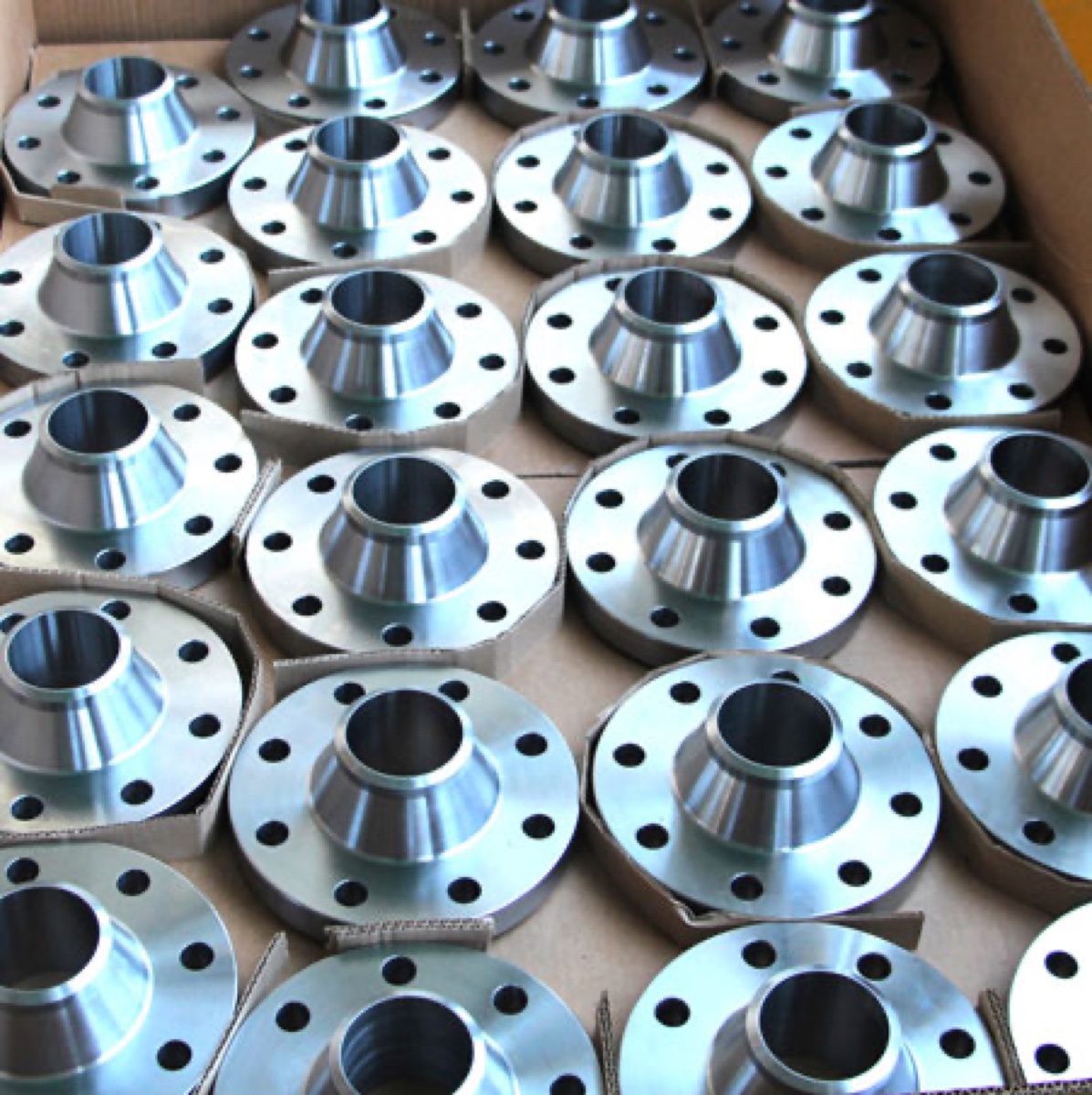
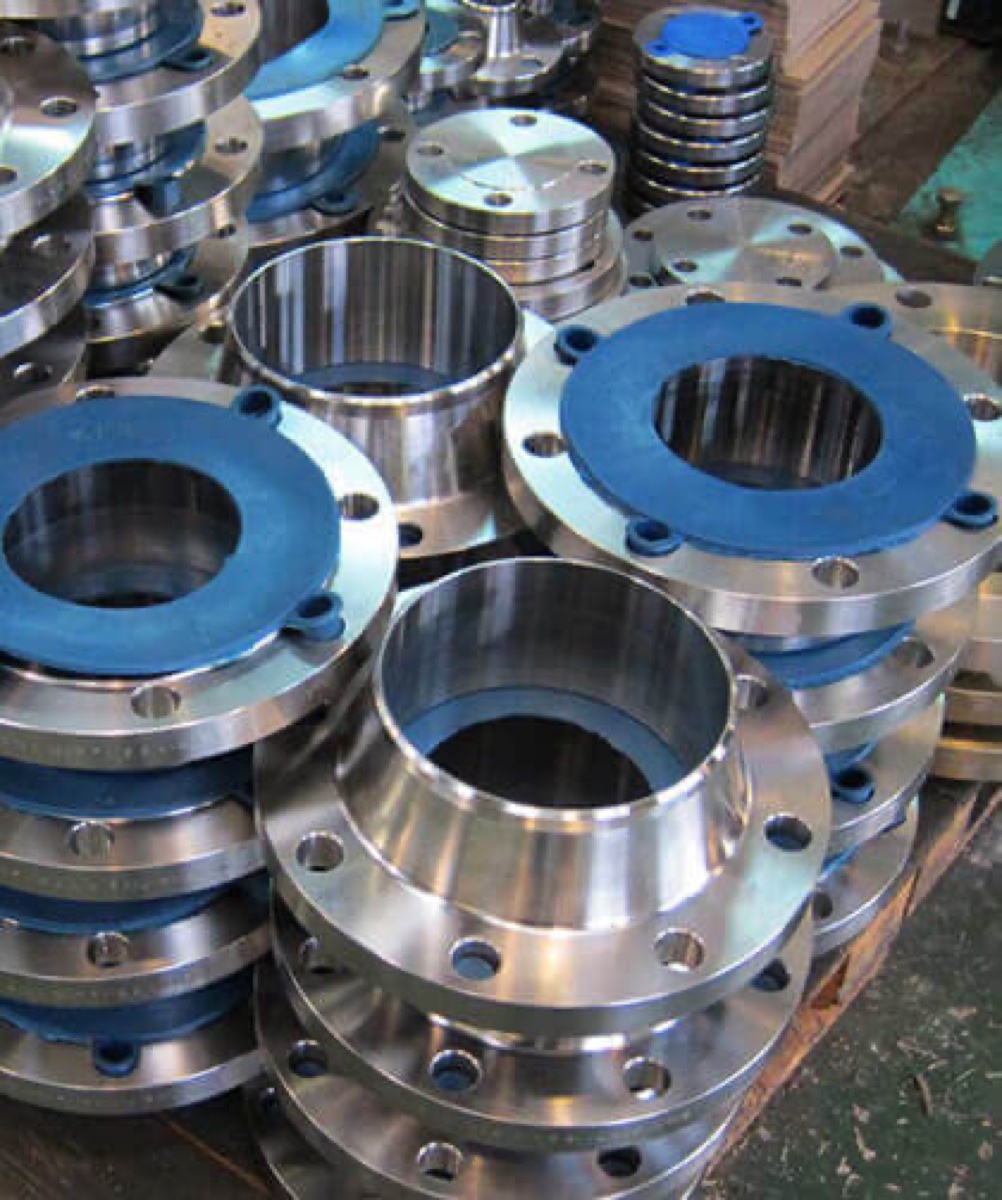
Severe chemical processing leads — hot contaminated sulfuric, hydrochloric and mixed acids — then FGD scrubber systems, pulp & paper bleach plants, wet-chlorine and hypochlorite service, pharmaceutical reactors, waste incineration, sour gas production and geothermal wells. Our nickel-alloy production below:
Hastelloy C276 weld neck flanges share their dimensions with every other material in the same class — OD, thickness, hub, bore, bolt circle and bolting per the standard tables. Full ASME B16.5 charts:
C-276 pricing tracks nickel and molybdenum plus the testing scope, so we quote live with a stated validity rather than publish a static list. To get a firm quotation, usually within 24 hours:
1
List your requirement — size (NB), class or PN, standard (ASME B16.5 / B16.47 / EN / DIN / BS), pipe schedule or bore, and quantity.
2
State the service & testing scope — medium, concentration and temperature; NACE MR0175 requirement; plus 3.2 witness, PMI, G28 or project specifications.
3
Send it across — via the inquiry form, WhatsApp, or email to sales@tescosteel.com — and we reply with price, delivery and stock position.
It is a weld neck flange forged from Hastelloy C-276 — the universal severe-corrosion alloy, UNS N10276 / 2.4819, a nickel base carrying 15-17% molybdenum, 14.5-16.5% chromium and 3-4.5% tungsten — to ASTM B564. The long tapered hub is butt-welded to the pipe with the bore matched to the schedule, giving a radiographable joint in the alloy plants reach for when everything else has failed: wet chlorine, hot contaminated acids, FGD scrubbers and bleach plants.
What is the idea behind the Hastelloy C-276 chemistry?
Maximum localized-corrosion resistance from a nickel base. The enormous 15-17% molybdenum plus 3-4.5% tungsten make pitting and crevice attack in chlorides a practical non-issue; the ~15% chromium keeps oxidizing media covered, so the alloy survives both reducing and oxidizing chemistry. And the carbon and silicon are refined to 0.010% and 0.08% — the fix that made C-276 famous, because welded joints keep their corrosion resistance without any post-weld treatment.
What is the difference between Hastelloy C-276 and C-22?
The Cr/Mo balance. C-276 carries more molybdenum (15-17% vs 13%) — the edge in reducing media like hot hydrochloric and sour brines. C-22 carries more chromium (20-22.5% vs 14.5-16.5%) — the edge in oxidizing acids like nitric and in wet-oxidation duty, with somewhat better weld-HAZ corrosion performance. C-276 is the incumbent with decades of case history; C-22 the more versatile newcomer. We forge both, and the medium decides.
What is the difference between Hastelloy C-276 and B-2/B-3?
Chromium — B-2/B-3 have essentially none. The B-family is pure nickel-molybdenum (~28% Mo), the single best answer to hot concentrated hydrochloric acid, but even traces of oxidizers (ferric ions, dissolved oxygen) attack it catastrophically. C-276 gives up some of that HCl performance in exchange for chromium, so it tolerates real-world contaminated, aerated acids. Unless the service is clean reducing acid, C-276 is the safer specification.
What is the difference between Hastelloy C-276 and Inconel 625?
625 carries 8-10% molybdenum with niobium; C-276 carries 15-17% plus tungsten — nearly double the localized-corrosion agent. In seawater and moderate chemical duty they overlap and 625 is often the economical pick with its higher strength. In the severe end — wet chlorine, hot HCl and H2SO4 mixtures, hypochlorite, FGD condensates — C-276's extra molybdenum is the difference between surviving and pitting through. The chemical industry treats C-276 as the benchmark.
What are the equivalent designations for Hastelloy C276?
UNS N10276; Werkstoff Nr. 2.4819; EN NiMo16Cr15W; JIS NW 0276; GOST ХН65МВУ (ЭП760); and the trade names Hastelloy C-276 or Alloy C-276. System partners: ASTM B622 seamless pipe, B366 butt-weld fittings, B575 plate, B574 bar and B564 forgings. An enquiry in any of these designations is quoted as the same material.
What is the chemical composition of Hastelloy C276?
Per ASTM B564: nickel balance (50.99% minimum), molybdenum 15.00 to 17.00%, chromium 14.50 to 16.50%, tungsten 3.00 to 4.50%, iron 4.00 to 7.00%, cobalt 2.50% maximum, with carbon held at 0.010% and silicon at 0.08% — the ultra-low residuals that keep welded joints resistant — plus manganese 1.00% max, phosphorus 0.04% max and sulphur 0.03% max.
What are the mechanical properties of Hastelloy C276 flanges?
Per ASTM B564 in the solution-annealed condition: tensile strength 690 MPa (100 ksi) minimum, yield strength 283 MPa (41 ksi) minimum and elongation 40% minimum — demonstrated on every certificate, with typical production material running well above (around 790/355 MPa). The alloy stays tough from cryogenic temperatures upward and work-hardens strongly when machined.
Which pipe and fittings do Hastelloy C276 weld neck flanges mate with?
ASTM B622 seamless C-276 pipe is the standard partner, with B366 butt-weld fittings, B575 plate and B574 bar completing the system. The weld neck bore is machined to the pipe schedule you state, so the bore runs flush through the joint and the bevel arrives ready for a matched-chemistry butt weld.
How are Hastelloy C276 flanges welded to pipe?
With matching ERNiCrMo-4 wire or ENiCrMo-4 electrodes and nickel-alloy discipline: scrupulous sulphur-free cleanliness, moderate heat input, interpass temperature control, no preheat and no PWHT — the ultra-low carbon and silicon mean the heat-affected zone keeps its corrosion resistance as-welded, which is precisely what C-276 was designed for. Autogenous welds in critical chemical service are usually avoided in favour of filler-added joints.
Why is Hastelloy C-276 called the universal corrosion alloy?
Because its resistance spans both halves of the corrosion map. Reducing media — hot hydrochloric, sulfuric, phosphoric, sour brines — are covered by the huge molybdenum plus tungsten content; oxidizing media — ferric and cupric chlorides, hypochlorite, wet chlorine — by the chromium. Almost every other alloy specializes in one half. So when a stream is mixed, contaminated or simply unknown, C-276 is the default that survives, and fifty years of chemical-plant case history back it.
Is Hastelloy C276 suitable for FGD scrubbers and wet chlorine?
Those are its signature duties. Flue-gas desulfurization condensates — hot, chloride-laden, acidic and oxidizing at once — sit exactly where C-276's combination of Mo, W and Cr performs, and it is a standing material for scrubber internals, dampers and ducting. In wet chlorine, hypochlorite and chlorine-dioxide bleach service it is one of the few metallic options with an accepted track record, which is why pulp-mill bleach plants specify it by name.
Is Hastelloy C276 suitable for sour service under NACE MR0175?
Yes — C-276 is listed in NACE MR0175 / ISO 15156 and sits near the top of the sour-service materials ladder: highly resistant to sulphide stress cracking, chloride SCC and pitting in H2S-CO2-chloride environments, it serves the harshest sour wells and downhole environments where even 825-class alloys reach their limits. State the NACE requirement in the enquiry and the flanges ship in the compliant solution-annealed condition.
What temperature range can Hastelloy C276 flanges be used in?
In wet-corrosion duty — its real job — C-276 serves from cryogenic temperatures to roughly 400 °C, and ASME code coverage extends further; above about 650 °C long exposures can precipitate intermetallic phases that dent ductility and corrosion resistance, so it is not a furnace alloy. For genuinely hot oxidation service the heat-resistant branch (Hastelloy X, Inconel 600/601) takes over — C-276's territory is chemistry, not flame.
What testing and certification do you supply with Hastelloy C276 flanges?
Every lot ships with EN 10204 3.1 mill test certificates covering chemical analysis — demonstrating the molybdenum, chromium, tungsten and ultra-low carbon/silicon windows — mechanical properties and the solution-anneal record, with 3.2 certification witnessed by Lloyd's, DNV, BV or TÜV on request. We also offer PMI verification, intergranular-corrosion testing to ASTM G28, hydrostatic testing and dye-penetrant examination, with full heat-number traceability.
Where are Hastelloy C276 weld neck flanges used?
Chemical and petrochemical processing of hot contaminated acids, flue-gas desulfurization systems, pulp and paper bleach plants, wet-chlorine and hypochlorite service, pharmaceutical and fine-chemical reactors, waste incineration and scrubbers, sour gas production, seawater and brine systems, and geothermal wells. Wherever the corrosion engineer has run out of cheaper options, C-276 is usually the answer.
What sizes and standards do you manufacture Hastelloy C276 weld neck flanges in?
From 1/2 inch NB to 56 inch NB: ASME B16.5 Class 150 to 2500 up to 24 inch, ASME B16.47 above, and European PN 2.5 to PN 400 patterns to EN 1092-1, DIN and BS 4504. Raised face is standard, ring joint on request, and every bore is machined to the mating pipe schedule from Sch 10 through XXS.
Do you keep Hastelloy C276 weld neck flanges in stock? What is the lead time?
C-276 moves steadily in chemical-plant and FGD projects, so common sizes in Class 150 and 300 rotate through production with popular items often available, while larger diameters, higher classes and witness-tested lots are forged to order — typically 4 to 6 weeks. Prices track nickel and molybdenum, so quotations carry a validity period.
Do you export Hastelloy C276 flanges outside India?
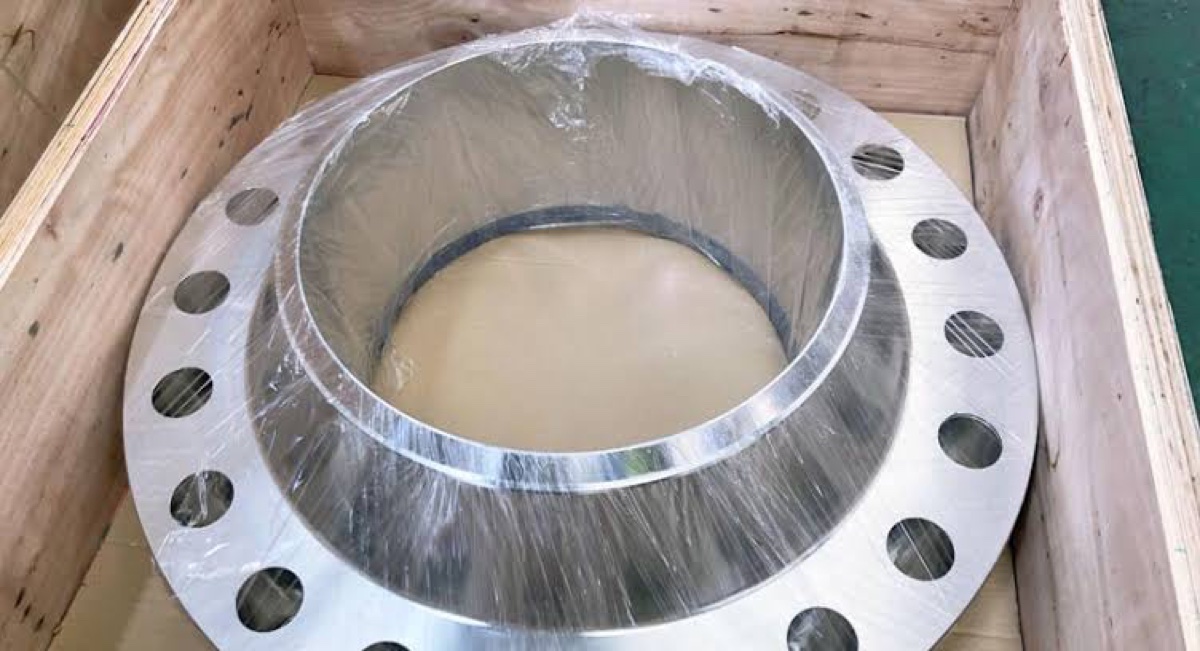
Yes. Tesco Steel & Engineering is an ISO 9001:2015 certified manufacturer based in Mumbai, and Hastelloy C276 flanges ship to chemical, power and oil and gas projects across the Middle East, Europe, Africa, Southeast Asia and the Americas. Flanges travel face-protected and seaworthy-packed, with full heat-number and test traceability.