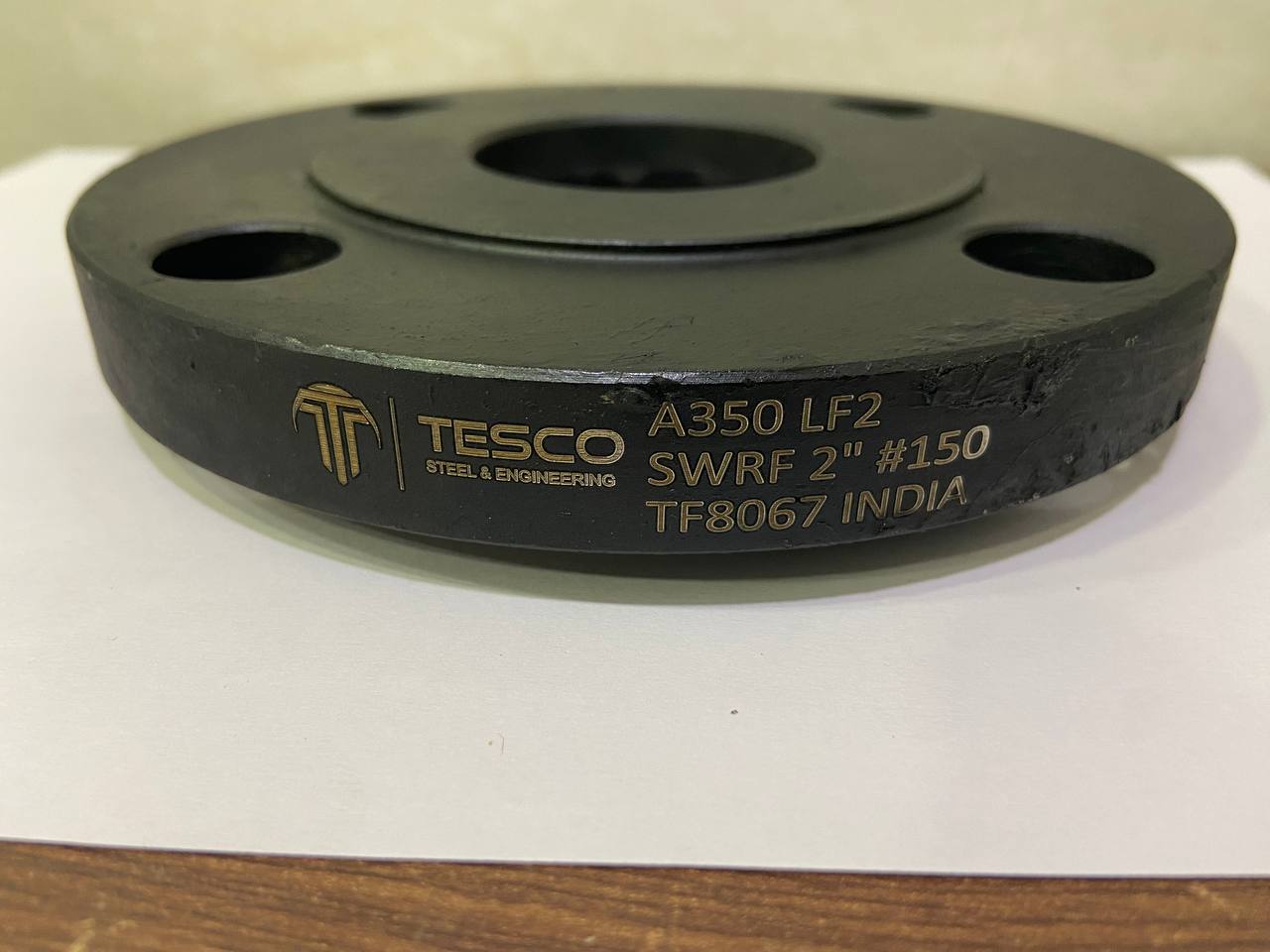
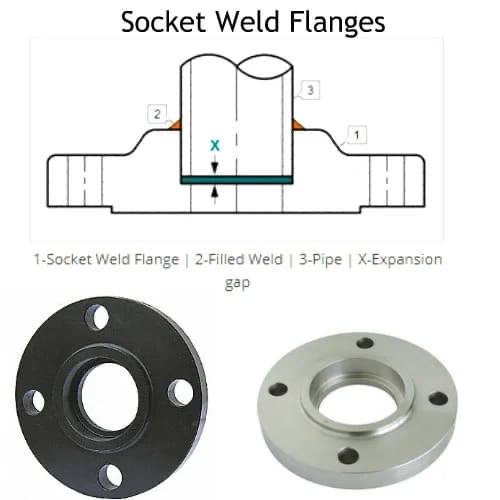
Tesco Steel & Engineering manufactures ASTM A350 LF2 socketweld flanges to ASME B16.5 from ½″ to 3″ NB in Classes 150–1500 (2500 and 4″ to order). LF2 is A105's cold-service twin — same strength group, but heat treated and Charpy impact tested at −46 °C on every heat — and small bore is exactly where the cold happens: letdown, blowdown and depressurisation auto-refrigerate the drains, vents and instrument taps this flange closes. The laser-marked 2″ #150 LF2 pictured is our production. Pipe seats in a machined socket, one external fillet weld (gap diagram below), schedule-matched bore. All three facings — SWRF, SWFF, SWRTJ — and NACE MR0175 to order: LF2 is the world's default sour-and-cold carbon steel. Colder than −46 °C? LF3, then stainless. Every lot with EN 10204 3.1/3.2 MTC including impact results. ISO 9001:2015, made in Mumbai, India — exported to 50+ countries.
ASTM A350 LF2 Cl.1 · LTCSCharpy Tested at −46 °CASME B16.5 ½″–3″ · Class 150–1500485–655 MPa · ≤197 HBNACE MR0175 — Sour & Cold in OneSWRF · SWFF · SWRTJSchedule-Matched BoresEN 10204 3.1 / 3.2 · ISO 9001:2015
Tesco A350 LF2 SWRF Flange — 2″ × 150#, Laser-Marked, Made in India
What is an ASTM A350 LF2 Socketweld Flange?
The cold-service small-bore flange. A forged ASTM A350 LF2 low temperature carbon steel flange with a machined socket: pipe seated square by geometry, one external fillet weld, through-bore matched to the pipe schedule. Same strength group as A105 — tensile 485–655 MPa, yield ≥250 MPa — but heat treated and Charpy tested at −46 °C on every heat, because blowdown and letdown chill small bore first. Sized by ASME B16.5 at ½″–3″ NB, Classes 150–1500; NACE MR0175 within its standard 197 HB ceiling; EN 10204 3.1 with impact results on every lot.
Also searched as: A350 LF2 socket weld flange, LF2 SWRF flange, LTCS socket weld flange, low temp carbon steel SW flange, LF2 Class 1 flange — all the same product family. Related pages: the facings — SWRF / SWFF / SWRTJ — the socketweld hub, the other LF2 types — blind, weld neck, slip-on, threaded — the warm twin A105 socketweld, and the colder ladder: LF3 and the LTCS hub.
Why LF2 Owns Cold & Sour Small Bore
The Cold Happens on Small Bore
Joule-Thomson letdown, blowdown orifices, depressurising vents — the services that hit −40 °C in seconds are almost always ½″–2″ connections. LF2's certificate removes brittle fracture's first ingredient exactly where the trigger lives.
Sour and Cold on One Certificate
The 197 HB ceiling sits inside NACE MR0175's carbon steel limit — H2S lines that blow down cold get hardness control and −46 °C toughness in the same flange.
Still Just Carbon Steel to Weld
Standard consumables, familiar preheat rules — the toughness comes from heat treatment and chemistry trims, not from anything a fabricator has to learn.
Cheap Enough to Standardise
The premium over A105 is modest — many gas-processing owners simply run all carbon steel small bore in LF2 and stop tracking two grades. We stock accordingly.
ASTM A350 LF2 Chemical Composition
Element
C
Mn
Si
P
S
Weight %
≤0.30
0.60–1.35
0.15–0.30
≤0.035
≤0.040
Read it against A105 and the toughness logic shows: carbon trimmed to 0.30% (strengthens but embrittles), manganese allowed to 1.35% (buys toughness), silicon floor for clean deoxidation — plus the usual residual ceilings, verified per heat. Still a plain weldable carbon steel; that is the point.
Mechanical Properties & Impact Testing
Property
ASTM A350 LF2 Requirement
Tensile Strength
485–655 MPa (70–95 ksi) — floor and ceiling: over-strong carbon steel is under-tough carbon steel
High-pressure gas duty — wellhead and compression small bore
ASTM A350 LF2 Socketweld Flange Specifications
ASTM A350 LF2 Socketweld Flanges are available in the following specifications:
Material Grade
ASTM A350 LF2 Class 1 (default, Charpy at −46 °C) / Class 2 (−18 °C); ASME SA-350 twin; dual-certification with A105 available where chemistry and testing satisfy both
Size
1/2"NB to 3"NB per ASME B16.5; 4″ and larger to order; DN15–DN80 per EN 1092-1 Type 03
Class
150#, 300#, 600#, 900#, 1500# (900# shares 1500# dimensions in most sizes); 2500# on request — gas duty runs the higher classes routinely
Facings
Raised Face (SWRF), Flat Face (SWFF), Ring Type Joint (SWRTJ) with groove per B16.20
Bore
Socket bore to pipe OD; through-bore matched to pipe schedule (Sch 40/80/160 — 80 and 160 dominate high-pressure small bore)
Welding
Single external fillet per B16.5/B31.3; 1/16″ expansion gap — see the diagram in the gallery and the FAQ
Service Span
−46 °C upward; sour service per NACE MR0175 / ISO 15156 with declaration; below −46 °C → LF3, then stainless
Surface Finish
Black oil-coated standard; galvanizing or epoxy to order
Testing
Tension, chemistry and Charpy V-notch at the class temperature per heat; hardness verified; socket depth and bore gauged piece by piece
Certification
EN 10204 3.1 with impact results (standard) / 3.2 witnessed; NACE declaration where specified
Specification Notes — Getting LF2 Sockets Right
Four honest notes.The 1/16″ gap matters doubly here: blowdown service swings metal temperature violently — pipe bottomed against the shoulder cracks the weld root exactly when the line does its job; the diagram below shows the set-back. State the class: an unqualified 'LF2' order is quoted and certified Class 1 (−46 °C); Class 2 exists and is milder — if a spec names it, name it. The weld needs its own low-temperature pedigree: our certificate covers the flange; impact-tested line classes also need impact-qualified weld procedures — flag it to your fabricator. And the socket weld limits stand: fillets cannot be radiographed and the socket gap is a crevice — mandatory-RT, lethal-service and severe-cycling blowdown classes escalate to the LF2 weld neck.
How Our A350 LF2 Socketweld Flanges Are Manufactured
1
Forging — cut billet of the certified LF2 heat is hot-forged into the flange blank with full heat traceability.
2
Heat treatment — mandatory for LF2: normalized (or N&T/Q&T) with furnace records retained against the heat number.
3
Impact testing — Charpy V-notch set tested at −46 °C (Class 1); tension, chemistry and hardness per heat.
4
Machining — faces, OD and drilling to ASME B16.5; socket counterbore and depth gauged piece by piece, through-bore matched to the ordered schedule; RF serrations, flat face or RTJ groove per B16.20.
5
Marking — laser-marked with grade, size, class, schedule and heat number — exactly as the 2″ × 150# unit photographed above.
6
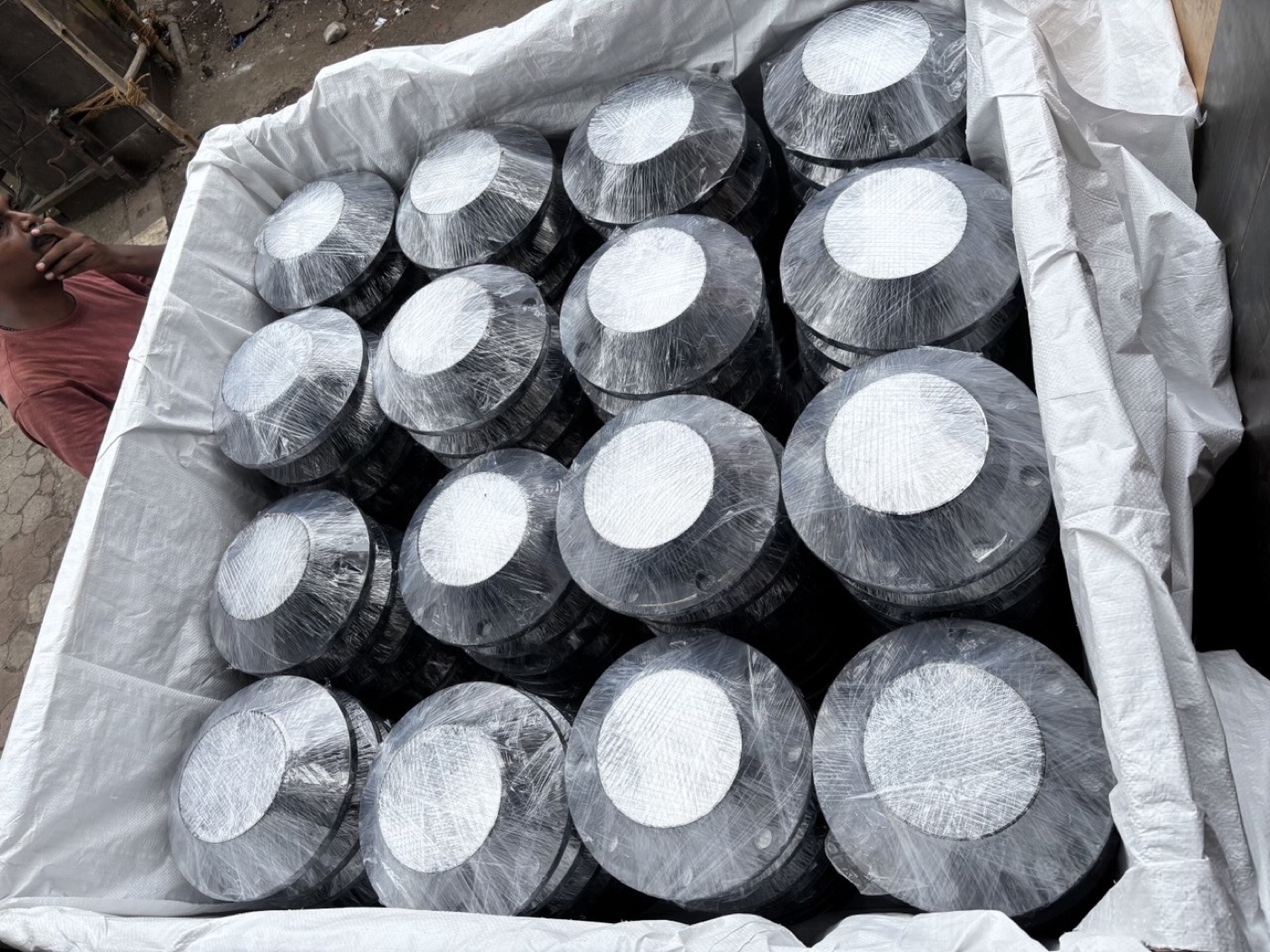
Certification & packing — EN 10204 3.1 MTC with impact results (3.2 witnessed on request); NACE declaration where specified; packed sea-worthy.
Where ASTM A350 LF2 Socketweld Flanges Are Used
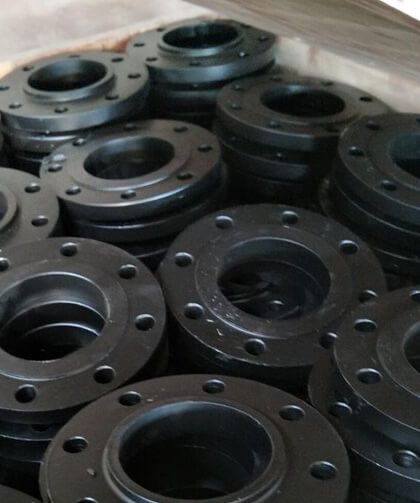
Where cold and sour meet small bore: gas processing and treating plants, blowdown and flare systems, letdown and depressurisation stations, wellhead and compression auxiliaries, LPG and refrigerated storage connections, cold-climate utility and instrument piping, and sour-service drains, vents and injection points. Production below:
An ASTM A350 LF2 socketweld flange is a forged low temperature carbon steel (LTCS) flange whose back carries a machined socket: the pipe end seats inside, self-aligned square to the face, and is secured with a single external fillet weld. LF2 is A105's cold-service twin — the same strength group (485 MPa tensile floor, 250 MPa yield) but mandatorily heat treated and Charpy V-notch impact tested at -46°C, so the certificate guarantees toughness where plain carbon steel goes brittle. Dimensioned to ASME B16.5 for ½" to 3" NB in Classes 150 to 1500, in raised face, flat face and ring joint facings — the laser-marked 2" Class 150 unit pictured on this page is from our production.
What does LF2 buy over A105?
Certified toughness below -29°C. A105 is rated to -29°C and no colder; LF2 Class 1 carries a mandatory heat treatment and a Charpy V-notch test at -46°C on every heat, with the results printed on the EN 10204 certificate. Three quieter differences follow from the toughness mission: the tensile band is capped (485-655 MPa, where A105 has no ceiling), hardness is capped at 197 HB, and the chemistry trims carbon to 0.30% while allowing more manganese — all choices that favour ductile behaviour. The price difference is modest, which is why many cold-climate and gas-processing owners simply standardise their carbon steel small bore on LF2 and stop tracking two grades.
Why does low temperature matter most on small bore?
Because the coldest metal in a plant is usually a small-bore connection. Whenever gas expands across a letdown valve, a blowdown orifice or a depressurising vent, the Joule-Thomson effect refrigerates the downstream metal — and those services are almost always ½" to 2" piping: drains, vents, instrument taps, sample points. A line that runs warm in normal operation can hit -40°C and colder in seconds during a blowdown. That is precisely the failure mode LF2 exists for: brittle fracture needs low toughness, a stress raiser and a trigger, and an impact-tested flange removes the first ingredient. This is why gas plants specify LTCS small bore even where the main headers are A105.
What is the chemical composition of ASTM A350 LF2?
Carbon ≤0.30%, manganese 0.60-1.35%, silicon 0.15-0.30%, phosphorus ≤0.035%, sulphur ≤0.040%, with the usual residual ceilings on copper, nickel, chromium, molybdenum and vanadium. Set it beside A105 and the toughness logic shows: carbon down from 0.35% (carbon strengthens but embrittles), manganese allowed up to 1.35% (manganese buys toughness), silicon floor raised for cleaner deoxidation. It remains a plain weldable carbon steel — standard consumables, familiar preheat rules — which is exactly why LF2 is the world's default sour-and-cold carbon steel flange grade rather than some exotic.
What are the mechanical properties of A350 LF2 socketweld flanges?
Tensile strength 485-655 MPa (70-95 ksi) — note the ceiling as well as the floor — yield strength 250 MPa (36 ksi) minimum, elongation 22% minimum and hardness capped at 197 HB, plus the defining requirement: Charpy V-notch impact energy verified at -46°C for Class 1. The tensile cap is deliberate: over-strong carbon steel is usually under-tough carbon steel, and A350 fences it out. The hardness ceiling doubles as the sour-service safeguard that keeps LF2 inside NACE MR0175 limits. Every heat's tension and impact results travel on the EN 10204 3.1 certificate.
What are LF2 Class 1 and Class 2?
Two impact-test temperatures for the same steel. Class 1 — the default, and what an unqualified 'LF2' order means — is Charpy tested at -46°C (-50°F), covering the classic LTCS band. Class 2 is tested at the milder -18°C (0°F), a fit for services that need better-than-A105 assurance without the full -46°C rating. Almost all stock and almost all specifications run Class 1; Class 2 appears mainly where an owner's spec calls it out deliberately. Our certificates state the class and the test temperature explicitly, and if your enquiry just says LF2, we quote and certify Class 1.
How is an LF2 socketweld flange welded — and why the 1/16" gap?
Exactly like every socket weld flange — the diagram pictured on this page shows the joint: the pipe bottoms against the socket shoulder, is withdrawn approximately 1/16" (1.6 mm), and a single external fillet weld secures it. The expansion gap (marked X in the diagram) is required by ASME B31.3 so pipe expansion cannot drive against the shoulder and crack the weld root — doubly relevant here, since blowdown service swings the metal temperature violently in both directions. LF2 welds with standard carbon steel consumables; where the line class requires impact-tested welds, the procedure and consumables are qualified for low temperature too — the flange certificate covers the flange, the weld procedure covers the joint.
What facings are A350 LF2 socketweld flanges made with?
All three, each with its own page on this site: raised face (SWRF) — the default, and the pattern of the marked 2" Class 150 flange photographed on this page — flat face (SWFF) for the cast iron, GRP and lined equipment that cannot take a raised ring, and ring type joint (SWRTJ) for high-pressure gas duty, where RTJ small bore is common in wellhead and compression service. The socket, the welding practice and the schedule-matched bore are identical across the three; only the gasket face changes, and the mating flange decides which you order.
What sizes and pressure classes do LF2 socketweld flanges come in?
ASME B16.5 standardises socket weld flanges from ½" to 3" NB in Classes 150, 300, 600, 900 and 1500 — Class 900 sharing Class 1500 dimensions in most small-bore sizes — with Class 2500 and 4" made to order. Gas processing pushes LF2 sockets toward the higher classes more often than general service does: Class 600 and 900 instrument and blowdown connections are routine. As with every socket flange, put the pipe schedule on the enquiry — Sch 80 and 160 dominate high-pressure small bore — so the through-bore matches the pipe ID and the flow path stays smooth.
Is A350 LF2 suitable for NACE MR0175 sour service?
Yes — LF2 is the world's default sour-service carbon steel flange grade. Its standard hardness ceiling of 197 HB sits inside the NACE MR0175 / ISO 15156 limit of 22 HRC for carbon steels, so compliant supply is a matter of certification discipline rather than a different product: state NACE on the enquiry and the certificate carries the declaration, with hardness results per heat. Sour gas processing is also where LF2's two missions meet — H2S lines that blow down cold need both the NACE hardness control and the -46°C toughness in the same small-bore flange, and LF2 delivers both on one certificate.
When should I not use a socket weld flange?
The standard socket weld limits apply unchanged. The gap between pipe end and socket shoulder is a crevice — corrosion-sensitive and stagnant services often specify butt welds instead, and hygienic lines exclude sockets entirely. Fillet welds cannot be radiographed, so mandatory-RT and lethal-service line classes escalate to the small-bore weld neck. And severe cyclic or vibrating duty concentrates stress at the fillet root — weld neck territory again. One LTCS-specific note: some severe-cycling blowdown specifications prefer butt-welded small bore precisely because the joints see brutal thermal transients; where your line class says so, our LF2 weld neck page has the matching flange.
What is used below -46°C?
The nickel-alloyed LTCS grades, then stainless. A350 LF3 — 3.5% nickel — is the next step, impact tested at -101°C and covering deep refrigeration and some LNG-adjacent duties; our LF3 pages cover Class 1 and 2. Below that, 9% nickel steel and the austenitic stainless grades (304/304L and 316/316L, tough to cryogenic temperatures without impact-test drama) take over — LNG, liquid nitrogen and oxygen services are stainless small-bore territory. The practical ladder for a piping engineer: A105 to -29°C, LF2 to -46°C, LF3 to -101°C, austenitic stainless beyond — each with its socket weld flange page on this site.
What details are needed to get an accurate LF2 socketweld flange quotation?
Six elements plus commercial terms: (1) size — ½" to 3" NB; (2) pressure class — 150 to 1500; (3) facing — SWRF, SWFF or SWRTJ with ring number; (4) the pipe schedule — Sch 40, 80 or 160, so the through-bore matches the pipe ID; (5) grade detail — LF2 Class 1 (the default) or Class 2, NACE MR0175 declaration if sour, coating if any; (6) certification — EN 10204 3.1 with impact results (our standard) or 3.2 witnessed. Add quantity and destination and we return price, weight and delivery — normally within 24 hours, with common sizes quoted from ready stock.
Who manufactures ASTM A350 LF2 socketweld flanges in India?
Tesco Steel & Engineering is an ISO 9001:2015 certified flange manufacturer based in Mumbai, India, producing ASTM A350 LF2 socket weld flanges from ½" to 3" NB (larger to order) in Classes 150-1500 — each forged from certified heats, heat treated with furnace records, Charpy tested at -46°C, machined with gauged socket depth and schedule-matched bore, and laser-marked with grade, size, class and heat number, exactly as the 2" Class 150 unit photographed on this page. Supplied with EN 10204 3.1/3.2 certification including impact results, NACE MR0175 declaration where specified, alongside the full socket weld range in A105, stainless, duplex and nickel alloys. Exported to more than 50 countries.