

Tesco Steel & Engineering manufactures DIN 3015 Part 1 Light Series pipe and tube clamps — twin-half polymer clamp bodies with steel weld plates, cover plates, and mounting rails for secure, vibration-damped support of hydraulic pipe, instrument tube, and cable conduit. Size 6 mm to 102 mm OD. Polypropylene (PP) / Polyamide / Aluminium body with Carbon Steel or Stainless Steel plates & bolts. ISO 9001:2015 certified. Made in India.
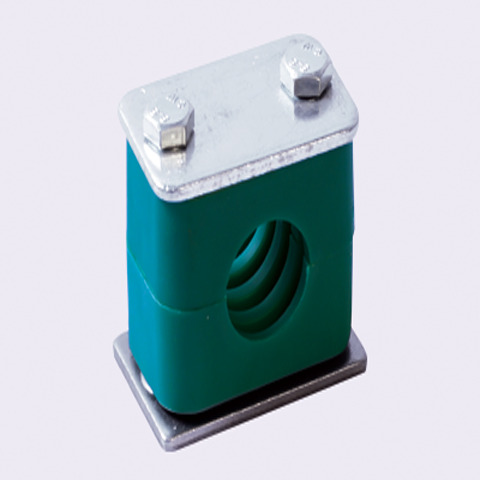
TES-LOK Light Series Pipe Clamp
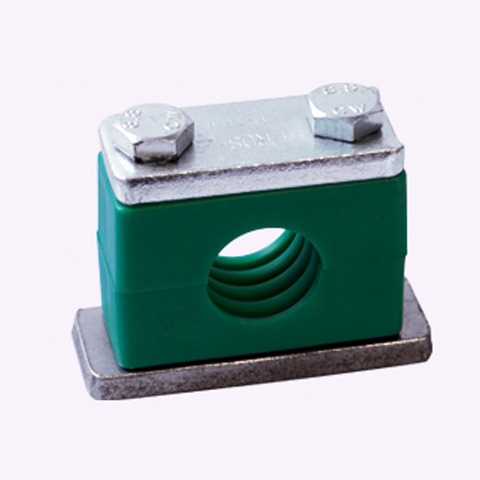
Heavy Series (Related)
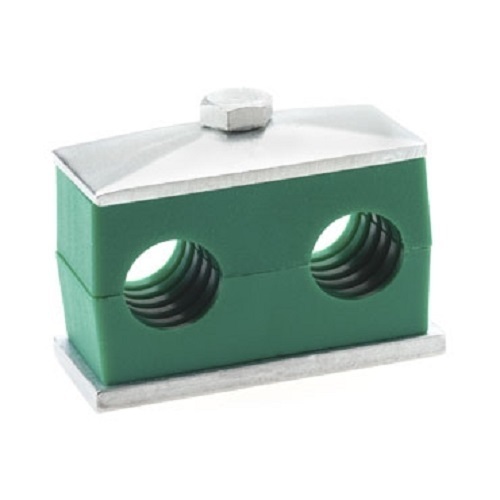
Twin Series (Related)
The "Light Series" (also called Standard Series) designation under DIN 3015 Part 1 covers standard-duty applications — the most widely used clamp series for hydraulic and instrumentation pipe runs. Heavier vibration, larger pipe, or higher mechanical loads call for the Heavy Series (DIN 3015 Part 2) or Twin/Double Series clamps, which TES-LOK also manufactures.
| Criterion | Light Series (Part 1) | Heavy Series (Part 2) | Twin / Double Series (Part 3) |
|---|---|---|---|
| Standard | DIN 3015 Part 1 | DIN 3015 Part 2 | DIN 3015 Part 3 |
| Duty level | Standard duty — general pipe/tube runs | Heavy duty — high vibration & load | Two pipes stacked in one clamp body |
| Body half height | Lower profile, lighter section | Taller, thicker section for higher grip force | Stacked twin bores |
| OD range | 6 mm to 102 mm | 6 mm to 273 mm (and larger) | Matched pairs per group |
| Working pressure | Up to ~100 bar (1500 PSI) pipe service | Higher — HP hydraulic pipe | As per pipe service |
| Typical use | Instrument tube, low/medium-vibration hydraulic pipe | High-pressure HP hydraulic pipe, heavy machinery | Routing two parallel lines together |
| Component | Function | Material Options |
|---|---|---|
| Clamp Body (two halves) | Grips the pipe/tube circumference; damps vibration | Polypropylene (PP), Polyamide, Aluminium |
| Weld Plate (mounting plate) | Welded to the structure to anchor the clamp | Carbon Steel (zinc plated), SS 304, SS 316 |
| Cover Plate (top plate) | Bridges the two clamp halves; bolt bears on it | Carbon Steel (zinc plated), SS 304, SS 316 |
| Bottom Plate | Bolt-on alternative to weld plate (no welding needed) | Carbon Steel (zinc plated), SS 304, SS 316 |
| Mounting Rail / Rail Nut | Carries multiple clamps in a row on one rail | Carbon Steel (zinc plated), SS 304, SS 316 |
| Hex Bolt / Stud | Clamps the assembly together to specified torque | Zinc-plated Grade 8.8, SS 304 (A2), SS 316 (A4) |
| Body Material | Temperature Range | Key Properties | Best For |
|---|---|---|---|
| Polypropylene (PP) | −40°C to +90°C | Good chemical resistance, economical, standard option | General hydraulic & instrument tube runs |
| Polyamide (PA / Nylon) | −40°C to +120°C | Higher temperature & abrasion resistance, tough | Hotter circuits, higher-vibration mounting |
| PP Electrically Conductive | −40°C to +90°C | Antistatic / conductive grade dissipates charge | ATEX / hazardous areas needing static dissipation |
| Aluminium | −60°C to +200°C | Metal body for high-temperature / fire-zone service | Engine rooms, fire zones, high-temperature areas |
| Parameter | Details |
|---|---|
| Brand | TES-LOK (Tesco Steel & Engineering) |
| Series | Light / Standard Series — DIN 3015 Part 1 |
| Pipe/Tube OD Range | 6 mm to 102 mm OD |
| Working Pressure | Up to 100 bar (1500 PSI) |
| Clamp Body Material | Polypropylene (PP), Polyamide, Aluminium, Conductive PP |
| Hardware Material | Carbon Steel (zinc plated), SS 304 (A2), SS 316 (A4) |
| Mounting Options | Weld plate, bolt-on bottom plate, mounting rail / rail nut |
| Temperature Range | PP: −40°C to +90°C | PA: −40°C to +120°C | Aluminium: up to +200°C |
| Standard | DIN 3015 Part 1 (Light Series) |
| Size Groups | Group 1 to Group 6 — each group covers a range of ODs with a common plate/rail size |
| Certifications | ISO 9001:2015 | material certificates on request |
Light Series clamps are organised into size groups — each group shares a common weld plate, cover plate, and rail dimension, so clamps for different pipe ODs in the same group mount on identical hardware. This standardises the mounting hardware across a mixed pipe-size installation.
| Group | Pipe/Tube OD Range | Typical Clamp Bolt |
|---|---|---|
| Group 1 | 6, 8, 10, 12 mm | M6 |
| Group 2 | 14, 15, 16, 18, 20, 22 mm | M8 |
| Group 3 | 25, 28, 30 mm | M8 |
| Group 4 | 32, 35, 38 mm | M10 |
| Group 5 | 40, 42, 44.5 mm | M10 |
| Group 6 | 48.3, 50, 60 mm (and up to 102 mm) | M10 / M12 |
Clamp body, weld plate, cover plate, and rail dimensions are manufactured to DIN 3015 Part 1 — fully interchangeable with standard light-series clamp hardware from any DIN 3015 supplier, simplifying procurement and spares.
The polymer clamp body grips the full pipe circumference, absorbing vibration and pressure pulsation instead of point-loading the pipe. This prevents fretting, abrasion, and fatigue cracking of the pipe — extending hydraulic line life and reducing noise transmission to the structure.
Weld plates, cover plates, rails, and bolts in zinc-plated carbon steel for general service, or SS 304 (A2) and SS 316 (A4) for corrosive, marine, and washdown environments. The polymer body grades cover PP, Polyamide, conductive PP, and aluminium.
Standardised size groups mean different pipe ODs in the same group mount on identical weld plates and rails — so a mixed-size pipe run uses common hardware. This reduces the spare-parts inventory and speeds installation on multi-line racks.
TES-LOK supplies the complete clamp group — body halves, weld/bottom plate, cover plate, rail, and bolts — as a matched assembly, or as individual components for spares. Single-source supply for the whole pipe-support bill of material.
Electrically conductive (antistatic) PP clamp bodies are available for ATEX and hazardous-area installations where static charge dissipation is required on hydraulic and fuel pipe runs.
| Industry | Typical Use Point | Why Light Series Clamp Preferred |
|---|---|---|
| Hydraulics & Machinery | Routing hydraulic pipe and instrument tube on power packs and machine frames | Vibration damping protects pipe from pulsation fatigue; modular groups speed install |
| Mobile & Construction Equipment | Securing hydraulic lines along excavator, crane, and loader chassis | Polymer body absorbs shock and machine vibration; SS hardware for outdoor exposure |
| Oil & Gas / Petrochemical | Instrument tube and small-bore pipe support on skids and platforms | SS 316 hardware + conductive body for corrosive and hazardous areas |
| Marine & Shipbuilding | Engine room hydraulic and fuel pipe routing | SS 316 (A4) hardware resists salt corrosion; aluminium body for fire zones |
| Power Generation | Lube oil and control pipe support in turbine halls | Polyamide body for hotter circuits; vibration isolation reduces noise transmission |
| Steel & Process Plants | Instrument and utility tube runs on structures and cable trays | Standardised group hardware for mixed-size pipe racks |
| Rail & Transport | Hydraulic, air, and fuel line mounting on rolling stock | Vibration-damped clamping for constant-motion environments |
| Renewable Energy | Hydraulic pipe routing in wind turbine nacelles and solar tracker drives | Compact light-series clamp suits confined nacelle pipe runs |
Q1. What is a DIN 3015 Light Series pipe clamp?
It is a standard-duty pipe/tube support clamp built to DIN 3015 Part 1. It uses a twin-half polymer body that grips the pipe circumference, mounted on a steel weld plate, bottom plate, or rail and secured with a cover plate and hex bolt. The light (standard) series is the most common clamp series for hydraulic and instrumentation pipe runs at standard vibration and load levels.
Q2. What is the difference between Light Series and Heavy Series clamps?
Light Series (DIN 3015 Part 1) is standard-duty, with a lower-profile body for general pipe/tube runs up to about 102 mm OD. Heavy Series (DIN 3015 Part 2) has a taller, thicker body for higher grip force and is used for high-pressure hydraulic pipe, heavy machinery, and high-vibration applications, in sizes up to 273 mm and beyond. Choose Heavy Series when vibration, pressure, or pipe size exceeds standard-duty limits.
Q3. What clamp body material should I choose?
Polypropylene (PP) is the economical standard choice for general service to +90°C. Polyamide (nylon) handles higher temperatures (+120°C) and greater abrasion/vibration. Conductive (antistatic) PP is for ATEX/hazardous areas needing static dissipation. Aluminium bodies are for high-temperature and fire-zone service up to +200°C. Match the body to the operating temperature and environment.
Q4. What hardware material should I use for marine or outdoor installations?
Use SS 316 (A4) weld plates, cover plates, rails, and bolts for marine, offshore, and coastal outdoor service — SS 316 resists chloride corrosion. SS 304 (A2) suits general outdoor and washdown service. Zinc-plated carbon steel is economical for dry indoor environments. The polymer body itself is corrosion-resistant; the hardware grade is what determines corrosion performance.
Q5. What is the "size group" system?
DIN 3015 organises clamps into size groups. All pipe ODs within one group share the same weld plate, cover plate, and rail dimensions — so different pipe sizes in the same group mount on identical hardware. This standardises mounting hardware across a mixed-size pipe rack, reducing spares and simplifying installation. For example, Group 1 covers 6–12 mm ODs on common M6-bolt hardware.
Q6. How does a pipe clamp reduce vibration?
The polymer clamp body grips the full circumference of the pipe and acts as a damping interface between the pipe and the rigid structure. Instead of the pipe resting on a hard point (which concentrates stress and transmits vibration), the resilient polymer absorbs pressure pulsation and machine vibration, preventing fretting wear, fatigue cracking, and noise transmission. This significantly extends hydraulic pipe service life.
Q7. Can I mount multiple clamps on a single rail?
Yes. The mounting rail option carries a row of clamps along one rail, allowing multiple parallel pipe/tube lines to be supported on a single welded or bolted rail. This is ideal for instrument tube racks and multi-line hydraulic routing, keeping lines neatly organised and reducing the number of individual mounting points.
Q8. Do you supply the complete clamp group or individual components?
Both. TES-LOK supplies the complete clamp group — body halves, weld/bottom plate, cover plate, rail, and bolts — as a matched assembly, or any individual component (body, plate, rail, bolt) for spares and replacements. We also manufacture the related Heavy Series, Twin/Double Series, Aluminium, Construction, Multilayer, and Rail-Nut clamp products. See the sidebar for the full clamp range.