Tesco Steel & Engineering forges ASTM A182 F5 slip on flanges — the 5% chromium, ½% molybdenumalloy steel that resists high-temperature sulfidic corrosion where carbon steel wastes away — to ASME B16.5 Class 150–2500 from ½″ to 24″ NB, larger patterns to order. The workhorse of hot refinery piping: crude and vacuum unit transfer lines, hydroprocessing hot sections, fired-heater circuits. Supplied heat treated per ASTM A182 with full heat traceability, faced SORF (flat face or RTJ where specified), alongside the complete chrome-moly family F9, F11, F22 and F91. Every lot with EN 10204 3.1/3.2 MTC. ISO 9001:2015, made in Mumbai, India — exported to 50+ countries.
ASTM A182 F5 · SA182 · K415455Cr-½Mo · Werkstoff 1.7362ASME B16.5 Class 150–2500½″ – 24″ NB · SORFRated to 649 °C per B16.5EN 10204 3.1 / 3.2 MTCISO 9001:2015 · Exported Worldwide
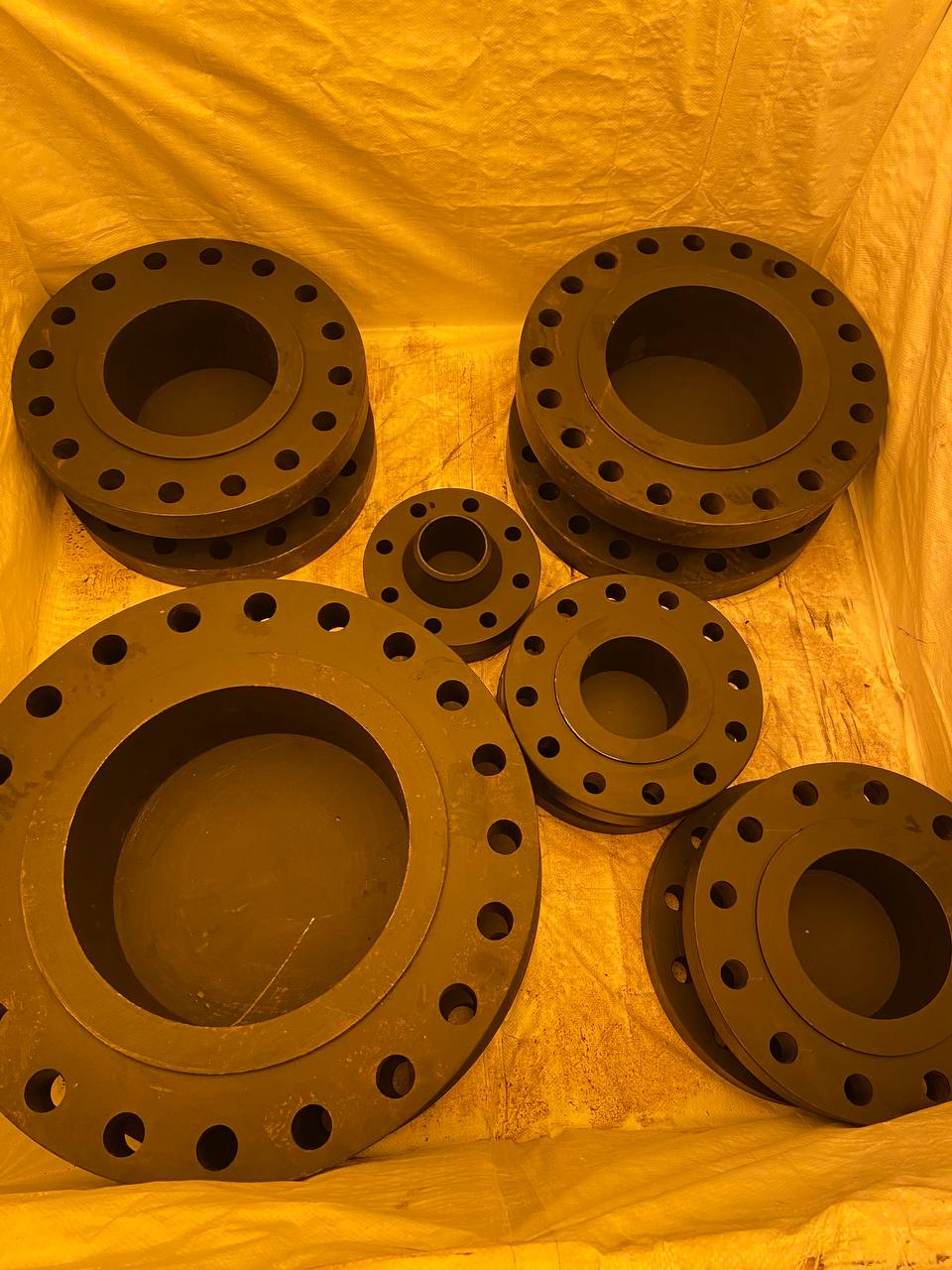
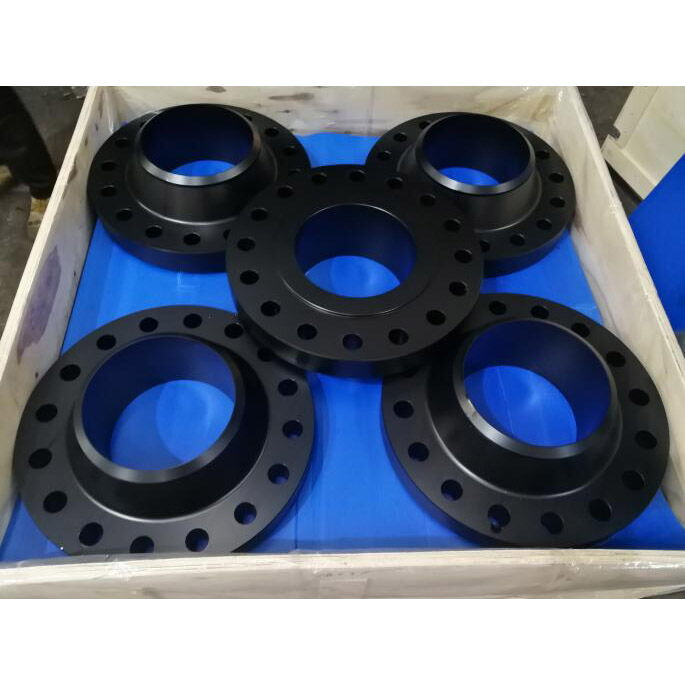
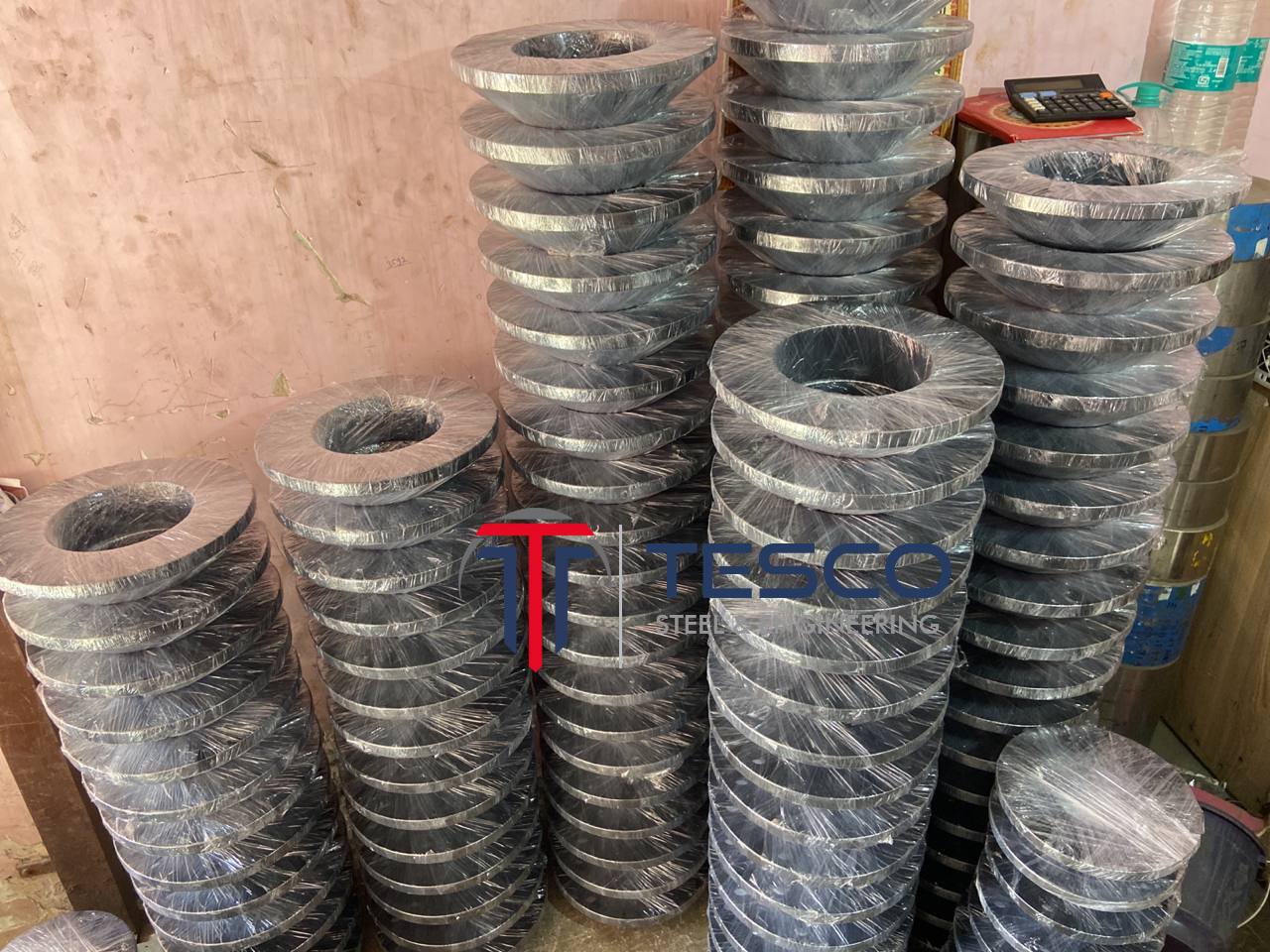
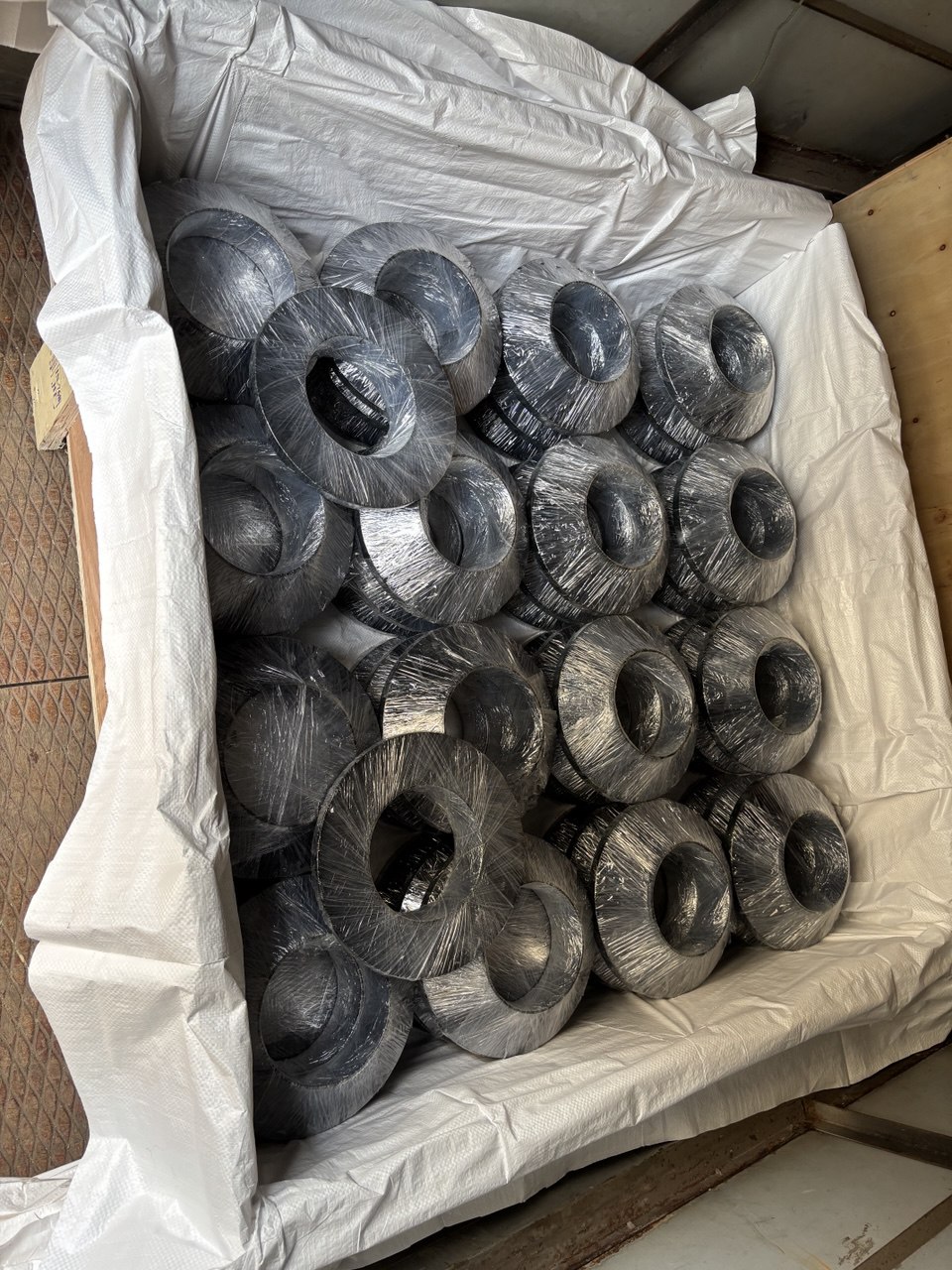
ASTM A182 Alloy Steel Slip On Flanges — Mixed Sizes, Export Crated at Our Mumbai Works
What is an ASTM A182 F5 Slip On Flange?
F5 = the sulfidation grade.ASTM A182 F5 is a 5Cr-½Mo alloy steel forging grade: the chromium forms a protective scale that resists high-temperature sulfidic attack, the molybdenum holds strength when the line runs hot. As a slip-on, it installs with two fillet welds — with alloy discipline: preheat, B6 consumables and PWHT. Rated to 649 °C in the B16.5 tables, it is the classic flange of hot refinery services that plain carbon steel cannot survive.
Also searched as: F5 slip on flange, 5Cr slip on flange, chrome moly slip on flange, SA182 F5 slip on flange, 1.7362 slip on flange, K41545 slip on flange — all refer to the product on this page.
Creep-strength-enhanced — modern high-energy steam
Rule of thumb: refineries climb the ladder for corrosion (sulfur), power plants climb it for creep strength (temperature). F5 is the corrosion rung — wet aqueous duty belongs to stainless steel instead.
ASTM A182 F5 Chemical Composition
C
Mn
Si
P
S
Cr
Mo
Ni
0.30 max
0.60 max
0.50 max
0.030 max
0.030 max
4.00-6.00
0.44-0.65
0.50 max
Values in weight % per ASTM A182 for the F5 forging grade. The 4-6% chromium is the working element against hot sulfidation; note this is the forging chemistry — the matching A335 P5 pipe grade runs leaner in carbon, so certificates are always read against the product standard.
ASTM A182 F5 Mechanical Properties
Tensile Strength, MPa (ksi)
Yield Strength, Min, MPa (ksi)
Elongation % min (2")
Reduction of Area % min
Hardness, HB
485 (70) min
275 (40) min
20
35
143-217
F5 is supplied heat treated per ASTM A182 (annealed or normalized and tempered), which is why the hardness is a bounded range — hard enough for service, soft enough to machine and weld. The high-strength variant F5a (620 MPa min tensile, 187-248 HB) is available where the design calls for it.
A182 F5 Slip On Flange Specifications
ASTM A182 F5 Slip On Flanges are available in the following specifications:
1/2"NB to 24"NB per ASME B16.5; larger patterns to order
Class
150#, 300#, 400#, 600#, 900#, 1500#, 2500#
Facing
Raised Face (SORF) — default; Flat Face or RTJ where the piping class specifies
Heat Treatment
Annealed or normalized & tempered per ASTM A182, thermal record retained
Service
Hot refinery duty — rated to 649 °C in the ASME B16.5 tables, creep governing in the upper range
Installation
Two fillet welds (hub + bore), pipe set back 1/8"; preheat + E8018-B6 consumables + PWHT ~700-760 °C per B31.3
Finish
Bare (anti-rust oiled); other surface preparation on request
Certification
EN 10204 3.1 (standard) / 3.2 witnessed
Equivalent Grades of ASTM A182 F5
Standard
ASME
UNS
Werkstoff Nr.
DIN / EN (working equivalent)
ASTM A182 F5
SA182 F5
K41545
1.7362
X12CrMo5 / 12CrMo19-5
European grades are duty equivalents rather than chemistry-identical matches — certificates always state the actual grade forged. System partners: ASTM A335 P5 pipe and A234 WP5 fittings — the 5Cr trio specified together on hot refinery lines.
Why A182 F5 Slip Ons Are Specified
Outlasts Carbon Steel in Hot Sulfur
Above ~260 °C, sulfur compounds eat carbon steel at an accelerating rate — 5% chromium slows the wastage several-fold, stretching turnaround intervals.
Holds Strength When the Line Runs Hot
The ½Mo addition keeps useful strength deep into the B16.5 tables — rated entries to 649 °C, far beyond A105's practical ceiling.
The Economical Corrosion Rung
F5 buys hot-sulfur life without jumping to 9Cr or stainless prices — the classic refinery upgrade when carbon steel corrosion allowances stop adding up.
Slip-On Fit-Up Economy
Where the piping class permits, the slip-on saves the weld-neck's bevel-matching and cut-length precision — useful on alloy lines where every rework costs PWHT.
Know the Handoffs
Hotter or more sulfurous: F9. Creep-driven steam duty: F11/F22. Critical RT-mandated lines: F5 weld necks.
How Our A182 F5 Slip On Flanges Are Manufactured
1
Forging — cut billet of certified A182 F5 heat is hot-forged into the flange blank, keeping full heat traceability from raw material to despatch.
2
Heat treatment — annealed or normalized & tempered per ASTM A182; 5Cr steel is air-hardening, so the controlled cycle is what delivers the 143-217 HB working condition.
3
Machining — hub, faces and bolt holes to ASME B16.5; the bore machined slightly over pipe OD per the slip-on tolerance.
4
Facing — SORF raised face with serrated stock finish; flat face or RTJ groove where the order specifies.
5
Testing & marking — mechanical, chemical and hardness verification against the heat, then permanent marking of grade, size, class and heat number.
6
Certification & packing — EN 10204 3.1 MTC (3.2 witnessed on request), export-packed as pictured on this page.
Where A182 F5 Slip On Flanges Are Used
Hot, sulfur-bearing hydrocarbon service: crude and vacuum distillation transfer lines, fired-heater inlet/outlet piping, hydrotreater and hydrocracker hot sections, FCC circuits, delayed coker services, and elevated-temperature lines where sulfidation retires carbon steel early. Our alloy steel production and packing below:
Example: “Slip On Flange, 6″ NB, ASME B16.5 Class 300, RF, ASTM A182 F5, EN 10204 3.1 — 20 pcs.” Quotations normally within 24 hours with price, unit weight and delivery.
ASTM A182 F5 Slip On Flanges — Frequently Asked Questions
What is an ASTM A182 F5 slip on flange?
It is a slip-on flange forged from ASTM A182 F5 — a 5% chromium, ½% molybdenum alloy steel — dimensioned to ASME B16.5. The flange slides over the pipe end and is secured with two fillet welds, and the 5Cr-½Mo chemistry supplies what carbon steel cannot: resistance to high-temperature sulfidic corrosion and retained strength in hot refinery service. It is the flange of crude and vacuum unit transfer lines, hydroprocessing hot sections and fired-heater piping.
What is the chemical composition of ASTM A182 F5?
Per ASTM A182: carbon 0.30% max, manganese 0.60% max, silicon 0.50% max, phosphorus 0.030% max, sulphur 0.030% max, chromium 4.0-6.0%, molybdenum 0.44-0.65% and nickel 0.50% max. The chromium is the working element — at high temperature it forms a protective scale that slows sulfidation many times over compared with carbon steel — while the molybdenum adds elevated-temperature strength.
What are the mechanical properties of A182 F5 slip on flanges?
Per ASTM A182: tensile strength 485 MPa (70 ksi) minimum, yield strength 275 MPa (40 ksi) minimum, elongation 20% minimum in 2", reduction of area 35% minimum, and hardness 143-217 HB — a bounded range, because F5 is supplied heat treated (annealed or normalized and tempered) and must stay machinable and weldable. Values are demonstrated per heat on the EN 10204 certificate.
What is the difference between A182 F5 and F5a?
Strength. Both belong to the 5Cr-½Mo family, but F5 (UNS K41545, carbon 0.30% max) is the standard grade at 485 MPa minimum tensile and 143-217 HB, while F5a (UNS K42544, carbon 0.25% max) is the high-strength variant at 620 MPa (90 ksi) minimum tensile, 450 MPa (65 ksi) yield and 187-248 HB. Most refinery piping classes call for plain F5; F5a appears where the design needs the extra strength. State the grade exactly on the order.
What temperature can A182 F5 slip on flanges handle?
F5 flanges work the roughly 400-650 °C window where carbon steel runs out. ASME B16.5 rates the 5Cr material class to 649 °C, with creep governing the allowable stresses in the upper part of that range; below roughly 400 °C plain A105 carbon steel is more economical unless sulfidation drives the selection. As with every flange, the pressure rating falls as temperature rises — check the B16.5 table for the class at design temperature.
Why does F5 contain 5% chromium?
Sulfidation resistance. Hot crude fractions and hydrogen-hydrocarbon streams attack steel through their sulfur compounds, and the attack accelerates sharply above about 260 °C. Chromium slows it dramatically — industry corrosion curves show 5Cr steel wasting several times slower than carbon steel in the same hot sour stream — which is why 5Cr-½Mo is the classic upgrade for crude unit transfer lines, heater piping and hydrotreater hot sections.
When is F5 chosen over F11 or F22?
By what governs the design. F11 (1¼Cr-½Mo) and F22 (2¼Cr-1Mo) are the strength grades — chosen for steam lines and creep duty where pressure-temperature strength matters most. F5 carries more chromium but less creep strength, so it is chosen where corrosion — high-temperature sulfidation — is the enemy, classically in refinery process service. Refinery specs typically step carbon steel to F5 or F9 by sulfur duty, while power plants step carbon steel through F11, F22 and F91 by temperature.
How is an A182 F5 slip on flange welded to pipe?
With two fillet welds — hub outside, bore inside, pipe set back 1/8" (3 mm) from the face — but under alloy-steel discipline: 5Cr-½Mo is air-hardening, so practice per ASME B31.3 requires preheat (typically 150-200 °C or higher), matching E8018-B6 / ER80S-B6 consumables, and post-weld heat treatment at about 700-760 °C. Factor the PWHT into fabrication planning; it is the price of the grade's hot-service performance.
What is the equivalent of ASTM A182 F5 in other standards?
ASME SA182 F5 is the boiler-code twin and UNS K41545 the designation number. European working equivalents are the 5% chromium steels X12CrMo5 (Werkstoff 1.7362) and the older DIN 12CrMo19-5. System partners specified alongside it: ASTM A335 P5 pipe and A234 WP5 fittings — the 5Cr trio of hot refinery lines. Certificates always state the actual grade forged.
Are slip on flanges allowed in high-temperature service?
Within limits. Slip-on flanges are permitted by ASME B31.3 and serve on lower-criticality hot lines, but many refinery piping classes restrict creep-range and cyclic services to weld neck flanges, whose full-penetration butt weld can be radiographed and resists thermal fatigue better than fillet welds. Follow the piping class: where it allows a slip-on, an F5 slip-on delivers the metallurgy at lower flange and fit-up cost.
Is A182 F5 a stainless steel?
No. With 4-6% chromium, F5 is an alloy steel, not a stainless steel — stainless needs roughly 10.5% chromium minimum to passivate. F5 rusts in ambient wet service like any carbon steel and is not the answer to aqueous corrosion; its chromium earns its keep at high temperature against sulfidation. For wet corrosion move to 300-series stainless; for hotter or more sulfurous duty than F5 can take, to F9 (9Cr-1Mo) or stainless.
What sizes and classes are A182 F5 slip on flanges available in?
From ½" to 24" NB per ASME B16.5 in Classes 150 through 2500, with larger patterns forged to order. Chrome-moly grades like F5 are project material rather than shelf stock, so flanges are typically forged against the order — standard sizes normally dispatch within a few weeks with EN 10204 3.1 certification. State the required delivery on the enquiry and we confirm the schedule with the quotation.
What details are needed to get an accurate A182 F5 slip on flange quotation?
Five elements plus commercial terms: (1) size and standard — e.g. 6" NB ASME B16.5; (2) pressure class — 150 through 2500; (3) facing — SORF (raised face) default, flat face or RTJ where specified; (4) grade — ASTM A182 F5 (or F5a where the design requires it), with any supplementary requirements such as hardness limits; (5) certification — EN 10204 3.1 or 3.2. No pipe schedule is needed for the slip-on bore. Add the quantity and destination and we return price, weight and delivery.
Who manufactures ASTM A182 F5 slip on flanges in India?
Tesco Steel & Engineering is an ISO 9001:2015 certified flange manufacturer based in Mumbai, India, forging ASTM A182 F5 slip on flanges from ½" to 24" NB per ASME B16.5 — alongside the full chrome-moly family F9, F11, F22 and F91 — with heat-treated supply, full heat traceability and EN 10204 3.1/3.2 certification on every lot. Flanges are marked with grade, size, class and heat number and export to more than 50 countries.