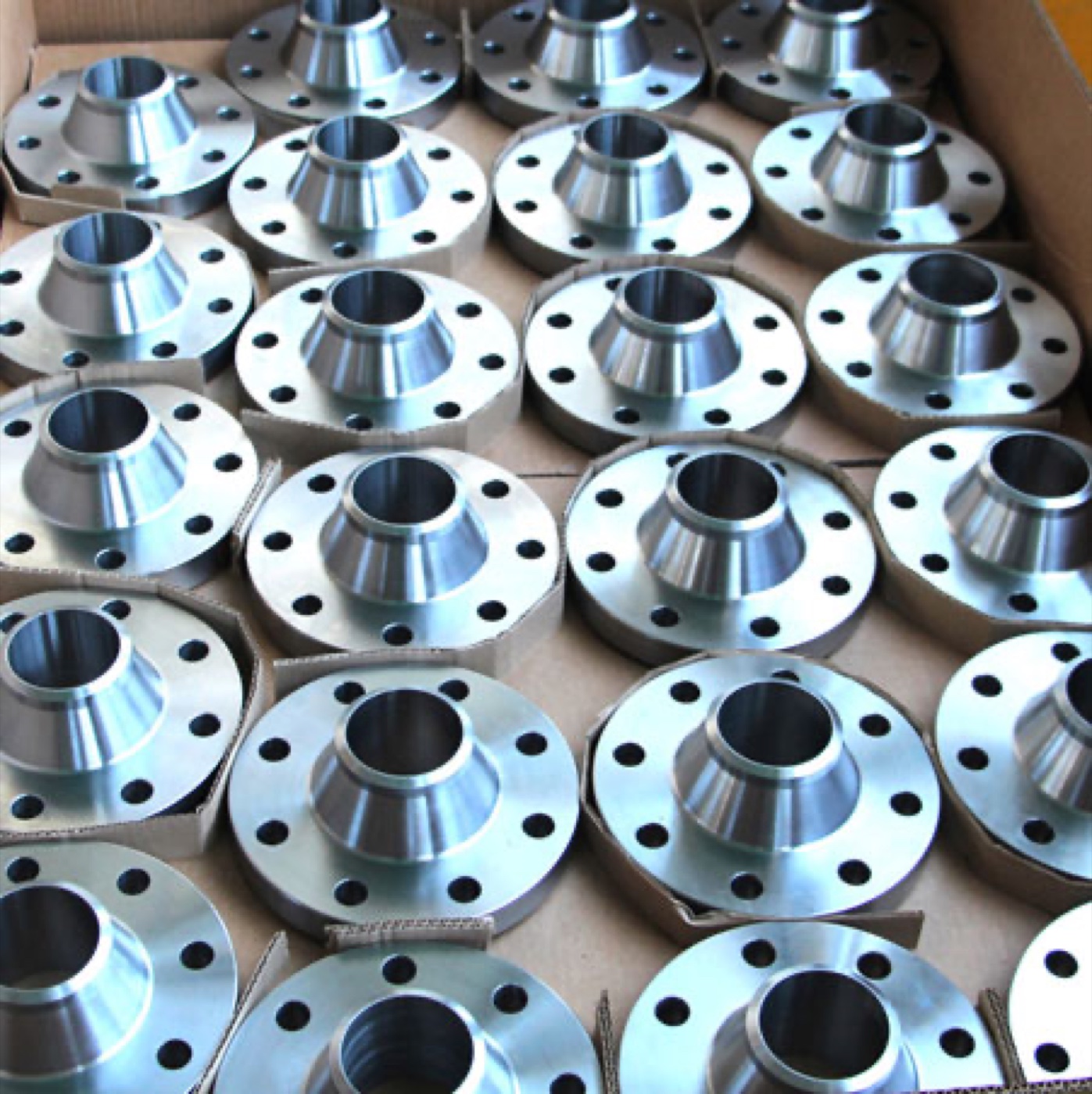
Tesco Steel & Engineering manufactures ASTM A182 F316 lap joint flanges — the molybdenum step on the chloride ladder (UNS S31600, W.Nr. 1.4401): 2–3% molybdenum fortifying the passive film where chlorides attack it, carried by the balancing-act chemistry that lowers chromium to 16–18% and raises nickel to 10–14% to hold the austenite — a certificate reading Cr 16.5% is correct 316, not sub-standard 304. The honest headline: molybdenum buys corrosion resistance, not strength — the certificate reads 515/205 MPa at 30%, identical to plain 304's, and chloride-plus-strength shoppers climb to the duplex bench. On the lap joint bench the ring question has a satisfying answer here: marine air is exactly where the never-wetted ring's molybdenum earns its keep. The single butt weld belongs to the A403 WP316 stub end per B16.9, ER316-class filler keeping the molybdenum continuous. Per ASME B16.5, ½″–24″ NB, Classes 150–2500, solution annealed, pickled & passivated, dual-certified 316/316L where the heat qualifies. Every lot with EN 10204 3.1/3.2 MTC. ISO 9001:2015, made in Mumbai, India — exported to 50+ countries.
ASTM A182 F316 · UNS S31600 · W.Nr. 1.4401Mo 2.00–3.00% — The Chloride Ladder's First StepThe Balancing Act — Cr Down, Ni UpMarine Air Is the Ring's FranchiseDual 316/316L CertificationStub Ends: A403 WP316 per B16.9½″–24″ NB · Classes 150–2500EN 10204 3.1 / 3.2 · ISO 9001:2015
ASTM A182 F316 Lap Joint Flanges — Specifications at a Glance
What is an ASTM A182 F316 Lap Joint Flange?
The molybdenum-bearing backing flange. An ASTM A182 F316 lap joint flange is the loose backing ring of the two-piece system in the molybdenum-bearing austenitic (UNS S31600) — 2–3% Mo against chloride pitting, with chromium at 16–18% and nickel at 10–14% in the grade's deliberate balance. The honest headline: molybdenum buys corrosion, not strength — 515/205/30%, identical to plain 304. The ring question's answer here: marine and coastal air is exactly the molybdenum's franchise on a never-wetted part. Per ASME B16.5, ½″–24″ NB, Classes 150–2500, solution annealed, dual-certified 316/316L; stub ends A403 WP316 per B16.9. EN 10204 3.1 on every lot.
Also searched as: F316 backing flange, 316 stainless lap joint flange, S31600 lap joint flange, marine grade loose flange, SS 316 LJ flange — all this page's product. Related pages: the lap joint hub (the pattern's full story), the ladder below — F304 — the L-variant — F316L — the ladder above — F51 duplex — the F316 bench — weld neck / blind / long weld neck — and the stainless steel overview.
Coastal & marine air, chemical atmospheres, washdown plants (this page)
A403 WP316 stub end
F316 — the molybdenum working precisely where the ring lives: in the salt air
The deciding question is refreshingly concrete: what air will this ring breathe for twenty-five years? Chloride-laden coastal air pits and tea-stains lesser stainless and corrodes coated carbon steel on a maintenance schedule — which makes marine atmosphere the one environment where the never-wetted ring's molybdenum is bought for the ring itself.
PREN ≥40 — hot seawater and aggressive brines, at 550 MPa yield
The honest advice runs both ways: duty without meaningful chlorides gains nothing from the molybdenum premium and descends to 304 — water that pits 316 names its chloride level and temperature and climbs to duplex. State the water — and the air — and the rung picks itself.
What the Pattern Gives This Grade
The Balancing Act
Chromium down to 16–18%, nickel up to 10–14% — molybdenum promotes ferrite, so the austenite-stabilising nickel rises to hold the structure. A certificate reading Cr 16.5% is correct 316, not sub-standard 304.
The Honest Headline
Molybdenum buys corrosion resistance, not strength — 515/205, identical to plain 304, same B16.5 tables, same work-hardening. Chloride resistance and strength at once is the duplex bench's sale.
The Ring's Own Franchise
Salt air is where the never-wetted ring's molybdenum earns its keep — coastal and marine installations buy the 316 ring for the ring's own quarter-century in the atmosphere, not for the process it never touches.
The Austenitic Portfolio, Intact
Cryo toughness without Charpy, rotation at every teardown, sensitization immunity on a ring no weld touches — everything the 304 page established, carried up one rung with the molybdenum riding along.
Specification Notes — Getting F316 Lap Joints Right
Three honest notes.Genuine seawater keeps climbing: 316's molybdenum covers coastal air and brackish duty, but hot brines and seawater immersion pit it — the duplex bench continues the ladder at PREN above 34. The strength is the austenitic bench's: 205 MPa yield and the group's faster hot derating — the class tables govern, and high-class large-bore rings size honestly. And the pattern's boundaries apply in any grade: heavy external loads, severe vibration and high-moment positions read the weld neck bench — lap joints earn their place where lines dismantle; the hub page states the boundaries fully.
How Our F316 Lap Joint Flanges Are Manufactured
1
Material — certified A182 F316 forgings, solution annealed and quenched, furnace records retained; heat-number transfer at the first operation.
2
Machining — B16.5 lap joint dimensions: OD, thickness, bolt circle to class; bore and shoulder turned to suit the stub end's lap — the austenitics' work-hardening priced in and owned by us.
3
Shoulder dressing — the radius dressed to bear evenly on the back of the lap — spreading bolt load instead of concentrating it.
4
Testing — chemistry certified per heat, PMI reading the Cr-Ni-Mo signature — the molybdenum column separating 316 from 304 in seconds; dual 316/316L designations stated where the heat qualifies.
5
Pickling & passivation — restoring the molybdenum-fortified passive film over every machined surface — never painted, never galvanised; and no welding, ever.
6
Pairing & certification — matched to A403 WP316 stub ends where ordered; one EN 10204 3.1 document per pair (3.2 witnessed on request); packed sea-worthy with laps and shoulders protected.
Where F316 Lap Joint Flanges Are Used
Where the molybdenum and the pattern meet: coastal and marine process plants whose pipework dismantles on schedule — the ring breathing the salt air its molybdenum was bought for — chemical and pharmaceutical duty inside 316's chloride range, food and beverage systems where 316 is the house grade, brackish cooling water circuits, and coastal cryogenic terminals where cold service and marine atmosphere arrive together. Production and supply below:
Stainless Lap Joints with Stub Ends — The Two-Piece PairThe Two-Piece System — Flange, Stub End, Butt Weld, PipeF316 Supply — Export Packing at Our Works
F316 Lap Joint Flange Dimensions
Flange dimensions are class-governed per ASME B16.5 — identical in every grade; stub ends per B16.9. Full class-by-class charts:
Example: “Lap Joint Flange, 6″ NB, ASME B16.5 Class 150, ASTM A182 F316 dual-certified 316/316L, with A403 WP316 stub ends Sch 40S (B16.9 Type A, supplied together), coastal installation, pairs on one MTC, EN 10204 3.1 — 20 sets.” Quotations normally within 24 hours with price, unit weights (both parts) and delivery.
F316 Lap Joint Flanges — Frequently Asked Questions
What is an ASTM A182 F316 lap joint flange?
An ASTM A182 F316 lap joint flange is the loose backing flange of the two-piece lap joint system, forged in the molybdenum-bearing austenitic (UNS S31600, W.Nr. 1.4401) — the world's second-favourite stainless, adding 2-3% molybdenum to the austenitic recipe for chloride pitting resistance that plain 304 cannot offer. Like every lap joint flange it slides over the pipe, sits free behind the stub end's flared lap, and carries the entire bolt load without touching the line fluid — and on this grade the ring question has a satisfying answer: marine and coastal air is exactly the environment where the never-wetted ring's molybdenum earns its keep. Manufactured per ASME B16.5 in ½" to 24" NB, Classes 150 to 2500, solution annealed, pickled and passivated, dual-certified 316/316L where the heat qualifies, with EN 10204 3.1/3.2 on every lot.
How does the two-piece lap joint system work?
By splitting sealing from bolting. The stub end butt-welds to the pipe: its flared lap provides the gasket face and does all the fluid contact. The backing flange never welds and never wets: it slides on before the stub end is welded — the classic site lesson — spins freely until the bolts enter, and transmits bolt load through its radiused shoulder onto the back of the lap. Two virtues follow, and 316 lines enjoy both: bolt holes always align, because the loose ring rotates — beloved wherever hygienic and marine pipework is broken and remade on schedule — and the flange's material follows its own duty rather than the line's chemistry, which on this grade splits neatly between the process chlorides the stub end faces and the salt air the ring lives in. The full pattern story — stub end types, the alloy economy, the honest boundaries — is on the lap joint hub page.
Does the backing flange behind a 316 line need to be 316 — the two honest answers?
It depends on the air more than the process, and both answers are honest. The economy answer: the ring never touches the line fluid, so on inland and sheltered systems a plain or galvanised carbon steel ring from our A105 page backs the wetted 316 stub end at a fraction of solid-stainless cost — the pattern's original story. The 316 answer — this page's product — wins where the ring's own environment argues for molybdenum: coastal and marine installations, where chloride-laden air pits and tea-stains lesser stainless and corrodes coated carbon steel on a maintenance schedule; chemical plants whose atmosphere carries its own aggression; and washdown industries that want stainless through the joint, where 316 is often the house grade anyway. The deciding question is refreshingly concrete: what air will this ring breathe for twenty-five years? State the site and we quote that ring — or both options side by side.
What is the chemical composition of ASTM A182 F316 (UNS S31600)?
Carbon ≤0.08%, manganese ≤2.00%, silicon ≤1.00%, chromium 16.0-18.0%, nickel 10.0-14.0%, molybdenum 2.00-3.00%, phosphorus ≤0.045%, sulphur ≤0.030%. Two shifts against 304 reward attention. Chromium is lower — 16-18 against 18-20 — and nickel is higher — 10-14 against 8-11. That is not carelessness but balance: molybdenum promotes ferrite, so the austenite-stabilising nickel must rise to hold the structure, and the chromium band gives way to make the alloy economics work. The certificate that reads Cr 16.5% is correct 316, not sub-standard 304. Chemistry is verified per heat and travels on the EN 10204 3.1 MTC, with dual 316/316L certification stated where the heat qualifies.
What are the mechanical properties of F316 lap joint flanges?
In the solution-annealed condition A182 requires tensile strength 515 MPa (75 ksi) minimum, yield strength 205 MPa (30 ksi) minimum and elongation 30% minimum — numerically identical to plain 304. That identity is the honest headline: molybdenum buys corrosion resistance, not strength. A 316 ring obeys the same austenitic B16.5 pressure-temperature tables, work-hardens in machining the same way, and doubles nothing — an engineer who needs chloride resistance and strength at once is shopping for the duplex bench, where this site's F51 page picks up the story at twice the yield. Within its own lane, 316's mechanicals are exactly what the backing-flange duty wants at the austenitic bench's home classes: modest yield, enormous ductility, and toughness that never disappears at low temperature. Supplied with the solution-anneal records retained.
What does the molybdenum actually do — F316 versus F304?
It fortifies the passive film where chlorides attack it. Chloride ions work at the weak points of stainless steel's protective oxide — pits nucleate, crevices activate, and once started, both are self-accelerating. Molybdenum enriches the film and the metal just beneath it, raising the threshold at which pitting begins: in the pitting-resistance arithmetic used across this site's duplex pages, each percent of molybdenum counts 3.3 times chromium's weight, which is why 2-3% moves the grade a full step up the chloride ladder. In practice that step covers coastal atmospheres, brackish cooling water, food-acid and pharmaceutical duty, and the general chemical exposure that stains and pits 304 — while genuine seawater and hot brines keep climbing to the duplex bench. Everything else about the two grades is deliberately similar: same strength floors, same cryogenic toughness, same welding ease, same finishes. The molybdenum column is the entire difference, and the price gap tracks it.
F316 or F316L — and what does dual certification mean?
The same L-logic as the 304 family, one step up the ladder. Plain 316 allows carbon to 0.08%; 316L caps it at 0.030%, starving weld sensitization and making the L-grade the standard for as-welded corrosion duty. The modern market answer is dual certification: most mill product is melted with low carbon while still meeting plain 316's strength floor, so one heat certifies as both — and our flanges are quoted dual 316/316L where the heat qualifies, satisfying specifications written either way. The lap joint wrinkle carries over verbatim from the 304L page's famous irony: the backing ring is never welded, so sensitization cannot touch it and its L is bought for uniformity — while the stub end's butt weld is where the L genuinely works, answered there by A403 WP316L and low-carbon filler. Where a document names either designation exclusively, the certificate states it exclusively; the 316L page on this site tells that variant's full story.
Is F316 suitable for cryogenic service?
Yes — the austenitic superpower applies unchanged. The face-centred-cubic structure has no ductile-brittle transition, so 316 keeps its toughness to liquid-nitrogen temperatures and beyond without impact-testing gymnastics: where A105 stops at -29°C and LF2 at -46°C, austenitic stainless simply continues, and the molybdenum neither helps nor hinders that. For the lap joint the point lands as it did on the 304 page: the never-wetted ring still gets cold — chilled through the lap it clamps and the frost climbing the line — and an austenitic ring answers without a single Charpy specimen. Where 316 earns its place over 304 on cold duty is the environment: LNG jetties and coastal cryogenic terminals put the ring in salt air, which is precisely the molybdenum's franchise — cold service and marine atmosphere arriving together is this page's natural habitat.
What stub ends pair with F316 lap joint flanges?
The matching stub end is wrought molybdenum-bearing austenitic per ASME B16.9 in ASTM A403 WP316 — the fitting specification serving the austenitic bench — welded to the pipe with the line's qualified stainless procedure and ER316-class filler, keeping the molybdenum continuous through the joint's one weld. That butt weld is the joint's only weld, and it belongs entirely to the stub end: the backing flange never enters the procedure. The matching rules are the pattern's usual dimensional ones — lap OD to the flange's shoulder, schedule to the line bore, B16.9 Type A or B lap details to order — plus the austenitic documentary one: dual 316/316L designations stated identically on both certificates where the heats qualify, pairs certified together on one EN 10204 document. On hygienic and marine systems the stub end's lap face is often specified with a finish callout — state it and the lap is machined and polished to suit.
Does an F316 backing flange need PWHT or a weld procedure?
No — the austenitic bench's honest answer, unchanged by the molybdenum. Austenitic stainless is the easy end of the welding world — no preheat, no PWHT, no hardenability drama — so the never-welded ring's dodge here saves procedure paperwork rather than furnace time, the smallest dodge on the bench as the 304 page says plainly. What the pattern genuinely delivers on 316 lines is its portfolio: the alloy economy where the inland specification takes that door, the rotation that aligns bolt holes on pipework broken and remade on schedule, a ring whose passive film — molybdenum-fortified for the salt air — is never once disturbed by heat, and sensitization immunity that makes the L-question academic on the ring. The discipline that exists concentrates on the stub end's single butt weld — qualified procedure, clean purge, ER316-class filler — welded once. The dodge covers the flange, not the joint, here as everywhere.
What sizes and pressure classes do F316 lap joint flanges come in?
½" to 24" NB per ASME B16.5 in Classes 150, 300, 400, 600, 900, 1500 and 2500, with larger diameters machined to B16.47 or drawing — the full class-by-class lap joint dimension charts are on this site. The order book mirrors the grade's habitat: marine, hygienic and chemical duty concentrates in Classes 150 and 300 — the austenitic bench's home classes — with higher classes appearing on coastal cryogenic and gas systems. Dimensionally an F316 lap joint flange is identical to any other grade's — B16.5 governs by class, not by material — so the charts serve every grade on the bench; what changes is the rating table behind the class, where the austenitic group's faster hot derating deserves a check on warm duty. State size, class and the stub-end question together, and our quotation returns price, unit weight and delivery per class.
How much does an F316 lap joint flange weigh?
Exactly what the same-size lap joint flange weighs in any other steel — B16.5 fixes the dimensions by class, and alloy density differences are negligible. Representative Class 150 figures for the flange alone: 1" roughly 0.8 kg, 2" roughly 2 kg, 4" roughly 5.5 kg, 8" roughly 14 kg, climbing steeply with class; the A403 WP316 stub end adds its schedule-dependent mass. The commercial arithmetic sits one step above the 304 family's: the molybdenum column carries a real surcharge that tracks the molybdenum market, yet remains far below the duplex and nickel benches — and where the economy answer applies, the carbon steel ring from our A105 page weighs the same and costs a fraction. Our quotations state unit and consignment weights per line item, flange and stub end separately, and the site's flange weight chart carries the full reference tables.
How are your F316 lap joint flanges manufactured?
As the pattern's standard sequence with austenitic care at the machining and finishing steps. Certified A182 F316 forgings are solution annealed and quenched — furnace records retained — then machined to B16.5's lap joint dimensions: OD, thickness and bolt circle to class, bore and shoulder turned to suit the stub end's lap, and the shoulder radius dressed to bear evenly on the back of the lap; the austenitics' work-hardening makes that machining tougher than the numbers suggest, a manufacturing problem we own so you don't. Chemistry is certified per heat with PMI reading the Cr-Ni-Mo signature — the molybdenum column separating 316 from 304 in seconds — and dual 316/316L designations stated where the heat qualifies. The finish is stainless's own: pickled and passivated, restoring the molybdenum-fortified passive film over every machined surface. Heat-number marking transfers at the first operation. No welding is performed on the flange at any stage. Where the order includes A403 WP316 stub ends, the pair is dimensionally matched and certified together on one EN 10204 3.1 document (3.2 witnessed on request). Packed sea-worthy with laps and shoulders protected.
What details are needed to get an accurate F316 lap joint flange quotation?
Seven elements plus commercial terms: (1) size and dimensional standard — e.g. 4" NB ASME B16.5; (2) pressure class — 150 to 2500; (3) the grade as your specification writes it — 316, 316L, dual 316/316L (our stock answer) or 316H, each stated exactly on the certificate; (4) the stub end — A403 WP316 matched pair with schedule and B16.9 type, or 'flange only', or the economy answer's carbon steel ring quoted from our A105 page; (5) the service where it helps — chloride level and temperature confirm the rung: harsher water climbs to the duplex bench, chloride-free duty descends to 304 and saves; (6) certification — EN 10204 3.1 (our standard) or 3.2 witnessed, pairs certified together on one document; (7) quantity as pairs or pieces, and destination. Quotations normally return within 24 hours with price, unit weights for both parts, and delivery.
Who manufactures ASTM A182 F316 lap joint flanges in India?
Tesco Steel & Engineering is an ISO 9001:2015 certified flange manufacturer based in Mumbai, India, producing ASTM A182 F316 lap joint (lapped joint) flanges per ASME B16.5 from ½" to 24" NB (larger to B16.47 or drawing) in Classes 150-2500 — each machined from certified, solution-annealed S31600 forgings, PMI-checked on the Cr-Ni-Mo signature, dual-certified 316/316L where the heat qualifies, pickled and passivated, with the shoulder dressed to bear evenly on the lap, heat-number marked, and certified to EN 10204 3.1/3.2. Matched A403 WP316 stub ends per B16.9 are supplied against the same order, pairs certified together on one document — or the economy answer's carbon steel backing rings from our A105 range, where the specification takes that door. Alongside the complete A182 F316 range — weld neck, slip-on, socket weld, threaded, blind, spectacle blind and long weld neck — the 304 family below and the duplex bench above on the chloride ladder, and the complete lap joint grade bench. Exported to more than 50 countries.