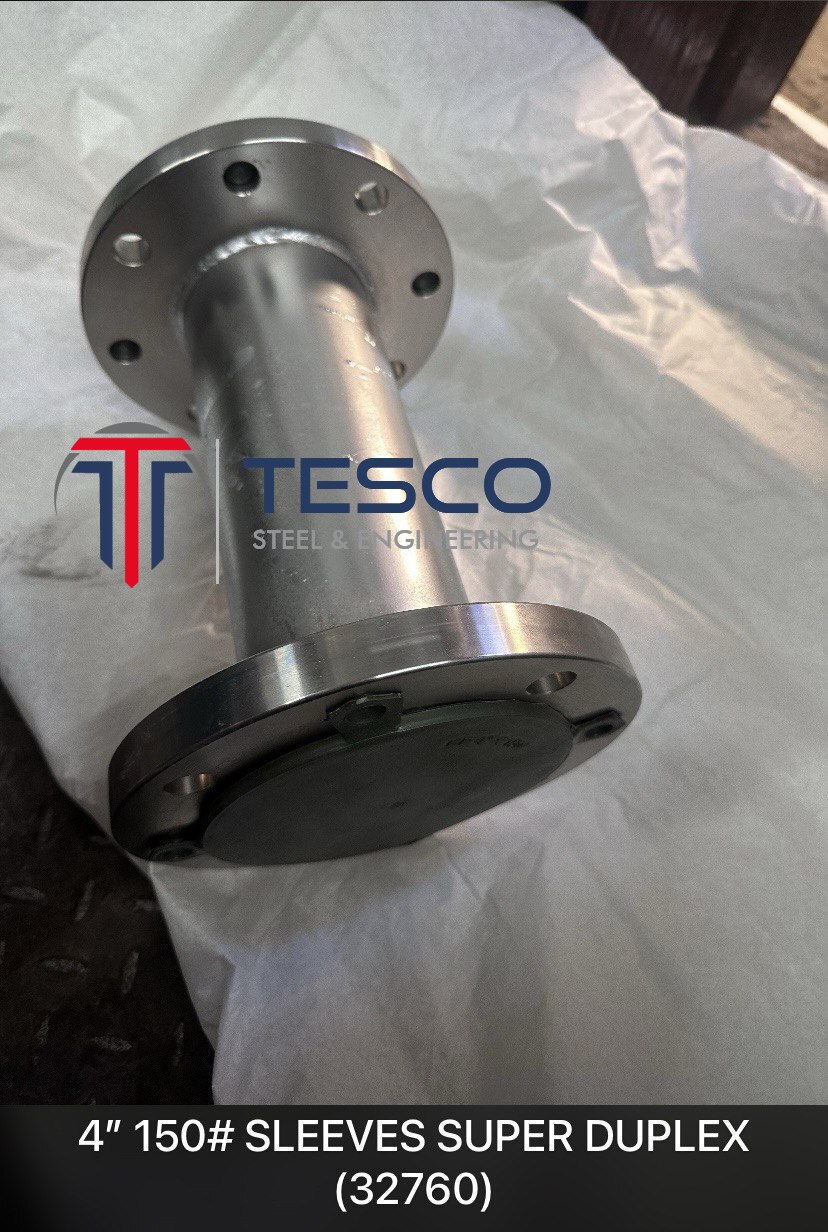
ASTM A182 F55 Lap Joint Flanges — Super Duplex S32760 Backing Flanges & Stub Ends
Tesco Steel & Engineering manufactures ASTM A182 F55 lap joint flanges — the super duplex twin from the other side: S32760, the Zeron 100 type (W.Nr. 1.4501), reaching the 40-PREN summit with deliberate copper and tungsten additions at 0.5–1.0% each — tungsten counting in the extended pitting formula at half molybdenum's weight, copper buying margin where acidity rides the chlorides — and the only common duplex grade whose certificate guarantees PREN ≥40 because the specification writes it in. Against F53 the certificate trades a slightly lower tensile floor for a notably higher ductility floor: 750/550 MPa at 25% elongation — a balance suited to hardware bolted and re-bolted across decades, which is precisely a lap joint ring's career. The ring never welds, dodging the summit's phase-balance discipline entirely; the single butt weld belongs to the A815 S32760 stub end per B16.9. Per ASME B16.5, ½″–24″ NB, Classes 150–2500, solution annealed, pickled & passivated. Every lot with EN 10204 3.1/3.2 MTC, computed PREN stated. ISO 9001:2015, made in Mumbai, India — exported to 50+ countries.
ASTM A182 F55 · UNS S32760 · W.Nr. 1.4501The Zeron 100 Type — Cu + W AlloyedPREN ≥40 — Guaranteed on the Certificate750/550 MPa at 25% ElongationNorth Sea Heritage DutyStub Ends: A815 S32760 per B16.9½″–24″ NB · Classes 150–2500EN 10204 3.1 / 3.2 · ISO 9001:2015
ASTM A182 F55 Lap Joint Flanges — Specifications at a Glance
What is an ASTM A182 F55 Lap Joint Flange?
The Zeron type's backing flange. An ASTM A182 F55 lap joint flange is the loose backing ring of the two-piece system in super duplex S32760 — the twin that reaches the 40-PREN summit with deliberate copper and tungsten additions, and the only common duplex grade whose certificate guarantees the pitting number: PREN = %Cr + 3.3×(%Mo + 0.5×%W) + 16×%N ≥ 40. The certificate reads 750/550 MPa at 25% elongation — F53's yield with a higher ductility floor. The ring never welds, escaping the summit's phase-balance discipline; the single butt weld belongs to the stub end. Per ASME B16.5, ½″–24″ NB, Classes 150–2500, solution annealed, pickled & passivated; stub ends A815 S32760 per B16.9. EN 10204 3.1 with the computed PREN stated.
Cu 0.50–1.00% and W 0.50–1.00% added deliberately — Mo and N trimmed because tungsten picks up part of the duty
The pitting guarantee
PREN computed by the engineer
PREN ≥40 written into the specification — guaranteed on every certificate
Tensile / elongation
800 MPa / 15%
750 MPa / 25% — the ductility floor many engineers quietly prefer
Yield
550 MPa
550 MPa — interchangeable on strength
The following
2507-naming specifications worldwide
North Sea and UK-heritage documents — the Zeron 100 lineage
Two routes to the same destination: their performance envelopes overlap almost completely, and the choice is nearly always made by the project specification rather than by metallurgy. We forge both — a document naming either gets exactly that grade and UNS on the certificate.
What the Pattern Gives This Grade
The Guaranteed Number
PREN ≥40 on the certificate, not in a calculation — uniquely among the common duplex grades, the specification writes the requirement in, and every heat must demonstrate it. A piping class asking for 'PREN ≥40 guaranteed' is naming S32760 whether it says so or not.
The Cu + W Margin
Tungsten — molybdenum's heavier cousin in the passive film — strengthens crevice resistance without accelerating the sigma clock; copper buys margin where acidity rides the chlorides — and acid-bearing marine air is exactly where a never-wetted ring lives.
The Ductility Trade
25% elongation against F53's 15%, at the same 550 MPa yield — a balance suited to hardware bolted, unbolted and re-bolted across decades of turnarounds: precisely a lap joint ring's career.
The Dodge, at Its Narrowest Margins
Super duplex welds under the family's tightest discipline — and the ring never welds: no procedure, no ferrite count, no heat-input anxiety, and no stress relief exists to go wrong.
Specification Notes — Getting F55 Lap Joints Right
Three honest notes.The band's walls apply here too: roughly −50 °C to +250–300 °C — not cryogenic below, capped above by the summit's eager embrittlement chemistry, and no stress-relieving heat treatment is ever applied. The twins are not interchangeable on paper: S32760 and S32750 certificates are audited literally — a document naming one is supplied with that one, and our PMI reads the Cu-W signature that tells them apart on the shelf. And the pattern's boundaries apply in any grade: heavy external loads, severe vibration and high-moment positions read the weld neck bench — lap joints earn their place where lines dismantle; the hub page states the boundaries fully.
How Our F55 Lap Joint Flanges Are Manufactured
1
Material — certified A182 F55 forgings, solution annealed and quenched with the care 25% chromium demands, furnace records retained; heat-number transfer at the first operation.
2
Machining — B16.5 lap joint dimensions: OD, thickness, bolt circle to class; bore and shoulder turned to suit the stub end's lap.
3
Shoulder dressing — the radius dressed to bear evenly on the back of the lap — spreading bolt load instead of concentrating it.
4
Testing — the PREN computed and stated on every certificate; PMI reads the Cu-W signature that distinguishes F55 from F53; chemistry and mechanicals certified per heat.
5
Pickling & passivation — the family's own finish, restoring the passive film — never painted, never galvanised; and no welding, ever — the ring keeps its solution-annealed structure for life.
6
Pairing & certification — matched to A815 S32760 stub ends where ordered; one EN 10204 3.1 document per pair, computed PREN on both halves (3.2 witnessed on request); packed sea-worthy with laps and shoulders protected.
Where F55 Lap Joint Flanges Are Used
Where the Zeron type's water and the pattern meet: North Sea and UK-heritage offshore topsides — seawater lift, injection and firewater ring mains whose spools dismantle for inspection — acidified and sulphuric-contaminated seawater duty where the copper earns its keep, erosive brine trains where the tungsten does, and the S32760-naming piping classes that specify certification as carefully as metal — specifically the positions that earn a lap joint: dismantling seawater headers, rotating spools on erosion duty, and compact high-class joints carried by the summit's yield. Production and supply below:
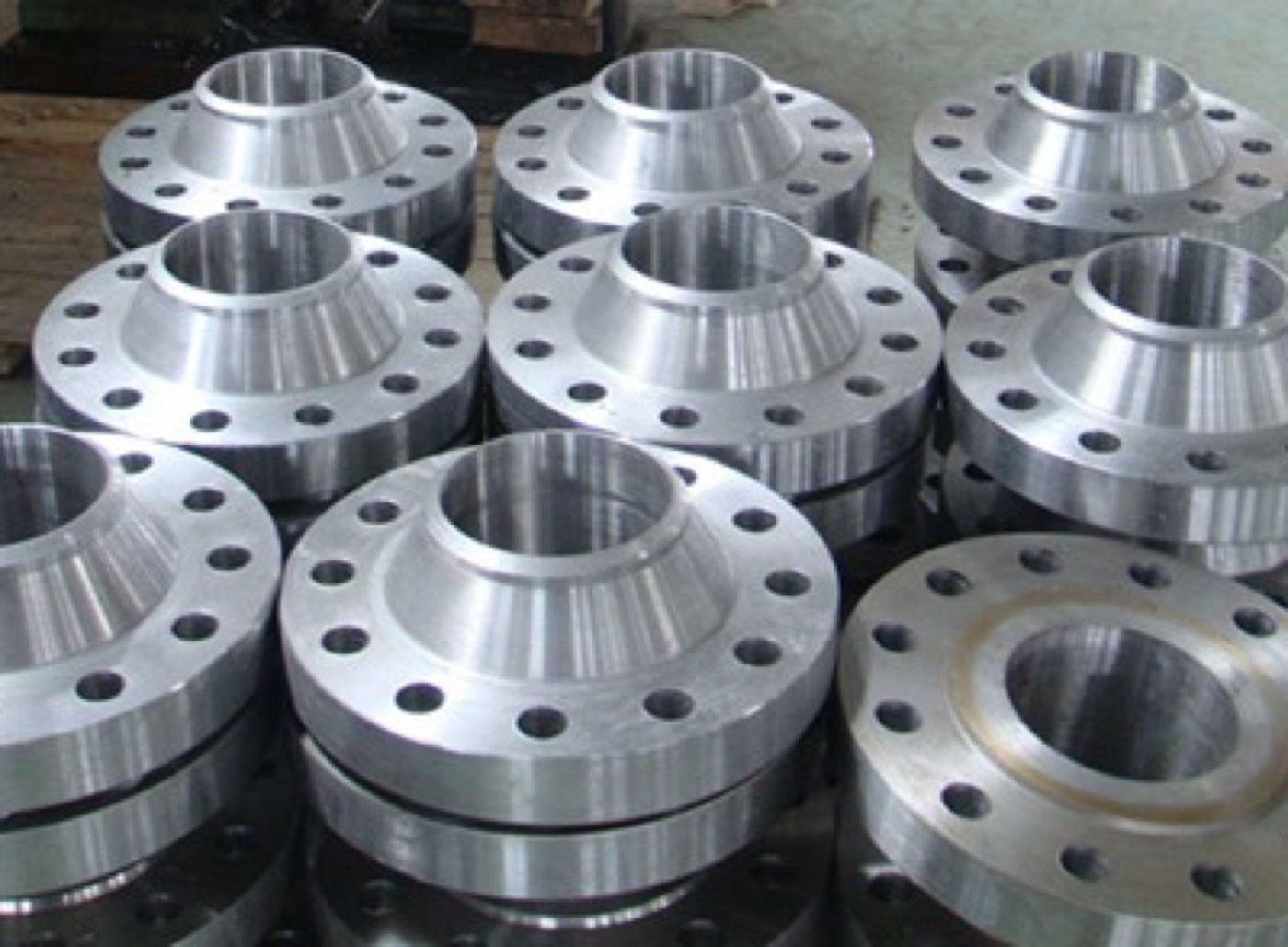
F55 S32760 — The Zeron Type, Machined at Our WorksThe Two-Piece System — Flange, Stub End, Butt Weld, PipeF55 Super Duplex Stock — Ready for Dispatch
F55 Lap Joint Flange Dimensions
Flange dimensions are class-governed per ASME B16.5 — identical in every grade; stub ends per B16.9. Full class-by-class charts:
Seven elements — the twin question matters most on this page:
1
Size & standard — e.g. 6″ NB ASME B16.5.
2
Pressure class — 150#–2500#.
3
The designation as your specification writes it — F55, S32760 or Zeron type; documents naming S32750 or 2507 are asking for F53, the twin.
4
Stub end — A815 S32760 matched pair with schedule and B16.9 type, or ‘flange only’.
5
The water — chloride level, temperature and any acidity confirm the twin's territory; chemistry beyond the summit changes families to the nickel alloys.
6
Certification — EN 10204 3.1 (our standard) / 3.2 witnessed, computed PREN stated, pairs certified together on one document.
Example: “Lap Joint Flange, 8″ NB, ASME B16.5 Class 300, ASTM A182 F55 (UNS S32760), with A815 S32760 stub ends Sch 40S (B16.9 Type A, supplied together), computed PREN on MTC, pairs on one document, EN 10204 3.1 — 12 sets.” Quotations normally within 24 hours with price, unit weights (both parts) and delivery.
F55 Lap Joint Flanges — Frequently Asked Questions
What is an ASTM A182 F55 lap joint flange?
An ASTM A182 F55 lap joint flange is the loose backing flange of the two-piece lap joint system, forged in super duplex S32760 (W.Nr. 1.4501) — the Zeron 100 type: the twin that reaches the 40-PREN summit with deliberate copper and tungsten additions, and the only common duplex grade whose certificate guarantees the pitting number because the specification writes it in. Like every lap joint flange it slides over the pipe, sits free behind the stub end's flared lap, and carries the entire bolt load without touching the line fluid — and because it never welds, it never enters super duplex's phase-balance welding discipline; the joint's single butt weld belongs to the stub end. Manufactured per ASME B16.5 in ½" to 24" NB, Classes 150 to 2500, solution annealed, pickled and passivated, with EN 10204 3.1/3.2 certification stating the computed PREN on every lot.
How does the two-piece lap joint system work?
By splitting sealing from bolting. The stub end butt-welds to the pipe: its flared lap provides the gasket face and does all the fluid contact. The backing flange never welds and never wets: it slides on before the stub end is welded — the classic site lesson — spins freely until the bolts enter, and transmits bolt load through its radiused shoulder onto the back of the lap. On the duplex pages of this bench the pattern's argument runs on chemistry — chlorides only touch what wets — and at the summit the argument sharpens: the duties that justify S32760 are hot, saline, often acidic and usually offshore, and the specifications that govern them almost always put super duplex on both halves of the joint, as the next FAQ explains. The full pattern story — stub end types, the alloy economy, the honest boundaries — is on the lap joint hub page.
Does the backing flange behind an S32760 line need to be super duplex?
Almost always yes — the same match answer the F53 page gives, and doubly so in F55's home waters. The duties that justify the Zeron type — North Sea topsides, firewater deluge, acidified seawater and erosive brine trains — put the ring itself in salt-laden air and deluge water for decades, where coated carbon steel is a maintenance liability and galvanised surfaces are unwelcome near stainless welding; and the UK-heritage piping classes that name S32760 write matched material through the joint, then audit certificates literally. So this page's normal order is F55 backing an A815 S32760 stub end, pairs on one document with the computed PREN stated on both. Where an inland or sheltered specification genuinely takes the pattern's economy door, our A105 page quotes the galvanised carbon steel ring — say so on the enquiry and both options price in a day.
What is the chemical composition of ASTM A182 F55 (UNS S32760)?
Carbon ≤0.030%, manganese ≤1.00%, silicon ≤1.00%, chromium 24.0-26.0%, nickel 6.0-8.0%, molybdenum 3.0-4.0%, nitrogen 0.20-0.30%, copper 0.50-1.00%, tungsten 0.50-1.00%, phosphorus ≤0.030%, sulphur ≤0.010%. Beside F53 the differences tell the design story: molybdenum trimmed to 3-4% and nitrogen to 0.20-0.30 — because tungsten picks up part of the pitting duty — while copper and tungsten appear as deliberate ranged additions rather than residual caps, and sulphur is held at the family's tightest ceiling. Chemistry is verified per heat, the PREN computed and stated, and PMI reads the Cu-W signature that distinguishes F55 from F53 on the shelf.
What are the mechanical properties of F55 lap joint flanges?
In the solution-annealed condition A182 requires tensile strength 750 MPa (109 ksi) minimum, yield strength 550 MPa (80 ksi) minimum and elongation 25% minimum. Two comparisons worth making: the yield matches F53's 550 MPa exactly — the two super duplexes are interchangeable on strength — while the certificate trades a slightly lower tensile floor (750 versus 800) for a notably higher ductility floor (25% versus 15%), a balance many piping engineers quietly prefer in hardware that will be bolted, unbolted and re-bolted across decades of turnarounds — which is precisely a lap joint ring's career. For the backing-flange duty the summit strength carries compact Class 900-1500 joints, exactly as on the F53 page. As across the duplex family, the strength arrives solution-annealed, with no ageing windows or hardness ceilings to manage in supply.
F55 or F53 — what is the difference between the super duplex twins?
Two routes to the same 40-PREN destination — this page is the alloyed route. F53 (S32750, 2507) gets there on chromium, molybdenum and nitrogen alone; F55 (S32760) trims the molybdenum and nitrogen slightly and adds deliberate copper and tungsten at 0.5-1.0% each, claiming extra margin in acidic and erosive seawater conditions. In practice their performance envelopes overlap almost completely, both are solution-annealed, both weld under the same discipline, and the choice is nearly always made by the project specification rather than by metallurgy: North Sea and UK-heritage documents tend to name S32760 — the Zeron 100 lineage — while others write 2507. We forge both — a specification naming either gets exactly that grade and UNS number on the certificate, and F53 has its own lap joint page on this site. On a matched-pair order the twin question applies to both halves: flange and stub end carry the same UNS, stated identically.
Why is PREN guaranteed on an S32760 certificate?
Because the specification writes it in — uniquely among the common duplex grades. For most alloys PREN is something an engineer computes from the chemistry; for S32760 the requirement PREN = %Cr + 3.3×(%Mo + 0.5×%W) + 16×%N ≥ 40 is part of the material standard, so every certified heat must demonstrate the number, not merely imply it. Note the formula itself is the extended version crediting tungsten at half molybdenum's weight — the arithmetic recognition of what the tungsten addition does. For specifiers this is a genuinely useful property: a piping class written around 'PREN ≥40 guaranteed' is naming S32760 whether it says so or not, and our EN 10204 certificates state the computed PREN per heat. On a lap joint order the guarantee travels on both halves — flange and stub end certificates each carry the number.
What makes F55 the 'Zeron 100 type' — what do the copper and tungsten do?
S32760 descends from Zeron 100, the super duplex developed in the UK with two deliberate additions its 2507 twin lacks. Tungsten behaves as molybdenum's heavier cousin in the passive film — it counts in the extended pitting formula and strengthens crevice resistance without accelerating the sigma-phase clock the way extra molybdenum would. Copper buys measurable margin in acidic environments — sulphuric-contaminated seawater, acidified wells, mineral-acid splash — where plain super duplex sits closer to its limit. The result is a grade with its own loyal following: North Sea and UK-heritage offshore specifications name S32760 by habit and history, and duty that combines chlorides with acidity leans toward it on merit. For the lap joint ring the additions matter mostly through the atmosphere it lives in — acid-bearing marine air is exactly where the copper earns its keep on a never-wetted part.
What stub ends pair with F55 lap joint flanges?
The matching stub end is wrought super duplex per ASME B16.9 in ASTM A815 UNS S32760 — the ferritic/austenitic fitting specification serving the duplex family — welded to the pipe with the line's qualified super duplex procedure: matching-composition filler for the Zeron type, a controlled heat-input window tighter than 2205's, and phase balance verified in the weld zone, because at this alloy level intermetallics punish carelessness quickly. That butt weld is the joint's only weld, and it belongs entirely to the stub end: the backing flange never enters the procedure. The matching rules are the pattern's usual dimensional ones — lap OD to the flange's shoulder, schedule to the line bore — plus the twin's documentary one: the same UNS on both certificates, stated identically, computed PREN on each, pairs certified together on one EN 10204 document. Where an order needs B16.9 Type A or Type B lap details, state it and the pair is machined to suit.
Does an F55 backing flange need PWHT or a weld procedure?
No — and at the summit the dodge is worth more than anywhere else on the duplex bench. Welding super duplex is the duplex discipline with narrower margins: the heat-input window is tighter, intermetallic phases form faster at 25% chromium, ferrite balance is checked more jealously, and there is still no thermal escape hatch — stress-relieving heat treatment is never applied, because every reheat courts the embrittlement the grade must avoid. The lap joint backing ring inherits none of this, because it is never welded to anything: no procedure, no ferrite count, no heat-input anxiety — the solution-annealed structure it left the furnace with is the structure it keeps for life. The discipline concentrates on the joint's single butt weld — stub end to pipe, welded once under the line's qualified super duplex procedure. The dodge covers the flange, not the joint — the stub end's weld takes the full discipline, always.
What sizes and pressure classes do F55 lap joint flanges come in?
½" to 24" NB per ASME B16.5 in Classes 150, 300, 400, 600, 900, 1500 and 2500, with larger diameters machined to B16.47 or drawing — the full class-by-class lap joint dimension charts are on this site. The order book mirrors the grade's habitat: seawater and firewater systems concentrate in Classes 150 and 300 at mid and large bore, with injection, hydraulic and process duty running Classes 600 to 1500 where the summit's 550 MPa yield earns compact joints — and the S32760-naming projects tend to specify the certification package as carefully as the metal. Dimensionally an F55 lap joint flange is identical to any other grade's — B16.5 governs by class, not by material. State size, class and the stub-end question together, and our quotation returns price, unit weight and delivery per class.
How much does an F55 lap joint flange weigh?
Exactly what the same-size lap joint flange weighs in any other steel — B16.5 fixes the dimensions by class, and alloy density differences are negligible. Representative Class 150 figures for the flange alone: 1" roughly 0.8 kg, 2" roughly 2 kg, 4" roughly 5.5 kg, 8" roughly 14 kg, climbing steeply with class; the A815 stub end adds its schedule-dependent mass. The commercial difference sits in the metallurgy and the paperwork: F55 carries the super duplex alloy surcharge — with tungsten's contribution priced in — plus solution annealing, per-lot testing and the PREN guarantee's documentation, yet still lands well below the nickel alloys it replaces on hot chloride duty. Our quotations state unit and consignment weights per line item, flange and stub end separately, and the site's flange weight chart carries the full reference tables.
How are your F55 lap joint flanges manufactured?
As the pattern's standard sequence with summit discipline at the heat-treatment and finishing steps. Certified A182 F55 forgings are solution annealed and quenched — the treatment that sets the fifty-fifty structure, run with the care 25% chromium demands, furnace records retained — then machined to B16.5's lap joint dimensions: OD, thickness and bolt circle to class, bore and shoulder turned to suit the stub end's lap, and the shoulder radius dressed to bear evenly on the back of the lap. Chemistry is certified per heat with the PREN computed and stated, and PMI reads the Cu-W signature that distinguishes F55 from F53 on the shelf. The finish is the family's own: pickled and passivated, restoring the passive film over every machined surface — never painted, never galvanised. Heat-number marking transfers at the first operation. No welding is performed on the flange at any stage — the ring keeps its solution-annealed structure for life. Where the order includes A815 S32760 stub ends, the pair is dimensionally matched and certified together on one EN 10204 3.1 document (3.2 witnessed on request). Packed sea-worthy with laps and shoulders protected.
What details are needed to get an accurate F55 lap joint flange quotation?
Seven elements plus commercial terms: (1) size and dimensional standard — e.g. 6" NB ASME B16.5; (2) pressure class — 150 to 2500; (3) the designation as your specification writes it — F55, S32760 or Zeron type; where the document names S32750 or 2507 it is asking for F53, the twin with its own page and its own certificate; (4) the stub end — A815 S32760 matched pair with schedule and B16.9 type, or 'flange only'; (5) the water where it helps — chloride level, temperature and any acidity confirm the twin's territory, and chemistry beyond the summit changes families to the nickel alloys; (6) certification — EN 10204 3.1 (our standard) or 3.2 witnessed, computed PREN stated, pairs certified together on one document; (7) quantity as pairs or pieces, and destination. Quotations normally return within 24 hours with price, unit weights for both parts, and delivery.
Who manufactures ASTM A182 F55 lap joint flanges in India?
Tesco Steel & Engineering is an ISO 9001:2015 certified flange manufacturer based in Mumbai, India, producing ASTM A182 F55 super duplex S32760 (Zeron 100 type) lap joint (lapped joint) flanges per ASME B16.5 from ½" to 24" NB (larger to B16.47 or drawing) in Classes 150-2500 — each machined from certified, solution-annealed S32760 forgings, PMI-checked on the Cu-W signature, the computed PREN stated on every certificate, pickled and passivated, with the shoulder dressed to bear evenly on the lap, heat-number marked, and certified to EN 10204 3.1/3.2. Matched A815 S32760 stub ends per B16.9 are supplied against the same order, pairs certified together on one document. Alongside the complete A182 F55 range — weld neck, slip-on, socket weld, threaded, blind, spectacle blind and long weld neck — the twin F53, the duplex rung F51, and the complete lap joint grade bench. Exported to more than 50 countries.