

TES-LOK ultra high purity (UHP) fittings — electropolished SS 316L metal face-seal (VCR-type), butt-weld, and gland fittings for semiconductor, specialty-gas, analytical, and biopharma systems where gas purity and contamination control are critical. Low-Ra internal finish, cleanroom assembled, double-bagged, and helium leak tested. Up to 8500 PSI (585 bar). Up to 537°C. ISO 9001:2015 certified. Made in India.
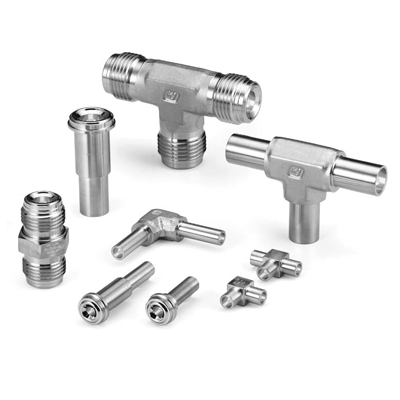
TES-LOK Ultra High Purity Fittings
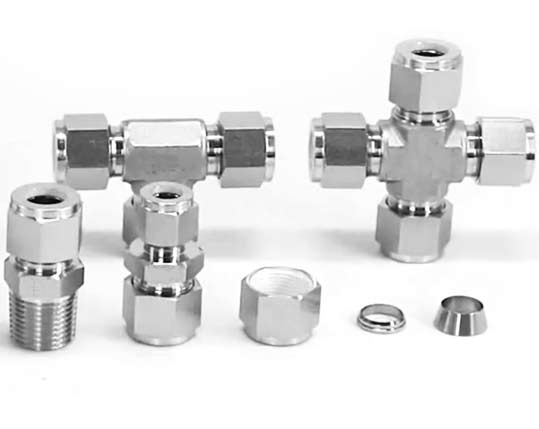
Instrumentation Tube Fittings
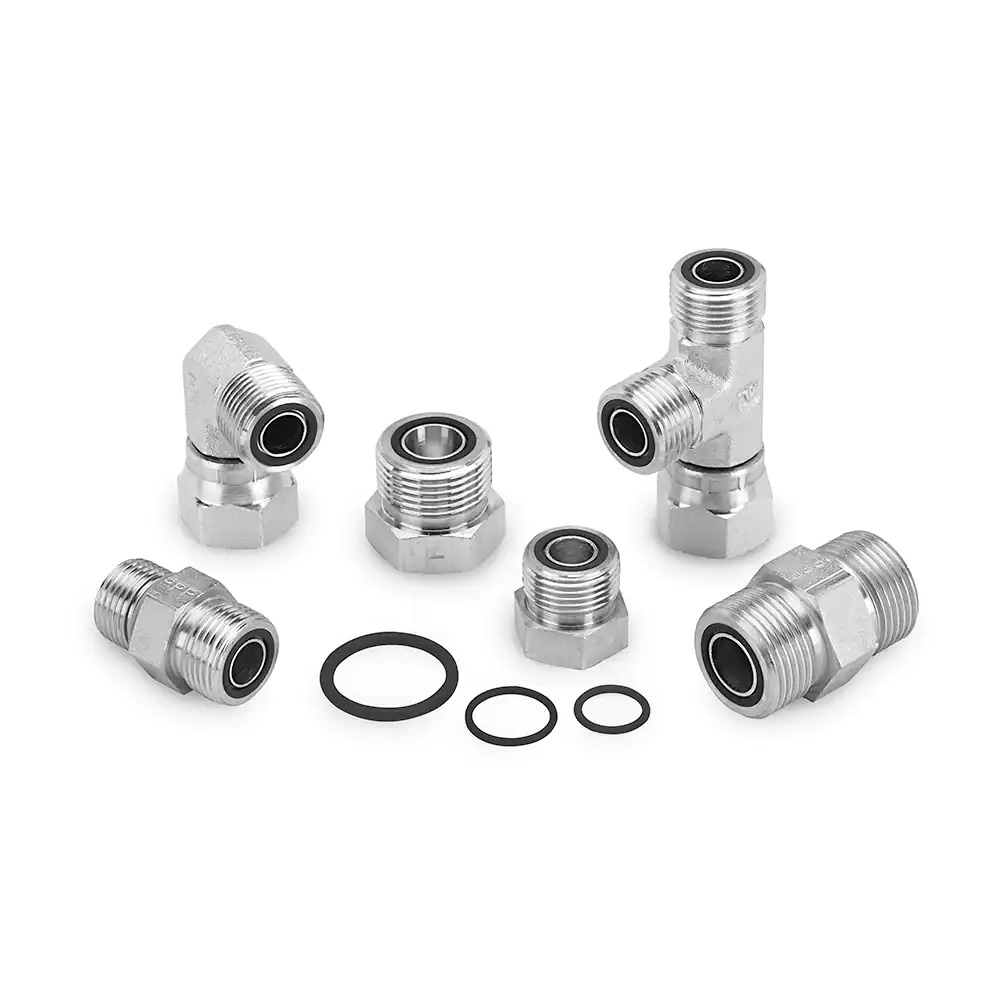
Face Seal Fittings (Related)
Unlike general instrument tube fittings, UHP fittings are defined as much by their surface finish, cleanliness, and leak integrity as by their mechanical form. Electropolishing removes the rough, contaminant-trapping surface left by machining, leaving a bright, passive chromium-rich layer that resists corrosion, minimises outgassing and moisture adsorption, and prevents particle generation in the flowing gas.
| Characteristic | UHP Requirement | Why It Matters |
|---|---|---|
| Material | SS 316L (low carbon), often VIM-VAR / high-purity melt | Clean, weldable, corrosion-resistant, low inclusions |
| Internal surface finish | Electropolished, low Ra (e.g. ~5–10 µin / 0.13–0.25 µm) | Smooth surface minimises particle traps, outgassing & moisture hold-up |
| Seal type | Metal face seal (VCR-type) or orbital butt weld | No elastomer to outgas, permeate, or shed particles |
| Cleanliness | Cleanroom cleaned & assembled, particle & hydrocarbon controlled | Prevents contamination of the ultra-clean gas path |
| Leak integrity | Helium leak tested to very low leak rates | Keeps atmosphere and moisture out of the gas stream |
| Packaging | Double-bagged in a cleanroom | Maintains cleanliness from factory to point of install |
| Criterion | Ultra High Purity (UHP) | Standard Instrument Fitting |
|---|---|---|
| Material | Electropolished SS 316L, high-purity melt | SS 316 / 304 standard finish |
| Internal finish | Low Ra, electropolished | As-machined / passivated |
| Seal | Metal face seal (VCR) / orbital weld | Twin-ferrule on tube OD |
| Cleanliness | Cleanroom, particle/moisture/HC controlled | Industrial clean |
| Leak testing | Helium leak tested (very low rate) | Pressure / functional test |
| Best for | Semiconductor, specialty gas, analytical, biopharma | General instrumentation & process |
| Type | Connection | Use |
|---|---|---|
| Metal Face Seal (VCR-Type) | Two glands + metal gasket, clamped by a nut | Leak-tight, serviceable UHP gas connections; the UHP workhorse |
| Orbital Butt Weld | Auto-orbital welded tube-to-fitting | Permanent, ultra-clean welded gas lines (no joint crevice) |
| UHP Tube Stub / Weld End | Pre-cleaned weld stub on connectors, elbows, tees | Building welded UHP distribution networks |
| Gland & Nut Sets | Male / female glands and gland nuts | Make-up and spares for face-seal connections |
| Shapes | Unions, elbows, tees, crosses, reducers, caps | Routing and branching UHP gas lines |
| Adapters | VCR-to-tube, VCR-to-thread (where permitted) | Interfacing UHP lines with components |
| Parameter | Details |
|---|---|
| Brand | TES-LOK (Tesco Steel & Engineering) |
| Type | UHP electropolished metal face-seal & orbital-weld fittings |
| Tube OD Range | 1/8" to 1" (and metric) — common UHP gas sizes; other sizes on request |
| Working Pressure | Up to 8500 PSI (585 bar) — size and configuration dependent |
| Working Temperature | Up to 537°C (1000°F) — configuration dependent |
| Material | SS 316 / 316L electropolished (high-purity melt); special alloys on request |
| Internal Finish | Electropolished, low Ra (typ. ~5–10 µin / 0.13–0.25 µm) |
| Seal | Metal-to-metal face seal (VCR-type gasket) or orbital butt weld |
| Cleanliness | Cleanroom cleaned & assembled; helium leak tested; double-bagged |
| Certifications | ISO 9001:2015 | EN 10204 3.1 MTC | surface-finish & leak-test reports on request |
Electropolishing leaves a bright, smooth, chromium-rich internal surface (low Ra) that resists corrosion, minimises outgassing and moisture adsorption, and prevents particle shedding into the gas stream — the foundation of UHP performance.
VCR-type metal-to-metal gasket seals (and orbital welds) eliminate the elastomer O-rings that outgas, permeate, and shed particles — delivering leak-tight, contamination-free connections for critical gases.
Fittings are cleaned and assembled under cleanroom conditions with particle, moisture, and hydrocarbon control, then double-bagged so the as-supplied cleanliness reaches the point of installation.
UHP fittings are helium leak tested to very low leak rates, ensuring atmosphere and moisture cannot ingress into the high-purity gas path — essential for process yield and gas integrity.
Weld-end and tube-stub fittings are prepared for automatic orbital welding, enabling permanent, crevice-free, ultra-clean welded gas distribution networks.
EN 10204 3.1 material test certificates, surface-finish (Ra) records, and helium leak-test reports available on request — the traceability required by semiconductor and biopharma QA.
| Industry | Typical Use Point | Why UHP Fittings |
|---|---|---|
| Semiconductor | Process & bulk specialty-gas distribution, gas cabinets, VMBs, tool hook-ups | Electropolished, particle/moisture-free, leak-tight gas delivery |
| Specialty & Electronic Gases | High-purity gas panels, cylinder manifolds, purifiers | Metal face seal — no elastomer contamination of pure gas |
| Analytical Instruments | GC / MS carrier and calibration gas lines | Low outgassing & leak-tightness for accurate analysis |
| Biopharmaceutical | High-purity gas and clean-process connections | Cleanroom-clean, traceable, crevice-free joints |
| Solar / Photovoltaic | Process gas delivery in cell manufacturing | UHP gas integrity for thin-film and cell processes |
| Research & Laboratories | UHV-adjacent and high-purity gas systems | Low leak / low outgassing connections |
| Fibre Optics & LED | Deposition and process-gas lines | Contamination-free delivery for sensitive processes |
| Hydrogen & Fuel Cell | High-purity hydrogen handling and test systems | Leak-tight metal seals for clean H₂ service |
Q1. What is an ultra high purity (UHP) fitting?
A UHP fitting is a gas-line fitting made, finished, and packaged to the cleanliness required by semiconductor, specialty-gas, analytical, and biopharma systems. It is made from electropolished SS 316L with a smooth low-Ra internal surface, seals by a metal face seal (VCR-type) or orbital weld rather than an elastomer, and is cleanroom assembled, helium leak tested, and double-bagged so it delivers gas with no added contamination.
Q2. How is a UHP fitting different from a standard instrument tube fitting?
A standard instrument fitting grips tube with twin ferrules and has an as-machined or passivated surface. A UHP fitting is electropolished to a low-Ra finish, seals with a metal face seal or orbital weld (no elastomer), is cleaned and assembled in a cleanroom, and is helium leak tested. UHP is defined by surface finish, cleanliness, and leak integrity as much as by mechanical form.
Q3. Why are UHP fittings electropolished?
Electropolishing removes the rough, microscopically jagged surface left by machining and forms a bright, smooth, chromium-rich passive layer. This low-Ra surface minimises particle traps, reduces outgassing and moisture adsorption, improves corrosion resistance, and prevents the fitting from shedding particles into the high-purity gas — all essential for UHP performance.
Q4. What is a metal face seal (VCR-type) fitting?
A metal face-seal fitting uses two glands with raised beads and a metal gasket clamped between them by a nut. The beads deform the gasket to form a metal-to-metal seal — with no elastomer to outgas, permeate, or shed particles. It is leak-tight, high-purity, and serviceable, which is why the VCR-type face seal is the workhorse UHP connection.
Q5. Can metal face-seal gaskets be reused?
No. The gland beads deform the metal gasket to make the seal, so a used gasket is permanently set and will not reliably reseal. Always fit a new gasket on every assembly, handle it only with clean tools/gloves, and never touch the sealing faces. Reusing a gasket risks leaks and contamination.
Q6. What surface finish (Ra) do you provide?
UHP fittings are supplied electropolished to a low internal Ra — typically around 5–10 µin (0.13–0.25 µm), with finer finishes available for the most demanding semiconductor applications. Surface-finish (Ra) measurement records can be provided on request as part of the documentation package.
Q7. Are UHP fittings helium leak tested?
Yes. UHP fittings are helium leak tested to very low leak rates to guarantee that atmosphere and moisture cannot ingress into the high-purity gas path. Helium leak-test reports are available on request, along with EN 10204 3.1 material certificates and surface-finish records.
Q8. How should UHP fittings be handled to keep their purity?
Keep fittings double-bagged until use, open them only in the cleanest available environment (ideally a cleanroom or purge box), handle with clean lint-free gloves, never touch sealing faces, use new gaskets, and assemble with clean tube and tools following UHP procedures (purge, particle control). Contaminating a UHP fitting on site defeats the cleanliness built in at the factory.