LWNRF Flanges — Long Weld Neck Raised Face (RFLWN) Flange Manufacturer
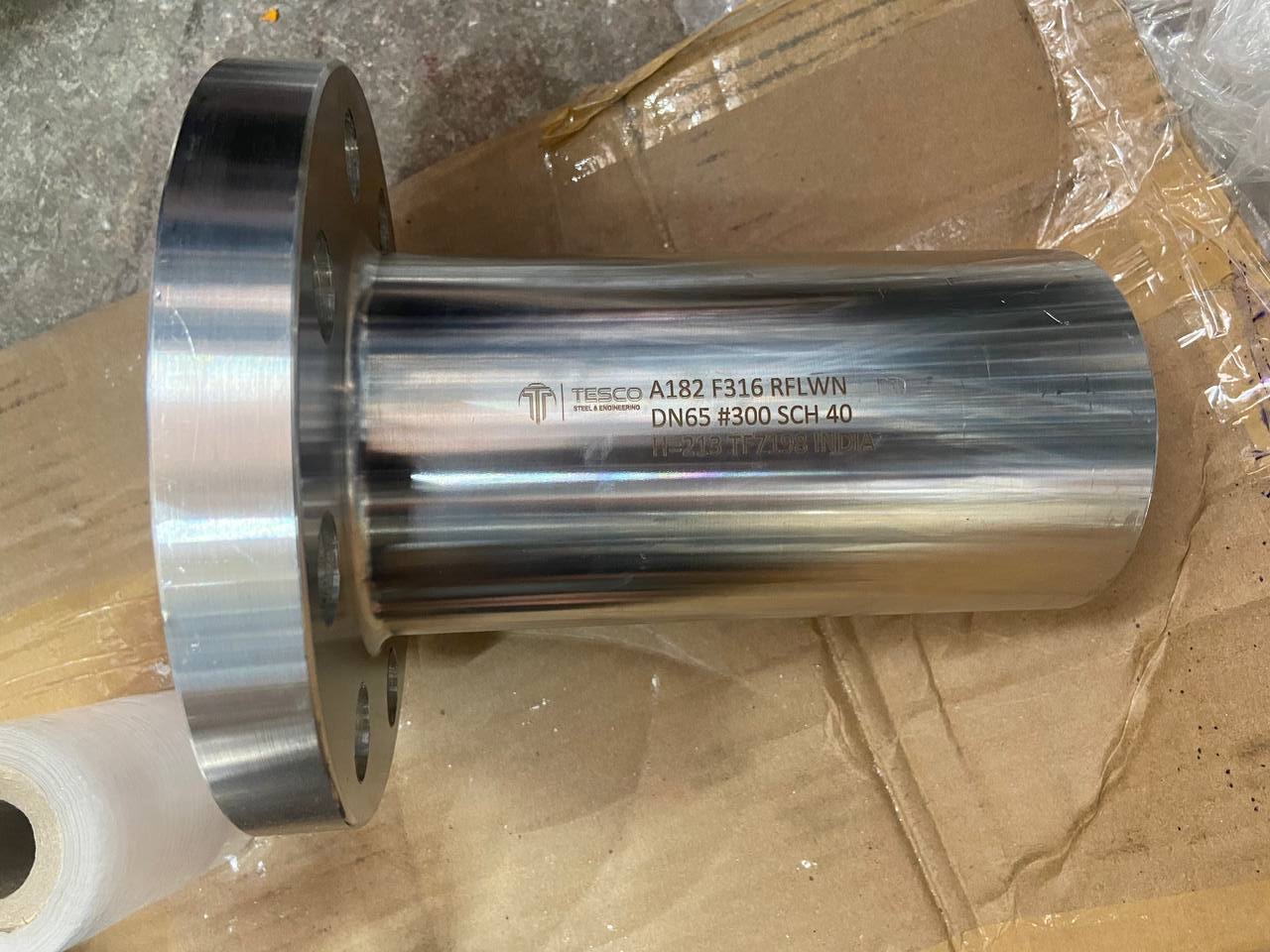
Tesco Steel & Engineering manufactures LWNRF flanges — Long Weld Neck Raised Face, written RFLWN in facing-first piping classes — with ASME B16.5 flange ends in Classes 150–2500 and the barrel made to order. This is the flange and the nozzle in one forging: instead of tapering to meet a pipe, the neck continues as a long, heavy-walled straight barrel that replaces the pipe nipple and its butt weld — one certificate, one closing weld, made out at the shell where the fabricator wants it. That is why pressure-vessel, exchanger and boiler nozzles are its home ground. Available in standard, heavy-barrel (HB) and equal-barrel patterns, barrel lengths 150/230/300 mm from stock and any length machined, bores matched to schedule — the laser-marked A182 F316 RFLWN DN65 #300 Sch 40 unit pictured is our production. Full material range from A105 and A350 LF2 through stainless, duplex and the nickel bench. Flat-face mate? LWNFF. Ring joint? LWNRTJ. Every lot with EN 10204 3.1/3.2 MTC. ISO 9001:2015, made in Mumbai, India — exported to 50+ countries.
Long Weld Neck × Raised FaceThe Flange + The Nozzle, One ForgingB16.5 Flange Ends · Class 150–2500Barrel: Length & Bore to OrderStandard · Heavy Barrel · Equal BarrelOne Closing Weld — At the ShellA105 · LF2 · SS · Duplex · Ni-AlloysEN 10204 3.1 / 3.2 · ISO 9001:2015
The flange and the nozzle in one forging. LWNRF — also written RFLWN — = Long Weld Neck Raised Face: instead of tapering to a pipe end, the neck continues as a long, heavy-walled straight barrel whose far end is bevelled for one closing butt weld, made out at the vessel shell or header. It replaces the weld neck + pipe nipple + extra circumferential weld of a built-up nozzle: one certificate, one weld to examine, integral metal where reinforcement calculations want it. Flange end — OD, drilling, raised face, ratings — is pure ASME B16.5, Classes 150–2500; barrel length and bore are yours to state. EN 10204 3.1 on every lot.
Also searched as: long welding neck flange, LWN RF flange, RFLWN flange, nozzle neck flange, vessel nozzle flange — all the same product. Related pages: LWNFF (flat face) / LWNRTJ (ring joint) siblings, the long weld neck hub, the standard WNRF weld neck it extends, flange-o-lets for the couplet alternative, and self-reinforced nozzle flanges beyond it.
LWNRF Flange Specifications
LWNRF (Long Weld Neck Raised Face) Flanges are available in the following specifications:
Type / Facing
Long weld neck flange with raised face — 1/16″ (1.6 mm) on Class 150/300, 1/4″ (6.4 mm) on Class 400+; serrated stock finish Ra 3.2–6.3 µm
Construction
Integral heavy-walled straight barrel, bevelled weld end (37.5° standard) — one closing butt weld at the shell, no pipe nipple
Flange End
OD, drilling, facing and P-T ratings per ASME B16.5; EN 1092-1 drilling to order
Size
1/2"NB to 24"NB per B16.5; larger to order per B16.47 or drawing
Class
150#, 300#, 400#, 600#, 900#, 1500#, 2500#
Barrel
Length overall to order — 150 / 230 / 300 mm common stock; bore to pipe schedule ID or special; standard, heavy-barrel (HB) and equal-barrel patterns
Spiral wound (B16.20), CNAF / PTFE / graphite sheet (B16.21), camprofile on hot exchanger nozzles
Modifications
Special bores (level bridles, standpipes), non-standard bevels, tapped holes, galvanizing / epoxy on carbon steel
Testing
Chemistry & mechanicals per heat; barrel bore and length gauged piece by piece; PMI on alloy grades
Certification
EN 10204 3.1 (standard) / 3.2 witnessed; NACE MR0175 where specified
Why Vessel Nozzles Specify the LWN
Three Parts Become One
Weld neck + pipe nipple + circumferential weld collapse into one certified forging — one heat number, one document trail, one weld to examine instead of two.
The Weld Moves to the Shell
The closing butt weld happens where the fabricator wants it — at the vessel or header — not at a fiddly nipple-to-flange joint; NDE counts drop with it.
Metal Where the Code Wants It
The heavy integral barrel puts section exactly where nozzle loads and opening-reinforcement calculations ask for it — the heavy-barrel pattern is area replacement in forged form.
Bridges What Pipe Cannot
Through thick insulation, tubesheets and channel covers the barrel runs clean and straight — and with each piece forged individually, odd lengths, bores and exotic grades carry no pattern penalty.
Specification Notes — Getting Long Weld Necks Right
Three honest notes.“Long” is not a dimension: the barrel length (face to weld end) and the bore (schedule or millimetres) must be stated on the enquiry — the flange end is B16.5's business, the barrel is yours. On a plain piping run the LWN is the wrong buy: a standard weld neck plus the pipe you already own is lighter and cheaper — the LWN's case is the nozzle, not the run. And very long projections deserve a two-way cost check: beyond roughly 300–400 mm of barrel, forged weight competes with a welded nipple — our quotation will show both routes when it is close, and the flange-o-let covers the light-duty couplet case.
How Our LWNRF Flanges Are Manufactured
1
Forging — each piece individually forged from the certified heat with the barrel integral — no welded build-ups — in every grade from A105 to the nickel alloys.
2
Heat treatment — normalised, quenched-and-tempered or solution annealed per the material specification; furnace records retained.
3
Machining — flange end to ASME B16.5; barrel turned to pattern (standard / HB / equal) and bored to the ordered schedule or drawing, length gauged face-to-weld-end.
4
Facing & bevelling — raised face turned with the serrated stock finish; weld end bevelled 37.5° (or per drawing) for the closing butt weld.
5
Testing & marking — chemistry and mechanicals per heat, PMI on alloy grades; laser-marked with grade, size, class, schedule and heat number — as on the pictured DN65 unit.
6
Certification & packing — EN 10204 3.1 MTC (3.2 witnessed on request); faces and bevels protected, packed sea-worthy.
Where LWNRF Flanges Are Used
Wherever a nozzle is being built rather than a pipe joined: pressure-vessel and column nozzles, heat-exchanger channel and shell connections, boiler and steam-drum nozzles, reactor instrument standpipes, level-bridle and gauge connections, manway-adjacent hardware and thick-insulation penetrations — across refineries, petrochemical plants, power stations and process skids. Production below:
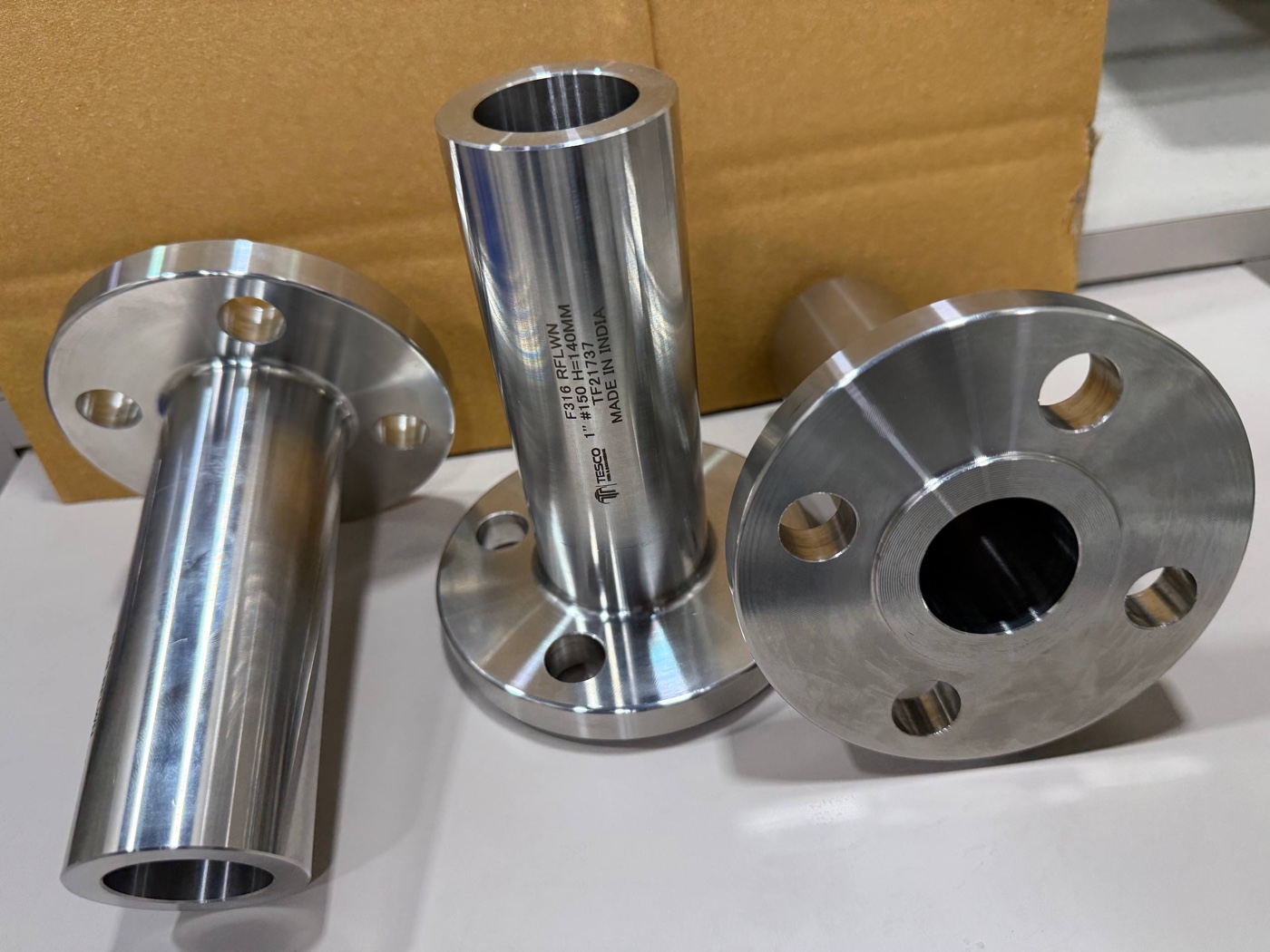
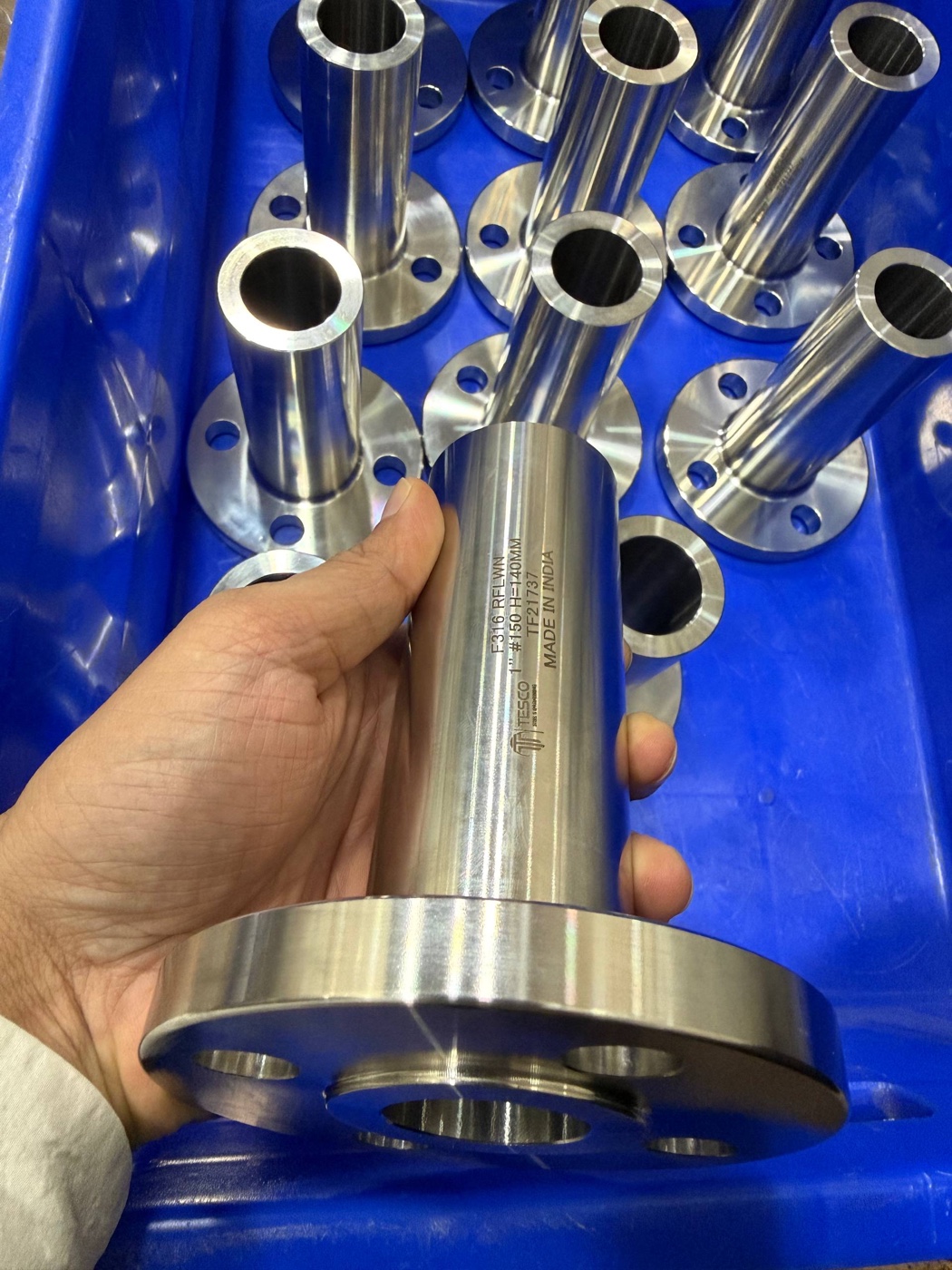
Tesco LWNRF — F316, DN65 × #300 — Laser-MarkedLong Weld Neck Flanges — Straight-Barrel BatchHeavy-Barrel LWN — Palletised for ExportF316 RFLWN Trio — 1″ #150, H=140 mm, Heat TF21737One in the Hand, a Bin Behind It — the Same Heat, Piece After Piece
LWNRF Flange Dimensions
Flange-end dimensions are class-governed per ASME B16.5; barrel length and bore per order. Full class-by-class charts:
Six elements — the barrel numbers are the ones estimators forget. Write LWNRF or RFLWN as your piping class prefers; both reach the same forging:
1
Size & standard — e.g. DN65 / 2½″ NB ASME B16.5.
2
Pressure class — 150#–2500#.
3
Barrel length — overall, face to weld end: 150 / 230 / 300 mm stock or any stated length.
4
Barrel bore & pattern — pipe schedule to match (e.g. Sch 40) or finished bore in mm; standard, heavy barrel or equal barrel; weld-end prep if non-standard.
5
Material & certification — e.g. ASTM A105, A350 LF2, A182 F316; coating for carbon steel; EN 10204 3.1 (our standard) / 3.2, PMI, NACE MR0175 as applicable.
Example — the pictured unit's own order line: “RFLWN Flange, DN65, ASME B16.5 Class 300, barrel 230 mm, Sch 40 bore, ASTM A182 F316, EN 10204 3.1 — 6 pcs, exchanger channel nozzles.” Quotations normally within 24 hours with price, unit weight and delivery.
LWNRF Flanges — Frequently Asked Questions
What is a LWNRF flange?
LWNRF stands for Long Weld Neck Raised Face — a weld neck flange whose neck, instead of tapering down to match a pipe end, is extended into a long, heavy-walled straight barrel that is itself the nozzle. The flange end carries standard ASME B16.5 dimensions, drilling and the raised face; the barrel runs at essentially constant outside diameter to whatever length the connection needs, and its far end is bevelled for the single closing butt weld — made out at the vessel shell, exchanger channel or header, not at the flange. In one certified forging it replaces the usual assembly of weld neck flange plus pipe nipple plus an extra circumferential weld, which is why pressure-vessel and heat-exchanger nozzles are its home ground.
How does a long weld neck differ from a standard weld neck flange?
Geometry and mission. A standard weld neck's hub tapers quickly down to the pipe's outside diameter and wall, ending in a weld bevel a few centimetres from the flange face — it is designed to butt-weld to pipe and continue as a piping run. A long weld neck keeps a full-section straight barrel for its entire length: no taper to pipe dimensions, wall far heavier than the matching schedule, length made to order. The mission follows the shape — the LWN is not a fitting on a pipe run but a nozzle in its own right, projecting through insulation, vessel walls or exchanger channels, with the butt weld relocated to the shell side where the fabricator wants it. Flange-end ratings are shared; everything from the hub outward is a different animal.
Why do vessel and exchanger designers specify LWN nozzles?
Because every part-count reduction on a pressure vessel pays three times. Built the old way, a nozzle is a weld neck flange, a pipe nipple, and two butt welds — each weld needing preparation, welding, NDE and a line on the inspection record. A long weld neck collapses that into one forging with a single closing weld at the shell: one certificate instead of two materials, one weld to examine instead of two, no nipple-to-flange fit-up, and a heavy integral barrel exactly where nozzle loads and reinforcement calculations want metal. On exchangers and boilers the barrel also bridges tubesheets, channel covers and thick insulation cleanly. The forging costs more than a flange plus nipple; the finished, examined, documented nozzle almost always costs less.
What does the raised face on a LWNRF flange do?
Exactly what it does on every raised-face flange: it concentrates the bolt load onto a reduced gasket area, so standard spiral wound and sheet gaskets seal reliably. Per ASME B16.5 the ring stands 1/16" (1.6 mm) proud on Class 150 and 300, and 1/4" (6.4 mm) on Class 400 and above — with the usual take-off note that published thicknesses include the small face but exclude the large one. The face carries the serrated stock finish of Ra 3.2-6.3 µm that grips the gasket. Vessel nozzles overwhelmingly specify RF; where the mating equipment is flat-faced the LWNFF pattern applies, and high-pressure ring-joint work goes to LWNRTJ — both have their own pages here.
How are the barrel length and bore of a LWN specified?
Two numbers that belong on every enquiry. Length: measured overall from the flange face to the weld end — 150 mm (6"), 230 mm (9") and 300 mm (12") are the common stock lengths, and any length machines to order; state it explicitly, because 'long' is not a dimension. Bore: the barrel is drilled and bored to order — most commonly to match the inside diameter of the connecting pipe schedule (the pictured F316 unit is bored Sch 40 for DN65), sometimes cylindrical special bores for level bridles, instrument standpipes or restriction work; state the schedule or the finished bore in millimetres. Add the weld-end preparation (standard 37.5° bevel unless told otherwise) and the nozzle is fully defined.
What are standard, heavy-barrel and equal-barrel LWN flanges?
Three barrel weights for three duties. The standard LWN carries a barrel a little heavier than the matching pipe — the general-purpose vessel nozzle. The heavy-barrel (HB) pattern thickens the wall substantially — often approaching the hub section for its full length — for high-pressure nozzles, heavy nozzle loads and reinforcement-limited openings, where the extra metal does the area-replacement work the code asks of a vessel opening. The equal-barrel pattern keeps the barrel outside diameter equal to the hub for a clean cylindrical profile — favoured on manway and instrument connections. All three share B16.5 flange ends; the barrel section is the variable, and the design calculation or the equipment drawing normally decides which is wanted.
Is the LWNRF flange covered by ASME B16.5?
Half of it, honestly. The flange end — outside diameter, bolt circle and drilling, raised face, thickness at the flange, and the pressure-temperature ratings — follows ASME B16.5 for its class and material group, which is what makes an LWN bolt interchangeably against any standard B16.5 mate. The barrel — its length, wall and bore — is not a B16.5 dimension: it is defined by the purchaser's drawing or by long-standing manufacturer standards for stock patterns. That split is normal and universal in the trade; it simply means an LWN enquiry needs the barrel numbers stated rather than implied. Our class-by-class LWN dimension charts cover the standardised flange ends from Class 150 to 2500, and every quotation confirms the barrel dimensions being priced.
Is LWNRF the same as RFLWN?
Yes — LWNRF, RFLWN, LWN RF and 'long weld neck raised face' all name the same flange, abbreviated type-first or facing-first exactly as SWRF/RFSW are on the socket weld side. Piping classes, vessel data sheets and marking practices differ between companies and regions, and the marking follows the paper: the DN65 Class 300 unit pictured on this page is laser-marked RFLWN because that is how the order wrote it. Write whichever form your specification uses — the product, the certificate and the price are identical.
What materials are LWNRF flanges available in?
The complete industrial range, because nozzles must match their vessels: carbon steel ASTM A105 (the volume standard), LTCS A350 LF2 for low temperature, stainless ASTM A182 F304/L, F316/L — the pictured DN65 Class 300 unit is F316 from our production — F321, F347, F310, F904L, duplex and super duplex F51/F53/F55, chrome-moly F5-F91 for fired equipment, and the full nickel bench: Monel 400, Inconel 600/601/625, Incoloy 800/800H/825, Hastelloy C-276/C-22 and titanium. Long weld necks are forged individually, so odd sizes, heavy barrels and exotic grades carry no pattern penalty — the billet simply follows the certificate. All grades ship with EN 10204 3.1 or 3.2 and PMI where specified.
Which gasket is used with a LWNRF flange?
Any standard raised-face ring gasket for its size and class — the flange end is pure B16.5, so gasket selection is identical to a weld neck of the same rating: spiral wound with centering ring per ASME B16.20 as the process default, CNAF, PTFE or graphite sheet per B16.21 for milder duty, and camprofile or corrugated-metal systems on large hot exchanger nozzles where flange rotation and thermal cycling punish plain spirals. Nozzle joints are often the plant's most thermally-cycled flanges, so on hot equipment the gasket maker's torque card deserves the respect it asks for. Flat-face and ring-joint variants are the LWNFF and LWNRTJ pages' territory.
When is a long weld neck the wrong choice?
Three honest cases. On a piping run: if the flange simply joins pipe to pipe, a standard weld neck plus the pipe you already own is lighter and cheaper — the LWN's value begins only where a nozzle or standpipe is being built. On very long projections: barrels beyond roughly 300-400 mm cost forging weight that a welded pipe nipple provides cheaply, so extreme lengths deserve a cost comparison in both constructions. And on weight-critical small connections where a forged couplet — a flange-o-let welded to the shell — does the same job with less metal; our flangeolet page covers that alternative. Inside its envelope — vessel, exchanger, boiler and instrument nozzles at ordinary lengths — the one-forging argument usually wins, and our quotation will show both routes when it is close.
What sizes and pressure classes do LWNRF flanges come in?
Flange ends follow ASME B16.5 from ½" to 24" NB in Classes 150, 300, 400, 600, 900, 1500 and 2500 — with the full class-by-class dimension charts on this site — and larger diameters are forged to order against B16.47 or drawing dimensions. Small-bore LWNs (½"-2") dominate instrument, level-bridle and sample connections; the middle sizes serve process nozzles; heavy-barrel patterns populate the upper classes on high-pressure equipment. European drilling to EN 1092-1 is machined to order on the same barrels. State size, class, barrel length and bore together — the four numbers define the forging — and our quotation returns price, unit weight and delivery per class.
What details are needed to get an accurate LWNRF flange quotation?
Six elements plus commercial terms: (1) size and dimensional standard — e.g. DN65 / 2½" NB ASME B16.5; (2) pressure class — 150 to 2500; (3) barrel length overall, face to weld end — 150/230/300 mm stock or any stated length; (4) barrel bore — pipe schedule to be matched (e.g. Sch 40) or finished bore in millimetres, with weld-end preparation if non-standard; (5) material grade and pattern — e.g. ASTM A182 F316, standard or heavy barrel — with coating stated for carbon steel; (6) certification — EN 10204 3.1 (our standard) or 3.2, PMI, NACE MR0175 where applicable. Add quantity and destination; the pictured DN65 unit's order line read simply: A182 F316 RFLWN, DN65, Class 300, Sch 40 bore. Quotations normally within 24 hours.
Who manufactures LWNRF flanges in India?
Tesco Steel & Engineering is an ISO 9001:2015 certified flange manufacturer based in Mumbai, India, producing long weld neck raised face flanges with B16.5 flange ends from ½" to 24" NB (larger to order) in Classes 150-2500, in standard, heavy-barrel and equal-barrel patterns — each forged individually from certified heats, heat treated per the material specification, machined with the barrel bored to the ordered schedule or drawing, bevelled for the closing weld, and laser-marked with grade, size, class, schedule and heat number — the A182 F316 RFLWN DN65 Class 300 Sch 40 unit pictured on this page is our production. Supplied with EN 10204 3.1/3.2 certification alongside the LWNFF and LWNRTJ facing siblings and the complete weld neck range. Exported to more than 50 countries.