

Tesco Steel & Engineering manufactures orifice flanges — pairs of flanges fitted with pressure tappings and jack screws that hold an orifice plate in the line for differential-pressure flow measurement. The orifice plate restricts the flow; the pressure difference across it (read through the flange taps) gives the flow rate. Supplied as orifice flange unions (weld-neck, slip-on, or threaded) to ASME B16.36. A105, SS 304, 316, 321, Monel, Inconel, and Incoloy. Class 150 to 2500 and PN6 to PN400. ISO 9001:2015 certified. Made in India.
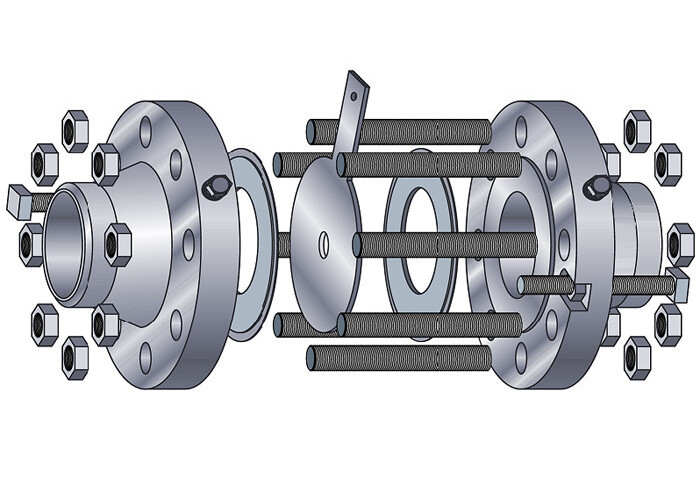
Orifice Flange Assembly (Union)
Orifice flange metering is the standard method for measuring gas, steam, and liquid flow in process plants and pipelines. Tesco Steel & Engineering supplies orifice flanges and complete unions with the matching orifice plates, dimensioned per the same standards as our weld neck and other flanges — see the flange dimensions charts.

Orifice Plates (Concentric / Eccentric / Segmental)
| Tapping Type | Tap Location | Notes |
|---|---|---|
| Flange Taps | 1 inch each side of the plate, in the flanges | Most common; taps built into the orifice flanges |
| Corner Taps | At the plate faces (corner) | Used on smaller bores & some standards |
| D & D/2 (radius) Taps | 1 pipe-dia up / half-dia down | In the adjacent pipe, for specific metering |
Orifice flanges normally carry flange taps drilled 1" from each plate face. The tapping standard is chosen to match the flow-calculation basis (e.g. ISO 5167 / AGA).
| Type | Description | Use |
|---|---|---|
| Weld Neck Orifice | Tapered hub butt-welded to pipe | Most common; higher pressure & accurate bore alignment |
| Slip-On Orifice | Slips over pipe, fillet-welded | Lower-pressure lines, easier fit |
| Threaded Orifice | Screwed onto threaded pipe | Small-bore, no-weld lines |
| Parameter | Details |
|---|---|
| Product | Orifice flanges / orifice flange unions (with pressure taps & jack screws) |
| Types | Weld neck, slip-on, threaded orifice flanges |
| Standard | ASME B16.36 (orifice flanges); ASME B16.5 dims; ISO 5167 metering |
| Pressure Class | 150, 300, 600, 900, 1500, 2500 lbs; PN6–PN400 |
| Pressure Tappings | Flange taps (1"), corner, or D & D/2 — to the metering standard |
| Hardware | Jack screws, bolting, gaskets; supplied as complete unions on request |
| Facing | RF (raised face), RTJ on request |
| Size | 1" to 24" and larger |
| Material | A105 carbon steel, SS 304/316/321, Monel, Inconel, Incoloy, special alloys |
| Certifications | ISO 9001:2015 | EN 10204 3.1 MTC on request |
| Material | Properties | Typical Use |
|---|---|---|
| A105 Carbon Steel | Strong, economical | Non-corrosive gas, steam & liquid lines |
| SS 304 / 316 / 316L | Good corrosion resistance | Process, chemical & hygienic metering |
| SS 321 | Stabilised for high temperature | High-temperature steam & gas lines |
| Monel 400 | Excellent in HF & marine media | HF, seawater & reducing media |
| Inconel / Incoloy | High-temperature & corrosion resistance | High-temperature & corrosive flows |
Precisely machined tappings and bores give reliable differential-pressure flow measurement to ASME B16.36 / ISO 5167.
Built-in jack screws spread the flanges so the orifice plate can be changed quickly without disturbing the spool.
Supplied as ready-to-install orifice flange unions — flanges, taps, jack screws, bolting, gaskets, and matching orifice plate.
A105, SS 304/316/321, Monel, Inconel, and Incoloy for gas, steam, and corrosive or high-temperature flows.
The full pressure-class range, with RF or RTJ facings, for low-pressure utility lines through to high-pressure metering runs.
Manufactured to ASME B16.36 and the chosen metering standard, or to your specification, with EN 10204 3.1 MTC.
| Industry | Typical Use | Why Orifice Flanges |
|---|---|---|
| Oil & Gas | Gas & liquid custody/flow metering | Standard, robust DP metering |
| Refinery & Petrochemical | Process flow measurement | Full material range; B16.36 |
| Power Generation | Steam & feed-water flow | SS 321 high-temperature taps |
| Chemical Plants | Corrosive-media flow metering | Monel / Inconel / Incoloy |
| Gas Distribution | Pipeline gas measurement | High-class metering runs |
| Water & Utilities | Water & utility flow | Economical carbon steel |
| Fertilizer & Process | Plant flow monitoring | Accurate, serviceable metering |
| Marine & Offshore | Topside flow measurement | SS / alloy corrosion resistance |
Q1. What are orifice flanges?
Orifice flanges are a pair of flanges with pressure tappings and jack screws that hold an orifice plate in a pipeline for differential-pressure flow measurement. The plate restricts the flow, and the pressure difference across it — read through the flange taps — is proportional to the flow rate. They are made to ASME B16.36.
Q2. How do orifice flanges measure flow?
Fluid speeds up as it passes through the orifice plate's bore, which lowers its pressure downstream. The flange tappings sense the pressure on each side, and a differential-pressure transmitter measures the difference. The flow rate is proportional to the square root of that differential pressure, so the assembly works as a flow meter.
Q3. What are the jack screws for?
The jack screws are bolts that push the two orifice flanges apart once the main flange bolts are loosened, creating a gap so the orifice plate can be removed, inspected, or replaced easily and safely — without prying the flanges or dismantling the whole spool.
Q4. What pressure tapping arrangements are available?
Flange taps (drilled 1" from each plate face, built into the orifice flanges) are the most common; corner taps and D & D/2 (radius) taps are also used depending on the bore and metering standard. The tapping type is chosen to match the flow-calculation basis such as ISO 5167.
Q5. What materials and classes do you supply?
A105 carbon steel, SS 304/316/321, Monel, Inconel, and Incoloy, in Class 150 to 2500 and PN6 to PN400, with RF or RTJ facings. The material and class are chosen for the fluid, pressure, and temperature of the metering run.
Q6. Do orifice flanges come with the orifice plate?
They can be supplied as a complete orifice flange union — the pair of flanges, pressure taps, jack screws, bolting, gaskets, and the matching orifice plate sized for your flow. We also supply the flanges or plates separately if you prefer to source the rest.
Q7. Why are straight pipe runs important?
Accurate orifice metering needs a stable, fully developed flow profile at the plate, so a minimum length of straight pipe is required upstream and downstream (per ISO 5167). Bends, valves, or fittings too close to the orifice disturb the flow and cause measurement errors, so the meter run is sized accordingly.
Q8. What flange types are orifice flanges made in?
Weld neck (most common, for higher pressure and accurate bore alignment), slip-on (lower pressure, easier fit), and threaded (small-bore, no-weld) orifice flanges — all with the pressure tappings and jack-screw provision required for metering.