

'SHAPING INDUSTRIES WITH THE FINEST STEEL'
'SHAPING INDUSTRIES WITH THE FINEST STEEL'
Tesco Steel & Engineering manufactures ASME B16.47 Series B Class 75 weld neck flanges — the lightest flange in the large-diameter standard, in the compact Series B (formerly API 605) pattern, built for large-bore water, air, vent, flare and low-pressure gas lines where Class 150 would be heavier than the service needs. Sizes NPS 26–60 (DN 650–1500), raised face or flat face, forged or rolled-ring forged, bored to your pipe wall. This page is the complete reference: the full 18-size dimension chart in mm with bolt circles, stud counts, hole sizes and weights, the Class 75 rating explained, the Series B vs Series A comparison and the material grades we produce — from A105 and A694 pipeline grades to SS 316 and duplex. ISO 9001:2015 certified, made in Mumbai, India — exported worldwide.
Most of ASME B16.47 is about carrying pressure; Class 75 is about not over-carrying it. The class came from API 605, written for the large-diameter, low-pressure carbon-steel flanges of refinery and tank-farm piping, and survives in B16.47 only as a Series B table — the compact pattern of many small bolts on a tight circle. Its home is large-bore cooling and circulating water, raw water, desalination intakes and outfalls, low-pressure gas, vent and flare headers, air and exhaust ducting, storage-tank and API 650 nozzles, FGD and scrubber piping.
The economics are the story: at every size the Class 75 flange weighs half or less of its Class 150 counterpart — 36 kg against 136 kg at 26″, 215 kg against 928 kg at 60″ (Series A) — multiplied across the dozens of joints of a water system. The weld neck hub still gives the butt-welded strength and fatigue life that large thin-wall pipe needs. Two B16.47 habits apply as always: the bore is not standardised (each flange is bored to the pipe OD × wall on the order), and the series matters — nothing in Series B interchanges with Series A or B16.5 drilling. The rating comes from B16.47’s own Table 3, covered below.
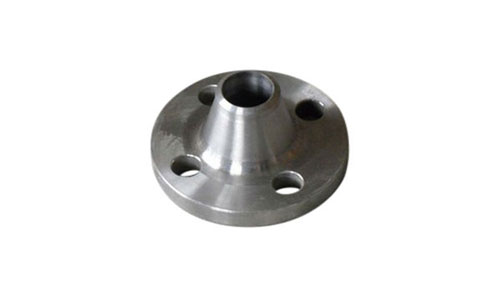
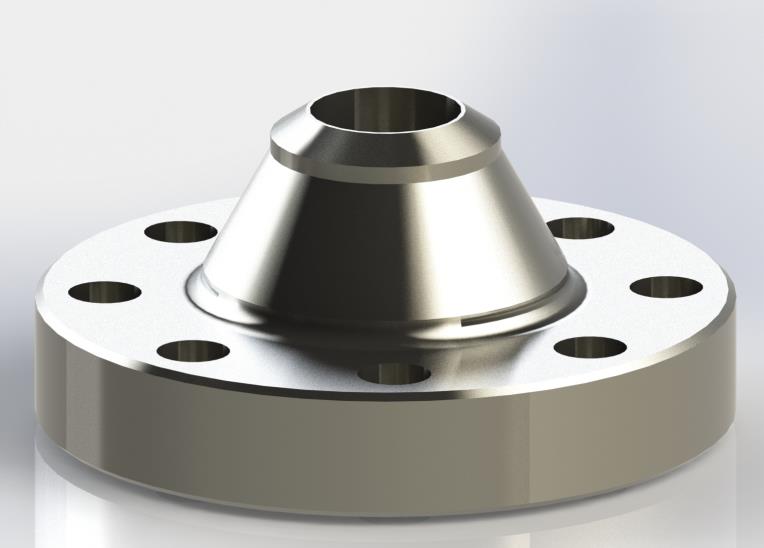
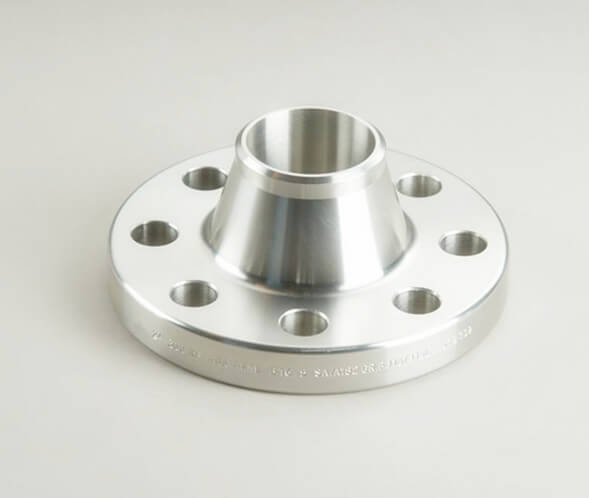
Class 75 is unique to ASME B16.47 Series B and is rated in B16.47 Table 3 — not the B16.5 tables the other classes borrow. It is not an ASME B16.5 class and has no B16.5 equivalent:
| Class | Material Group | Rating at −29 to 38 °C | Basis |
|---|---|---|---|
| Class 75 (≈PN 10) | Group 1.1 — A105 / A350 LF2 carbon steel | 9.6 bar (140 psig) | ASME B16.47 Table 3, decreasing with temperature |
Refer to ASME B16.47 Table 3 for the full temperature curve and other material groups, and confirm for your bolting and gasket. The class is intended for low-pressure service where a Class 150 flange would be unnecessarily heavy — when the design pressure outgrows it, step up to Series B Class 150.
All dimensions in mm per ASME B16.47-2020 Series B, Class 75. Letters follow the figure: O = outer diameter, C = flange thickness (including the 2 mm raised face), X = hub diameter at base, A = hub diameter at the weld bevel (= pipe OD per B36.10M), R = raised face diameter, V = length through hub (measured from the raised face), B = bolt circle (PCD), H = bolt hole diameter. Prefer it on paper? Download the full Series B Class 75 dimensions datasheet (PDF) — the same chart with the drawing, rating, materials and ordering notes, ready for the workshop.
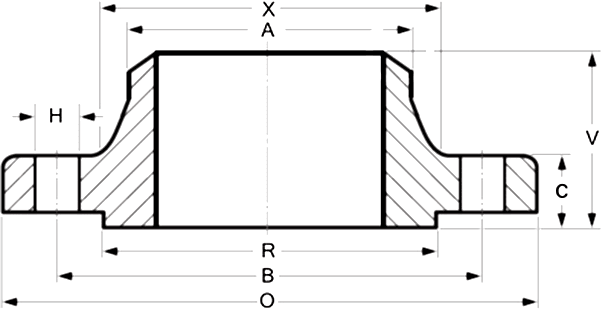
Weld Neck Flange Dimension Reference — ASME B16.47 Series B
| Size in Inch | Size in mm | Outer Diameter | Flange Thickness | Hub OD | Weld Neck OD | RF Diameter | Length Through Hub | PCD | No. of Studs | Hole Ø | Stud Size | Approx Weight (kg) |
|---|---|---|---|---|---|---|---|---|---|---|---|---|
| O | C | X | A | R | V | B | — | H | — | |||
| 26 | 650 | 762 | 31.8 | 676 | 660.4 | 705 | 57 | 723.9 | 36 | 19.1 | 5/8 | 36 |
| 28 | 700 | 813 | 31.8 | 727 | 711.2 | 756 | 60 | 774.7 | 40 | 19.1 | 5/8 | 39 |
| 30 | 750 | 864 | 31.8 | 778 | 762.0 | 806 | 64 | 825.5 | 44 | 19.1 | 5/8 | 41 |
| 32 | 800 | 914 | 33.5 | 829 | 812.8 | 857 | 68 | 876.3 | 48 | 19.1 | 5/8 | 48 |
| 34 | 850 | 965 | 33.5 | 879 | 863.6 | 908 | 72 | 927.1 | 52 | 19.1 | 5/8 | 50 |
| 36 | 900 | 1034 | 35.1 | 935 | 914.4 | 965 | 84 | 992.1 | 40 | 22.2 | 3/4 | 66 |
| 38 | 950 | 1084 | 36.6 | 986 | 965.2 | 1016 | 87 | 1043.0 | 40 | 22.2 | 3/4 | 73 |
| 40 | 1000 | 1135 | 36.6 | 1037 | 1016.0 | 1067 | 91 | 1093.7 | 44 | 22.2 | 3/4 | 77 |
| 42 | 1050 | 1186 | 38.1 | 1087 | 1066.8 | 1118 | 94 | 1144.5 | 48 | 22.2 | 3/4 | 84 |
| 44 | 1100 | 1251 | 41.4 | 1140 | 1117.6 | 1175 | 103 | 1203.5 | 36 | 25.4 | 7/8 | 104 |
| 46 | 1150 | 1302 | 42.9 | 1191 | 1168.4 | 1226 | 106 | 1254.3 | 40 | 25.4 | 7/8 | 111 |
| 48 | 1200 | 1353 | 44.5 | 1242 | 1219.2 | 1276 | 110 | 1305.1 | 44 | 25.4 | 7/8 | 122 |
| 50 | 1250 | 1403 | 46.2 | 1294 | 1270.0 | 1327 | 114 | 1355.9 | 44 | 25.4 | 7/8 | 132 |
| 52 | 1300 | 1457 | 46.2 | 1345 | 1320.8 | 1378 | 119 | 1409.7 | 48 | 25.4 | 7/8 | 141 |
| 54 | 1350 | 1508 | 47.8 | 1397 | 1371.6 | 1429 | 124 | 1460.5 | 48 | 25.4 | 7/8 | 154 |
| 56 | 1400 | 1575 | 49.3 | 1451 | 1422.4 | 1486 | 133 | 1521.0 | 40 | 28.6 | 1 | 181 |
| 58 | 1450 | 1626 | 50.8 | 1502 | 1473.2 | 1537 | 137 | 1571.8 | 44 | 28.6 | 1 | 195 |
| 60 | 1500 | 1676 | 54.1 | 1553 | 1524.0 | 1588 | 143 | 1622.6 | 44 | 28.6 | 1 | 215 |
| Series B (this page) | Series A | |
|---|---|---|
| Origin | API 605 (large-diameter CS flanges) | MSS SP-44 (pipeline flanges) |
| Geometry | Compact — many small bolts, tight circle | Larger OD, thicker, fewer / larger bolts |
| Classes | 75, 150, 300, 400, 600, 900 | 150–900 — no Class 75 |
| Typical use | Storage tanks, utility & low-pressure process | Pipelines, valves, pumps, vessel nozzles |
| Interchange | Never interchangeable with each other or with B16.5 / B16.1 drilling | |
Rule of thumb: match the mating equipment, and state the series on every drawing and enquiry. For Class 75 the series answers itself — the class exists only in Series B — but the pattern still mates with nothing outside its own table.
B16.47 Series B Class 75 weld neck flanges are produced in the material families below — forged or rolled-ring forged, each with EN 10204 3.1 mill certificates, heat-number traceability and PMI on request:
| Material Family | Typical Flange Grades | Best suited to |
|---|---|---|
| Carbon Steel | ASTM A105 / A105N; A266 Cl.2 for large forgings | Water systems, utility headers, tank nozzles |
| High-Yield Pipeline | ASTM A694 F42, F52, F60 | Matched to API 5L X42–X60 line pipe |
| LTCS | ASTM A350 LF2 Cl.1 / Cl.2, LF3 | Low-temperature service, impact tested |
| Stainless Steel | A182 F304/L, F316/L, F321 | Corrosive utility, desalination & effluent service |
| Duplex / Super Duplex | A182 F51 (2205), F53 (2507) | Seawater intake & outfall, FGD service |
| Clad / Weld Overlay | CS + 316L, Inconel 625 or Cu-Ni face overlay | Corrosion resistance at carbon-steel cost — on request |
| EN Equivalents | P250GH, P355NH / L360NB (1.0582), 1.4404 — on request | European specifications |
Large diameter flanges are manufactured to order — use the Ask for Quote button or the inquiry form for today’s price and delivery position.
| Pressure Class | Series B (ex API 605) | Series A (ex MSS SP-44) |
|---|---|---|
| Class 75 | Series B Class 75 Weld Neck (this page) | — (no Series A Class 75) |
| Class 150 | Series B Class 150 Weld Neck | Series A Class 150 Weld Neck |
| Class 300 | Series B Class 300 Weld Neck | Series A Class 300 Weld Neck |
| Class 400 | Series B Class 400 Weld Neck | Series A Class 400 Weld Neck |
| Class 600 | Series B Class 600 Weld Neck | Series A Class 600 Weld Neck |
| Class 900 | Series B Class 900 Weld Neck | Series A Class 900 Weld Neck |
Below NPS 26, see our ASME B16.5 Class 150 weld neck chart. Related references: Weld Neck Flanges overview · Series B Class 75 Blind · All Flange Dimension Charts · Flange Weight Chart.
At every size the Class 75 flange weighs half or less of its Class 150 counterpart — 36 kg against 136 kg at 26″ — with full ASME B16.47 compliance, tolerances and marking.
The tapered hub and full-penetration butt weld carry the joint loads that large, thin-wall utility pipe cannot take through a slip-on fillet weld.
36–52 studs of ⅝″–1″ — ordinary hand and air tooling, no tensioners, no heavy rigging for most sizes.
Cooling and circulating water, raw water, desalination intakes and outfalls, low-pressure gas, vent and flare headers, air and exhaust ducting, storage-tank and API 650 nozzles, FGD and scrubber piping, utility headers.
What is an ASME B16.47 Series B Class 75 weld neck flange?
A large diameter welding neck flange — NPS 26 through 60 — in the lightest class ASME B16.47 tabulates. Series B, formerly API 605, is the compact bolting pattern: smaller OD, thinner flange and many small bolts on a tight circle. Class 75 exists only in Series B, developed for large-bore, low-pressure lines such as water, air, vent, flare and low-pressure gas, where a Class 150 flange would be heavier and costlier than the service needs.
What are the dimensions of a B16.47 Series B Class 75 weld neck flange?
They are tabulated in ASME B16.47-2020 and reproduced in full in the chart above: for each of the eighteen sizes from NPS 26 to 60, the outer diameter, flange thickness, hub diameters at base and bevel, raised face diameter, length through hub, bolt circle, stud count, hole diameter and stud size — all in millimetres — plus the approximate weight. A 36 in flange, for example, is 1034 mm OD and 35.1 mm thick on a 992.1 mm bolt circle with forty 3/4 in studs, at about 66 kg.
What is Class 75 and where does it come from?
Class 75 is the lowest pressure class in ASME B16.47 and exists only in Series B. It was carried over from API 605, the American Petroleum Institute standard written for large-diameter, low-pressure carbon steel flanges on refinery and tank-farm piping, which ASME adopted into B16.47 as Series B in 1990. There is no Series A Class 75 and no B16.5 equivalent — it is a class of its own.
Can a Class 75 flange replace a Class 150 flange?
Only if two conditions hold: the design pressure and temperature must fall within the Class 75 rating — 9.6 bar (140 psig) at ambient for carbon steel — and the mating flange must also be Series B Class 75, because the drilling does not match Class 150 of either series. Where both hold, the saving is dramatic: a 36 in Class 75 flange weighs about 66 kg against roughly 290 kg for its Series A Class 150 counterpart.
What pressure can a B16.47 Series B Class 75 flange handle?
Class 75 is rated in ASME B16.47 Table 3, not the B16.5 tables the other classes borrow: for Group 1.1 carbon steel such as A105, 9.6 bar (140 psig) from -29 to 38 °C, decreasing with temperature. It is not an ASME B16.5 class and has no B16.5 equivalent. Refer to B16.47 Table 3 for the full curve and other material groups, and confirm for your bolting and gasket.
Why choose Class 75 at all?
Weight and money. Large-bore utility lines — cooling water, air, vent, flare — rarely see more than a few bar, and a Class 150 flange there carries steel the service never uses. The Class 75 chart cuts the flange weight by half or more at every size: 36 kg instead of 136 kg at 26 in, 215 kg instead of 928 kg at 60 in, against Series A Class 150. Over a circulating-water system with dozens of joints, the saving in material, handling and bolting is substantial.
Series A or Series B — which do I need?
Match the mating equipment. Series B (ex API 605) is the compact pattern with many small bolts, common on storage tanks and low-pressure process plant; Series A (ex MSS SP-44) is the heavier pipeline pattern. For Class 75 the question answers itself — the class exists only in Series B — but the series must still be stated on the enquiry, because nothing in Series B interchanges with Series A or with B16.5/B16.1 drilling.
Is Series B Class 75 interchangeable with any other drilling?
No. Class 75 has no Series A counterpart, and its bolt circles and hole patterns match neither Class 150 of either series nor any B16.5 or B16.1 flange. A Class 75 flange mates only with another Series B Class 75 flange — which is why the class and series must appear on every drawing and enquiry.
Does the thickness in the chart include the raised face?
Yes — for Class 75 the tabulated thickness C includes the 2 mm raised face, and the length through hub V is measured from the raised face. The hub diameter at the bevel A equals the pipe outside diameter per ASME B36.10M, which is how the flange lines up with the pipe for the butt weld.
Why is the bore not shown in the dimension table?
Because ASME B16.47 deliberately leaves it to the purchaser. Large diameter pipe is ordered by wall thickness rather than schedule, so there is no standard bore to print — the flange is bored to match the pipe stated on the order. Give the pipe OD and wall thickness (or the exact ID) with your enquiry; our chart weights assume a bore for STD (9.53 mm) wall pipe.
How much does a B16.47 Series B Class 75 weld neck flange weigh?
From the weight column in our chart: a 26 inch weighs about 36 kg, a 36 inch about 66 kg, a 48 inch about 122 kg and a 60 inch about 215 kg — light enough that most sizes are a two-man or small-crane lift rather than a rigging operation. These are approximate carbon-steel weights bored for STD wall pipe; the exact weight varies with the bore and material.
Why do the bolt counts drop at NPS 36, 44 and 56?
Because the stud size steps up at those sizes — from 5/8 to 3/4 in at NPS 36, to 7/8 in at 44 and to 1 in at 56 — and fewer, larger studs replace many smaller ones. A 34 in flange carries fifty-two 5/8 in studs while a 36 in carries forty 3/4 in studs. It is a normal feature of the Series B pattern, but worth knowing when counting holes against a mating flange.
Which gasket and bolts are used with these flanges?
Spiral wound gaskets to ASME B16.20 or non-metallic full-face gaskets to B16.21 — the natural choice on flat-faced low-pressure joints — with stud bolts and heavy hex nuts: A193 B7 / A194 2H for carbon steel, B8M Class 2 for stainless flanges. Studs run 5/8 to 1 in on this chart, 36 to 52 per flange, and the holes are drilled 3.2 mm larger than the stud — ordinary hand and air tooling makes these joints up.
What materials are available for Series B Class 75 flanges?
Carbon steel ASTM A105/A105N and A266 Cl.2 for large forgings, high-yield A694 F42/F52/F60 matched to API 5L line pipe, low-temperature A350 LF2/LF3, stainless A182 F304/L, F316/L and F321, duplex F51 and super duplex F53, plus carbon-steel flanges with 316L, Inconel 625 or copper-nickel weld overlay on request. EN equivalents such as P250GH, P355NH and 1.4404 are available — all with EN 10204 3.1 certificates, 3.2 on request.
What facing do these flanges come with?
A 2 mm raised face as standard, serrated to 125-250 microinch Ra (3.2-6.3 micrometre), with flat face on request — common on Class 75 duty where full-face gaskets and soft rubber sheet are the gasket culture. State RF or FF with the enquiry.
How are your B16.47 flanges manufactured, tested and certified?
Forged from certified ingots or blooms, or rolled-ring forged at the larger diameters, then normalised, quenched-and-tempered or solution annealed per the material specification. Dimensional inspection follows ASME B16.47 tolerances with face finish per MSS SP-6, and marking per B16.47 and MSS SP-25 including "B16.47 SER. B" and "CL 75". Every batch ships with EN 10204 3.1 certificates; UT per ASTM A388, MPI/DPT, PMI, Charpy impact testing, NACE MR0175, PED and IBR compliance and 3.2 endorsement are available on request.
What other names does this flange go by?
ANSI B16.47 Series B Class 75 WNRF flange, API 605 Class 75 weld neck flange, 75 lb large diameter welding neck flange and 26-60 in low-pressure WN flange all describe the same product, and the rating sits at roughly PN 10 in metric terms. ANSI and ASME B16.47 are the same standard — custodianship moved to ASME but the old names, API 605 especially, persist on drawings.
What sizes does Class 75 cover, and what about higher pressures?
Eighteen sizes, NPS 26 through 60 — the full B16.47 range. When the design pressure outgrows the 9.6 bar Class 75 rating, the next step is Series B Class 150, which keeps the compact pattern, or Series A Class 150 where the mating equipment demands the heavier MSS SP-44 drilling — both charts are on this site, linked below.