

TES-LOK 45° Male Elbow Tube Fittings — double-ferrule compression tube end at a 45-degree angle to a male NPT / BSPT / BSP threaded port connection. Provides a low-stress, low-turbulence direction change for instrument tubing in confined panel spaces. ISO 9001:2015 certified. Made in India.
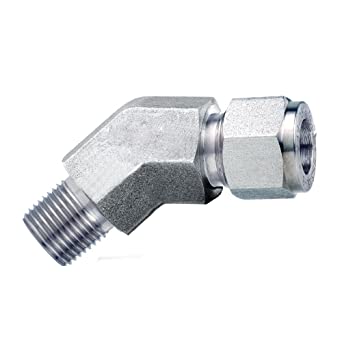
TES-LOK 45° Male Elbow
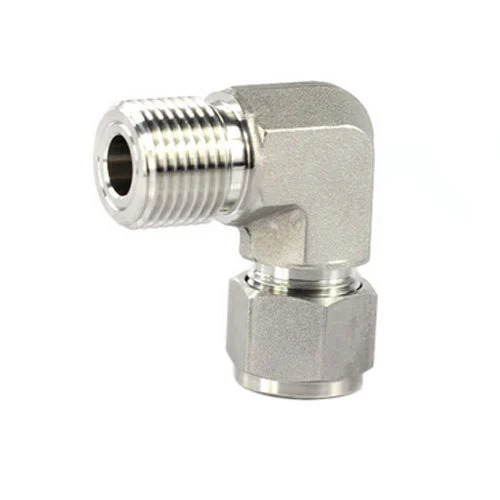
Male Elbow — 90° Series
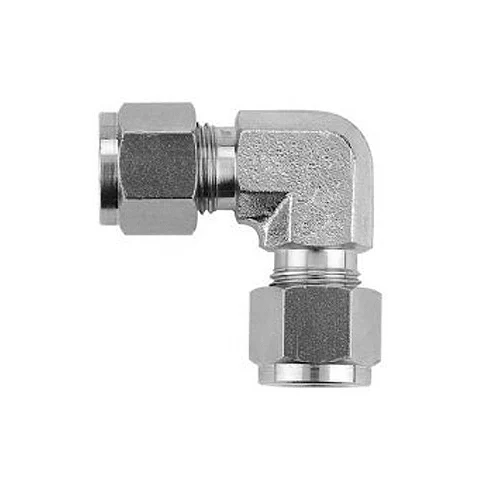
Union Elbow (Related)
The 45° male elbow is machined from a single bar stock — no brazing, no welding, no weak joints. The body retains the same wall thickness and pressure rating as the straight male connector in the same size, since the angle is machined into the body geometry rather than achieved by bending the fitting after manufacture.
| Criterion | 45° Male Elbow | 90° Male Elbow |
|---|---|---|
| Direction change | Half right-angle — tube exits diagonally | Full right-angle — tube exits perpendicular to thread axis |
| Pressure drop | Lower — gentler sweep reduces turbulence | Higher — sharper turn increases flow resistance |
| Tubing stress | Lower — less abrupt change in tube direction | Higher — abrupt right-angle can stress the tube run |
| Vibration fatigue | Better — smoother geometry dampens vibration transmission | More susceptible — sharp corner concentrates vibration stress |
| Panel depth required | More depth behind panel (tube exits at 45°) | Less depth — tube turns parallel to panel face |
| Typical use case | Instrument runs where tube approaches port at a diagonal; high-flow gas analysers; angled bulkhead entries | Tight panel entries; tube runs parallel to surface then into a port perpendicular to it |
| Equivalent pipe fitting | 45° street elbow (ASME B16.11 equivalent) | 90° street elbow (ASME B16.11 equivalent) |
| Configuration | Tube End | Thread End | Best Application |
|---|---|---|---|
| Standard 45° Male Elbow | Double-ferrule compression (tube OD) | Male tapered NPT or BSPT | General instrumentation — most common type |
| 45° Male Elbow — BSPP with Dowty Seal | Double-ferrule compression | Male BSPP (G) + bonded seal recess | European valve bodies with BSPP ports; no-tape seal |
| Reducing 45° Male Elbow | Smaller tube OD (e.g. 1/4") | Larger male thread (e.g. 1/2" NPT) | Connecting small-bore instrument tube to large-bore valve port at 45° |
| 45° Male Elbow — Metric Tube | Metric OD compression (6 mm, 8 mm, 10 mm, 12 mm) | Male NPT or BSPT | Metric tubing systems to NPT/BSPT ports — common in European projects |
| 45° Male Street Elbow | Male tapered thread one end | Female thread other end | Male-to-female thread direction change in pipe assemblies (no compression) |
| Parameter | Details |
|---|---|
| Brand | TES-LOK (Tesco Steel & Engineering) |
| Elbow Angle | 45° (measured between tube axis and thread axis centre line) |
| Tube OD Range | 1/16", 1/8", 3/16", 1/4", 5/16", 3/8", 1/2", 5/8", 3/4", 1" | Metric: 3 mm, 4 mm, 6 mm, 8 mm, 10 mm, 12 mm, 14 mm, 16 mm |
| Male Thread Sizes | 1/8", 1/4", 3/8", 1/2", 3/4", 1" — NPT / BSPT / BSPP |
| Pressure Rating | SS 316: up to 6 000 PSI | Brass: 300 / 1 000 / 3 000 PSI depending on size and tube OD |
| Temperature Range | SS 304 / 316: −196°C to 450°C | Brass: −40°C to 150°C | Inconel 600: up to 800°C |
| Body Material | SS 304, SS 316 / 316L, Brass (CW617N), Inconel 600, Monel 400, Hastelloy C-276 |
| Ferrule Material | Matched to body material — SS 316 ferrules with SS 316 body; Brass ferrules with Brass body |
| End Connections | Tube end: double-ferrule compression | Thread end: male tapered (NPT / BSPT) or male parallel (BSPP) |
| Surface Finish | Bright annealed and passivated (SS); bright zinc or nickel plated (Brass) |
| Body Construction | Single-piece CNC-machined from bar stock — no brazing, no welding |
| Thread Standards | NPT: ASME B1.20.1 | BSPT: BS 21 / ISO 7-1 | BSPP: BS 2779 / ISO 228 |
| Certifications | ISO 9001:2015 | EN 10204 3.1 MTC on request | Hydrostatic test certification available |
| Material | Max Temp | Pressure (1/4" tube) | Corrosion Resistance | Typical Industry |
|---|---|---|---|---|
| SS 304 | 450°C | 5 000 PSI | Good — general service | Food, pharma, water treatment |
| SS 316 / 316L | 450°C | 6 000 PSI | Excellent — chloride resistant | Oil & gas, offshore, chemical |
| Brass (CW617N) | 150°C | 3 000 PSI | Moderate — no ammonia | HVAC, compressed air, hydraulics |
| Inconel 600 | 800°C | 4 000 PSI | Outstanding — high-temp oxidation | Furnaces, steam superheat, nuclear |
| Monel 400 | 480°C | 4 500 PSI | Excellent — HF, seawater | Offshore, desalination, HF acid service |
| Hastelloy C-276 | 500°C | 4 000 PSI | Superior — strong acids | Chemical reactors, acid gas service |
| Tube OD (Inch) | Tube OD (mm) | Male Thread Options | Max Pressure — SS 316 | Max Pressure — Brass |
|---|---|---|---|---|
| 1/8" | 3.18 mm | 1/8" NPT / BSPT | 6 000 PSI | 3 000 PSI |
| 1/4" | 6.35 mm | 1/4", 3/8" NPT / BSPT | 6 000 PSI | 3 000 PSI |
| 3/8" | 9.53 mm | 3/8", 1/2" NPT / BSPT | 5 000 PSI | 1 000 PSI |
| 1/2" | 12.7 mm | 1/2", 3/4" NPT / BSPT | 4 500 PSI | 1 000 PSI |
| 5/8" | 15.88 mm | 3/4" NPT / BSPT | 4 000 PSI | 300 PSI |
| 3/4" | 19.05 mm | 3/4", 1" NPT / BSPT | 3 500 PSI | 300 PSI |
| Fitting Type | Both Ends | Angle | Direction Change | Choose When |
|---|---|---|---|---|
| 45° Male Elbow | Compression + Male thread | 45° | Diagonal half-turn | Tube approaches port at a diagonal; want lower pressure drop |
| 90° Male Elbow | Compression + Male thread | 90° | Full right angle | Tube must turn perpendicular; tight panel spaces |
| Union Elbow | Compression + Compression | 90° | Full right angle | Tube-to-tube right-angle joint; no thread port needed |
| Female Elbow | Compression + Female thread | 90° | Full right angle | Tube to female-ported instrument or valve |
| Adjustable Elbow | Compression + Male thread (swivel) | 0–360° swivel | Any direction after assembly | Direction known only at installation time; alignment-critical ports |
| Street Elbow (Male) | Male thread + Male thread | 45° or 90° | Direction change in threaded run | Thread-to-thread direction change; no tube compression needed |
The 45° angle is machined directly into the body from solid bar stock. No brazing or welding at the bend — no heat-affected zones, no joint weaknesses. The body wall thickness is uniform from tube end to thread end, maintaining the full pressure rating throughout.
The 45° geometry produces a shorter flow-path disturbance and lower turbulence at the direction change. At high gas flow velocities — such as in analyser sample conditioning lines — this reduces erosion risk and maintains accurate sample transport times.
Every batch is hydrostatic-tested. EN 10204 3.1 material test certificates available for SS 316, Inconel, Monel, and Hastelloy grades. Heat numbers tracked from bar stock to finished fitting — required by many EPC and owner-operator specifications.
Routing a tube through a 45° fitting instead of bending the tube creates a straight, stress-free tube run on both sides of the fitting. This prevents work-hardening and micro-cracking at tight bends — critical for high-cycle instrument lines subject to pressure pulsation.
NPT, BSPT, and BSPP (with bonded seal) all available in the same tube OD — from the same Mumbai warehouse. Mixed-standard projects (e.g. US NPT instruments in an ASME plant, BSPT gauges alongside NPT valves) can be fulfilled from a single supplier order.
Standard sizes in SS 316 and Brass are maintained in stock. Special alloy 45° elbows (Inconel 600, Monel 400, Hastelloy C-276) are manufactured to order with 2–4 week lead time, EN 10204 3.1 MTC, and dimensional inspection report.
| Industry | Typical Use Point | Why 45° Elbow Preferred |
|---|---|---|
| Oil & Gas Upstream | Wellhead instrument manifold tubing entries at angled approach to valve bodies | Avoids tight tube bends in compact wellhead skids; lower vibration fatigue |
| Petrochemical / Refinery | Analyser sample conditioning panels — sample transport lines from fast-loop to analyser | Lower pressure drop maintains sample velocity for accurate response time |
| Power Generation | Turbine instrument rack tubing — temperature and pressure transmitter connections | Neat diagonal routing in packed instrument racks without sharp bends |
| Pharmaceutical | Clean room instrument panel connections at diagonal approach to transmitters | SS 316L passivated body; easy clean-in-place; no crevice at bend |
| Chemical Processing | Reactor instrument lines — pressure transmitter tapping connections on angled nozzles | Matches nozzle orientation without bending tube; reduces process nozzle load |
| Food & Beverage | Hygienic instrument panel connections — CIP/SIP pressure measurement points | SS 316 body, no dead-legs, no crevice; matches diagonal panel entry angles |
| HVAC & Building Services | Gauge and sensor connections to duct tapping points at angled penetrations | Brass 45° elbow accommodates common 45° duct entry angles cleanly |
| Shipbuilding / Marine | Instrument tubing runs in engine rooms with limited straight-run space | SS 316 resists salt atmosphere; 45° elbow reduces tube-bend count in tight runs |
Q1. What is the difference between a 45° male elbow and a 90° male elbow tube fitting?
Both have a compression tube end and a male threaded port end, but the angle between the two axes differs. In a 45° elbow the tube exits at a 45° angle (half a right angle) to the thread — creating a diagonal direction change. In a 90° elbow the tube exits perpendicular to the thread — a full right-angle turn. Use 45° when the tube approaches the port at a shallow angle, when pressure drop must be minimised, or when a 90° bend would stress the tube run.
Q2. Can I use a 45° male elbow with metric tube OD?
Yes. TES-LOK 45° male elbows are available with metric OD compression ends: 3 mm, 4 mm, 6 mm, 8 mm, 10 mm, 12 mm, and 14 mm. The male thread end can be NPT, BSPT, or BSPP regardless of whether the tube end is imperial or metric — specify both ends clearly when ordering.
Q3. Is the pressure rating of a 45° male elbow the same as a straight male connector?
Yes. Because TES-LOK 45° elbows are machined from solid bar stock (not bent after machining), the body wall thickness at the compression end and thread end is unchanged compared to the straight connector. The 45° body pressure rating is equal to the straight male connector in the same size, material, and tube OD.
Q4. Can a 45° male elbow be used on a BSPP (parallel thread) port?
Yes — specify the BSPP variant with a bonded (Dowty) seal recess on the thread shoulder. The standard 45° male elbow has NPT or BSPT tapered threads. For BSPP ports, a plain NPT/BSPT fitting must not be used — the thread forms are incompatible. TES-LOK supplies all three thread options: NPT, BSPT, and BSPP+bonded seal.
Q5. How is the angle of a 45° male elbow measured — tube axis to thread axis or thread axis to overall fitting height?
The 45° angle is the included angle between the centre line of the tube bore and the centre line of the male thread. It is the geometrical angle between the two pipe-run axes. This means if the thread is screwed into a vertical port, the tube exits the fitting at 45° from vertical — i.e., diagonally upward/downward depending on orientation.
Q6. What is the difference between a 45° male elbow and a 45° street elbow?
A 45° male elbow (this product) has one compression tube end and one male thread end — it connects instrument tube to a threaded port. A 45° street elbow has two threaded ends (one male, one female or both male), used for direction changes in fully threaded pipe assemblies with no compression tube involved. The street elbow cannot accept instrument tubing; the male elbow cannot be used as a thread-to-thread fitting.
Q7. Do you supply 45° male elbows in Inconel or Hastelloy?
Yes, on a make-to-order basis. Inconel 600, Inconel 625, Monel 400, and Hastelloy C-276 bodies with matching ferrule sets are available. Lead time is typically 3–5 weeks with EN 10204 3.1 material test certificates. Minimum order is 10 pieces per size. Contact TES-LOK's sales team with tube OD, thread size, material grade, and operating conditions.
Q8. How many times can a 45° male elbow be disassembled and reassembled?
The fitting body and male thread can be used indefinitely provided the threads and body bore are undamaged. The ferrules are permanently swaged onto the tube at first assembly — if the tube is removed, new ferrules must be used. TES-LOK supplies spare ferrule kits for all sizes. The thread end can be disconnected and reconnected multiple times with fresh PTFE tape each time.