

Tesco Steel & Engineering manufactures PU fittings — one-touch push-in pneumatic fittings that connect PU and nylon tube to air lines, valves, and cylinders without tools. The tube is simply pushed in and gripped by a stainless collet while an O-ring seals on the tube OD; pressing the release ring frees the tube. Available as straight, elbow, tee, bulkhead, and threaded styles in Polyurethane, Aluminium, PE, PVC, Brass, and Stainless Steel. Thread 1/8" to 1/2". 0–100 PSI. −20°C to 80°C. ISO 9001:2015 certified. Made in India.
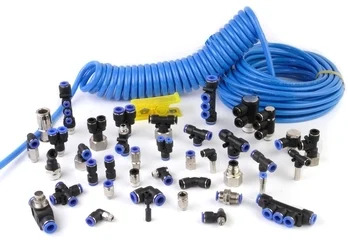
PU Push-In Fittings
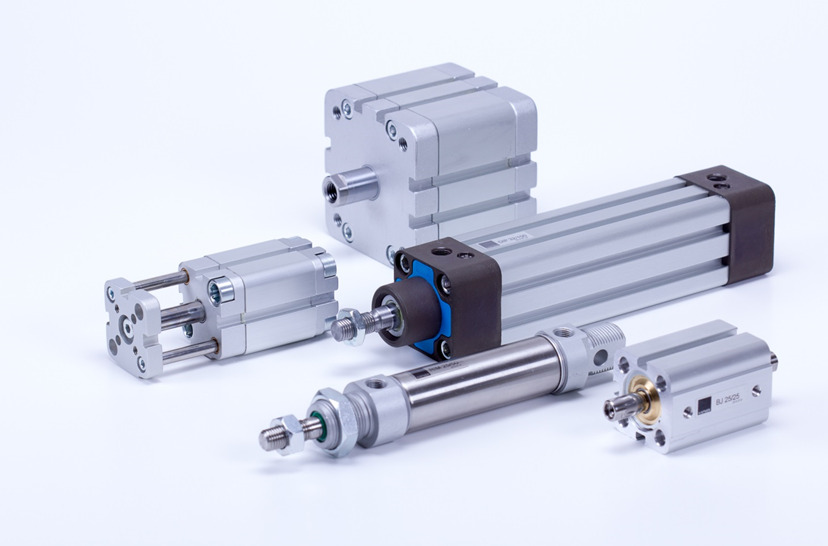
Pneumatic Cylinder (Related)
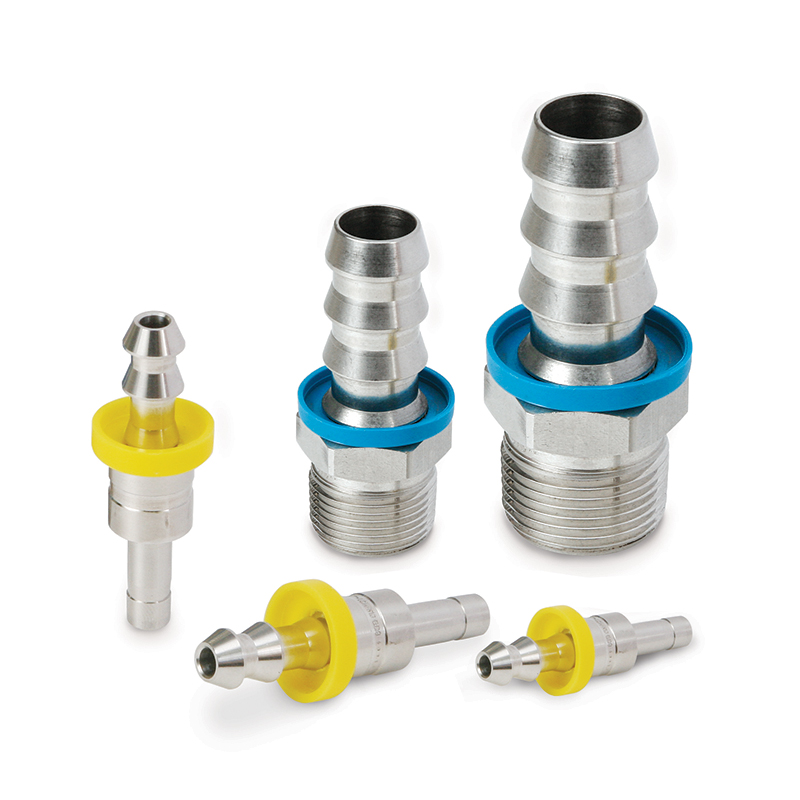
Push-on Hose Fittings (Related)
PU fittings are the standard way to plumb compressed-air automation. They pair with PU pipe / pneumatic tubing to build complete air-line networks, and come in every geometry — straight, elbow, tee, Y, bulkhead, manifold, and threaded male/female stud — to route air anywhere.
| Style | Description | Use |
|---|---|---|
| Straight / Male Stud | Tube to male thread (NPT/BSP) | Connect tube to a port or valve |
| Male / Female Elbow (90°) | Tube to thread at right angle | Routing around corners; swivel options |
| Union Straight | Tube to tube inline | Joining / extending tube runs |
| Union Elbow / Tee / Y | Tube-to-tube turns & branches | Branching & distributing air |
| Bulkhead Union | Through-panel tube connection | Passing air through a panel/wall |
| Manifold / Banjo / Plug | Multi-port & special forms | Distribution blocks & blanking |
| Material | Properties | Best For |
|---|---|---|
| Polyurethane / Engineering Plastic | Light, economical, corrosion-free | General factory air & automation |
| Brass (often nickel-plated) | Robust, good pressure & temperature | Industrial pneumatics, durable service |
| Stainless Steel | Excellent corrosion resistance | Food, marine, washdown & corrosive areas |
| Aluminium | Light & strong | Manifolds & weight-sensitive builds |
| Polyethylene / PVC | Economical, chemical-resistant | Low-pressure fluid & water lines |
| Parameter | Details |
|---|---|
| Product | One-touch push-in pneumatic fitting (PU fitting) |
| Thread Size | 1/8" to 1/2" (NPT, BSP / BSPT, M-metric) |
| Tube Size | OD 4 mm to 16 mm (to suit PU / nylon / PE tube) |
| Working Pressure | 0 to 100 PSI (≈0–7 bar); vacuum to pressure |
| Operating Temperature | −20°C to 80°C |
| Materials | Polyurethane / engineering plastic, Aluminium, Polyethylene, PVC, Brass, Stainless Steel |
| Collet | Stainless-steel gripping collet; release-ring |
| Seal | O-ring (NBR / FKM) on tube OD; thread sealant on stud |
| Styles | Straight, elbow, tee, Y, union, bulkhead, manifold, banjo, plug |
| Certifications | ISO 9001:2015 | RoHS-compliant materials on request |
Push the tube in to connect, press the ring to release — no tools, no thread-cutting on the tube, and reusable connections for fast builds and changes.
A stainless collet grips the tube and an O-ring seals on the OD for a leak-tight joint that holds securely under pressure and vibration.
Straight, elbow, tee, Y, union, bulkhead, manifold, and banjo styles — including swivel elbows — route air anywhere in the machine.
Engineering-plastic for economy, brass for robust industrial service, and stainless steel for food, marine, and washdown environments.
Threads from 1/8" to 1/2" in NPT, BSP, and metric, sized for tube OD 4 to 16 mm — matched to our PU pipe range.
Reliable sealing from vacuum up to 100 PSI across −20°C to 80°C for general compressed-air and light fluid service.
| Industry | Typical Use | Why Push-In Fitting |
|---|---|---|
| Factory Automation | Air to valves, cylinders & manifolds | Fast tool-free assembly & changes |
| Machine Tools | Clamping & blow-off air lines | Compact elbows in tight spaces |
| Robotics | Air on moving arms & grippers | Swivel elbows; reusable joints |
| Packaging & Printing | Vacuum & air control | Clean, reliable sealing |
| Food & Pharma | Washdown & hygienic air lines | Stainless-steel fittings |
| Material Handling | Conveyors & pneumatic controls | Durable brass bodies |
| Instrumentation | Low-pressure signal & air lines | Leak-tight, easy routing |
| Workshops | Air-tool & spray connections | Quick connect / disconnect |
Q1. What is a PU fitting?
A PU fitting is a one-touch push-in (push-to-connect) pneumatic fitting that joins PU, nylon, or PE tube to air lines, valves, and cylinders without tools. A stainless collet grips the tube and an O-ring seals on the tube OD. You push the tube in to connect and press the release ring to remove it.
Q2. How does a push-in fitting hold the tube?
Inside the fitting, a collet with angled stainless-steel teeth grips the tube's outside diameter — the harder the tube is pulled, the tighter it grips. An O-ring seals around the same OD. To release, the collet ring is pressed against the body, which retracts the teeth so the tube can be withdrawn.
Q3. What materials are the fittings available in?
Polyurethane / engineering plastic for economical general air service, brass (often nickel-plated) for robust industrial use, stainless steel for food, marine, and washdown environments, plus aluminium, polyethylene, and PVC for specific needs. Choose the material for the pressure, temperature, and environment.
Q4. What thread and tube sizes are available?
Threads from 1/8" to 1/2" in NPT, BSP/BSPT, and metric, sized for tube OD 4 mm to 16 mm. The push-in port is matched to the tube OD and the stud thread to the port it screws into.
Q5. What pressure and temperature can they handle?
Standard PU/push-in fittings work from vacuum up to 100 PSI (about 7 bar) across −20°C to 80°C. For higher pressures or temperatures, choose brass or stainless bodies with appropriate tube and seals, and confirm the rating for the exact service.
Q6. Why does the tube have to be cut square?
The O-ring seals on the tube's outside diameter and the collet grips around it, so the tube end must be square, round, and burr-free. An angled or crushed cut causes leaks and can let the tube blow out under pressure. Always use a proper tube cutter, not pliers or a knife.
Q7. Are push-in fittings reusable?
Yes. The tube can be released by pressing the collet ring and re-inserted many times, which is what makes push-in fittings ideal for assembling and modifying pneumatic systems. Check the O-ring and collet for wear if a joint is repeatedly remade, and replace the fitting if the seal is damaged.
Q8. What tube should I use with PU fittings?
Use good-quality PU, nylon, or PE tube with a consistent OD and wall, matched to the fitting's push-in size — see our PU pipe range. A correct, round tube OD is essential for the O-ring to seal and the collet to grip reliably.