

TES-LOK O-Seal Straight Thread Male Adapters — compression tube fittings with ISO metric or UNF parallel straight thread and a captured elastomeric O-ring for no-tape, no-compound face sealing into DIN 3852 / ISO 1179-2 / ISO 228 instrumentation ports. SS 304, SS 316, Brass. Up to 6000 PSI. ISO 9001:2015 certified. Made in India.
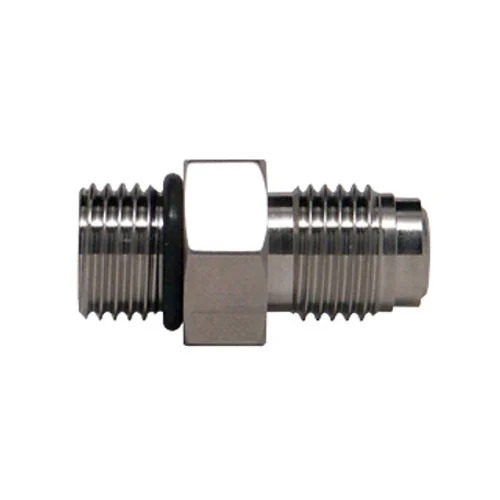
TES-LOK O-Seal Male Adapter
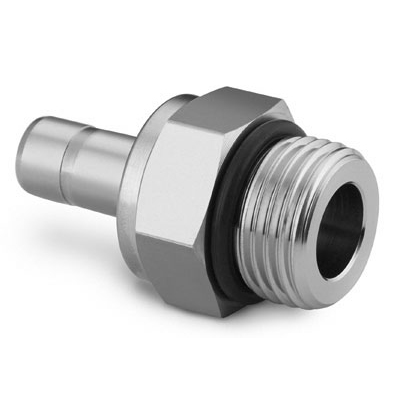
Straight Thread Adapter — Related
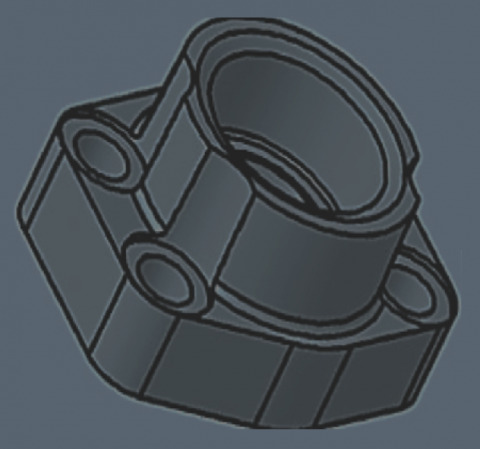
Integrated Threaded O-Ring
The term "O-Seal" is widely used in European and Asian instrumentation markets to describe any straight-thread fitting where sealing is achieved by an integral O-ring on the fitting body rather than by thread interference (as with NPT/BSPT) or a separate seal washer (as with bonded seals). It covers both metric-thread variants (DIN 3852 / ISO 1179) and inch-UNF variants (BS 5200 / ISO 228 O-ring ports).
| System | Thread | Sealing Element | Port Standard | Sealant? | Best Use |
|---|---|---|---|---|---|
| O-Seal (this product) | ISO metric or UNF parallel | Integral O-ring in fitting groove — no separate part | DIN 3852 / ISO 1179-2 / ISO 228 | None | European instrumentation, metric-ported valves & manifolds |
| BSPP + Bonded (Dowty) Seal | BSPP (G) parallel 55° | Separate bonded seal washer in fitting recess | BS 2779 / ISO 228 | None | BSPP-ported valves; seal replaceable as spare part |
| SAE ORB / MS16142 | UNF parallel 60° | O-ring in groove on fitting shoulder | SAE J1926 / MS16142 | None | Hydraulic valves, cylinders; aerospace/military |
| ORFS (SAE J1453) | UNF parallel 60° | O-ring in face cone groove on fitting | SAE J1453 / ISO 8434-3 | None | High-pressure hydraulic tube & hose OEM |
| NPT | Tapered 60° | Thread interference — no O-ring | ASME B1.20.1 | PTFE tape | General piping, US instrumentation |
| BSPT (Rc) | Tapered 55° | Thread interference — no O-ring | BS 21 / ISO 7-1 | PTFE tape | UK / European piping |
| Configuration | Tube End | O-Seal Thread End | Application |
|---|---|---|---|
| Standard Straight O-Seal Adapter | Double-ferrule compression | ISO metric male (M10×1 to M33×2) or UNF male straight thread with O-ring groove | Instrument tube to DIN 3852 / ISO 228 port — most common configuration |
| Reducing O-Seal Adapter | Smaller tube OD compression | Larger metric / UNF straight thread | 1/4" tube OD into M22×1.5 port; 6 mm tube into 1/2" BSPP-O port |
| O-Seal Elbow Adapter (90°) | Double-ferrule compression at 90° | ISO metric / UNF straight O-ring thread | Right-angle entry into metric-ported manifold or valve block |
| O-Seal Elbow Adapter (45°) | Double-ferrule compression at 45° | ISO metric / UNF straight O-ring thread | Diagonal tube entry — lower pressure drop than 90° elbow |
| Weld-End O-Seal Adapter | Socket-weld or butt-weld bore | ISO metric / UNF straight O-ring thread | Small-bore pipe to metric-ported valve body; no tube compression needed |
ISO metric straight threads used in O-seal adapters follow DIN 3852 Part 1 & 2 port dimensions. The thread size is specified as M(diameter)×(pitch) — e.g. M14×1.5. O-ring cross-section diameter and groove depth are fixed by the standard for each thread size.
| Metric Thread | Approx. Bore / Port Size | O-Ring (DIN 3869) | Tube OD (Typical) | Max Pressure — SS 316 |
|---|---|---|---|---|
| M10 × 1 | DN 4 | 8.0 × 1.5 mm | 4 mm / 1/8" | 6 000 PSI |
| M12 × 1.5 | DN 6 | 9.25 × 1.78 mm | 6 mm / 1/4" | 6 000 PSI |
| M14 × 1.5 | DN 6 | 11.0 × 1.78 mm | 6 mm / 1/4" | 6 000 PSI |
| M16 × 1.5 | DN 8 | 12.37 × 1.78 mm | 8 mm / 5/16" | 5 500 PSI |
| M18 × 1.5 | DN 10 | 14.99 × 1.78 mm | 10 mm / 3/8" | 5 000 PSI |
| M20 × 1.5 | DN 10 | 16.36 × 1.78 mm | 10 mm / 3/8" | 5 000 PSI |
| M22 × 1.5 | DN 12 | 18.64 × 1.78 mm | 12 mm / 1/2" | 4 500 PSI |
| M26 × 1.5 | DN 16 | 22.22 × 1.78 mm | 16 mm / 5/8" | 4 000 PSI |
| M33 × 2 | DN 20 | 28.17 × 1.78 mm | 20 mm / 3/4" | 3 500 PSI |
| M42 × 2 | DN 25 | 37.69 × 1.78 mm | 25 mm / 1" | 3 000 PSI |
| Parameter | Details |
|---|---|
| Brand | TES-LOK (Tesco Steel & Engineering) |
| Thread End Type | ISO metric straight (M10×1 to M42×2) | UNF straight (1/4"-28 to 1-5/8"-12) |
| Tube End Type | Double-ferrule compression — tube OD 3 mm to 25 mm (metric) or 1/8" to 1" (inch) |
| O-Ring Standard | DIN 3869 (metric O-ring groove geometry) | ISO 3601 (metric O-ring dimensions) |
| O-Ring Material | NBR (Nitrile) — standard | Viton (FKM) — on request | EPDM — on request |
| Pressure Rating | SS 316: up to 6 000 PSI (M10–M14 sizes) | Brass: up to 3 000 PSI |
| Temperature Range | SS 316: −196°C to 450°C | Brass: −40°C to 150°C (limited by O-ring material) |
| Body Material | SS 304, SS 316 / 316L, Brass (CW617N), Carbon Steel (on request) |
| Ferrule Material | Matched to body — SS 316 ferrules with SS body; Brass ferrules with Brass body |
| Port Thread Standards | DIN 3852 Part 1 & 2 | ISO 1179-2 (Ed seal / O-ring) | ISO 228-1 (BSPP equivalent with O-ring) |
| Surface Finish | Bright annealed and passivated (SS); zinc or nickel plated (Brass) |
| Certifications | ISO 9001:2015 | EN 10204 3.1 MTC on request | Hydrostatic test certification available |
| Material | Max Temp (Body) | Corrosion Resistance | Typical Industry |
|---|---|---|---|
| SS 304 | 450°C | Good — general service | Food, pharma, water treatment |
| SS 316 / 316L | 450°C | Excellent — chloride resistant | Chemical processing, offshore, marine instrumentation |
| Brass (CW617N) | 150°C | Moderate — no ammonia / acids | HVAC, compressed air, low-pressure metric-ported instruments |
| Carbon Steel (1018) | 400°C | Low — requires coating / protection | Hydraulic machinery with DIN 3852 metric ports |
| Elastomer | Temperature Range | Compatible Media | Avoid With |
|---|---|---|---|
| NBR (Nitrile) — Standard | −40°C to +100°C | Mineral oils, hydraulic fluids, diesel, compressed air, water | Ketones, esters, strong acids, steam |
| Viton (FKM) | −20°C to +200°C | Aromatic & chlorinated solvents, fuels, hot oils, HF acid | Ketones (MEK, acetone), amines, hot steam |
| EPDM | −40°C to +150°C | Hot water, steam, phosphate ester fluids, ozone/UV exposure | Mineral oils, petroleum-based fluids |
| Silicone | −55°C to +200°C | Dry air, inert gases, food-contact applications | Steam, concentrated acids, fuels |
The O-ring groove dimensions — width, depth, and corner radii — are machined to DIN 3869 tolerances for every metric thread size. This ensures the correct O-ring cross-section compression (15–25%) without cutting or over-extruding the ring, which is the primary cause of field leaks on straight-thread O-ring fittings.
Unlike bonded seals (a separate washer that can be forgotten or misplaced during maintenance), the O-Seal is seated in the fitting groove and retained during transport and assembly. There is no separate seal component to stock, misplace, or install incorrectly in the field.
TES-LOK supplies O-Seal adapters in both ISO metric (DIN 3852 M10×1 to M42×2) and UNF inch threads from a single product range — simplifying procurement on mixed-standard projects where German, Japanese, or Korean metric-ported equipment runs alongside US or British instrumentation.
Eliminates PTFE tape fragment risk from instrumentation flow paths. Critical in analyser systems, semiconductor gas panels, and pharmaceutical CIP circuits where thread tape debris can block orifices, contaminate samples, or violate GMP cleanliness requirements.
Straight-thread O-seal connections can be assembled and disassembled many times — simply replace the O-ring (available as a spare kit) at each reassembly cycle. No re-taping, no re-cutting of thread, no port damage from over-tightening a tapered thread. Port service life is significantly longer than NPT or BSPT ports.
EN 10204 3.1 material test certificates for SS 316 bodies. Hydrostatic test at 1.5× rated pressure available per batch. O-ring groove dimensional inspection reports available for project QA. Suitable for EPC and owner-operator document control requirements.
| Metric Thread | Torque — SS 316 Body (Nm) | Torque — Brass Body (Nm) | Hex (AF) |
|---|---|---|---|
| M10 × 1 | 10–14 Nm | 8–11 Nm | 13 mm AF |
| M12 × 1.5 | 14–18 Nm | 10–14 Nm | 17 mm AF |
| M14 × 1.5 | 18–24 Nm | 13–17 Nm | 19 mm AF |
| M16 × 1.5 | 24–30 Nm | 17–22 Nm | 22 mm AF |
| M18 × 1.5 | 30–38 Nm | 22–28 Nm | 24 mm AF |
| M22 × 1.5 | 42–52 Nm | 30–38 Nm | 27 mm AF |
| M26 × 1.5 | 58–70 Nm | 40–50 Nm | 32 mm AF |
| M33 × 2 | 80–96 Nm | 56–68 Nm | 41 mm AF |
| Industry | Typical Use Point | Why O-Seal Preferred |
|---|---|---|
| European Instrumentation | Metric-ported pressure transmitters, flow computers, temperature heads — DIN 3852 ports | DIN 3852 metric O-seal is the dominant port standard on European instrumentation — no adaptor needed |
| Chemical & Petrochemical | Analyser sample conditioning panels, process gas chromatograph connections | No tape fragments in sample path; O-ring replaceable without disturbing tube run |
| Hydraulic Machinery (Metric) | German / Japanese valve blocks and manifolds with DIN 3852 metric O-ring ports | Straight match to metric ORB ports on Bosch Rexroth, Parker, Yuken, and Kawasaki valve bodies |
| Pharmaceutical / Biotech | Metric-ported bioreactor instrument connections, sterile filter housings | SS 316L passivated body; integral O-ring — no loose seal components to contaminate GMP area |
| Food & Beverage | Hygienic pressure measurement tapping points with metric-ported sensor bodies | FDA-acceptable EPDM or silicone O-ring option; SS 316 body; zero tape contamination |
| Power Generation | Cooling water and lube oil instrumentation with metric port valves | Viton O-ring handles hot oil to 150°C; multiple reassembly cycles for scheduled maintenance |
| Semiconductor / Electronics | Ultra-high purity gas panel connections to metric-ported mass flow controllers | No PTFE tape particles; O-ring seated in groove — minimum wetted surface compared to bonded seal |
| Marine & Offshore | European-standard valve packages with DIN metric instrument ports | SS 316 body + Viton O-ring resist chloride and saltwater environments |
Q1. What is the difference between an O-Seal straight thread adapter and a bonded (Dowty) seal adapter?
Both are straight-thread fittings with O-ring-type face seals, but the seal element is different. An O-Seal adapter has an elastomeric O-ring permanently retained in a precision groove machined into the fitting body — the O-ring is integral and cannot fall out. A bonded seal (Dowty seal) adapter has a separate metal-backed rubber washer (the bonded seal) that sits in a recess on the fitting shoulder and must be handled separately. The O-Seal system is preferred where there is a risk of losing the seal washer during maintenance or where space does not allow easy placement of a separate seal component.
Q2. Can I use the same O-Seal adapter for both metric and BSPP (G) ports?
No. ISO metric threads (M14×1.5, M16×1.5, etc.) and BSPP / G threads are different thread forms. BSPP is a 55° parallel thread per BS 2779 / ISO 228; ISO metric threads are 60° per ISO 724. They have different pitch, different thread form angle, and different O-ring groove dimensions. Always select the adapter to match the specific port thread — metric O-Seal for DIN 3852 metric ports, BSPP+bonded seal for ISO 228 G-thread ports.
Q3. How do I identify a DIN 3852 / ISO 1179-2 metric O-ring port?
A DIN 3852 metric O-ring port has a flat-faced boss machined around the port opening, a visible chamfer at the bore entry, and a metric parallel thread (e.g. M14×1.5). It does not taper. The metric thread pitch and diameter can be verified with a thread gauge or by counting threads. Common sizes on European instrumentation are M10×1 (small sensors), M14×1.5 (common gauge ports), M20×1.5 (medium transmitter ports), and M33×2 (larger manifold ports).
Q4. What O-ring size should I use with an M14×1.5 O-Seal adapter?
Per DIN 3869 / ISO 3601, an M14×1.5 O-Seal uses an O-ring with a 11.0 mm internal diameter and 1.78 mm cross-section (equivalent to AS568-111 or ISO 3601-001-0111). TES-LOK M14×1.5 adapters are supplied with the correct O-ring pre-installed. Replacement O-rings are available separately by thread size.
Q5. Can the O-ring in an O-Seal adapter be replaced in the field?
Yes. The O-ring can be removed with a blunt O-ring pick tool (never a sharp metal tool — it will damage the groove) and a new O-ring rolled in. TES-LOK supplies replacement O-ring kits for every thread size, in NBR, Viton, and EPDM. Always replace the O-ring at every reassembly for safety-critical or high-pressure connections.
Q6. Is an O-Seal straight thread adapter suitable for vacuum service?
Yes. O-ring face seals are excellent for vacuum service, unlike tapered thread fittings (NPT/BSPT) where the thread interference seal can allow slow in-leakage at vacuum levels below 1 mbar. For vacuum applications down to 10⁻³ mbar, use a Viton O-ring (lower permeability than NBR) and ensure the groove is clean and the O-ring is free of surface defects. For ultra-high vacuum (below 10⁻⁶ mbar), consult TES-LOK for metal face seal options.
Q7. Do TES-LOK O-Seal adapters fit Bosch Rexroth or Parker metric valve ports?
Yes. TES-LOK O-Seal adapters are manufactured to DIN 3852 / ISO 1179-2 port dimensions — the same standard used by Bosch Rexroth, Parker Hannifin, Hydronit, Brevini, and most European and Asian hydraulic valve manufacturers for their metric O-ring ports. The thread end of the TES-LOK adapter will engage correctly with any DIN 3852-compliant port.
Q8. Do you supply O-Seal adapters in Monel or Hastelloy for aggressive chemical service?
Yes, on a made-to-order basis. Monel 400 and Hastelloy C-276 O-Seal adapters are available with matching ferrule sets. Combine with PTFE-encapsulated O-rings for the strongest chemical resistance. Lead time is 3–5 weeks with EN 10204 3.1 MTC. Minimum order is 10 pieces per thread size. Contact TES-LOK's sales team with your thread size, tube OD, fluid, pressure, and temperature details.