

TES-LOK SAE MS Male Adapters — compression tube fittings with SAE/MS straight UNF thread and O-ring boss (ORB) seal for leak-free connection of instrument tubing to SAE-ported hydraulic valves, pumps, cylinders, manifolds, and aerospace assemblies. ISO 9001:2015 certified. SAE J514 • SAE J1926 • MS16142. Made in India.
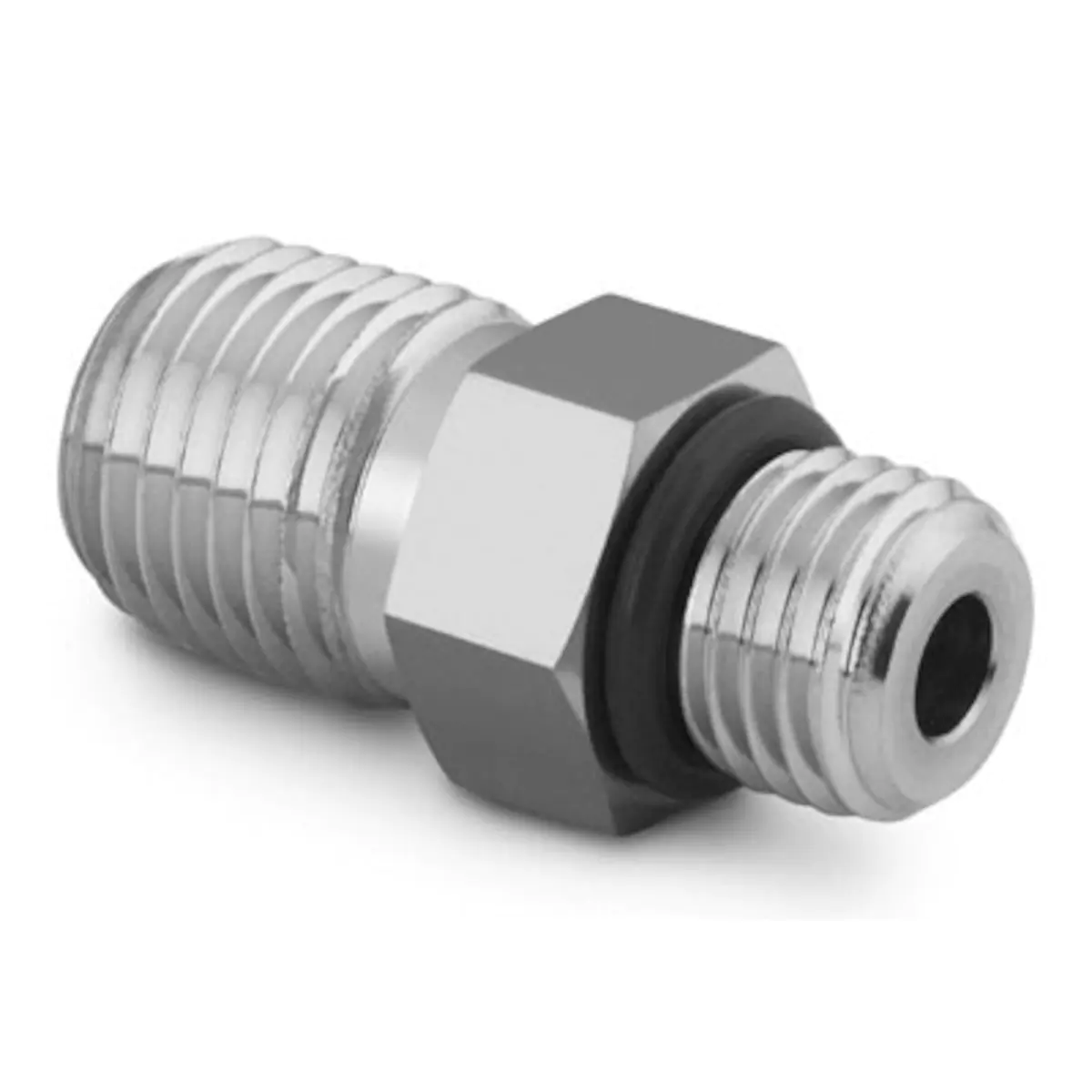
TES-LOK SAE MS Male Adapter
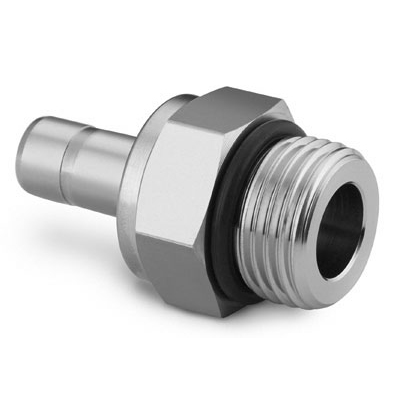
SAE MS Straight Thread Series
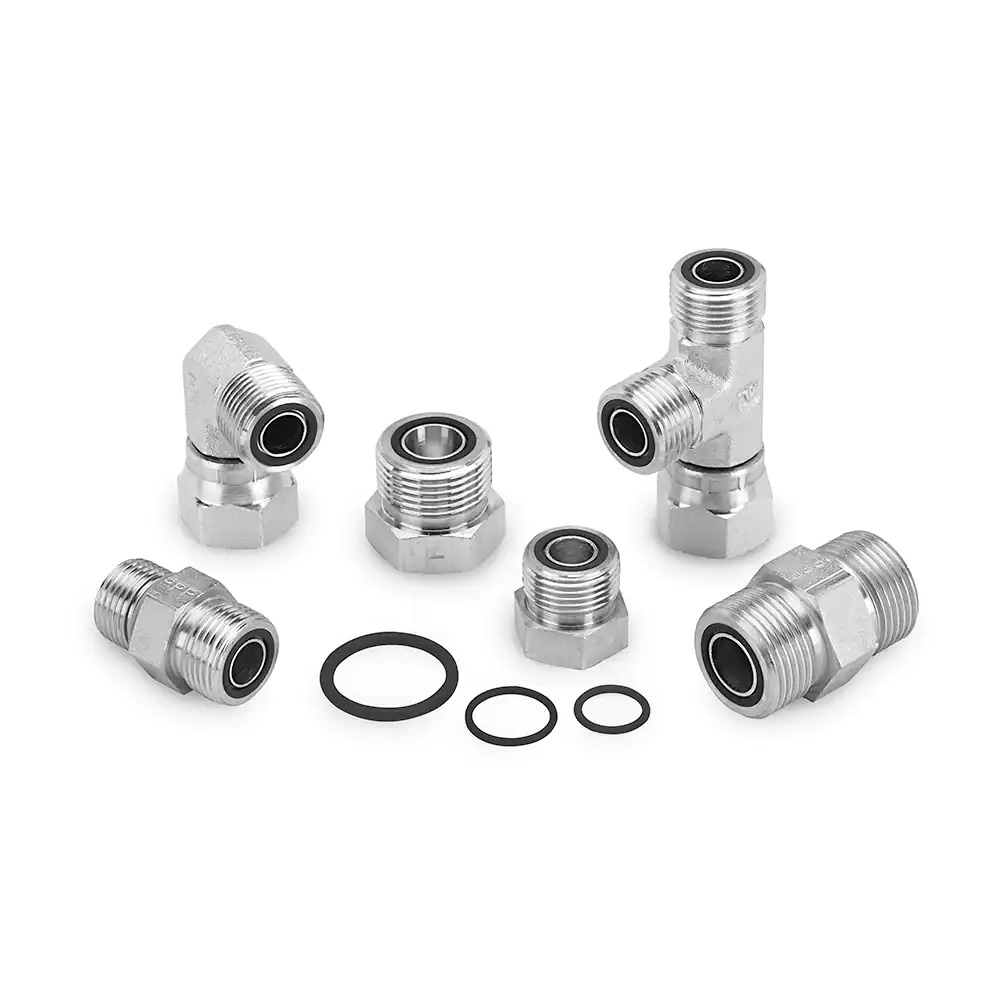
O-Ring Face Seal (ORFS) — Related
"SAE" refers to the Society of Automotive Engineers thread standard; "MS" refers to the Military Standard designation (MS16142) which defines the same straight-thread O-ring port system for aerospace and defence applications. Both refer to the same UNF straight thread with O-ring boss geometry — the terms are used interchangeably in industrial practice.
| System | Thread Type | Sealing Method | Sealant Needed? | Re-usable? | Best For |
|---|---|---|---|---|---|
| SAE MS / ORB | UNF straight (60°) | O-ring axially compressed at port boss face | No — O-ring seals dry | Yes — replace O-ring | Hydraulics, aerospace, industrial machinery |
| NPT | Tapered 60° | Thread interference + sealant/tape | PTFE tape required | Limited — tape needed each time | General piping, instrumentation |
| BSPT (Rc) | Tapered 55° | Thread interference + tape | PTFE tape required | Limited | UK / European piping |
| BSPP + Bonded Seal | Parallel 55° | Dowty seal at thread shoulder face | No — seal included | 1–2 assemblies per seal | European instrumentation BSPP ports |
| ORFS (SAE J1453) | UNF straight | O-ring in cone-face groove; flat face contact | No — O-ring seals | Yes — replace O-ring | High-pressure hydraulics, OEM tubing |
| JIC 37° Flare | UNF straight | 37° metal-to-metal flare contact | No — metal seal | Yes | Hydraulic tube & hose, fuel systems |
SAE and MS fittings are specified by dash size — a number that equals the nominal tube or port size in sixteenths of an inch. A -4 fitting = 4/16" = 1/4". The UNF thread size associated with each dash size is fixed by the standard.
| Dash Size | Tube OD (Inch) | UNF Thread Size | O-Ring Size (AS568) | Max Pressure (SS 316) |
|---|---|---|---|---|
| -2 | 1/8" | 5/16"-24 UNF | AS568-902 | 6 000 PSI |
| -4 | 1/4" | 7/16"-20 UNF | AS568-904 | 6 000 PSI |
| -6 | 3/8" | 9/16"-18 UNF | AS568-906 | 5 500 PSI |
| -8 | 1/2" | 3/4"-16 UNF | AS568-908 | 5 000 PSI |
| -10 | 5/8" | 7/8"-14 UNF | AS568-910 | 4 500 PSI |
| -12 | 3/4" | 1-1/16"-12 UN | AS568-912 | 4 000 PSI |
| -16 | 1" | 1-5/16"-12 UN | AS568-916 | 3 500 PSI |
| -20 | 1-1/4" | 1-5/8"-12 UN | AS568-920 | 3 000 PSI |
| -24 | 1-1/2" | 1-7/8"-12 UN | AS568-924 | 2 500 PSI |
| -32 | 2" | 2-1/2"-12 UN | AS568-932 | 2 000 PSI |
| Parameter | Details |
|---|---|
| Brand | TES-LOK (Tesco Steel & Engineering) |
| Dash Size Range | -2 through -32 (1/8" OD to 2" OD) |
| SAE/MS Thread End | Straight UNF / UN male thread per SAE J1926 / MS16142; O-ring groove behind threads |
| Tube End | Double-ferrule compression — accepts instrument/hydraulic tubing OD from 1/8" to 2" |
| O-Ring Material | NBR (Nitrile) — standard | Viton (FKM) — on request | EPDM — on request |
| Pressure Rating | SS 316: up to 6 000 PSI (dash -4) | Carbon Steel: up to 6 000 PSI | Brass: up to 3 000 PSI |
| Temperature Range | SS 316: −196°C to 450°C | Carbon Steel: −40°C to 400°C | Brass: −40°C to 150°C | Limited by O-ring material |
| Body Material | SS 304, SS 316 / 316L, Carbon Steel (1018 / 1215), Brass (CW617N), Inconel 625 (on request) |
| Ferrule Material | Matched to body — SS 316 ferrules with SS body; Brass ferrules with Brass body |
| Thread Standard | SAE J1926-1 | ISO 11926-1 | MS16142 (military) |
| O-Ring Standard | AS568 (Imperial) | ISO 3601 (Metric equivalent) |
| Surface Finish | Passivated (SS); zinc-plated or phosphate coated (Carbon Steel); bright zinc / nickel (Brass) |
| Certifications | ISO 9001:2015 | EN 10204 3.1 MTC on request | Hydrostatic test certification available |
| Material | Max Temp | Corrosion Resistance | Typical Application |
|---|---|---|---|
| Carbon Steel (1018) | 400°C | Moderate — requires protective coating | Hydraulic power units, mobile equipment, industrial machinery |
| SS 304 | 450°C | Good — general corrosion resistance | Food, pharma, water-based fluid systems |
| SS 316 / 316L | 450°C | Excellent — chloride resistant | Chemical processing, offshore, marine hydraulics |
| Brass (CW617N) | 150°C | Moderate — no ammonia or strong acids | HVAC, pneumatics, low-pressure hydraulics |
| Inconel 625 | 650°C | Outstanding — high-temp oxidation & corrosion | Aerospace, high-temperature hydraulic circuits, defence |
| Configuration | Tube End | SAE/MS End | Orientation | Best For |
|---|---|---|---|---|
| Standard (Fixed) SAE Male Adapter | Double-ferrule compression | SAE ORB male — fixed position | Fixed on assembly — set by thread engagement | Compact assemblies where tube direction is predetermined |
| Adjustable SAE Male Adapter | Double-ferrule compression | SAE ORB male + back-up washer + locknut | Swivels 360° before locknut tightened | Instrument racks — tube direction known only at installation |
| SAE Male Elbow Adapter (90°) | Double-ferrule compression | SAE ORB male — 90° to tube axis | Fixed 90° angle | Port access at right angle to tube run |
| SAE Male Elbow Adapter (45°) | Double-ferrule compression | SAE ORB male — 45° to tube axis | Fixed 45° angle | Diagonal port entry — lower pressure drop |
| Reducing SAE Male Adapter | Smaller tube OD | Larger SAE ORB thread | Straight | Small instrument tube (1/4") into large SAE port (-12 or -16) |
The O-ring groove width, depth, and corner radii are held to SAE J1926 tolerances — ensuring correct O-ring compression (15–25% squeeze) without cutting or extruding the O-ring. Under-depth grooves cause low squeeze and leakage; over-depth grooves cause O-ring extrusion and failure under pressure cycling.
TES-LOK SAE MS adapters are manufactured to comply with both SAE J514 / J1926 (commercial hydraulic standard) and MS16142 (US military standard) — enabling use on both commercial industrial projects and defence / aerospace specifications from the same part number.
The elastomeric O-ring provides a positive, positive-pressure, positive-vacuum seal without PTFE tape, anaerobic compounds, or pipe sealant. No contamination risk to hydraulic fluid. No cure time. Immediate pressure-test after assembly.
The adjustable variant (locknut type) allows the fitting body to be rotated to any position before the locknut is tightened — a critical advantage when tube routing must be determined after the fitting is threaded into the valve port. No need to remove and re-install the fitting to change tube direction.
Dash -4 through -16 in SS 316 and Carbon Steel maintained ex-stock in Mumbai. Dash -20, -24, -32 and special alloys (Inconel) manufactured to order with 2–3 week lead time. Single-source procurement for complete hydraulic and instrumentation skid bills of material.
Full material traceability from mill certificate to finished fitting. Hydrostatic testing at 1.5× rated pressure available per batch. Dimensional inspection reports per SAE J1926 thread gauging. Suitable for EPC contractor and owner-operator QA/QC requirements.
| Dash Size | UNF Thread | Torque — Steel Body (Nm) | Torque — SS 316 Body (Nm) | Torque — Brass Body (Nm) |
|---|---|---|---|---|
| -4 | 7/16"-20 | 12–16 Nm | 14–18 Nm | 9–12 Nm |
| -6 | 9/16"-18 | 20–26 Nm | 22–28 Nm | 14–18 Nm |
| -8 | 3/4"-16 | 34–42 Nm | 36–44 Nm | 22–28 Nm |
| -10 | 7/8"-14 | 47–57 Nm | 50–60 Nm | 30–38 Nm |
| -12 | 1-1/16"-12 | 61–75 Nm | 65–80 Nm | 40–50 Nm |
| -16 | 1-5/16"-12 | 95–115 Nm | 100–120 Nm | 60–75 Nm |
| Industry | Typical Use Point | Why SAE MS Preferred |
|---|---|---|
| Hydraulic Power Units | Pump outlet / inlet instrument tapping points, actuator port connections, valve manifold SAE ports | SAE ORB ports are the dominant standard on hydraulic valves and cylinders worldwide — direct fit without adapters |
| Mobile & Construction Equipment | Excavator hydraulic circuits, crane slew circuits, loader valve banks | SAE/MS connections resist vibration and shock loads better than NPT; no thread loosening over time |
| Aerospace & Defence | Aircraft hydraulic systems per MS16142; armoured vehicle hydraulic actuators; missile hydraulic actuators | MS16142 military qualification; material certs to AS/EN standards; traceable heat numbers |
| Oil & Gas | Subsea BOP hydraulic control systems, wellhead accumulator instrument connections | SS 316 body resists salt water; O-ring seal provides reliability in vibrating wellhead environments |
| Industrial Machinery | Injection moulding machine hydraulics, metal-forming press circuits, CNC machine tool hydraulic ports | SAE ORB is the standard port on most industrial hydraulic valves; no conversion needed |
| Power Generation | Steam turbine governing hydraulics, lube oil system instrument connections | SS 316 body + Viton O-ring tolerates turbine oil temperatures above 100°C |
| Automotive & Test Rigs | Vehicle hydraulic brake test rigs, powertrain test bench instrument connections | SAE J514 compliance ensures traceability in automotive OEM and test environments |
| Shipbuilding / Marine | Bow thruster hydraulics, deck crane hydraulic circuits, hatch actuator control ports | SS 316 body resists marine atmosphere; SAE ORB connections standard on marine hydraulic components |
Q1. What is the difference between SAE O-ring boss (ORB) and O-ring face seal (ORFS)?
Both use straight UNF threads and an O-ring seal, but the geometry differs fundamentally. ORB (SAE J1926 / MS16142): the O-ring sits in a groove on the fitting shoulder and seals against the flat boss face of the female port. ORFS (SAE J1453): the O-ring sits in a groove machined into the fitting face and seals against a machined cone face in the female port. ORB ports and ORFS ports are not interchangeable — the fitting must match the port type exactly.
Q2. How do I identify an SAE O-ring boss port on a hydraulic valve?
An SAE ORB port has a flat-faced machined boss area around the port hole, a visible chamfer at the port entry, and a straight UN/UNF thread. It does not taper. There is no O-ring groove in the port face itself (the groove is on the fitting, not the port). Compare with: NPT/BSPT ports taper noticeably when you look down the bore; ORFS ports have a cone-shaped internal chamfer. If the port is flat-faced with a straight thread, it is most likely SAE ORB — confirm the thread pitch against the SAE J1926 dash size chart.
Q3. What O-ring material should I specify for hydraulic oil service?
For mineral-oil-based hydraulic fluids (ISO 46, ISO 68, HV 46), specify NBR (Nitrile) — the standard option. For synthetic hydraulic fluids (phosphate ester, water-glycol, polyol ester), specify Viton (FKM). For water-based fluids and biodegradable esters, EPDM is suitable. Always verify the O-ring compatibility with the specific fluid formulation — fluid additive packages can affect elastomer compatibility even within the same base fluid type.
Q4. Can an SAE MS male adapter be used on a JIC 37° flare port?
No. JIC 37° flare connections (SAE J514 JIC) use the same UNF thread sizes as ORB, but the sealing mechanism is completely different — the JIC fitting has a 37° flared nose that seals against a matching 37° cone seat in the port. An ORB fitting screwed into a JIC port will not have O-ring contact with any sealing surface and will leak. Always verify the port type before selecting the adapter end configuration.
Q5. What is the "adjustable" SAE male adapter and when should I use it?
An adjustable SAE male adapter (also called "SAE adjustable port adapter") has a back-up washer and a separate jam/locknut on the thread behind the O-ring groove. Thread the fitting into the port until the O-ring contacts the boss face, then back off 1–1.5 turns. Rotate the fitting body to point the tube outlet in the desired direction, then tighten the locknut to compress the O-ring and lock the position. Use when tube routing direction is determined after the fitting is already in the port — avoids having to remove and re-thread the fitting to change orientation.
Q6. What does the dash number mean in SAE MS fittings — e.g. dash -8?
The dash number equals the nominal tube OD in sixteenths of an inch. Dash -8 = 8/16" = 1/2" tube OD. This also corresponds to a specific UNF thread size (3/4"-16 UNF for -8), a specific O-ring groove size (AS568-908), and a specific wrench hex size. All dimensions are fixed by the SAE J1926 / MS16142 standard for each dash size.
Q7. Are TES-LOK SAE MS adapters interchangeable with Parker or Swagelok SAE fittings?
Yes for the SAE ORB thread end — TES-LOK adapters are manufactured to SAE J1926 / MS16142 dimensional standards, so the thread end will engage correctly with any SAE-compliant female port regardless of the original port manufacturer. For the compression tube end: TES-LOK uses the same double-ferrule geometry as industry-standard systems and ferrules are dimensionally interchangeable, though TES-LOK recommends using TES-LOK ferrule sets with TES-LOK bodies for certified performance.
Q8. Do you supply material test certificates for SAE MS male adapters?
Yes. EN 10204 3.1 material test certificates are available for SS 304, SS 316, and Inconel 625 bodies. Carbon steel and Brass adapters are supplied with EN 10204 2.1 compliance certificates as standard; 3.1 certificates are available on request. Hydrostatic test certificates and dimensional inspection reports per SAE J1926 gauging are available for project orders.