

TES-LOK Needle Valve Tube Fittings — precision tapered-needle flow control with double-ferrule compression tube end connections. Infinitely variable throttling from fully closed to fully open. SS 316 · Brass · Monel · Inconel · Straight / Angle / Union Bonnet patterns · Up to 6,000 PSI · ISO 9001:2015 certified.
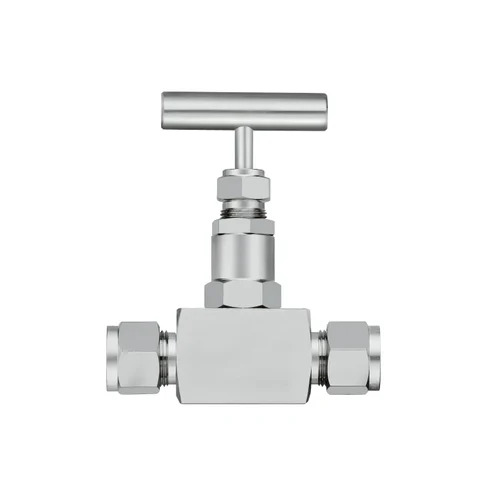
A needle valve tube fitting integrates a precision needle valve body with double-ferrule compression tube end connections — the same ferrule geometry used in standard TES-LOK tube fittings — so the valve threads directly into the instrument tube system with no separate adapters, unions, or transition pieces.
Flow control is achieved by a slender, tapered needle stem that threads against a matching conical seat machined into the valve body. Turning the handwheel clockwise advances the needle into the seat, progressively reducing the annular flow area until the valve is fully closed; turning counter-clockwise retracts the needle and opens flow. The fine-pitch stem thread gives far more precise incremental control than a ball valve, globe valve, or gate valve — making the needle valve the instrument of choice for flow trimming, calibration gas adjustment, sample stream control, and gauge root isolation.
TES-LOK Needle Valve Tube Fittings are available in three patterns — straight (inline), angle (90°), and union bonnet — and in a full range of materials from SS 316 (standard) through Monel, Inconel, and Hastelloy for corrosive or extreme-temperature service. Maximum working pressure is 6,000 PSI. All valves are supplied with full Mill Test Certificates and ISO 9001:2015 certification.
When the handwheel is turned clockwise (closed direction), the stem thread advances the needle tip into the conical seat. As the gap between needle and seat narrows, flow velocity increases and volume decreases — giving precise throttling. At full closure, the needle tip seats metal-to-metal (or against a soft seat insert) to achieve zero leakage shut-off.
When turned counter-clockwise (open direction), the needle retracts, enlarging the annular flow area. The number of turns from fully closed to fully open is typically 3–7 turns depending on the valve orifice size — each half-turn producing a predictable, repeatable change in Cv. This repeatability is what makes needle valves indispensable for calibration and analytical instrument flow control, where the same flow setting must be reproduced reliably after each maintenance interval.
The packing gland above the needle seat prevents process fluid from leaking up the stem. Standard packing is PTFE (suitable up to ~260 °C / 500 °F); graphite (Grafoil) packing is specified for high-temperature steam, hot-oil, or hydrogen service. The packing nut can be retightened in service without removing the valve from the line.
Straight (Inline) Pattern
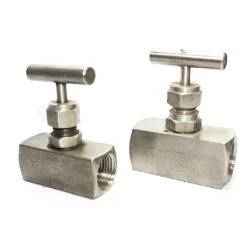
High Pressure Pattern
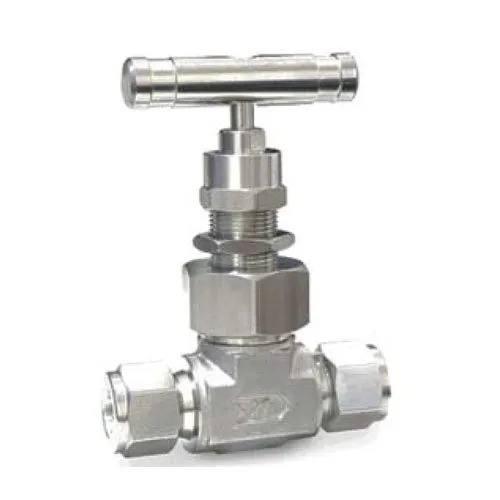
Union Bonnet Pattern
| Pattern | Port Geometry | Key Feature | Best For |
|---|---|---|---|
| Straight (Inline) | Both ports on same axis (180°) | Most compact inline valve; direct flow path | Instrument isolation, flow trimming, calibration gas lines |
| Angle (90°) | Ports at 90° to each other | Direction change + flow control in one body; saves a separate elbow | Panel-mount installations, space-constrained instrument loops |
| Union Bonnet | Straight or angle; threaded union bonnet | Bonnet removable in-line for stem/packing maintenance without disturbing tube connections | Critical service, high-maintenance environments, offshore module piping |
| Parameter | Details |
|---|---|
| Product name | Needle Valve Tube Fitting |
| Brand | TES-LOK (Tesco Steel & Engineering) |
| End connections (standard) | Double-ferrule compression tube both ends |
| End connections (optional) | Compression tube one end + NPT/BSP male or female other end |
| Patterns | Straight (inline) · Angle (90°) · Union bonnet |
| Valve mechanism | Tapered needle stem against conical seat — metal-to-metal shut-off |
| Tube OD range | 1/4" to 1" (imperial) · 6 mm to 25 mm (metric) |
| Orifice size | 1/16" to 1/4" (varies by valve size) |
| Max working pressure | Up to 6,000 PSI (SS 316, ambient temperature) |
| High-pressure option | Up to 10,000 PSI (special body, SS 316) |
| Body material | SS 316 (standard) · SS 316L · SS 304 · Brass · Monel 400 · Inconel 600 · Hastelloy C-276 |
| Stem material | SS 316 (standard) · Matching body alloy on request |
| Packing | PTFE (standard, up to 260 °C) · Graphite/Grafoil (high temperature, up to 540 °C) |
| Temperature range | −65 °F to +500 °F PTFE · up to +1000 °F Graphite packing |
| Flow direction | Bidirectional (standard) · Unidirectional on request (soft-seat versions) |
| Cv range | 0.004 to 0.30 (depending on orifice and OD) |
| Quality certification | ISO 9001:2015 · EN 10204 3.1 MTCs · Fire-safe API 607 on request |
| Tube OD | Std Orifice | Approx Cv | Max Pressure (SS 316) | Typical Use |
|---|---|---|---|---|
| 1/4" | 1/16" | 0.004–0.010 | 6,000 PSI | Instrument isolation, calibration gas |
| 3/8" | 3/32" | 0.010–0.040 | 6,000 PSI | Sample conditioning flow trim |
| 1/2" | 1/8" | 0.030–0.100 | 6,000 PSI | Process gauge root valve, bleed/purge |
| 3/4" | 3/16" | 0.080–0.200 | 5,000 PSI | Chemical injection flow control |
| 1" | 1/4" | 0.150–0.300 | 4,500 PSI | Hydraulic flow trim, high-flow instrument loops |
| 6 mm | 1.5 mm | 0.004–0.010 | 6,000 PSI | Metric instrument loops, offshore analyser systems |
| 12 mm | 3 mm | 0.030–0.100 | 6,000 PSI | Metric process gauge isolation |
Cv values and pressure ratings are indicative. Actual values depend on orifice configuration, body design, and operating temperature. Contact Tesco Steel for certified data sheets.
| Configuration Code | Inlet | Outlet | Application |
|---|---|---|---|
| CC — Compression / Compression | Compression tube | Compression tube | Standard — both ends connect to instrument tubing |
| CM — Compression / Male Thread | Compression tube | Male NPT/BSP | Tube inlet; male thread screws into female instrument port |
| CF — Compression / Female Thread | Compression tube | Female NPT/BSP | Tube inlet; female thread receives male nipple or stud |
| MM — Male Thread / Male Thread | Male NPT/BSP | Male NPT/BSP | Both ends screw into female-threaded manifold or body ports |
| FF — Female Thread / Female Thread | Female NPT/BSP | Female NPT/BSP | Both ends receive male nipples — panel-mount or manifold connection |
The fine-pitch needle stem thread translates handwheel rotation into a precise, incremental change in the annular flow area. Unlike a ball valve (which has only on/off control) or a globe valve (which is coarser), a needle valve can hold a stable flow rate at any point between fully closed and fully open — essential for calibration gas streams, analyser sample conditioning, and bleed/purge rate control.
Double-ferrule compression tube ends are machined directly into the valve body — the same geometry as TES-LOK union connectors, elbows, and tees. The valve installs at any point in an instrument tube system using the same ferrule nuts already on the tube, with no adapters, unions, or transition fittings. This reduces the total fitting count and eliminates two additional potential leak joints per valve installation.
The TES-LOK needle tip seats against a matching conical metal seat to achieve bubble-tight shut-off without elastomeric inserts. Metal-to-metal seating is suitable for high-temperature steam, hydrogen, and cryogenic service where polymer soft seats degrade. Optional PEEK soft-tip inserts are available for zero-leakage shut-off at lower pressures.
The union bonnet variant allows the complete stem-and-packing assembly to be withdrawn from the valve body while the body remains installed in the tube line. Packing can be replaced, the stem inspected, and the needle reground without removing the valve from service or disturbing the tube connections — critical for offshore and remote installations where valve removal is costly or impractical.
TES-LOK Needle Valve Tube Fittings are available with a locking device (locking nut or handwheel lock) that prevents inadvertent stem rotation from vibration or accidental contact. This is particularly important on calibration gas flow controllers, where an unintended change in valve position affects instrument accuracy across the entire loop.
Available in SS 316 (standard), SS 316L, SS 304, Brass (non-corrosive service), Monel 400 (seawater, hydrofluoric acid), Inconel 600 (high temperature), and Hastelloy C-276 (strongly corrosive media). All materials are supplied with EN 10204 3.1 MTCs. NACE MR0175 / ISO 15156 compliant materials and documentation are available on request for sour service.
| Valve Type | Control Type | Shut-Off | Cv | Best For |
|---|---|---|---|---|
| Needle Valve | Infinite throttling | Metal-to-metal / soft seat | Very low (0.004–0.30) | Precise low-flow control, calibration, bleed/purge |
| Ball Valve | On/off only | Soft seat (PTFE) | High (Cv >1.0) | Isolation; not suited for throttling |
| Globe Valve | Throttling (coarse) | Soft or metal seat | Medium (0.1–5.0) | General flow regulation; less precise than needle |
| Check Valve | None — flow prevention | Spring-loaded | Low–medium | Backflow prevention only |
| Manifold Valve | Isolation + equalise | Soft seat | Low–medium | DP transmitter isolation and equalisation |
Step 1 — Install the tube end connections. Prepare the tube ends (cut square, deburr, clean) and make up the compression tube connections on both valve ports per the standard TES-LOK installation procedure: insert tube fully to shoulder, hand-tighten the ferrule nut, then tighten 1¼ turns for initial make-up.
Step 2 — Determine flow direction. Most TES-LOK needle valves are bidirectional. Where a flow arrow is marked on the body, connect the upstream port to the higher-pressure source and the downstream port to the instrument or sample system. For soft-seat versions, correct flow direction is mandatory — the arrow must face upstream.
Step 3 — Initial opening. Before pressurising, turn the handwheel fully counter-clockwise until it stops — this is the fully open position. Never force the handwheel past the stop; over-driving the needle into the seat will damage the needle tip and seat surface, degrading shut-off performance.
Step 4 — Throttle to desired flow rate. Turn the handwheel clockwise (close direction) slowly until the desired flow rate is achieved. Count the turns from fully open as a reference mark. Mark the handwheel position with a permanent marker or use the turn-counter scale if fitted. Each half-turn corresponds to a reproducible Cv increment for the specific valve size.
Step 5 — Packing adjustment. If stem leakage is observed around the packing gland, tighten the packing nut by ¼ turn at a time until leakage stops — do not over-tighten, as excess packing compression increases stem operating torque and accelerates packing wear. For union bonnet valves, replace packing by loosening the union nut, withdrawing the bonnet-and-stem assembly, and re-packing before reinserting.
| Industry | Typical Application |
|---|---|
| Oil & Gas | Instrument isolation at wellheads, calibration gas flow control, HP separator level gauge root valves |
| Refinery / Petrochemical | Analyser sample conditioning flow trim, bleed/purge control on instrument headers, DCS loop isolation |
| Power Generation | Boiler gauge root valve, steam impulse line isolation, turbine lube oil flow adjustment |
| Chemical / Pharma | Reagent dosing rate control, CIP/SIP flow trimming, sterile utility line bleed valves |
| Laboratory & Analytical | Gas chromatograph carrier gas flow control, mass spectrometer sample inlet trimming, laboratory bench gas regulators |
| Marine & Offshore | Deck instrument isolation, hydraulic circuit flow trim, HVAC flow balancing |
▶ What is a needle valve tube fitting?
▶ How does a needle valve work?
▶ What is the difference between a straight and angle needle valve?
▶ What is a union bonnet needle valve?
▶ What tube OD sizes are available?
▶ What is the maximum pressure rating?
▶ What materials are available?
▶ Which industries use needle valve tube fittings?
ISO 9001:2015 certified manufacturer. SS 316 · Brass · Monel · Inconel · Hastelloy. 1/4"–1" compression tube. Straight · Angle · Union Bonnet. Up to 6,000 PSI. PTFE & Graphite packing. Short lead times.
✉ Email Quote 📞 WhatsApp 📞 Call Us