

Tesco Steel & Engineering manufactures forged rings — seamless rings produced by the forging / ring-rolling process and then finished by CNC machining. Forging refines and circumferentially orients the grain and closes internal voids, so a forged ring has higher strength, toughness, and fatigue life than a cast or plate-cut ring — ideal for flanges, bearing races, gears, valve and pump rings, and turbine rings. Made in stainless, carbon, and alloy steel, Inconel, Monel, and Hastelloy (304/316/321/310, Inconel 600/601/625/800, Monel 400/K500, and more). ISO 9001:2015 certified. Made in India.
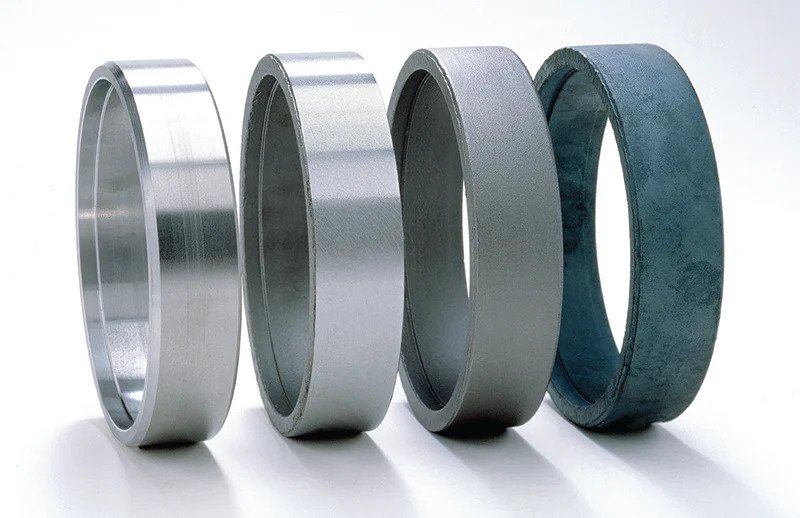
Seamless Forged Ring
Forged rings are a forged-component / special-products line. Tesco Steel & Engineering manufactures them to drawing alongside forged turbines and other forgings — see our special products range.
| Property | Forged Ring | Cast / Plate-Cut Ring |
|---|---|---|
| Grain structure | Worked, grain flows circumferentially | As-cast / cut; random or straight grain |
| Internal soundness | Voids & porosity closed | Possible porosity / inclusions |
| Strength & toughness | Higher | Lower |
| Fatigue / hoop strength | Superior (grain follows the hoop) | Reduced |
| Best for | High-stress flanges, races, gears, rings | Lower-duty / simple parts |
| Form | Description |
|---|---|
| Flange Blanks | Forged rings machined into flanges & ring-type flanges |
| Bearing Races | Inner/outer races for large bearings |
| Gear Blanks | Ring blanks for gears & ring gears |
| Valve & Pump Rings | Body rings, seats, & wear rings |
| Turbine / Compressor Rings | Nozzle, diaphragm & casing rings |
| Tyres & Slewing Rings | Large-diameter rings for kilns, cranes & bearings |
| Material | Properties | Typical Use |
|---|---|---|
| Stainless Steel (304/316/321/310) | Corrosion & oxidation resistant | General & corrosive-service rings |
| Carbon & Alloy Steel | High strength (Cr-Mo, 4140, etc.) | Flanges, gears, bearing races |
| Inconel 600 / 601 / 625 / 718 | Excellent high-temperature strength | Hot-section & turbine rings |
| Monel 400 / K500 | Excellent in marine & reducing media | Marine & corrosive rings |
| Incoloy / Hastelloy | High-temp & aggressive-media resistance | Severe-service rings |
Circumferential grain flow and closed porosity give high hoop strength, toughness, and fatigue life.
Precision CNC machining produces the exact ring dimensions and profile from the forging.
SS, carbon & alloy steel, Inconel, Monel, Incoloy, and Hastelloy for high-temperature and corrosive duty.
Seamless rolled rings — no weld seam — inspected by NDT for internal soundness.
From small machined rings to large-diameter rolled rings for slewing bearings and kilns.
Full material traceability and EN 10204 3.1 material test certificates on request.
| Industry | Typical Use | Why Forged Ring |
|---|---|---|
| Oil & Gas | Flanges, valve & wellhead rings | High strength; sour/high-temp alloys |
| Power Generation | Turbine, generator & casing rings | Hoop strength & fatigue life |
| Aerospace & Defence | Engine & structural rings | High strength-to-weight; nickel alloys |
| Bearings & Gears | Races, slewing & ring gears | Seamless, tough, machinable blanks |
| Wind & Renewables | Slewing & tower-flange rings | Large-diameter rolled rings |
| Cement & Steel | Kiln tyres & mill rings | Large, durable forged rings |
| Marine & Shipbuilding | Flanges & equipment rings | Monel/SS corrosion resistance |
| Chemical / Process | Vessel & valve rings | Corrosion-resistant alloy forgings |
Q1. What are forged rings?
Forged rings are seamless rings made by forging — usually by piercing a billet and expanding it on a ring-rolling mill (or open-die forging) — and then CNC machining to final size. Forging orients the grain around the ring and closes porosity, giving much higher strength, toughness, and fatigue life than cast or plate-cut rings. They are the blanks for flanges, bearing races, gears, and other ring components.
Q2. Why are rings forged rather than cut from plate or cast?
In a forged (rolled) ring the grain flows around the circumference, matching the hoop stresses a ring carries, and internal voids are closed. A ring cut from plate has straight grain and a ring cast may have porosity, so both are weaker and less fatigue-resistant. For high-stress flanges, races, and gears the forged ring is far superior.
Q3. What is ring rolling?
Ring rolling is the forging process that makes seamless rings: a pierced preform is placed on a ring-rolling mill where rolls reduce its wall and grow its diameter, producing a seamless ring with circumferential grain flow. It is used for everything from small flanges to very large slewing-bearing and kiln-tyre rings.
Q4. What are forged rings used for?
As blanks and finished parts for flanges and ring-type flanges, bearing races, gear and ring-gear blanks, valve and pump body/seat/wear rings, turbine and compressor rings, and large kiln tyres and slewing rings — anywhere a strong, seamless ring is needed.
Q5. What materials are forged rings made from?
Stainless steels (304/316/321/310), carbon and alloy steels (Cr-Mo, 4140, etc.), Inconel (600/601/625/718), Monel (400/K500), Incoloy, and Hastelloy. The grade is chosen for the load, temperature, and environment — nickel alloys for high-temperature or corrosive service.
Q6. Are forged rings heat-treated and tested?
Yes. After forging they are heat-treated to develop the required mechanical properties, CNC-machined, and inspected with dimensional, NDT (ultrasonic/dye-penetrant), and mechanical/material tests. Certification (EN 10204 3.1) is supplied on request.
Q7. What sizes of forged ring can you supply?
A wide range — from small machined rings to large-diameter rolled rings for slewing bearings, wind-turbine flanges, and kiln tyres — depending on the alloy and equipment. Send your ring dimensions and we will confirm feasibility.
Q8. Can forged rings be supplied to our drawing and certified?
Yes. We manufacture forged rings entirely to your drawing — OD, ID, height, profile, material, heat-treat condition, and testing — with full traceability and EN 10204 3.1 material test certificates on request. Send your drawing and duty for a quote.