

UNS S32760 | Zeron 100 | DIN 1.4501 | W + Cu Alloyed | PRE(N+W) ~42 | YS 550 MPa | Seawater Qualified
ASTM A182 Grade F55 is a super duplex stainless steel standardised under UNS S32760 and DIN 1.4501 (X2CrNiMoCuN25-6-3), widely known by its commercial designation Zeron 100 — originally developed by Weir Materials (now IMI Critical Engineering) and among the most specified super duplex grades for aggressive marine and chemical environments.
F55 belongs to the same PREN ≥40 super duplex family as F53/2507 but is distinguished by two unique alloying additions that F53 does not contain:
The combined W + Cu alloying gives F55/Zeron 100 a unique dual capability: seawater-grade pitting resistance from the high Cr-Mo-W-N alloy system, plus reducing-acid resistance from the Cu addition — a combination unavailable in any single other standard ASTM duplex grade.
At yield strength ≥550 MPa (3.2× Grade 316L), F55 also delivers the structural efficiency advantage common to all super duplex grades, enabling significant wall-thickness and weight savings versus austenitic alternatives.
Mechanism: W forms Mo-like passivating oxides (WO₃) in the passive film and slows pit propagation by adsorbing at active sites in the dissolution zone.
PRE contribution: +1.65 per %W → 0.75% W adds approximately +1.24 to PRE(N+W) vs standard PREN
Best for: Crevice corrosion resistance, pitting under deposits, extended passive range in chloride media
Mechanism: Cu suppresses the anodic hydrogen evolution reaction in reducing acids (H₂SO₄, HCl) — the predominant dissolution mechanism in acid-chloride environments. This is not captured by the PREN formula.
Effect: Measurably lower corrosion rates in dilute H₂SO₄ and HCl vs 2507 (no Cu)
Best for: Mixed acid-chloride service, chemical plants, FGD slurries with acidic pH
| Property / Environment | F53 / 2507 (UNS S32750) | F55 / Zeron 100 (UNS S32760) |
|---|---|---|
| PREN (standard formula) | ~43 | ~41 |
| PRE(N+W) including W | ~43 (no W) | ~42 |
| Seawater pitting resistance | Excellent (CPT >50°C) | Excellent (CPT >50°C) |
| Crevice corrosion resistance | Very good | Superior (W benefit) |
| Dilute H₂SO₄ / HCl resistance | Good | Superior (Cu benefit) |
| Acetic acid resistance | Good | Superior (Cu benefit) |
| Yield strength | ≥550 MPa | ≥550 MPa |
| Elongation | ≥15% | ≥25% (better specified ductility) |
| Max interpass (welding) | 100°C | 100°C |
| Filler metal | ER2594 | ER2594 or Zeron 100X |
| PWHT | Prohibited | Prohibited |
| DIN / EN | 1.4410 | 1.4501 |
| NORSOK MDS | MDS D58 | MDS D59 |
| Element | Min (%) | Max (%) | Role & Significance |
|---|---|---|---|
| Chromium (Cr) | 24.0 | 26.0 | Primary pitting and general corrosion barrier; 25% Cr is the super duplex standard |
| Nickel (Ni) | 6.0 | 8.0 | Austenite stabiliser; maintains phase balance at high Cr+Mo+W content |
| Molybdenum (Mo) | 3.0 | 4.0 | Pitting resistance (3.3× contribution to PREN); synergistic with W |
| Tungsten (W) | 0.50 | 1.00 | Unique element — enhances crevice corrosion and pitting resistance; 1.65× contribution to PRE(N+W) |
| Copper (Cu) | 0.50 | 1.00 | Unique element — suppresses anodic dissolution in reducing acids (H₂SO₄, HCl, acetic acid) |
| Nitrogen (N) | 0.20 | 0.30 | Strongest austenite stabiliser; 16× contribution to PREN; improves strength |
| Carbon (C) | — | 0.030 | Extra-low C prevents sensitisation during welding |
| Silicon (Si) | — | 1.00 | Controlled to limit sigma phase; slightly higher limit than 2507 |
| Manganese (Mn) | — | 1.00 | Controlled; lower limit than 2507 (≤1.2%) for cleanliness |
| Phosphorus (P) | — | 0.030 | Controlled for toughness and grain boundary integrity |
| Sulfur (S) | — | 0.010 | Tight S limit for corrosion resistance and hot workability |
| Property | Requirement | Imperial |
|---|---|---|
| Tensile Strength (UTS) | ≥750 MPa | ≥110 ksi |
| Yield Strength (0.2% offset) | ≥550 MPa | ≥80 ksi |
| Elongation in 2 in (50 mm) | ≥25% | ≥25% |
| Hardness (max) | 310 HBW | 32 HRC |
| NACE/ISO 15156-3 hardness limit | 350 HBW | 36 HRC |
| Heat Treatment Condition | Solution annealed 1020–1100°C + water quench | |
| Microstructure (target) | 40–60% ferrite / 40–60% austenite | |
| Impact (Charpy V-notch) | 27 J min at −46°C (transverse) | |
F55 specifies elongation ≥25% — significantly better than F53/2507 (≥15%) and F51/2205 (≥20%). This higher ductility requirement is an important advantage in applications involving thermal cycling, vibration, or complex stress states such as seawater injection system pipework, which experiences frequent pressure-flow transients.
PRE(N+W) = %Cr + 3.3 × %Mo + 1.65 × %W + 16 × %N
At nominal composition (25% Cr, 3.5% Mo, 0.75% W, 0.25% N):
PRE(N+W) = 25 + (3.3 × 3.5) + (1.65 × 0.75) + (16 × 0.25) = 25 + 11.55 + 1.24 + 4.0 = 41.8
Standard PREN (without W credit):
PREN = 25 + 11.55 + 4.0 = 40.6
Note: Both formulas place F55 above the PREN ≥40 seawater immersion threshold. The W contribution of +1.24 to PRE(N+W) is real engineering value, but in critical seawater applications ASTM G48 Method E (CPT testing) is always the definitive corrosion qualification test.
UNS S31803 — Standard Duplex
PREN ~35
YS: 450 MPa
Offshore splash zone; moderate Cl⁻; no seawater immersion
UNS S32760 — Super Duplex
PRE ~42
YS: 550 MPa
Seawater + reducing acids; W+Cu alloyed; best-in-class ductility
UNS S32750 — Super Duplex
PREN ~43
YS: 550 MPa
Seawater; pure chloride service; no W or Cu; max Mo (4%)
| Regime | Temperature Range | Notes for F55 / Zeron 100 |
|---|---|---|
| Minimum service temperature | −50°C (−58°F) | 27 J Charpy V-notch at −46°C required; good cryogenic toughness confirmed by testing |
| Continuous service maximum | 280°C (536°F) | W+Mo high alloy content increases sigma-phase driving force; conservative upper limit important |
| ASME B16.5 Group 2.3 design limit | 315°C (600°F) | Allowable stress decreasing above 280°C; use conservatively |
| 475°C embrittlement | 300–500°C | Spinodal decomposition of high-Cr ferrite; faster in W-alloyed grade; AVOID |
| Sigma phase zone | 600–1000°C | Fe-Cr-Mo-W intermetallic; forms within 1–5 min at 850°C; strict interpass control essential |
| Solution anneal (permissible HT only) | 1020–1100°C + WQ | Restores phase balance; dissolves all sigma, chi, and nitride precipitates |
In F55/Zeron 100, the additional W and the high Cr-Mo content mean sigma-phase kinetics are among the fastest of any commercial duplex grade. The maximum interpass welding temperature of 100°C (same as F53/2507) must be strictly enforced. Heat input should be kept at the lower end (0.5–1.5 kJ/mm) and each weld pass allowed to cool below 100°C before the next pass is deposited. Failure to control interpass temperature risks sigma-phase formation in the heat-affected zone, which will be invisible to the naked eye but will destroy pitting resistance in seawater service.
| Welding Parameter | Requirement for F55 / UNS S32760 |
|---|---|
| Preheat | Not required. Surfaces must be clean, dry, chloride-free. Moisture causes porosity and H absorption. |
| Maximum interpass temperature | 100°C — strict super duplex requirement; measure with contact thermometer before each pass |
| Filler metal (GTAW/GMAW) | AWS ER2594 (25Cr-9.5Ni-3.5Mo-0.25N) — standard; or Zeron 100X (proprietary over-alloyed Zeron filler) for critical applications |
| Filler metal (SMAW) | AWS E2594-XX — matching ER2594 electrode composition |
| Shielding gas (GTAW) | Ar + 2–3% N₂; nitrogen addition essential to maintain austenite balance in weld metal |
| Post-weld heat treatment | PROHIBITED in 300–1050°C range. Solution anneal 1020–1100°C + WQ for rework only. |
| Ferrite Number target | FN 25–65 (WRC-1992 diagram; measure with calibrated ferritescope after welding) |
| Heat input | 0.5–1.5 kJ/mm; avoid excessive multi-pass overlap that accumulates heat |
| Post-weld corrosion test | ASTM G48 Method A or E on weld coupon recommended for offshore and seawater service |
| Procedure qualification | ASME Section IX or EN ISO 15614-1; must include hardness survey, ferrite check, Charpy impact, and G48 test for offshore QA |
| Phase | Temperature Range | Effect on F55 | Recovery |
|---|---|---|---|
| 475°C Embrittlement | 300–500°C | Spinodal decomposition of high-Cr+W ferrite into α' + α phases; severe toughness loss; hardness increase; irreversible in service | Solution anneal 1020–1100°C + WQ |
| Sigma (σ) Phase | 600–1000°C | Fe-Cr-Mo-W intermetallic at phase boundaries; catastrophic toughness and corrosion loss; worst near 850°C in Zeron 100 | Solution anneal 1060–1100°C + WQ |
| Chi (χ) Phase | 700–900°C | W-rich intermetallic (W stabilises chi phase more than in W-free 2507); embrittlement and local PREN reduction | Solution anneal + WQ |
| Cr₂N Precipitation | 700–950°C | Chromium nitride at ferrite/austenite interfaces; sensitisation; reduces weld HAZ pitting resistance | Rapid cooling through critical range; solution anneal if needed |
The tungsten content of F55 (0.5–1.0%) slightly promotes chi-phase formation compared to W-free 2507 — reinforcing the need for strict heat input control and 100°C maximum interpass temperature during welding. In the correctly solution-annealed condition, all these phases are absent and the alloy performs as specified.
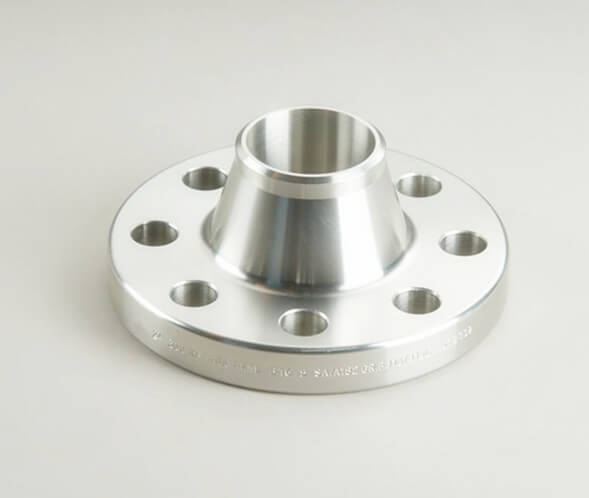
Preferred for offshore subsea and high-pressure seawater injection lines. Bore-matching tapered hub minimises turbulence and erosion at the flange junction. Available in RTJ facing for subsea tie-in connections.

Used in above-waterline process piping and topsides applications where the full fatigue performance of weld neck is not required. Fillet-welded inside and outside per ASME B31.3.
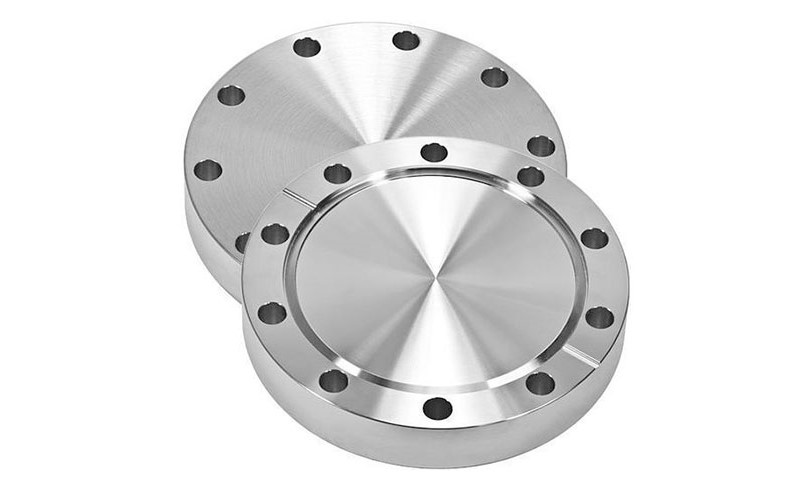
Heavy-wall closures for high-pressure seawater, chemical, and FGD isolation duties. RTJ-faced blinds widely specified for offshore systems. Full corrosion resistance across the entire wetted face area.
| ASTM A182 F55 Flange Specifications | |
|---|---|
| Standard | ASTM A182 Grade F55 / ASME SA182 Grade F55 |
| Size Range | ½″ NB to 56″ NB (DN 15 to DN 1400) |
| Pressure Classes (B16.5) | Class 150, 300, 600, 900, 1500, 2500 |
| Pressure Classes (B16.47) | Class 150, 300, 400, 600, 900 — Series A (MSS SP-44) & Series B (API 605) |
| P-T Group | ASME B16.5 Group 2.3 |
| Schedules | SCH 10S, 40S, 80S, XS, XXS, STD, Sch 20, 40, 80, 160 |
| Facing Types | Raised Face (RF), Flat Face (FF), Ring Type Joint (RTJ) — RTJ standard for offshore applications |
| DIN / EN Equivalent | 1.4501 (X2CrNiMoCuN25-6-3) — EN 10028-7, EN 10088-3 |
| Offshore Standard | NORSOK M-630 MDS D59 (S32760 / Zeron 100 material data sheet) |
| Heat Treatment | Solution annealed 1020–1100°C + water quench (mandatory for all product) |
| Testing & Inspection | PMI, chemical analysis, tensile, hardness, Charpy impact at −46°C, ferrite measurement, dimensional, visual, ASTM G48 corrosion test (seawater service), hydrostatic (on request) |
| ▶ View A182 F55 Flange Dimensions (ASME B16.5 / B16.47) |
PRE(N+W) ~42 qualifies F55 for full seawater immersion service. The W addition improves crevice corrosion resistance beyond what the Mo content alone would provide. Critical Pitting Temperature in 10% FeCl₃ (ASTM G48 Method E) is >50°C — same order as F53/2507, fully seawater qualified.
The 0.5–1.0% Cu addition gives F55 measurably superior resistance to dilute H₂SO₄, HCl, and acetic acid compared to F53 (no Cu). In chemical plants where chloride and reducing-acid conditions coexist — such as FGD slurry with low-pH excursions — F55 provides the F53-equivalent seawater resistance plus the Cu-driven acid resistance in a single alloy.
Crevice corrosion under gaskets, deposits, or in tight gaps is one of the most severe corrosion mechanisms in seawater service. The W contribution improves the resistance to crevice corrosion initiation beyond what Mo alone provides — making F55 particularly suitable for bolted flanged joints in seawater service where crevice geometry is inherent to the design.
ISO 15156-3 permits F55/S32760 in H₂S-containing environments at ≤36 HRC hardness. Combined with PRE(N+W) ≥40, the simultaneous sour-service compliance and seawater-grade pitting resistance makes F55 one of the most versatile materials for combined chloride-sour offshore production service — where many competing alloys fail one of the two requirements.
| Component | Specification | Grade |
|---|---|---|
| Flanges | ASTM A182 / ASME SA182 | Grade F55 |
| Seamless & Welded Pipe | ASTM A790 / ASME SA790 | Grade S32760 |
| Buttweld Fittings | ASTM A815 / ASME SA815 | Grade WPS32760 |
| Plate (vessels & heat exchangers) | ASTM A240 / ASME SA240 | Grade S32760 |
| Bar & Rod | ASTM A276 / ASME SA276 | Grade S32760 |
| Filler Metal (GTAW/GMAW) | AWS A5.9 | ER2594 or Zeron 100X (NOT ER2209) |
| Filler Metal (SMAW) | AWS A5.4 | E2594-XX |
| Gaskets | Spiral-wound 316L + graphite; solid Inconel 625 RTJ ring for offshore critical connections | Per pressure class and service |
| Bolting | ASTM A193 Grade B8M (316SS) or Duplex S31803; A194 Grade 8M nuts | Per flange class |
Precision answers optimised for AI search engines, engineers, and procurement teams — each with specific numerical data for direct use in specifications and material selection.
Tesco Steel & Engineering manufactures ASTM A182 F55 (UNS S32760 / Zeron 100) flanges against customer specifications. All material is supplied with full EN 10204 3.1 or 3.2 mill test reports, PMI verification, and dimensional certificates. TPI by Bureau Veritas, Lloyd's Register, DNV GL, SGS, or TÜV available on request.
Submit your enquiry specifying size, pressure class, facing (RF/RTJ/FF), schedule, quantity, and special testing requirements (NACE, NORSOK, G48 corrosion test, Charpy impact) for the fastest quotation.
Countries we export to: ASTM A182 F55 Super Duplex Steel Flanges Manufacturers / Suppliers / Stockist in Kuwait, UAE, Germany, Saudi Arabia, West Africa, Iraq, Congo, Mexico, Bahrain, Canada, Philippines, Thailand, Kenya, Oman, Malaysia, Turkey, Qatar, Sudan, Netherlands, Nigeria, Lithuania, Gabon, Russia, Vietnam, Angola, Bolivia, Indonesia, UK, Yemen, Italy, United States, Venezuela, Spain, Iran, Estonia, Kazakhstan, Algeria, Jordan, Ecuador, Portugal, Colombia, Libya, Chile, Peru, South Africa, Namibia, Afghanistan, Israel, Zambia, Morocco, Denmark, Taiwan, Norway, Belarus, Lebanon, Sri Lanka, Bulgaria, Ukraine, Belgium, Finland, Romania, France, Brazil, Trinidad & Tobago, Fiji, Tunisia, Ghana, Egypt, Czech Republic, Azerbaijan, Poland, Greece, Croatia, New Zealand, Tanzania.
| Grade | A182 F55 |
| UNS | S32760 |
| Commercial Name | Zeron 100 |
| DIN / EN | 1.4501 |
| Type | Super Duplex SS |
| Cr content | 24–26% |
| Ni content | 6–8% |
| Mo content | 3.0–4.0% |
| W content | 0.50–1.00% |
| Cu content | 0.50–1.00% |
| N content | 0.20–0.30% |
| PRE(N+W) | ~42 |
| UTS (min) | 750 MPa |
| YS (min) | 550 MPa |
| Elongation | ≥25% |
| Hardness (max) | 310 HBW / 32 HRC |
| B16.5 Group | 2.3 |
| Service Temp | −50°C to 280°C |
| NACE hardness | ≤36 HRC |
Tungsten (0.5–1.0%):
Copper (0.5–1.0%):
| F51 / 2205 | PREN ~35 |
| F53 / 2507 | PREN ~43 |
| F55 / Zeron 100 ★ | PRE(N+W) ~42 |
PREN ≥40 = seawater immersion qualified
F55 adds W+Cu beyond the PREN number
| Preheat | Not required |
| Max interpass | 100°C ⚠ |
| Filler (GTAW) | ER2594 |
| Alt. filler | Zeron 100X |
| NOT to use | ER2209 ✗ |
| PWHT | PROHIBITED |
| FN target | 25–65 |
| Shielding gas | Ar + 2–3% N₂ |
| 475°C embrittlement | 300–500°C |
| Sigma + chi phase (W) | 600–1000°C |
| Solution anneal only | 1020–1100°C + WQ |
W promotes chi phase — even stricter thermal control needed vs standard duplex.

