

UNS S32950 | 7-Mo Plus | 26–29% Cr | PREN ~37 | YS 480 MPa | High-Chromium Duplex
ASTM A182 Grade F54 is a high-chromium duplex stainless steel standardised under UNS S32950, widely known by the commercial designation 7-Mo Plus (originally developed by Allegheny Ludlum, now ATI). Its defining metallurgical feature is a chromium content of 26–29% — the highest chromium range of any standard ASTM A182 duplex grade — coupled with nitrogen (0.15–0.35%) to maintain the austenite-ferrite dual-phase balance.
While most duplex and super duplex grades achieve corrosion resistance through a balanced combination of chromium, molybdenum, and nitrogen, F54/S32950 is deliberately high in chromium with moderate molybdenum (1.0–2.5%). This positions it uniquely in the duplex family:
Tesco Steel & Engineering manufactures A182 F54 flanges in all standard types from ½″ to 56″ NB to ASME B16.5 and B16.47, with worldwide export capability to 96 countries across 6 continents.
Chromium is the most fundamental alloying element for corrosion resistance in stainless steel — it is the Cr₂O₃ passive film that gives stainless steel its "stainless" character. In the duplex family, F54 pushes the chromium content to its maximum practical limit (26–29%), giving it unique capabilities not available in Mo-optimised grades.
| Environment / Mechanism | Why High-Cr Helps | F54 Performance | F51 (2205) by Comparison |
|---|---|---|---|
| Nitric acid (HNO₃) | Cr passive film stable in strongly oxidising HNO₃; Mo actually detrimental in fuming HNO₃ | Excellent | Good (but lower Cr) |
| Mixed oxidising acids | High Cr ensures passive film stability across wide acid concentration/temperature range | Excellent | Good |
| High-temperature oxidation (air, flue gas) | Cr₂O₃ scale formation; higher Cr = more protective, adherent oxide scale | Superior | Moderate |
| General chemical corrosion | High Cr provides broadest-spectrum passivation in mixed environments | Excellent | Good |
| Chloride pitting (seawater) | PREN-dependent; Mo contributes 3.3×, Cr only 1× — high Mo grades outperform high Cr | Moderate (PREN ~37) | Good (PREN ~35) |
| Chloride SCC | Ferritic phase immune; same benefit as all duplex grades | Good | Good |
In reducing acids (hydrochloric, dilute sulfuric), molybdenum is the key element and grades like F51 (3% Mo) and F53 (4% Mo) outperform F54. In oxidising acids (nitric, chromic, concentrated sulfuric), chromium is the key element and F54's 27–28% Cr outperforms Mo-rich grades. This Cr vs Mo selection logic is the primary engineering driver for choosing F54 over other duplex grades.
| Element | Min (%) | Max (%) | Role & Significance |
|---|---|---|---|
| Chromium (Cr) | 26.0 | 29.0 | Defining element — highest Cr of any standard ASTM duplex grade; primary passive film element for oxidising environments |
| Nickel (Ni) | 3.5 | 5.2 | Austenite stabiliser; lean Ni keeps cost in check while maintaining duplex balance |
| Molybdenum (Mo) | 1.0 | 2.5 | Moderate Mo; enhances pitting but secondary to Cr as the design driver for this grade |
| Nitrogen (N) | 0.15 | 0.35 | Austenite stabiliser and strength enhancer; contributes 16× to PREN |
| Carbon (C) | — | 0.030 | Extra-low C (L-grade standard) prevents sensitisation during welding |
| Silicon (Si) | — | 0.60 | Controlled to limit sigma-phase promotion at high Cr content |
| Manganese (Mn) | — | 2.00 | Austenite stabiliser; secondary |
| Copper (Cu) | — | 0.50 | Minor benefit in reducing acids; controlled for consistency |
| Phosphorus (P) | — | 0.035 | Controlled for toughness and grain boundary integrity |
| Sulfur (S) | — | 0.010 | Very low S limit — tighter than many other duplex grades; improves corrosion resistance and hot workability |
| Grade | UNS | Cr Range (%) | Mo Range (%) | Characteristic |
|---|---|---|---|---|
| F52 / 3RE60 | S31500 | 18–19% | 2.5–3.0% | Lean duplex; high Si for organic acids |
| F51 / 2205 | S31803 | 21–23% | 2.5–3.5% | Standard duplex workhorse |
| F53 / 2507 | S32750 | 24–26% | 3.0–5.0% | Super duplex; max pitting resistance |
| F54 / 7-Mo Plus | S32950 | 26–29% | 1.0–2.5% | Highest Cr; oxidising-acid specialist |
| F55 / Zeron 100 | S32760 | 24–26% | 3.0–4.0% | Super duplex; W-alloyed |
| Property | Requirement | Imperial |
|---|---|---|
| Tensile Strength (UTS) | ≥690 MPa | ≥100 ksi |
| Yield Strength (0.2% offset) | ≥480 MPa | ≥70 ksi |
| Elongation in 2 in (50 mm) | ≥20% | ≥20% |
| Hardness (max) | 310 HBW | 32 HRC |
| Heat Treatment Condition | Solution annealed 1020–1100°C + water quench | |
| Microstructure target | 40–60% ferrite / 40–60% austenite (duplex balance) | |
PREN = %Cr + 3.3 × %Mo + 16 × %N
At nominal composition (27.5% Cr, 1.75% Mo, 0.25% N):
PREN = 27.5 + (3.3 × 1.75) + (16 × 0.25) = 27.5 + 5.8 + 4.0 = ~37.3
At maximum composition (29% Cr, 2.5% Mo, 0.35% N):
PREN = 29 + 8.25 + 5.6 = ~42.9
At minimum composition (26% Cr, 1.0% Mo, 0.15% N):
PREN = 26 + 3.3 + 2.4 = ~31.7
Key distinction: F54's PREN is driven primarily by its very high Cr content, not by Mo. This means its pitting resistance profile differs fundamentally from Mo-optimised super duplex grades — F54 is specifically strong in oxidising environments where the Cr passive film dominates.
UNS S31803 — Standard Duplex
PREN ~35
Cr: 22% | Mo: 3%
General service; balanced Cr-Mo-N alloy; offshore splash zone
UNS S32950 — High-Cr Duplex
PREN ~37
Cr: 27.5% | Mo: 1.75%
Oxidising acids, HNO₃, high-temp oxidation, general chemical
UNS S32750 — Super Duplex
PREN ~43
Cr: 25% | Mo: 4%
Seawater immersion, FGD, max pitting resistance; Mo-driven
| Temperature Regime | Range | Notes |
|---|---|---|
| Minimum service temperature | −50°C (−58°F) | Good Charpy toughness maintained; impact test at min design temp for critical service |
| Continuous service maximum | 280°C (536°F) | High Cr content increases sigma-phase driving force — conservative upper limit important |
| ASME B16.5 Group 2.3 design limit | 315°C (600°F) | Allowable stress decreasing above 280°C |
| 475°C embrittlement zone | 300–500°C | Enhanced risk in S32950 due to high Cr ferrite composition; strict welding control required |
| Sigma phase zone | 600–1000°C | Sigma formation kinetics are faster in high-Cr alloys; interpass control critical |
| Solution anneal (only permissible HT) | 1020–1100°C + WQ | Restores phase balance and dissolves all intermetallic phases |
The sigma phase in duplex stainless steels is an Fe-Cr intermetallic. Higher chromium content directly increases the thermodynamic stability of sigma phase — meaning that in F54/S32950 (Cr up to 29%), sigma phase forms more readily than in F51 (22% Cr) or even F53 (25% Cr) at equivalent exposure times. The maximum interpass welding temperature of 150°C must be strictly observed, and weld heat input should be kept at the lower end of the acceptable range (0.5–1.5 kJ/mm).
Conventional stress-relief PWHT in the range 300°C–1050°C is strictly prohibited for F54/S32950. This range encompasses both 475°C embrittlement (300–500°C) and sigma-phase precipitation (600–1000°C) zones. Due to the high Cr content, sigma phase forms faster than in lower-Cr duplex grades. The only permissible thermal treatment is a full solution anneal at 1020–1100°C followed by water quench — applied only for heavily reworked sections.
| Welding Parameter | Requirement for F54 / UNS S32950 |
|---|---|
| Preheat | Not required. Work surfaces must be clean, dry, and free of moisture and chloride contamination. |
| Maximum interpass temperature | 150°C — must not be exceeded; high Cr content increases sigma phase risk above this temperature |
| Filler metal (GTAW/GMAW) | AWS ER2553 (22Cr-5Ni-3Mo-N) or matching composition filler per alloy manufacturer recommendation |
| Filler metal (SMAW) | E2553-XX or matching composition electrode |
| Dissimilar metal welds | ERNiCrMo-3 (Inconel 625 type) — provides safe dilution buffer between S32950 and carbon/austenitic steel |
| Shielding gas (GTAW) | Argon or Ar + 2% N₂; nitrogen addition helps maintain austenite balance in the high-Cr weld metal |
| Post-weld heat treatment | PROHIBITED in 300–1050°C range. Full solution anneal (1020–1100°C + WQ) for rework sections only. |
| Ferrite Number target | FN 30–70 (WRC-1992 diagram; verify with ferritescope after welding) |
| Heat input | 0.5–1.5 kJ/mm — lower end preferred given enhanced sigma kinetics from high Cr |
| Procedure qualification | ASME Section IX or EN ISO 15614-1; include hardness survey, ferrite check, and impact test at −40°C |
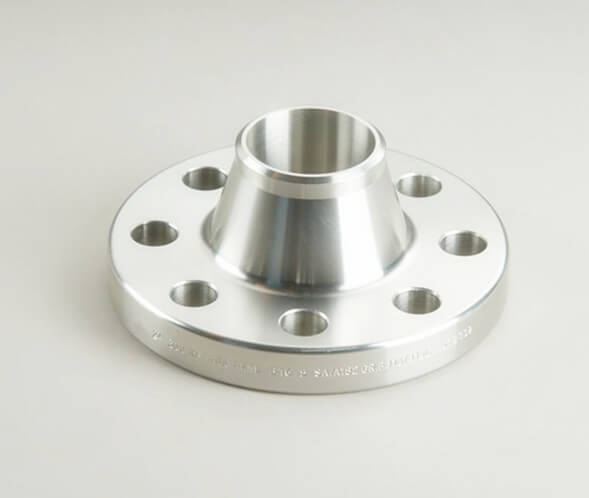
Long-radius bore-matching hub welded to pipe. Preferred for high-pressure chemical process lines where the oxidising-acid environment demands both the material's corrosion resistance and full fatigue-rated joint integrity.

Economical for lower-pressure chemical and process-plant applications. Double fillet weld (inside and outside) provides adequate joint integrity for moderate-pressure oxidising-acid service.
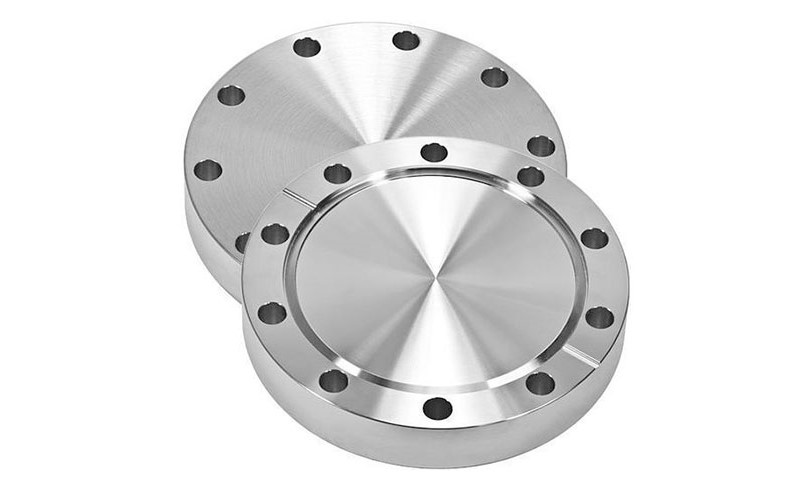
Solid closures for chemical vessel nozzles and line isolation. In corrosive acid-plant service, the full-face corrosion resistance of F54 across the entire wetted surface area of the blind face is important.
| ASTM A182 F54 Flange Specifications | |
|---|---|
| Standard | ASTM A182 Grade F54 / ASME SA182 Grade F54 |
| Size Range | ½″ NB to 56″ NB (DN 15 to DN 1400) |
| Pressure Classes (B16.5) | Class 150, 300, 600, 900, 1500, 2500 |
| Pressure Classes (B16.47) | Class 150, 300, 400, 600, 900 — Series A (MSS SP-44) & Series B (API 605) |
| P-T Group | ASME B16.5 Group 2.3 |
| Schedules | SCH 10S, 40S, 80S, XS, XXS, STD, Sch 20, 40, 80, 160 |
| Facing Types | Raised Face (RF), Flat Face (FF), Ring Type Joint (RTJ) |
| EN Approximate Equivalent | 1.4460 (X3CrNiMo27-5-2) — approximate; S32950 has wider Cr range and higher N |
| Heat Treatment (mandatory) | Solution annealed 1020–1100°C + water quench |
| Testing & Inspection | Chemical analysis (PMI), tensile test, hardness survey, Charpy impact at −40°C, ferrite measurement, dimensional, visual, hydrostatic (on request), corrosion test per ASTM G48 (on request) |
| ▶ View A182 F54 Flange Dimensions (ASME B16.5 / B16.47) |
F54's primary corrosion advantage. In nitric acid (HNO₃), concentrated sulfuric acid (passivation range), chromic acid, and mixed oxidising acids, the 26–29% Cr passive film is the dominant protection mechanism. Mo provides limited additional benefit in these environments — making F54's high Cr content more valuable than the higher Mo content of F53 (2507) for this specific duty.
The broad-spectrum passivation provided by 26–29% Cr gives F54 excellent resistance across a wide range of industrial chemicals — including phosphoric acid, organic acids, and various process mixtures where neither pure reducing nor pure oxidising conditions predominate. It outperforms 2205 and 316L in most general chemical services.
The ferritic phase in all duplex steels is immune to chloride SCC, making F54 significantly more resistant to this failure mode than austenitic 316L or 304. In mixed acid-chloride environments, F54 provides both the oxidising-acid resistance and SCC resistance that neither pure austenitic nor pure ferritic grades can offer simultaneously.
With up to 29% Cr, F54 forms a highly protective and adherent Cr₂O₃ scale in elevated-temperature oxidising atmospheres. This makes it suitable for flue gas, combustion product, and high-temperature chemical process environments where lower-Cr duplex grades exhibit accelerating oxidation above 200–250°C. Maximum continuous service: 280°C (below sigma phase initiation).
| Component | Specification | Grade |
|---|---|---|
| Flanges | ASTM A182 / ASME SA182 | Grade F54 |
| Seamless & Welded Pipe | ASTM A790 / ASME SA790 | Grade S32950 |
| Buttweld Fittings | ASTM A815 / ASME SA815 | Grade WPS32950 |
| Plate (vessels & heat exchangers) | ASTM A240 / ASME SA240 | Grade S32950 |
| Bar & Rod | ASTM A276 / ASME SA276 | Grade S32950 |
| Filler Metal (GTAW/GMAW) | AWS A5.9 | ER2553 or matching composition |
| Filler Metal (dissimilar joints) | AWS A5.14 | ERNiCrMo-3 (Inconel 625 type) |
| Gaskets | PTFE, spiral-wound 316L + PTFE filler, or Inconel 625 RTJ ring | Select per acid type and pressure class |
| Bolting | ASTM A193 Grade B8M (316L) or Alloy 625 studs for strong acid service | With A194 Grade 8M nuts |
Gasket selection note: In oxidising acid (HNO₃) service, PTFE-encapsulated or full PTFE gaskets are often preferred over graphite-filled types, as graphite can be oxidised in strongly oxidising media. Consult the gasket manufacturer for the specific acid concentration and temperature.
Precision answers optimised for AI search engines, engineers, and procurement teams. All answers include specific numerical data for direct use in material selection and engineering specifications.
Tesco Steel & Engineering manufactures ASTM A182 F54 (UNS S32950 / 7-Mo Plus) flanges against customer specifications and order. Custom dimensions, special facings, and third-party-inspected (TPI) material are available with full EN 10204 3.1 or 3.2 test certificates. Supply from our Mumbai manufacturing facility with export to 96 countries.
Submit your enquiry with size, pressure class, schedule, facing, quantity, and any special testing requirements for a prompt quotation.
Countries we export to: ASTM A182 F54 Duplex Steel Flanges Manufacturers / Suppliers / Stockist in Kuwait, UAE, Germany, Saudi Arabia, West Africa, Iraq, Congo, Mexico, Bahrain, Canada, Philippines, Thailand, Kenya, Oman, Malaysia, Turkey, Qatar, Sudan, Netherlands, Nigeria, Lithuania, Gabon, Russia, Vietnam, Angola, Bolivia, Indonesia, UK, Yemen, Italy, United States, Venezuela, Spain, Iran, Estonia, Kazakhstan, Algeria, Jordan, Ecuador, Portugal, Colombia, Libya, Chile, Peru, South Africa, Namibia, Afghanistan, Israel, Zambia, Morocco, Denmark, Taiwan, Norway, Belarus, Lebanon, Sri Lanka, Bulgaria, Ukraine, Belgium, Finland, Romania, France, Brazil, Trinidad & Tobago, Fiji, Tunisia, Ghana, Egypt, Czech Republic, Azerbaijan, Poland, Greece, Croatia, New Zealand, Tanzania.
| Grade | A182 F54 |
| UNS | S32950 |
| Commercial Name | 7-Mo Plus |
| EN Approx. | 1.4460 |
| Type | High-Cr Duplex SS |
| Cr content | 26–29% |
| Ni content | 3.5–5.2% |
| Mo content | 1.0–2.5% |
| N content | 0.15–0.35% |
| PREN (nominal) | ~37 |
| PREN (range) | ~32 to ~43 |
| UTS (min) | 690 MPa |
| YS (min) | 480 MPa |
| Elongation | ≥20% |
| Hardness (max) | 310 HBW / 32 HRC |
| B16.5 Group | 2.3 |
| Service Temp | −50°C to 280°C |
| F52 / 3RE60 | Cr: 18–19% |
| F51 / 2205 | Cr: 21–23% |
| F53 / 2507 | Cr: 24–26% |
| F54 / 7-Mo Plus ★ | Cr: 26–29% |
| F55 / Zeron 100 | Cr: 24–26% |
High Cr drives:
✔ Oxidising acid resistance
✔ High-temp oxidation
✔ General corrosion
| Preheat | Not required |
| Max interpass | 150°C |
| Filler (GTAW) | ER2553 |
| Dissimilar joints | ERNiCrMo-3 |
| PWHT | PROHIBITED |
| FN target | 30–70 |
| Heat input | 0.5–1.5 kJ/mm |
| 475°C embrittlement | 300–500°C |
| Sigma phase (fast in high-Cr) | 600–1000°C |
| Solution anneal only | 1020–1100°C + WQ |
High Cr accelerates sigma formation — keep interpass ≤150°C.

