

Tesco Steel & Engineering manufactures 410 stainless steel flanges — the martensitic, hardenable, magnetic 12% chromium stainless grade, forged to ASTM A182 F6a (UNS S41000, EN 1.4006 / X12Cr13, JIS SUS410). Unlike austenitic 304/316, Grade 410 can be heat-treated to high strength, hardness and wear resistance while offering moderate corrosion resistance — the right choice for valve trim, pump and turbine parts, fasteners and mild-corrosion flanged service. Available in weld neck, slip-on, blind, socket-weld, threaded, lap-joint and plate types to ASME B16.5 / B16.47. Class 150 to 2500, NPS 1/2″ to 56″, PN6 to PN400. ISO 9001:2015 certified. Made in India.

SS 410 (ASTM A182 F6a) Flanges

SS 410 Weld Neck & Blind Flanges
Tesco Steel & Engineering manufactures SS 410 flanges per ASTM A182 F6a and ASME B16.5, in all flange types from weld neck to blind, Class 150 to 2500 — supplied with EN 10204 3.1 / 3.2 certification, hardness testing, PMI and third-party inspection on request. Explore the wider stainless steel flange range, SS 410S flanges, SS 430 flanges, and the flange dimension charts.
| SS 410 flanges are available in the following specifications: | |
|---|---|
| Material Grade | SS 410 / ASTM A182 F6a / UNS S41000 / EN 1.4006 / SUS410 / X12Cr13 |
| Microstructure | Martensitic (hardenable, magnetic) |
| Size | 1/2″ NB to 56″ NB (DN 15 to DN 1400) |
| Class / Rating | 150#, 300#, 600#, 900#, 1500#, 2500# · 3000#, 6000#, 9000# (socket-weld / threaded) |
| Pressure Ratings | PN 6 – PN 400 (PN6, 10, 16, 25, 40, 64, 100, 160, 250, 320, 400) |
| Schedule / Wall Thickness | STD, XS, XXS, SCH 20, 40, 80, 160 |
| Standards | ASTM A182 F6a, ASME B16.5, ASME B16.47 (Series A & B), MSS SP-44, DIN EN 1092-1, BS 4504, JIS B 2220 |
| Flange Types | Weld Neck (WNRF), Slip-On (SORF), Blind, Socket Weld (SWRF), Lap Joint, Threaded / Screwed, Plate, Long Weld Neck, Orifice |
| Flange Faces | Raised Face (RF), Flat Face (FF), Ring Type Joint (RTJ), Tongue & Groove (T&G) |
| Heat Treatment | Hardened & tempered (per A182 F6a class); annealed for machining |
| Testing | Hardness (HBW/HRC), PMI, hydrostatic, UT, MT, PT per spec |
Grade 410 is a straight-chromium (~12% Cr) martensitic stainless with low nickel. The chromium provides corrosion and oxidation resistance, while the carbon content allows the steel to be hardened by quench-and-temper heat treatment. Forged flanges follow ASTM A182 F6a, supplied in tempering classes 1–4 for increasing strength.
| Element | SS 410 / ASTM A182 F6a (UNS S41000) |
|---|---|
| Carbon (C) | 0.15% max |
| Chromium (Cr) | 11.50 – 13.50% |
| Nickel (Ni) | 0.50% max |
| Manganese (Mn) | 1.00% max |
| Silicon (Si) | 1.00% max |
| Phosphorus (P) | 0.040% max |
| Sulfur (S) | 0.030% max |
| Iron (Fe) | Balance |
| Mechanical Property (ASTM A182 F6a) | Class 1 | Class 2 |
|---|---|---|
| Tensile Strength (min) | 485 MPa (70 ksi) | 585 MPa (85 ksi) |
| Yield Strength 0.2% (min) | 275 MPa (40 ksi) | 450 MPa (65 ksi) |
| Elongation (min) | 18% | 18% |
| Reduction of Area (min) | 35% | 35% |
| Hardness (max) | 197 HBW | 241 HBW |
| Density | 7.75 g/cm³ | |
| Magnetic | Yes (martensitic) — in all conditions | |
Higher-strength tempering classes 3 and 4 are available where greater hardness/strength is required; specify the class to suit the application.
| Standard | SS 410 Designation |
|---|---|
| UNS (USA) | S41000 |
| ASTM A182 (forgings) | F6a (Classes 1–4) |
| EN / DIN (Europe) | 1.4006 / X12Cr13 |
| JIS (Japan) | SUS 410 |
| BS (UK) | 410S21 |
| GOST (Russia) | 12Kh13 |
| ISO | X12Cr13 |
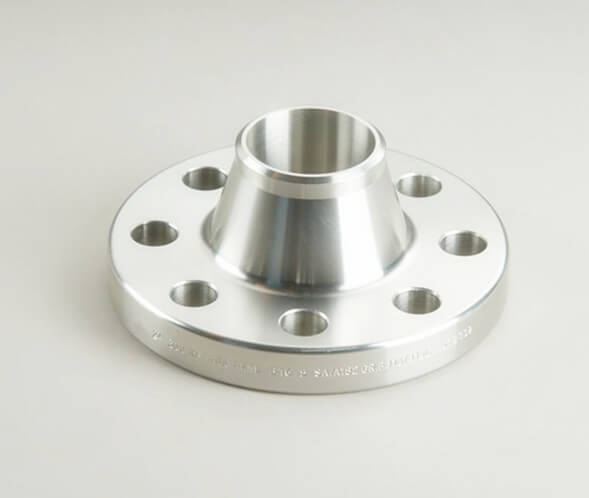
410 Weld Neck Flange (WNRF)

410 Slip-On Flange (SORF)
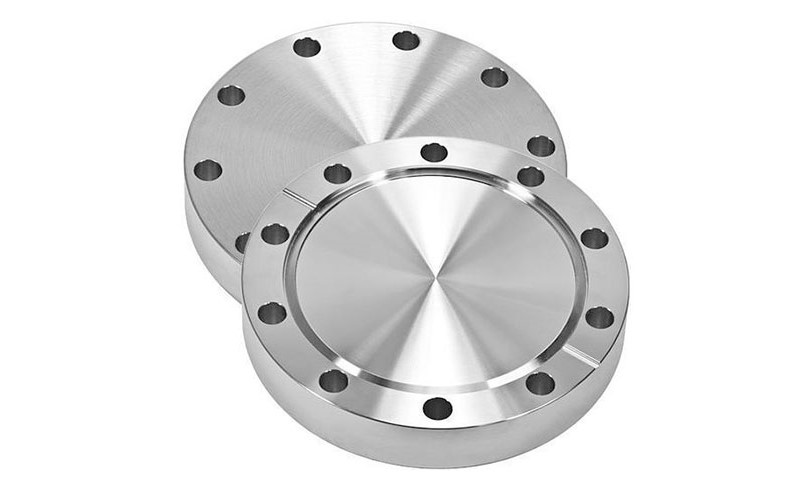
410 Blind Flange (BFF)
| Flange Type | Description & 410-Specific Use |
|---|---|
| Weld Neck (WNRF) | Tapered hub butt-welded to pipe for high-strength, high-pressure mild-corrosion lines; weld with preheat + post-weld temper to manage the hard HAZ. |
| Slip-On (SORF) | Slipped over the pipe and fillet-welded; used for moderate-pressure 410 connections where machinability and strength are wanted. |
| Blind (BFF) | Solid disc to close a pipe end or vessel nozzle in mild-corrosion service; benefits from 410's strength and hardness. |
| Socket Weld (SWRF) | Small-bore (1/2″–2″) high-strength instrument and process connections. |
| Lap Joint (LJRF) | Used with a stub end where frequent dismantling is needed; backing ring rotates for bolt alignment. |
| Threaded (TRFF) | Internal NPT/BSP threads for non-welded connections where 410's hardness resists thread wear. |
| Long Weld Neck / Orifice / Plate | Nozzle, flow-metering and plate flanges machined from 410 bar/forgings for strength-critical, mild-corrosion duty. |
| Property | 410 (S41000) | 304 (S30400) | 420 (S42000) | 430 (S43000) |
|---|---|---|---|---|
| Structure | Martensitic | Austenitic | Martensitic | Ferritic |
| Hardenable by heat treatment | Yes | No | Yes (higher hardness) | No |
| Magnetic | Yes | No (annealed) | Yes | Yes |
| Chromium | 11.5–13.5% | 18–20% | 12–14% | 16–18% |
| Carbon | 0.15% max | 0.08% max | ≥ 0.15% | 0.12% max |
| Corrosion resistance | Moderate | Good | Moderate (lower) | Moderate |
| Strength / wear | High | Moderate | Highest (cutlery, knives) | Moderate |
| ASTM Flange Grade | A182 F6a | A182 F304 | (bar/forging A276/A479) | A182 F6a-type / ferritic |
| Best For | Valve trim, shafts, fasteners, turbine parts | General corrosive service | Cutlery, surgical, high-hardness wear | Decorative, mild auto/appliance |
| Industry | Typical Application |
|---|---|
| Oil & Gas / Refining | Valve trim & seats, fastener flanges, fractionation tower internals (mild-corrosion service) |
| Power Generation | Steam turbine components, blade and shaft connections, mild-service piping flanges |
| Pumps & Valves | Pump shafts, valve stems and seat flanges needing wear resistance and strength |
| Petrochemical | Mild-corrosion process connections, high-strength bolting flanges |
| General Engineering | Fasteners, machine components, wear-resistant flanged joints |
| Mineral & Ore Processing | Abrasion-resistant flanged connections in mild chemistry |
Hardenable martensitic 12% Cr stainless — high strength, hardness and wear resistance for valve trim, shafts and fasteners.
Supplied in tempering classes 1–4 with controlled hardening and tempering to meet specified mechanical properties.
WNRF, SORF, blind, socket-weld, threaded, lap-joint, LWN, orifice and plate — in RF, FF, RTJ and T&G faces.
EN 10204 3.1 / 3.2 MTC, hardness testing, PMI and third-party inspection on request.
410 flange prices depend on size, pressure class, schedule, flange type, ASTM A182 F6a tempering class, quantity and current alloy rates. Being a low-nickel 12% Cr grade, 410 is often more economical than nickel-bearing austenitic grades. Tesco Steel & Engineering offers competitive ex-works pricing from Mumbai with full export documentation and heat-treatment traceability. Click Ask for Quote or message us on WhatsApp at +91 92233 66922 with grade/class, flange type, size (NB), pressure class, quantity and documentation requirements.
Q1. What is a 410 stainless steel flange?
A 410 stainless steel flange is a pipe flange made from Grade 410 (UNS S41000), a martensitic 11.5–13.5% chromium stainless steel. Unlike austenitic grades (304/316), 410 is hardenable by heat treatment, is magnetic, and offers high strength and wear resistance with moderate corrosion resistance. Forged flanges are supplied to ASTM A182 Grade F6a and machined to ASME B16.5 / B16.47, used for valve trim, pump and turbine components, fasteners and mild-corrosion service.
Q2. What is the ASTM grade for 410 stainless steel flanges?
Forged 410 flanges are supplied to ASTM A182 Grade F6a (UNS S41000) — the forging specification for 12% chromium martensitic stainless. F6a is furnished in tempering classes 1 to 4 with increasing strength, so the required class is specified to match the mechanical properties needed. The dimensional standard is ASME B16.5 (1/2″–24″ NB) or ASME B16.47 (26″ and above).
Q3. Is 410 stainless steel magnetic?
Yes. Grade 410 is martensitic and strongly magnetic in both annealed and hardened conditions — a key practical difference from austenitic 304 and 316, which are essentially non-magnetic when annealed. The magnetism comes from the body-centred crystal structure of the 12% chromium alloy.
Q4. Can 410 stainless steel be hardened?
Yes. Grade 410 is hardenable by heat treatment — austenitising around 925–1010 °C, quenching in air or oil, then tempering. The tempering temperature sets the final strength and toughness: low tempering gives maximum hardness, while tempering at 600–750 °C gives a tougher, lower-hardness condition. This is why 410 is used for valve seats, shafts, fasteners and turbine blades that need wear resistance and high strength.
Q5. How are 410 stainless steel flanges welded?
410 is weldable but the hard martensitic structure is crack-sensitive, so welding requires control: preheat to 200–315 °C, maintain interpass temperature, and apply a post-weld temper (typically 650–760 °C followed by slow cool) to restore toughness in the heat-affected zone. Matching ER410 / E410 filler is used where the weld is to be hardened; ER309L (austenitic) is used where a tougher as-welded joint without PWHT is acceptable.
Q6. What is the corrosion resistance of 410 stainless steel?
Grade 410 offers moderate corrosion resistance — good in mild atmospheres, fresh water, steam, many mild chemicals and combustion gases, and best when hardened and polished. It is not suitable for seawater, chlorides or strongly acidic/oxidising environments, where austenitic 316L, duplex or higher alloys are required. 410 is chosen primarily for strength, hardness and wear resistance rather than corrosion resistance.
Q7. What is the difference between 410 and 304 stainless steel flanges?
410 is martensitic — hardenable, magnetic, high strength and wear resistance but only moderate corrosion resistance (12% Cr, very low nickel). 304 is austenitic — non-magnetic, not hardenable by heat treatment, with better general corrosion resistance (18% Cr, 8% Ni). Choose 410 where strength, hardness and wear matter (valve trim, shafts, fasteners); choose 304/316 where corrosion resistance and weldability are the priority.
Q8. What are the equivalent grades of SS 410?
SS 410 equivalents include UNS S41000, ASTM A182 F6a (forgings), EN 1.4006 / X12Cr13, JIS SUS410, BS 410S21, GOST 12Kh13 and ISO X12Cr13 — all the same 12% chromium martensitic stainless steel.
Q9. What is the maximum service temperature for 410 stainless steel flanges?
Grade 410 can be used continuously up to about 650 °C in mild oxidising conditions, with intermittent service to around 760 °C; above these, scaling increases and strength falls. It is not used at cryogenic temperatures because martensitic grades become brittle. For high-temperature oxidation resistance beyond 650 °C, ferritic/austenitic grades such as 430, 321 or 310S are preferred.
Q10. Are 410 stainless steel flanges supplied with material test certificates?
Yes. Every 410 flange is supplied with EN 10204 3.1 (or 3.2) mill test certificates confirming chemistry, mechanical properties (per the specified ASTM A182 F6a tempering class), hardness and heat-treatment records, with PMI, hardness testing and third-party inspection on request. Tesco Steel & Engineering is an ISO 9001:2015 certified manufacturer and exporter from Mumbai, India.