U Syphon Manufacturer
TES-LOK U-Syphon (Pigtail / Horseshoe) — classic single-loop condensate barrier for steam pressure gauge protection. SS 304 · SS 316 · Brass · Inconel · Monel · NPT · BSPT · BSPP · Up to 6,000 PSI · ISO 9001:2015 certified.
ISO 9001:2015 Certified
Up to 400 °C
Up to 6,000 PSI
NPT · BSPT · BSPP
SS 304 · SS 316 · Brass · Inconel · Monel
Global Export
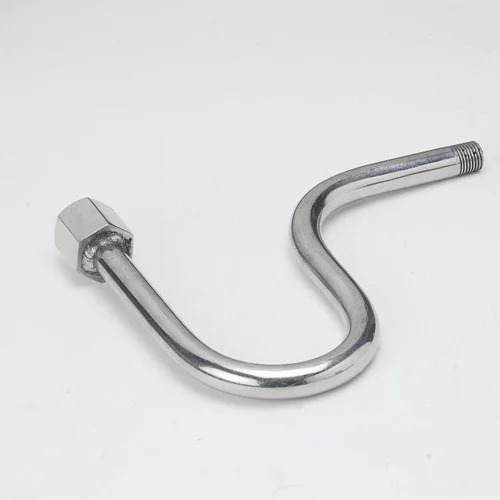 U-Type Pigtail Syphon
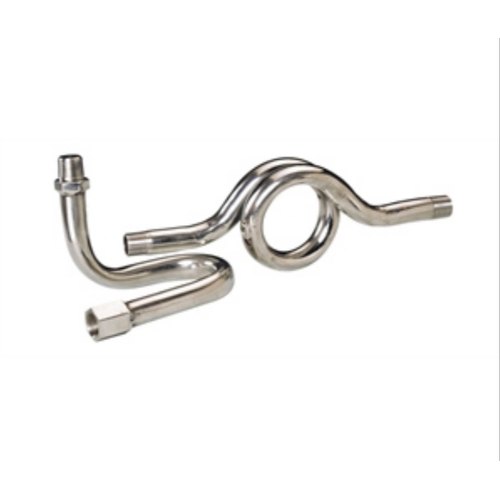 U Syphon — Steam Service
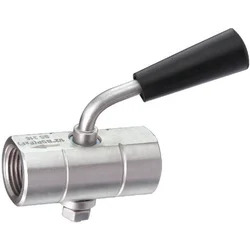 U Syphon + Gauge Cock
Tesco Steel & Engineering manufactures TES-LOK U-Syphon (also known as pigtail syphon or horseshoe syphon) — the simplest, most widely installed condensate-barrier fitting used to protect pressure gauges, thermometers, and pressure transmitters on steam and high-temperature process lines. The U-Syphon's single open loop geometry creates a stable condensate reservoir that permanently shields the gauge bourdon tube from direct steam contact, eliminating thermal damage and measurement error caused by steam head effects. TES-LOK U-Syphons are manufactured in SS 304, SS 316, Brass, Inconel, Monel, and Hastelloy across NPT, BSPT, and BSPP thread standards — compatible with all standard pressure gauge connections worldwide.
U-Syphon Geometry & Design Principle
What Makes the U-Shape Work
The U-syphon is bent into a single open U-loop (or pigtail coil) so that the lowest point of the loop sits below both the process connection at the bottom and the gauge connection at the top. Gravity causes condensed water to collect and remain in the bottom of the loop at all times. When steam enters the lower leg, it contacts this cool water pocket and condenses — it cannot travel upward through the water-filled loop to reach the gauge. Pressure is transmitted perfectly through the incompressible liquid column.
Pigtail vs. Horseshoe Geometry: The terms "pigtail syphon" and "horseshoe syphon" both describe U-type devices but differ slightly in bend radius. A pigtail syphon has a tighter, coil-like loop (tube bent into a 360° or near-360° circle in one plane). A horseshoe syphon has a wider, more open U-bend. Both function identically — the choice is aesthetic/space-driven. TES-LOK supplies both geometries to order.
U-Syphon vs Other Syphon Types — Selection Guide
| Feature | U-Syphon (Pigtail) | Q-Type (Coil) Syphon | C-Type Syphon | Straight Syphon |
|---|
| Loop Geometry |
Single open U-loop or pigtail |
Multi-turn helical/pancake coil |
Single 180° C-bend |
No loop — straight tube with enlarged bore |
| Condensate Volume |
5–15 mL (moderate) |
20–60 mL (high) |
8–18 mL (moderate) |
2–5 mL (very low) |
| Steam Pressure Range |
Up to ~40 bar (MP steam) |
Any pressure incl. superheated >40 bar |
Up to ~25 bar |
Low pressure only (<6 bar) |
| Pulsation Damping |
Good — loop absorbs some pulsation |
Excellent — multiple turns provide high damping mass |
Moderate |
Poor — minimal hydraulic capacitance |
| Overall Height / Footprint |
Compact — 60–120 mm typical height |
Larger — 80–150 mm diameter coil |
Very compact — narrowest profile |
Smallest — just a nipple extension |
| Typical Use Case |
Standard LP/MP steam gauge panels; HVAC; utility steam; boiler room boards |
HP steam, superheated steam, power plant, refinery steam headers |
Panel boards where horizontal spacing is limited |
Very low-pressure steam only; horizontal installations |
| Cost |
Lowest — simple single-bend fabrication |
Higher — multi-turn coil forming |
Low |
Lowest |
| TES-LOK Availability |
Stock — all materials, all thread forms |
Stock (SS 316 & Brass); 3–5 days others |
On request |
On request |
Thread Forms & End Connections
| Thread Standard | Designation | Seal Mechanism | Compatible Gauges |
|---|
| NPT |
ASME B1.20.1 — 60° tapered |
Thread interference; PTFE tape or anaerobic sealant |
US, Middle East, Indian process gauges with NPT bottom entry |
| BSPT |
BS 21 / ISO 7 — 55° tapered |
Thread interference; PTFE tape or anaerobic sealant |
European, Asian, and UK gauges with tapered BSP port |
| BSPP (BSP) |
BS 2779 / ISO 228 — 55° parallel |
Dowty bonded seal or flat washer in gauge socket |
European gauges with parallel BSP socket; Swagelok accessories |
| SAE 45° Flare |
SAE J512 |
Metal-to-metal 45° flare seat |
Hydraulic instruments, mobile/off-highway gauges |
BSPP Sealant Warning — No PTFE Tape on Parallel Threads:
BSPP (parallel BSP) U-syphon threads seal on the face, not on the thread form. Never wrap PTFE tape on BSPP threads. Use a Dowty bonded seal (metal-backed rubber washer) placed in the gauge boss socket. PTFE tape on a parallel thread creates false assembly torque, and the joint will weep under steam pressure cycling. NPT and BSPT (both tapered) require 2–3 wraps of PTFE tape (ASTM D1668 Grade D) starting from the second thread, applied clockwise when viewed from the thread end.
Thread Sealant Selection
| Thread Type | Sealant Method | Application Notes |
|---|
| NPT (Tapered) |
PTFE tape — 2–3 wraps clockwise from 2nd thread; or high-temp anaerobic thread sealant |
Leave first thread bare; 1½–2 turns past handtight on assembly |
| BSPT (Tapered) |
PTFE tape — 2–3 wraps; or anaerobic sealant rated to steam temperature |
Do not cross-thread NPT syphon into BSPT gauge — 60° vs 55° flank angle difference |
| BSPP (Parallel) |
Dowty bonded seal (EN ISO 1179-1); no PTFE tape |
Inspect Dowty seal face for scoring before each use; replace if surface damaged |
Standard Size Range
| Connection Size | Tube OD (Body) | Loop Height (Approx.) | NPT | BSPT | BSPP | Max Pressure (SS) |
|---|
| 1/4" | 10–12 mm | 60–80 mm | ✓ | ✓ | ✓ | 6,000 PSI |
| 3/8" | 14–16 mm | 70–90 mm | ✓ | ✓ | ✓ | 4,500 PSI |
| 1/2" | 18–22 mm | 80–110 mm | ✓ | ✓ | ✓ | 3,500 PSI |
| 3/4" | 24–28 mm | 100–130 mm | ✓ | ✓ | — | 2,500 PSI |
| Custom OD/length | Per drawing | Per drawing | ✓ | ✓ | ✓ | Per calculation |
Material & Technical Specifications
| Parameter | Details |
|---|
| Brand | TES-LOK (Tesco Steel & Engineering) |
| Product Type | U-Syphon — Pigtail / Horseshoe configuration |
| Connection Size | 1/4" to 3/4" NPT / BSPT / BSPP; custom sizes on request |
| Material — SS | SS 304 (ASTM A276/A479), SS 316 (ASTM A276/A479), SS 316L |
| Material — Brass | ASTM B283 — C36000 free-machining brass |
| Material — High Alloy | Inconel 600/625 (ASTM B166), Monel 400 (ASTM B164), Hastelloy C-276 (ASTM B574) |
| PTFE Ferrule Standard | ASTM D1710 / ASTM D3294 (for PTFE tape and ferrule components) |
| Pressure Rating — SS | Up to 6,000 PSI (413 bar) at ambient; de-rated per ASME B31.3 temperature tables |
| Pressure Rating — Brass | 300 PSI / 1,000 PSI / 3,000 PSI depending on grade and wall thickness |
| Working Temperature | –50 °C to +400 °C (material dependent) |
| Surface Finish | Bright annealed / electropolished / pickled & passivated per ASTM A380 |
| Design Standards | DIN 16282 (syphon tubes), BS 6212 (gauge fittings), ASME B16.14 (threaded accessories) |
| Quality Standard | ISO 9001:2015 certified manufacturing |
| Certifications Available | EN 10204 3.1 MTR, PMI, NACE MR0175, Hydrostatic test certificate |
| Interchangeability | Fully compatible with Swagelok, Parker A-LOK, Ham-Let, Hoke gauge accessories (same thread standard) |
Installation Procedure
Orientation is Critical: A U-syphon must always be installed with the loop below both connection ports — the process port at the bottom leg and the gauge port at the top leg, with the loop's lowest point collecting condensate. Installing the U-syphon horizontally or upside-down destroys the condensate trap — water drains out and steam reaches the gauge directly.
1
Confirm thread match: Check syphon thread form (NPT / BSPT / BSPP) against the gauge bottom connection and the process boss. NPT and BSPT are not interchangeable — both are tapered 1:16 but have different thread angles (60° vs 55°). Mixing will cross-thread and damage both fittings.
2
Apply sealant to process-side thread: For NPT/BSPT: apply 2–3 wraps of PTFE tape clockwise from the second thread. For BSPP: place a Dowty bonded seal in the process boss socket. Leave the gauge-side thread bare until pre-filling is complete.
3
Thread onto process connection: Screw the lower leg of the U-syphon into the process boss or gauge valve. Tighten 1½–2 turns past handtight (NPT / BSPT) or to specified torque for BSPP (20–35 N·m for 1/2"). Ensure the syphon loop hangs downward vertically.
4
Pre-fill the loop with water: Using a small syringe or filling bottle, fill the U-loop completely with clean water through the open upper (gauge-side) port before fitting the gauge. Confirm water is visible at the top. This initial condensate charge is mandatory — an empty syphon provides no protection.
5
Fit the pressure gauge: Apply sealant to the gauge-side thread and connect the pressure gauge. Tighten to gauge manufacturer's specification — typically 1½–2 turns past handtight for tapered threads. Do not over-tighten, especially with brass gauge bodies.
6
Slowly open the isolation valve: Open the root valve or gauge cock very slowly — full-bore sudden opening can create a water hammer in the syphon that spikes gauge pressure. Crack open gradually over 10–20 seconds. Allow 1–3 minutes for the condensate level to stabilise before reading the gauge.
7
Leak check all joints: Inspect all threaded connections with steam-rated leak detection solution. If a joint weeps, snug by ¼ turn maximum while hot — do not force. For persistent leaks, isolate, cool, depressurise, disassemble, re-seal, and re-assemble.
Never Operate Without Pre-Fill:
Commissioning a steam gauge without pre-filling the U-syphon loop is the single most common cause of pressure gauge failure on steam lines. Live steam enters the empty loop, fills it with vapour, and contacts the bourdon tube at full steam temperature — immediately causing thermal distortion and bourdon tube set or rupture. Always pre-fill before opening any steam valve.
When to Use a U-Syphon
| Service Condition | U-Syphon Suitable? | Notes |
|---|
| Saturated steam — LP (up to 6 bar) |
Yes — ideal |
Standard application; Brass or SS 304 acceptable |
| Saturated steam — MP (6–40 bar) |
Yes — suitable |
Use SS 316 for reliability above 12 bar; avoid Brass above 12 bar |
| Saturated steam — HP (>40 bar) |
Marginal — Q-type preferred |
U-syphon condensate volume may be insufficient; coil syphon provides better thermal mass and damping at >40 bar |
| Superheated steam (>250 °C) |
Marginal — Q-type preferred |
Superheated steam condenses more slowly; Q-type coil recommended for sustained superheat service |
| High-pulsation steam (turbine exhaust, reciprocating compressors) |
Acceptable with snubber |
Install a piston snubber or diaphragm snubber in series if gauge pointer oscillates excessively |
| Chloride-bearing steam condensate (coastal/marine) |
Yes — with correct material |
Specify Monel 400 or Hastelloy C-276; SS susceptible to chloride SCC above 60 °C |
| Hot water (non-steam) service above 80 °C |
Yes |
U-syphon also protects gauges on hot-water systems; condensate pre-fill still required |
| Horizontal gauge installation |
Not recommended |
U-loop must be vertical to trap condensate by gravity; horizontal installation drains the loop — use an angled or coil syphon instead |
Why Choose TES-LOK U-Syphons
Simplest & Most Reliable Design
The U-loop has no moving parts, no seals to replace, and no complex geometry. A correctly installed, pre-filled U-syphon will protect a pressure gauge for the gauge's full service life without maintenance or adjustment.
Compact Footprint
With a typical loop height of 60–110 mm, the U-syphon adds minimal height to gauge assemblies. Ideal for space-constrained instrument panels, boiler room gauge boards, and valve skids.
Universal Thread Compatibility
TES-LOK U-syphons are manufactured to NPT, BSPT, and BSPP standards — fully interchangeable with Swagelok, Parker, Ham-Let, and Hoke gauge accessories. No adaptors, no cross-standard compromises.
Full Alloy Range for Corrosive Service
SS 304, SS 316, Brass, Inconel 600, Monel 400, Hastelloy C-276 — material selection to cover clean steam, sour service, chloride-bearing condensate, caustic steam, and pharmaceutical clean steam.
Certified & Traceable
ISO 9001:2015 certified manufacturing. EN 10204 3.1 material test reports, PMI, and hydrostatic test certificates available on request — meeting EPC contractor and owner-engineer requirements.
Stock Availability
1/4" and 1/2" U-syphons in SS 316 and Brass maintained in Mumbai warehouse. Immediate dispatch for plant shutdowns and emergency replacements. Bulk orders and plant-wide standardisation packs available.
Applications
| Industry / Facility | Specific Application | Material |
|---|
| Power Plants & Utilities | Boiler steam drum pressure gauges, LP steam header gauges, deaerator pressure instruments | SS 316 |
| Oil & Gas Refineries | Process steam utility gauges, reboiler steam pressure, steam injection well instruments | SS 316 / Monel (sour service) |
| Petrochemical Plants | Steam-traced line pressure gauges, column overhead steam instruments, heat exchanger steam side indicators | SS 316L |
| Pharmaceutical & Food | Autoclave pressure gauges, steriliser steam measurement, CIP/SIP clean steam lines | SS 316L electropolished |
| HVAC & Building Services | Boiler room steam heating gauges, steam control panel boards, hospital steam systems | Brass (LP steam) |
| Textile & Dyeing | Dye autoclave pressure indicators, steam chest gauges on calendar rolls | Brass / SS 304 |
| Sugar & Distillery | Multiple-effect evaporator steam gauges, vapour pressure measurement on vacuum pans | SS 304 / Brass |
| Marine & Offshore | Boiler pressure gauges, steam-heated cargo tank instruments, laundry and galley steam pressure | Monel 400 (chloride) |
Frequently Asked Questions
What is the difference between a U-syphon and a pigtail syphon?
They are the same product described by different names. A "U-syphon" or "U-type syphon" refers to the device's U-shaped loop geometry. A "pigtail syphon" (also "pig-tail syphon") refers to the tight coiled-loop variant where the tube is bent into a near-circular or spiral shape in one plane — resembling a pig's tail. Both create a condensate trap in the same way. The horseshoe syphon is the open-U variant with a wider bend radius. TES-LOK manufactures all three configurations to the same material and pressure specifications.
Can a U-syphon be installed horizontally?
No. A U-syphon relies entirely on gravity to keep the loop filled with condensate water. Horizontal installation means the lowest point of the loop is no lower than the process port — condensate cannot accumulate and the loop will remain empty. Steam will pass straight through to the gauge. For horizontal gauge installations, use a coil (Q-type) syphon oriented vertically, or use a separate condensate pot, which can be mounted at any orientation once correctly filled and sealed.
How often does a U-syphon need to be replaced or maintained?
A correctly specified, correctly installed U-syphon in clean steam service requires no scheduled maintenance and has a service life equivalent to the pressure gauge itself — typically 5–10 years in normal service. Replacement is needed if the tube wall is thinned by corrosion or erosion, if the threaded ends show visible damage, or if the syphon has been mechanically damaged (kinked or crushed). Inspect syphons during plant turnarounds by visual examination and a simple water fill test. A syphon that cannot hold the water pre-fill (water drains immediately when filled) has a thread or body leak and must be replaced.
What thread standard should I choose — NPT, BSPT, or BSPP?
Match the syphon thread to the gauge's bottom connection thread — not to the process pipe thread. Check the gauge data plate or supplier datasheet. NPT (ASME B1.20.1) is standard on US-made and most Indian-made gauges. BSPT (BS 21 / ISO 7) is standard on European and many Asian gauges with tapered ports. BSPP (BS 2779 / ISO 228) is used on European gauges designed for face-sealing parallel connections (identifiable by a flat sealing face or Dowty seal groove in the port). Do not mix thread standards — cross-threading damages both the syphon and the gauge boss.
Will a U-syphon affect the accuracy of my pressure gauge reading?
A properly pre-filled U-syphon does not reduce gauge accuracy. Pressure is transmitted through the incompressible water column without signal attenuation. The only correction is the static head of the condensate column — for a typical 80–120 mm U-loop height filled with water, the head correction is approximately 0.008–0.012 bar (8–12 mbar). This is constant and negligible for most process gauges (typical accuracy class 1.6% of full scale). For precision gauges (class 0.25 or better), this offset can be zeroed during commissioning with the process at a known reference pressure.
Can I use a Brass U-syphon on 20 bar steam?
This is not recommended. Brass U-syphons are typically rated to 300–1,000 PSI (20–69 bar) at ambient temperature, but the ASTM B283 brass specification does not account for dezincification and creep that occur when brass is exposed to high-temperature steam condensate above 12 bar (approximately 190 °C) for extended periods. At 20 bar, steam temperature is approximately 212 °C — above the reliable service limit for brass. For steam above 12 bar, specify SS 316 U-syphons, which maintain mechanical properties up to 400 °C and are not susceptible to dezincification.
Is a U-syphon the same as a condensate pot?
No — they serve similar but distinct purposes. A U-syphon is a simple bent tube fitting screwed directly between the process boss and the pressure gauge. It holds a small volume (5–15 mL) of condensate and is used for individual gauge protection. A condensate pot is a larger, separate vessel (100–500 mL capacity) that is typically used in differential pressure measurement applications — for example, protecting both HP and LP legs of a DP transmitter on a steam drum level measurement. A condensate pot can also serve as a reservoir syphon for instruments that cannot be located directly below the process connection. Use a U-syphon for simple gauge protection; use a condensate pot when volume, equalization of both DP legs, or remote mounting is required.
Are TES-LOK U-syphons compatible with Swagelok or Parker gauge accessories?
Yes. TES-LOK U-syphons are manufactured to the same ASME B1.20.1 (NPT), BS 21/ISO 7 (BSPT), and BS 2779/ISO 228 (BSPP) thread standards used by Swagelok, Parker A-LOK, Ham-Let, and Hoke. Thread pitch, taper, and flank angles are identical — no adaptors required. Specify the correct thread standard when ordering to match your existing instrument piping inventory.

