

Tesco Steel & Engineering manufactures SS 316 Bossets (weld-on half couplings / instrument bosses) — short precision-machined fittings fillet-welded onto pipe and vessel walls to create permanent, reinforced instrument tap points and branch connections. Female NPT / BSP thread after boring. SS 316 · Carbon Steel A105 · Duplex · Monel · Inconel · 1/2"–2" BSP / NPT · ISO 9001:2015 certified.
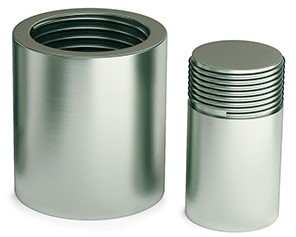
A bosset (also called a weld-on half coupling, instrument boss, or pipe boss) is a short, solid cylindrical or hexagonal fitting that is fillet-welded onto the outer surface of a pipe or pressure vessel wall to create a permanent, reinforced branch connection point. Once welded in position, a hole is drilled or bored through the pipe wall at the bosset location, and the bosset body is then threaded internally to the required NPT or BSP thread size. The result is a flush, fully supported instrument tap point — stronger and neater than drilling and tapping the pipe wall directly, and more compact than a full threaded flange connection.
Bossets are the standard method for creating instrument tap points in process piping systems across oil & gas, petrochemical, chemical, power generation, and offshore installations. A hex nipple, male adapter, instrument isolation valve, pressure gauge standpipe, or condensate pot can be threaded directly into the bosset female thread port, connecting the instrument impulse line to the process line without any additional flanges or intermediary fittings. The bosset's solid body provides full wall support around the bored opening, preventing stress concentration at the instrument tap hole — particularly important on pressure-rated piping under ASME B31.3 and B31.1.
| Fitting | Weld Type | Branch End | Reinforcement | Best For |
|---|---|---|---|---|
| Bosset (Half Coupling) | Fillet weld onto pipe OD surface | Female NPT/BSP thread (after boring) | Bosset body reinforces bore; repad may be added for larger bores | Small-bore instrument tap points (1/2"–2") on process pipes and vessel nozzles; threaded instrument connections |
| Weldolet | Butt weld into pipe wall with contoured base | Butt-weld prep for branch pipe | Integral reinforcement — self-reinforcing per ASME B16.9 | Larger-bore pressure-rated branch pipe connections; ASME B31.3 structural branches |
| Sockolet | Fillet weld with contoured base into pipe hole | Socket-weld bore for branch pipe | Integral reinforcement | Socket-weld branch pipe connections; smaller-bore (up to 2") high-pressure branches |
| Threadolet | Fillet weld with contoured base into pipe hole | Female NPT thread bore | Integral reinforcement with contoured base | Threaded instrument branches requiring full reinforcement per ASME B31.3 on smaller parent pipes |
| Flangolet | Fillet weld onto pipe OD | Raised-face flange for instrument connection | Flanged face — bolted instrument connection | Flanged instrument connections; connections requiring periodic removal of the entire instrument assembly |
Bosset installation is a welding operation requiring a qualified welder working to the applicable piping code. The sequence is:
| Type | Body Form | Thread After Boring | Application |
|---|---|---|---|
| Round Body Bosset | Cylindrical body, flat base for pipe OD welding | Female NPT or BSP (bored and tapped on site or pre-tapped) | Standard instrument tap points on process pipes; most widely used type |
| Hex Body Bosset | Hexagonal body, flat base | Female NPT or BSP (pre-tapped or site-tapped) | Where wrench access is needed on the bosset body itself; instrument isolation valve direct-threaded connection |
| Pad-Type Bosset | Cylindrical boss with integral reinforcing pad base | Female NPT or BSP | Smaller parent pipe walls where the bosset bore is relatively large — the pad distributes the branch opening stress over a wider area of the pipe wall |
| Long-Neck Bosset | Extended cylindrical neck above the weld base | Female NPT or BSP at the top of the neck | Insulated pipes where the instrument connection must project above the insulation thickness to allow direct gauge/transmitter connection without insulation cut-outs |
| Pre-Tapped Bosset | Any body form — thread machined before despatch | Female NPT or BSP pre-cut in factory to specified size | Reduces site work; used where site threading is not practical or where thread quality must be factory-controlled to a dimension sheet |
| Thread Size Range | 1/2" to 2" NPT, BSPT, or BSPP (female, after boring) |
| Body OD | Typically 30–80 mm OD depending on thread size (larger OD available on request) |
| Body Height | Standard: 30–60 mm; long-neck: 60–150 mm; custom on request |
| Base Form | Flat base (for welding to pipe or vessel OD); contoured base on request for small-diameter parent pipes |
| Weld Type | Fillet weld around full bosset base circumference |
| Standard Material | SS 316 (ASTM A276 / A479) |
| Optional Materials | SS 316L, SS 304, Carbon Steel (ASTM A105), LTCS (A350 LF2), Duplex Steel (UNS S31803), Monel 400, Inconel 600, Hastelloy C-276 |
| Welding Compatibility | Material matches parent pipe for direct fillet weld; dissimilar metal welding procedures available for cross-material applications |
| Thread Standard | NPT per ASME B1.20.1; BSPT per BS EN 10226; BSPP per BS EN ISO 228-1 |
| Applicable Codes | ASME B31.3 (Process Piping); ASME B31.1 (Power Piping); PED 2014/68/EU; local pressure vessel codes |
| Testing | Dimensional check; visual weld inspection; PT/MT on request; hydrostatic test as part of line test |
| Quality Certification | ISO 9001:2015; EN 10204 3.1 MTCs available; PMI testing on request; NACE MR0175 on request |
The bosset material must be metallurgically compatible with the parent pipe material for welding — always specify bosset material to match the parent pipe specification:
| Parent Pipe Material | Bosset Material | Weld Filler Wire | Typical Service |
|---|---|---|---|
| Carbon Steel A106 Gr. B | Carbon Steel A105 | ER70S-6 / E7018 | General process piping, utilities, moderate temperature service |
| LTCS A333 Gr. 6 | LTCS A350 LF2 | ER70S-6 (impact-tested) | Cryogenic and low-temperature service, LNG, refrigeration |
| SS 316 / 316L | SS 316 / 316L | ER316L | Corrosive process fluids, offshore, pharmaceutical, food processing |
| SS 304 / 304L | SS 304 / 304L | ER308L | General corrosion service, water treatment, mild chemical service |
| Duplex UNS S31803 | Duplex UNS S31803 | ER2209 | High-chloride offshore service, seawater cooling, sour gas systems |
| Monel 400 | Monel 400 | ERNiCu-7 | Hydrofluoric acid service, seawater, aggressive chemical processes |
| Inconel 600 | Inconel 600 | ERNiCr-3 | High-temperature oxidising environments; nuclear service |
| Hastelloy C-276 | Hastelloy C-276 | ERNiCrMo-4 | Highly aggressive chemical service, wet chlorine, mixed acid streams |
Drilling and tapping a bare pipe wall directly leaves a thin-walled thread in the pipe body with no additional reinforcement — the thread engagement is limited to the pipe wall thickness, which may be as little as 3–4 mm on lighter schedules. A bosset provides a full-length thread engagement of 20–40 mm in a solid body, with the bosset wall adding reinforcement metal around the bore opening. This produces a stronger, more fatigue-resistant instrument tap that can withstand vibration, thermal cycling, and the mechanical loads from instrument weight without cracking or thread pull-out.
Direct pipe tapping (drilling and threading the pipe wall without a bosset) is possible on thick-walled pipe, but produces a threaded port that is flush with the pipe OD — difficult to seal, difficult to plug, and subject to corrosion and mechanical damage during construction. A bosset raises the instrument connection above the pipe surface, making the port accessible for thread sealing, gauge/valve connection, and future maintenance without interference from adjacent pipe insulation or supports.
Long-neck bossets project above the insulation thickness, allowing instrument valves and gauges to be connected above the insulation layer without requiring custom insulation cut-outs or cladding boxes at every instrument tap. This simplifies both the initial insulation installation and subsequent instrument maintenance access — a major benefit on long, heavily insulated steam and hot-oil lines with numerous temperature and pressure taps.
Standard SS 316 bossets resist chloride attack, sour gas (H2S), steam condensate, and process chemical corrosion in the highly exposed location where the bosset sits on the pipe OD — outside any thermal insulation and exposed to weather, cleaning fluids, and process leaks. SS 316 bossets on SS 316 process pipe provide a fully compatible, weldable, corrosion-resistant instrument tap point for offshore, chemical, and pharmaceutical service.
Bossets are available in eight materials — from carbon steel A105 for standard utility piping to Hastelloy C-276 for the most aggressive chemical service streams. This ensures a bosset specification can always be matched to the parent pipe material and process service, maintaining full metallurgical compatibility at the weld joint and avoiding dissimilar metal weld challenges in critical service piping.
EN 10204 3.1 material test certificates are available for all SS 316 and exotic alloy bossets. PMI (positive material identification) testing available on request. Full heat and lot traceability supports documentation requirements for oil & gas, offshore, and petrochemical piping systems where every pressure-boundary component in the instrument tap assembly must be certified.
▶ What is a bosset?
A bosset (weld-on half coupling / instrument boss) is a short cylindrical or hexagonal fitting fillet-welded onto the outer surface of a pipe or vessel wall to create a permanent, reinforced instrument tap point or branch connection. After welding, a hole is bored through the pipe wall at the bosset location and the bosset is threaded internally (NPT or BSP) to accept instrument connections — hex nipples, isolation valves, gauges, or transmitters.
▶ What is the difference between a bosset and a weldolet?
A bosset is a simple cylindrical fitting welded onto the pipe OD surface and then bored — used for small-bore instrument tap points. A weldolet is a contour-machined butt-weld outlet fitting with integral reinforcement conforming to the parent pipe curvature — used for larger-bore pressure-rated branch pipe connections under ASME B16.9 and B31.3. Bossets are simpler and lower-cost for instrument taps; weldolets are structurally superior for piping branches.
▶ What is the difference between a bosset and a sockolet?
A bosset is welded onto the pipe OD surface without a contoured base — it is simpler and cheaper. A sockolet has a contoured base machined to fit the parent pipe curvature and is welded into a pre-cut hole in the pipe wall with the branch bore pre-aligned — it provides integral reinforcement per ASME B16.11. Use bossets for instrument taps; use sockolets for socket-weld branch pipe connections requiring code-compliant reinforcement.
▶ What thread forms are available?
NPT (ASME B1.20.1), BSPT (BS EN 10226), and BSPP (BS EN ISO 228-1). The thread is machined into the bosset bore either in the factory (pre-tapped) or on site after welding and boring. Thread sizes 1/2" to 2" are standard; other sizes on request.
▶ Does the bosset material need to match the parent pipe?
Yes — for direct fillet welding, the bosset material must be metallurgically compatible with the parent pipe material to achieve a sound weld. SS 316 bosset on SS 316 pipe; carbon steel A105 bosset on carbon steel A106 pipe; duplex bosset on duplex pipe. Dissimilar metal welding is possible but requires a qualified WPS and is generally avoided in critical service. Always confirm bosset material against the pipe material specification and the applicable piping class.
▶ Do bossets require post-weld heat treatment?
PWHT requirements depend on parent pipe material, wall thickness, and applicable piping code (ASME B31.3 or B31.1). Carbon steel bossets on CS pipe above certain wall thicknesses require PWHT per ASME B31.3 Table 331.1.1. SS 316 bossets on SS 316 pipe generally do not require PWHT but may need solution annealing for high-temperature sensitisation-sensitive service. Confirm with the project welding engineer and piping class specification.
▶ What materials are available?
SS 316, SS 316L, SS 304, Carbon Steel A105, LTCS A350 LF2, Duplex Steel UNS S31803, Monel 400, Inconel 600, and Hastelloy C-276. EN 10204 3.1 MTCs and PMI available on request. Match material to parent pipe specification.
▶ What is the pressure rating of a bosset connection?
The pressure rating depends on the parent pipe pressure class, bosset material and wall thickness, weld quality, and bore size. For a properly welded 1/2" NPT bosset on Schedule 40 or heavier pipe under ASME B31.3, the bosset connection is typically rated for the full pipeline pressure class. The threaded port NPT/BSP rating must also be confirmed against the system pressure — consult the piping stress engineer for specific pressure/temperature service conditions.
SS 316 · Carbon Steel · Duplex · Monel · Inconel · NPT · BSP · Round Body · Hex Body · Long-Neck · Pre-Tapped · ISO 9001:2015 · EN 10204 3.1 MTCs available
✉ Email Quote 📞 WhatsApp