

Tesco Steel & Engineering manufactures high hub blinds (hubbed blind flanges / high-hub blanks) — solid blind flanges with an integral raised hub (boss) on the back face that adds metal and stiffness to close off a pipe end, nozzle, or vessel opening under high pressure. The hub reinforces the blank, reduces deflection, and can carry a tapped or bored connection. Made to ASME/ANSI B16.5 & B16.47 in A105, SS 304/316/321, Duplex, Monel, Inconel, Hastelloy, and more. Size 1/2" to 56", Class 150 to 9000, PN1 to PN400. ISO 9001:2015 certified. Made in India.
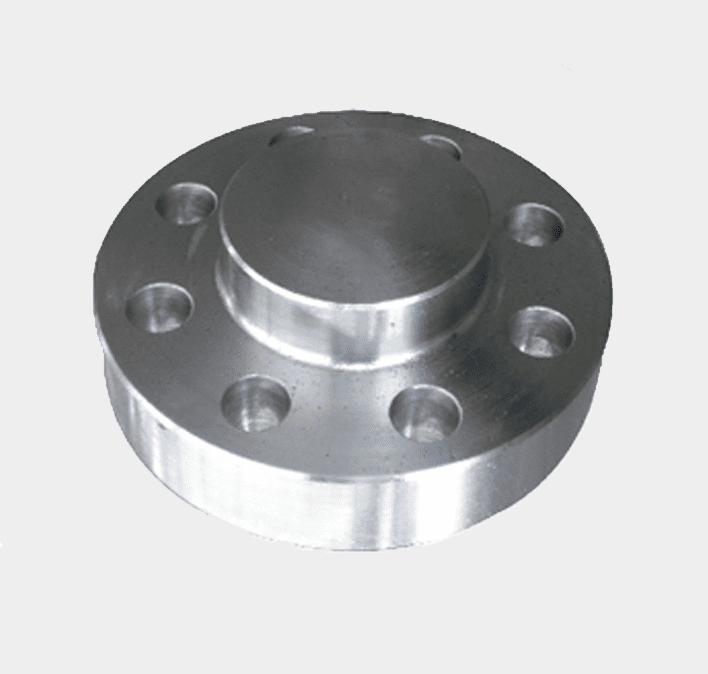
High Hub Blind (Hubbed Blind Flange)
High hub blinds are the reinforced cousin of the standard blind flange and are used alongside spectacle blinds for isolation. Tesco Steel & Engineering forges them to ASME/ANSI, EN, and DIN standards in the full material range — see the specifications below and the flange dimensions charts.
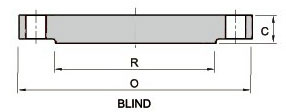
Blind / Hub Blind Dimensional Reference (ASME B16.5)
| Criterion | High Hub Blind | Standard (Flat) Blind Flange |
|---|---|---|
| Back face | Raised reinforcing hub / boss | Flat disc |
| Stiffness | Higher — less deflection under pressure | Relies on flange thickness |
| Pressure | Suited to higher pressure / larger bore | General blanking duty |
| Add-on connection | Boss can be drilled / tapped / bored | Requires extra reinforcement to tap |
| Best for | High-pressure end closures & reinforced blanks | Routine end / nozzle closure |
Choose a high hub blind where the closure sees high pressure, a large bore, or needs a machinable reinforced boss; a flat blind flange suits routine blanking.
| High Hub Blinds are available in the following specifications: | |
|---|---|
| Size | 1/2"NB to 56"NB |
| Class | 150#, 300#, 3000#, 6000#, 9000# |
| Sch (Schedule) | XS, XXS, STD & Schedule 20, 40, 80, 160 |
| Pressure Ratings | PN 1 - PN 400 |
| Stainless Steel High Hub Blinds | ASTM A 182 F - 304 / 304H / 304L / 316 / 316H / 316L / 316Ti, 309, 310, 317L, 321, 347, 904L |
| Duplex Steel High Hub Blinds | ASTM A 182 - F 51, F 53, F 55 |
| Alloy Steel High Hub Blinds | ASTM A 182 - F5, F9, F11, F21, F22 & F91 |
| Carbon Steel High Hub Blinds | ASTM A 105 |
| Low Temp. Carbon Steel High Hub Blinds (LTCS Orifice Flanges Flanges) | A 350 LF2 |
| Copper Nickel (Cu-Ni) High Hub Blinds | C70600, 90/10, C71500, 70/30, C71640 |
| Nickel High Hub Blinds | UNS N02200, UNS N02201 |
| Monel High Hub Blinds | UNS N04400, UNS N05500, Alloy 20 |
| Inconel High Hub Blinds | UNS N06600, UNS N06601, UNS N06625, UNS N08800, UNS N08810, UNS N08825 |
| Hastelloy High Hub Blinds | UNS N10276, UNS N06022, UNS N10665, UNS N06455 |
| Titanium High Hub Blinds | Gr. 1, Gr. 2, Gr. 3, DTH 3.7035, DTH 3.7055 |
| Other Services | Hot Dip Galvanized (GI) High Hub Blinds Sand Blasting on High Hub Blinds Shot Peening on High Hub Blinds Epoxy Coating on High Hub Blinds FBE Coating on High Hub Blinds |
The integral hub stiffens the blank, reducing deflection and enabling higher-pressure end and nozzle closures.
The solid hub can be drilled, tapped, or bored for a vent, drain, instrument, or small branch connection.
ASME B16.5 / B16.47 bolt pattern and facing — bolts up to standard mating flanges and gaskets.
A105, LTCS, SS 304/316/321, Duplex, Monel, Inconel, Hastelloy, Copper-Nickel, and Titanium.
The full size and pressure-class range, RF/RTJ/FF facings, for utility lines through to high-pressure service.
Forged to ASME/EN/DIN or your drawing, certified with EN 10204 3.1 MTC.
| Material | Properties | Typical Use |
|---|---|---|
| A105 Carbon Steel / A350 LF2 (LTCS) | Strong, economical; LF2 for low temp | Non-corrosive & low-temperature lines |
| SS 304 / 316 / 321 | Good corrosion resistance; 321 high-temp | Process, chemical & high-temperature service |
| Duplex 2205 / Super Duplex 2507 | High strength & chloride resistance | Seawater & offshore closures |
| Monel 400 / Inconel | Excellent in HF, marine & high-temp | HF, seawater & high-temperature service |
| Hastelloy / Copper-Nickel / Titanium | Superior corrosion resistance | Aggressive chemical & marine service |
| Industry | Typical Use | Why High Hub Blind |
|---|---|---|
| Oil & Gas | High-pressure end & nozzle closures | Reinforced blank; tappable boss |
| Refinery & Petrochemical | Header ends & vessel openings | High-pressure closure; full material range |
| Power Generation | Boiler & steam-line closures | SS 321 high-temperature service |
| Chemical Plants | Corrosive-line blanking | Monel / Inconel / Hastelloy |
| Pipelines | High-pressure end closures | Stiff, reinforced blank to Class 9000 |
| Pressure Vessels | Nozzle & manway blanks | Reinforced, machinable closure |
| Offshore & Marine | Topside & subsea closures | Duplex / alloy corrosion resistance |
| Water & Utilities | Line ends & future-tie-in blanks | Economical reinforced closure |
Q1. What is a high hub blind?
A high hub blind (hubbed blind flange) is a solid, no-bore blind flange with a raised hub or boss on its back face. It bolts onto a mating flange to close off a pipe end, nozzle, or opening like an ordinary blind flange, but the extra metal of the hub reinforces and stiffens the blank for higher-pressure service and provides a solid boss that can be drilled or tapped.
Q2. How is a high hub blind different from a standard blind flange?
A standard blind flange is a flat disc; a high hub blind adds a raised hub on the back face. The hub increases stiffness and reduces centre deflection under pressure, so the closure can take higher pressure or a larger bore for the same face, and the boss can be machined to add a vent, drain, or instrument connection.
Q3. Why use a high hub blind instead of a thicker flat blind?
The hub concentrates reinforcement where it is most needed — the centre of the blank — so a high hub blind resists deflection more efficiently than simply making a flat blind thicker. It can also be tapped for a branch or instrument connection, which a thin flat blind cannot accept without extra reinforcement.
Q4. What sizes, classes, and standards are available?
Size 1/2" to 56" NB, Class 150 to 9000 and PN1 to PN400, to ASME/ANSI B16.5 and B16.47 (and EN/DIN), with RF, RTJ, or FF facings. The bolt circle and holes match a standard flange of the same class so it bolts up to normal mating flanges.
Q5. What materials are high hub blinds made from?
Carbon steel (A105) and LTCS (A350 LF2), stainless steels (304/316/321 and others), Duplex (F51/F53/F55), alloy steels, Monel, Inconel, Hastelloy, Copper-Nickel, and Titanium. The grade is selected for the fluid, pressure, and temperature of the closure.
Q6. Can the hub be drilled or tapped for a connection?
Yes. The solid hub provides reinforced metal that can be drilled, tapped, or bored to add a vent, drain, instrument, or small branch connection. When doing so, enough surrounding metal must be retained so the reinforcement and pressure rating are maintained.
Q7. What facings can a high hub blind have?
Raised face (RF), ring-type joint (RTJ), and flat face (FF) per ASME B16.5. The facing must match the mating flange — for example an RTJ high hub blind for an RTJ flange — with the correct gasket for the facing and class.
Q8. Can high hub blinds be supplied to our drawing and certified?
Yes. We forge high hub blinds to ASME/EN/DIN standards or to your drawing — size, class, facing, material, and any hub machining — with EN 10204 3.1 material test certificates on request. Send your closure details and service conditions for a quote.