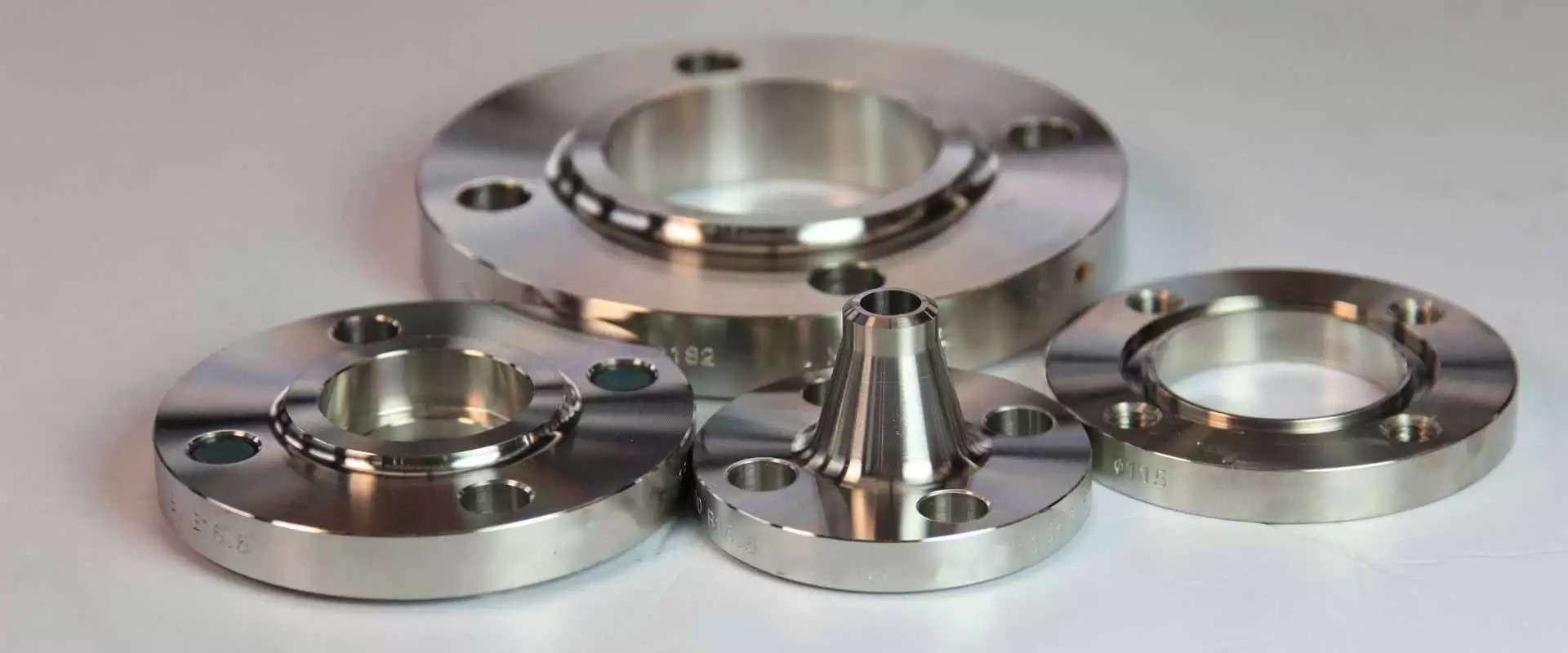
Hastelloy C4 Weld Neck Flanges | Hastelloy C4 Blind Flanges | Hastelloy C4 Slip On Flanges | Hastelloy C4 Socket Weld Flanges | ASTM B564 C4 Flanges | UNS N06455 Flanges | W.Nr. 2.4610 Flanges | Alloy C-4 Flanges | Ni-Cr-Mo Flanges | ASME B16.5 Hastelloy C4
Hastelloy C4 flanges (UNS N06455, W.Nr. 2.4610, ASTM B564 / ASME SB-564) are manufactured from a titanium-stabilised nickel-chromium-molybdenum (Ni-Cr-Mo) alloy that represents the thermally stable evolution of the C-family Hastelloy alloys. Developed to overcome the heat-affected zone (HAZ) sensitisation problems of earlier C-type alloys such as C276, Hastelloy C4 achieves broad corrosion resistance across both oxidising and reducing acid environments while retaining its full corrosion resistance in the as-welded condition — without requiring post-weld solution annealing.
The alloy contains 14–18% chromium and 14–17% molybdenum for fundamental corrosion resistance, titanium (up to 0.70%) as a carbide/nitride stabiliser that prevents grain-boundary chromium depletion during welding or thermal exposure, and ultra-low carbon (0.015% max) to minimise sensitisation risk. Zero tungsten distinguishes it from C276. Tesco Steel & Engineering manufactures Hastelloy C4 flanges in India to all ASME B16.5, ASME B16.47, EN 1092-1, and DIN specifications, with EN 10204 3.1 / 3.2 material test certificates.
Hastelloy C4 is a member of the C-family of nickel-molybdenum-chromium alloys developed by Haynes International (the registered trademark owner of the Hastelloy name). The C-family alloys — including C276, C22, C4, C2000, and C-2000 — are the premier corrosion-resistant alloys for the most aggressive chemical environments encountered in industry. C4 was specifically developed to solve the heat-affected zone sensitisation problem that limited the applicability of the earlier C276 alloy in as-welded fabrications.
| Alloy | UNS | Cr (%) | Mo (%) | W (%) | Ti (%) | C max (%) | Key Advantage |
|---|---|---|---|---|---|---|---|
| C276 | N10276 | 14.5–16.5 | 15–17 | 3–4.5 | — | 0.01 | Industry standard; broadest experience base; excellent reducing + oxidising |
| C4 | N06455 | 14–18 | 14–17 | None | 0.70 max | 0.015 | Best thermal stability; as-welded HAZ corrosion resistance; zero W |
| C22 | N06022 | 20–22.5 | 12.5–14.5 | 2.5–3.5 | — | 0.015 | Best oxidising acid resistance; highest Cr; good pitting resistance |
| C2000 | N06200 | 22–24 | 15–17 | — | — | 0.01 | Cu addition; broadest chemical resistance spectrum; highest oxidising + reducing performance |
| B2 | N10665 | 1.0 max | 26–30 | — | — | 0.02 | Unmatched HCl resistance; reducing-only; not for oxidising media |
| Element | Composition (%) | Role & Significance |
|---|---|---|
| Nickel (Ni) | Balance (~65% min) | Base metal — provides the fundamental corrosion-resistant, ductile matrix; enables dissolution of high Mo and Cr without phase instability |
| Chromium (Cr) | 14–18 | Provides passive oxide film (Cr₂O₃) for oxidising acid resistance and chloride pitting resistance; higher Cr = better oxidising environment performance |
| Molybdenum (Mo) | 14–17 | Critical for reducing acid resistance (HCl, H₂SO₄) and crevice corrosion resistance; increases pitting resistance; Mo > 14% classifies C4 as a high-Mo Ni alloy |
| Titanium (Ti) | 0.70 max | The stabilising element — forms stable TiC preferentially over Cr₂₃C₆, preventing grain-boundary chromium depletion during welding or elevated-temperature service (550–900°C) |
| Iron (Fe) | 3.0 max | Kept low (vs C276's 4–7%) to reduce sigma-phase and mu-phase formation tendency during thermal exposure |
| Carbon (C) | 0.015 max | Ultra-low to minimise carbide formation potential; combined with Ti stabilisation gives robust HAZ protection |
| Cobalt (Co) | 2.0 max | Residual from production; not a deliberate addition; controlled to limit in nuclear or regulated applications |
| Manganese (Mn) | 1.0 max | Residual deoxidiser; limited to preserve toughness and corrosion resistance |
| Silicon (Si) | 0.08 max | Very low limit — Si promotes sigma-phase formation in Ni alloys; strictly controlled in C4 |
| Tungsten (W) | None (not specified) | Absence of W (vs C276's 3–4.5%) is deliberate — W reduces thermal stability by promoting mu-phase precipitation |
| Property | Hastelloy C4 — ASTM B564 (Forgings, Annealed) |
|---|---|
| Tensile Strength (UTS) — Minimum | 690 MPa (100 ksi) |
| Yield Strength (0.2% Offset) — Minimum | 283 MPa (41 ksi) |
| Elongation — Minimum | 40% |
| Hardness — Maximum | 85 HRB |
| Density | 8.64 g/cm³ |
| Elastic Modulus at 20°C | ~205 GPa (29.7 × 10⁶ psi) |
| Thermal Conductivity at 100°C | ~11.7 W/m·K |
| Coefficient of Thermal Expansion (20–100°C) | 11.2 × 10⁻⁶ /°C |
| Max. Service Temp. — Oxidising atmosphere | 870°C (1600°F) |
| Max. Service Temp. — Non-oxidising atmosphere | 1040°C (1900°F) |
| ASME B16.5 Material Group | 3.2 (Nickel Alloys) |
Understanding the sensitisation mechanism is essential to correctly specifying C4 versus C276:
| Environment | C4 Performance | vs C276 | Notes |
|---|---|---|---|
| HCl — all concentrations, ambient | Excellent | Equivalent | High Mo (14–17%) provides outstanding HCl resistance |
| HCl — dilute, elevated temperature | Excellent | Equivalent | Superior to all stainless steels and most Ni alloys |
| H₂SO₄ — all concentrations | Excellent | Equivalent | Both Cr and Mo contribute to H₂SO₄ resistance |
| H₃PO₄ (phosphoric acid) | Excellent | Equivalent | Including wet-process H₃PO₄ with fluoride impurities |
| HNO₃ — moderate concentrations | Good | Equivalent | Cr provides oxidising acid resistance |
| HF — dilute | Moderate | Equivalent | Neither C4 nor C276 preferred for hot concentrated HF |
| Acetic acid / formic acid | Excellent | Equivalent | Organic acid environments including pharmaceutical streams |
| Wet chlorine gas / Cl₂(aq) | Excellent | Equivalent | Resists all concentrations at ambient and elevated temperature |
| Sodium hypochlorite (NaOCl) | Excellent | Equivalent | Bleach and hypochlorite at all concentrations |
| Chlorine dioxide (ClO₂) | Excellent | Equivalent | Pulp and paper bleach plant; one of few alloys that resists ClO₂ |
| Mixed HNO₃ + HCl (aqua regia) | Moderate | Equivalent | Concentrated aqua regia attacks all C-family alloys |
| Chloride pitting / crevice corrosion | Excellent | C276 slight edge (W content) | PREN ~55 for C4 vs ~65 for C276 |
| Weld HAZ in acid service (as-welded) | Excellent | C4 significantly superior | Ti stabilisation prevents HAZ sensitisation — C4's defining advantage |
| Seawater and marine chloride | Excellent | Equivalent | Resists biofouling-enhanced crevice corrosion that destroys duplex SS |
| Flange Type | Code | Standard | Application in Corrosive Service |
|---|---|---|---|
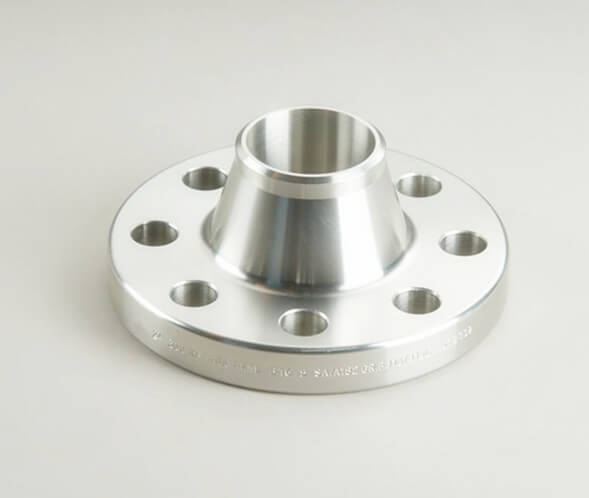
| Weld Neck | WNRF | ASME B16.5 / B16.47 | Preferred type for high-integrity C4 connections — tapered bore reduces stress concentration at the weld joint in corrosive high-pressure service |
| Slip On | SORF | ASME B16.5 | Moderate-pressure acid systems; lower installation precision; dual fillet weld inside and outside |
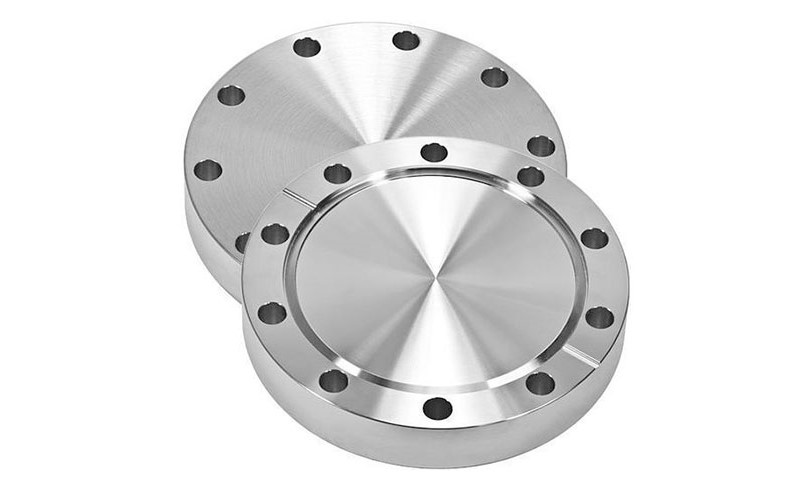
| Blind | BL | ASME B16.5 / B16.47 | Closing corrosive process lines; inspection access ports on chemical reactors and vessels |
| Socket Weld | SWRF | ASME B16.5 | Small-bore (½″–2½″) high-pressure chemical injection, sample lines, and instrument take-offs in acid service |
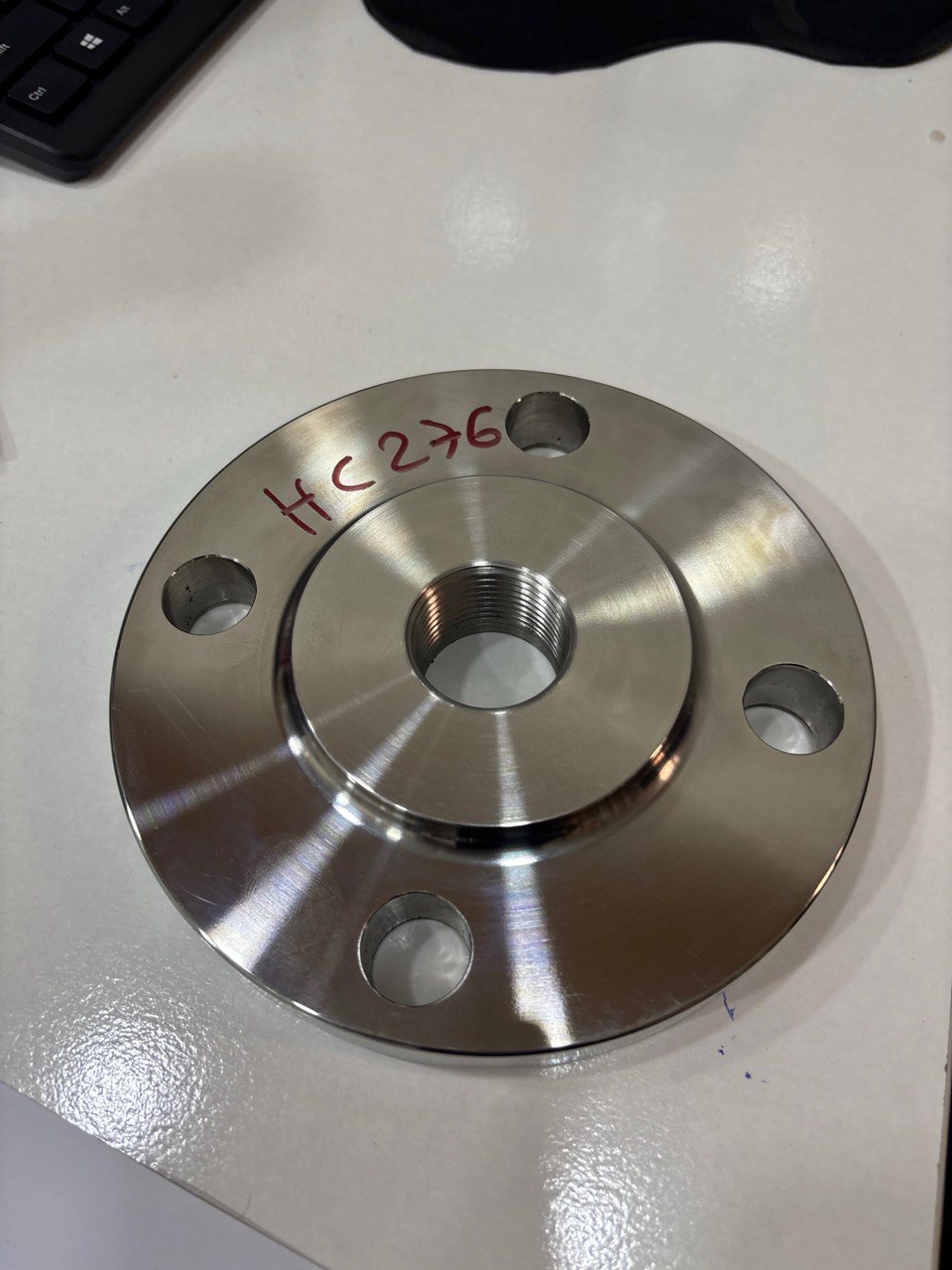
| Threaded / Screwed | TH | ASME B16.5 | Low-pressure vent, drain, and instrument connections; avoids welding of C4 in field where shielding is difficult |
| Lapped Joint | LJ | ASME B16.5 | Used with C4 stub ends — allows less-expensive backing flanges where only the stub end contacts the process fluid |
| Long Weld Neck | LWN | ASME B16.36 / API | Pressure vessel and heat exchanger nozzles in strong acid service — eliminates separate nozzle-to-flange weld joint |
| Spectacle Blind | SB | ASME B16.48 | Positive isolation of corrosive process lines for maintenance — C4 eliminates attack during standby in acid atmosphere |
| Orifice Flanges | ORF | ASME B16.36 | Flow measurement in aggressive chemical and pharmaceutical process streams |
| Ring Type Joint | RTJ | ASME B16.5 | High-pressure acid service requiring positive metal-to-metal seal in critical applications |
| Plate / Flat Flanges | PL / FF | Customer drawing | Tank nozzles, equipment flanges, and custom connection points in acid storage and handling |
| Industry | Application | Why Hastelloy C4? |
|---|---|---|
| Chemical Processing | HCl acid handling systems, H₂SO₄ dilution and distribution, phosphoric acid plants, mixed acid reactors, pickling lines | Resists all concentrations of HCl and H₂SO₄; as-welded HAZ stability critical for large fabricated reactor vessels and columns |
| Pulp & Paper | Bleach plant piping — chlorine dioxide (ClO₂), chlorine (Cl₂), hypochlorite (NaOCl) stages; kraft digester nozzles | Only the C-family Ni alloys reliably resist ClO₂; C4's weld stability eliminates HAZ failures in large bleach plant piping fabrications |
| Flue Gas Desulphurisation (FGD) | Absorber tower internals, slurry recirculation flanges, mist eliminator supports, limestone feed piping | Mixed H₂SO₄ / HCl condensate with chloride; C4 resists the combined acid environment that causes premature failure in duplex SS and C276 as-welded |
| Pharmaceutical | Reactor nozzles, heat exchanger flanges, organic acid process piping, product-contact flanges in API synthesis | Resistance to organic acids, halogenated solvents, and mixed acid reaction media; as-welded HAZ integrity critical for GMP-compliant fabrications where PWHT changes microstructure documentation |
| Offshore & Oil Refining | Sour water strippers, amine treating units, acid alkylation piping, chloride stress corrosion service lines | Resists H₂S, HCl, and organic acid environments; C4 preferred where large as-welded assemblies cannot be solution annealed offshore |
| Hydrometallurgy | High-pressure acid leach (HPAL) autoclave nozzles, CCD (counter-current decantation) circuits, electrowinning piping | Hot concentrated H₂SO₄ in HPAL conditions; C4's HAZ stability critical for large autoclave fabrications and as-welded nozzle connections |
| Wet-Process Phosphoric Acid | Evaporator flanges, pump casings, pipeline connections in impure H₃PO₄ with fluoride, chloride, and solids | Resists the combined corrosive action of H₂SO₄, HF, and H₃PO₄ in wet-process conditions that corrode SS 316L and duplex rapidly |
| Power Generation | Condenser flange connections in chloride-containing cooling water; high-pressure steam systems with acid condensate | Chloride pitting resistance superior to any stainless steel; C4 used where duplex SS fails from crevice corrosion at flange joints |
| Waste Treatment | High-temperature incineration scrubber piping, acid waste neutralisation systems, HCl recovery units | Combined temperature + acid attack in incinerator scrubbers; C4's thermal stability at 550–870°C critical for elevated-temperature connections |
Hastelloy C4 is weldable by all standard processes used for nickel alloys. Its titanium stabilisation gives it significantly better as-welded corrosion resistance than C276, making it the preferred fabrication alloy for large chemical plant assemblies:
| Welding Parameter | Requirement for Hastelloy C4 |
|---|---|
| Preferred Process | GTAW (TIG) — most common for flanges and pipe joints; GMAW (MIG) and SAW for heavy fabrication |
| Filler Metal | AWS A5.14 ERNiCrMo-7 (Hastelloy C-4 matching filler); ERNiCrMo-10 (C22 filler — overmatching; acceptable) |
| Shielding Gas | Argon or Ar/He mixtures; 99.99% purity; positive pressure purge to prevent air ingress |
| Preheat | Not required; weld at ambient temperature; do NOT preheat (increases time in sensitisation range) |
| Interpass Temperature | Maximum 150°C — control strictly to limit heat input and time in 550–900°C sensitisation zone |
| Heat Input | Low-to-medium heat input preferred — reduces HAZ width and exposure time in sensitisation range |
| Post-Weld Heat Treatment | Not required for most applications (C4's primary advantage over C276). Solution anneal at 1050–1080°C + rapid water quench available if required by specification |
| PWHT for C276 (comparison) | C276 often requires solution anneal after welding in critical corrosive service — C4 eliminates this costly step |
| Cleaning | Pickle in HNO₃/HF solution after welding to remove weld oxides and restore passive film; rinse with DI water |
| ASME Qualification | WPS/PQR per ASME Section IX, P-Number 45 (UNS N06455 group) |
| Standard | Scope |
|---|---|
| ASTM B564 / ASME SB-564 | Nickel alloy forgings — primary material standard for Hastelloy C4 flanges (UNS N06455) |
| ASTM B575 / ASME SB-575 | Low-carbon Ni-Cr-Mo alloy plate — Grade N06455 (for plate flanges and spectacle blinds) |
| ASTM B619 / B622 | Welded / seamless Ni-alloy pipe — N06455 (for stub ends and pipe nipples supplied with flanges) |
| ASME B16.5 | Pipe flanges, NPS ½–24, Classes 150–2500 — Ni alloys are Material Group 3.2 with dedicated P-T tables |
| ASME B16.47 | Large diameter flanges NPS 26–60 (Series A: MSS SP-44; Series B: API 605) |
| ASME B16.36 | Orifice flanges, NPS 1–16 |
| ASME B16.48 | Line blanks — spectacle blinds and paddle blanks |
| EN 1092-1 | European flange standard — PN rated (PN 6 to PN 400) |
| DIN 2527 / 2631–2638 | German DIN flanges — W.Nr. 2.4610 |
| NACE MR0175 / ISO 15156 | Materials for H₂S-containing oil & gas environments — C4 compliant for sour service |
| AWS A5.14 | Nickel alloy welding rods and electrodes — ERNiCrMo-7 (C4 filler) |
| ASTM G28 Method A | Ferric sulphate-sulphuric acid corrosion test for detecting sensitisation in Ni-Cr-Mo alloys |
| ASME Section IX | Weld procedure qualification — P-Number 45 group for C4 |
| EN 10204 3.1 / 3.2 | Material test certificates — 3.1 standard, 3.2 third-party on request |
| Hastelloy C4 Flanges — Available Specifications | |
|---|---|
| Material Grade | Hastelloy C4, UNS N06455, W.Nr. 2.4610, Nicrofer 6616 (VDM designation) |
| Material Standard | ASTM B564 / ASME SB-564 |
| Size Range | ½″ NB to 56″ NB (DN 15 to DN 1400) |
| Pressure Class (ASME) | 150#, 300#, 600#, 900#, 1500#, 2500# |
| Pressure Rating (PN) | PN 6, PN 10, PN 16, PN 25, PN 40, PN 64, PN 100, PN 160, PN 250, PN 320, PN 400 |
| Schedule | STD, XS, XXS, Sch 10, 20, 40, 80, 120, 160 |
| Flange Types | Weld Neck (WNRF), Slip On (SORF), Blind (BL), Socket Weld (SWRF), Threaded (TH), Lapped Joint (LJ), Long Weld Neck (LWN), Spectacle Blind (SB), Orifice (ORF), Ring Type Joint (RTJ), Plate Flanges, Flat Flanges |
| Flange Face | Raised Face (RF), Flat Face (FF), Ring Type Joint (RTJ), Male-Female (MF), Tongue & Groove (T&G) |
| Facing Finish | 125–250 AARH stock finish (ASME B16.5); smooth for PTFE gaskets; RTJ grooves per ASME B16.20 |
| Dimensional Standards | ASME B16.5, ASME B16.47 Series A & B, EN 1092-1, DIN 2527/2631–2638, JIS B2220, AWWA, BS 4504, MSS SP-44 |
| Corrosion Test | ASTM G28 Method A (ferric sulphate-sulphuric acid immersion, 120 h — available on request to verify sensitisation resistance) |
| Additional Services | PMI (XRF/OES for alloy verification), Hydrostatic testing, RT, UT, Liquid penetrant (LP/PT), Pickling & passivation, Third-party inspection (Bureau Veritas, SGS, DNV, Lloyd's, TÜV), Marking per MSS SP-25 |
Full documentation from raw material heat certificate (ASTM B564) to final dimensional inspection, PMI, and packing records — traceable throughout.
Positive Material Identification by XRF or OES is performed on all C4 flanges before despatch to confirm UNS N06455 composition — especially Mo and Cr content.
We supply Hastelloy C4 flanges to chemical plants, FGD systems, pharmaceutical facilities, pulp & paper mills, and offshore platforms across 6 continents.
C4 flanges manufactured to your piping class sheet, material requisition, or dimensional drawing — any type, face, size, and pressure class.
3.1 certificates supplied as standard. Third-party 3.2 inspection available with Bureau Veritas, SGS, DNV, Lloyd's, TÜV, or your nominated TPIA.
Our technical team advises on C4 vs C276 vs C22 vs C2000 selection for your specific process fluid, temperature, and fabrication requirements — at no charge.
Hastelloy C4 (UNS N06455, W.Nr. 2.4610, ASTM B564) is a titanium-stabilised nickel-chromium-molybdenum (Ni-Cr-Mo) alloy containing approximately 65% Ni, 14–18% Cr, 14–17% Mo, up to 0.70% Ti, and ultra-low carbon (0.015% max). It is a member of the C-family Hastelloy alloys, engineered to provide the broad corrosion resistance of C276 — across both oxidising and reducing acid environments — with significantly superior weld heat-affected zone (HAZ) thermal stability. The titanium addition locks carbon as stable TiC, preventing grain-boundary chromium depletion during welding or high-temperature service and allowing C4 to be used in as-welded condition without post-weld heat treatment.
Hastelloy C4 is designated UNS N06455. The European W.Nr. is 2.4610. ASTM forging standard: ASTM B564 / ASME SB-564. Plate standard: ASTM B575. VDM Metals trade name: Nicrofer 6616. AWS welding filler: ERNiCrMo-7.
Both alloys have similar corrosion resistance in immersion service. The critical differences: Composition: C276 contains 3–4.5% tungsten (W) and up to 0.01% C; C4 has zero W, up to 0.70% Ti, and 0.015% max C. Thermal stability: C276's HAZ can form mu-phase, P-phase, and chromium carbide precipitates in the 550–900°C range, reducing local corrosion resistance; C4's Ti stabilisation prevents this. As-welded performance: C4 maintains full corrosion resistance in as-welded HAZ; C276 often requires solution anneal after welding in critical acid service. Pitting resistance (PREN): C276 (~65) slightly higher than C4 (~55) due to W content. When to choose C4: large fabricated assemblies, field welding, service at 550–900°C, pharmaceutical GMP applications where PWHT complicates quality documentation.
C22 (UNS N06022) has higher chromium (20–22.5% vs 14–18% for C4) and lower molybdenum (12.5–14.5% vs 14–17%), plus 2.5–3.5% W. The higher Cr in C22 gives it better resistance to oxidising environments (concentrated HNO₃, ferric/cupric chlorides, hot acid oxidising salts). C4's higher Mo provides superior resistance to reducing environments (HCl, H₂SO₄). C4 has better HAZ thermal stability than C22 due to Ti stabilisation. C22 has higher pitting resistance (PREN ~66). Decision: C4 for reducing acid priority; C22 for oxidising acid priority or mixed oxidising/reducing with pitting concern.
Titanium prevents sensitisation — the process by which chromium is depleted from grain boundaries during welding or thermal exposure (550–900°C). In unsensitised alloys, carbon migrates to grain boundaries and forms chromium carbides (Cr₂₃C₆), depleting Cr from the adjacent matrix and creating corrosion-susceptible zones. Titanium has ~100× stronger thermodynamic affinity for carbon than chromium, so it preferentially forms stable titanium carbides (TiC) that do not deplete Cr. With C4's very low carbon (0.015% max), the amount of TiC formed is small and harmless. The result: the grain boundaries in C4 contain the same chromium concentration as the bulk metal — no depleted zones, no preferential corrosion in the HAZ.
Per ASTM B564 (forgings, annealed): Tensile Strength minimum 690 MPa (100 ksi); Yield Strength minimum 283 MPa (41 ksi); Elongation minimum 40%; Hardness maximum 85 HRB. Density: 8.64 g/cm³. Elastic modulus: ~205 GPa. Maximum continuous service temperature: 870°C in oxidising atmosphere, 1040°C in non-oxidising atmosphere.
Hastelloy C4 resists: hydrochloric acid (HCl) at all concentrations and temperatures; sulphuric acid (H₂SO₄) across a wide concentration range including boiling dilute; phosphoric acid (H₃PO₄) including wet-process impure; formic and acetic acids at elevated temperatures; wet chlorine gas; sodium hypochlorite and chlorine dioxide; mixed acid environments; and most chemical process streams. It does not resist fuming sulphuric acid (oleum), concentrated boiling HNO₃ (where C22 is preferred), or anhydrous hot HF.
Specify Hastelloy C4 over C276 when: (1) Post-weld heat treatment is not feasible — large fabrications, field welds, repair welds; C4's HAZ is already corrosion-resistant without PWHT; (2) Service in the 550–900°C range — C4's Ti stabilisation prevents phase precipitation that would reduce C276's corrosion resistance; (3) Pharmaceutical / GMP applications — where PWHT changes material documentation and C4's as-welded stability simplifies compliance; (4) HAZ attack has been the historical failure mode in the previous alloy. In straightforward immersion applications with full PWHT capability, C276 and C4 are equivalent — C276 may be more cost-competitive due to wider availability.
Yes — this is Hastelloy C4's primary engineering advantage. The titanium stabilisation prevents sensitisation in the weld HAZ, so C4 does not require post-weld solution annealing to maintain its corrosion resistance in most applications. Weld using GTAW with ERNiCrMo-7 filler, argon shielding, maximum 150°C interpass temperature, and low heat input. After welding, pickle in HNO₃/HF solution to restore the passive film. An ASTM G28 Method A corrosion test on a weld coupon can verify HAZ resistance if required by specification.
Material: ASTM B564 / ASME SB-564 (UNS N06455 forgings). Flange dimensions: ASME B16.5 (NPS ½–24, Class 150–2500, Material Group 3.2); ASME B16.47 (NPS 26–60); EN 1092-1. Welding filler: AWS A5.14 ERNiCrMo-7. Sour service: NACE MR0175 / ISO 15156. Corrosion test: ASTM G28 Method A. Test certificates: EN 10204 3.1 (standard) / 3.2 (third-party on request). Weld qualification: ASME Section IX P-Number 45.
Hastelloy C4 Flanges — Manufacturer / Supplier / Stockist in: Kuwait, UAE, Germany, Saudi Arabia, West Africa, Iraq, Congo, Mexico, Bahrain, Canada, Philippines, Thailand, Kenya, Oman, Malaysia, Turkey, Qatar, Sudan, Netherlands, Nigeria, Lithuania, Gabon, Russia, Vietnam, Angola, Bolivia, Indonesia, UK, Yemen, Italy, United States, Venezuela, Spain, Iran, Estonia, Kazakhstan, Algeria, Jordan, Ecuador, Portugal, Colombia, Libya, Chile, Peru, South Africa, Namibia, Afghanistan, Israel, Zambia, Morocco, Denmark, Taiwan, Norway, Belarus, North Macedonia, Lebanon, Sri Lanka, Bulgaria, Ukraine, Belgium, Finland, Slovakia, Romania, France, Brazil, Trinidad & Tobago, Fiji, Tunisia, Ghana, Egypt, Czech Republic, Azerbaijan, Poland, Greece, Costa Rica, New Zealand, Croatia, Puerto Rico, Tanzania, Somalia, Singapore, Australia, Japan, South Korea, Bangladesh, China.
Major Exporting Cities: Dubai, Abu Dhabi, Sharjah, Riyadh, Jeddah, Al Jubail, Al Khobar, Dammam, Kuwait City, Manama, Doha, Muscat, Tehran, Ahvaz, Lagos, Nairobi, Johannesburg, Moscow, Atyrau, Istanbul, London, Aberdeen, Houston, Los Angeles, New York, Dallas, Toronto, Calgary, Montreal, Singapore, Kuala Lumpur, Bangkok, Jakarta, Ho Chi Minh City, Hanoi, Seoul, Busan, Tokyo, Sydney, Melbourne, Cairo, Casablanca, Algiers, Karachi, Mumbai, Chennai, Pune, Vadodara.