

Tesco Steel & Engineering manufactures flat flanges — flat-face (FF) flanges whose gasket-seating face is machined completely flat, with no raised face or ring-joint groove. The flat surface lets the gasket make full-face contact and eliminates the bending moment on the flange when the bolts are torqued — essential when mating to cast-iron or non-metallic equipment that could crack under a raised-face load. Made in carbon steel, SS 304/316/321, duplex and alloy steel to ASME B16.5, EN, DIN, STAS, VSM and NS. NPS 1/2″ to 56″, Class 150 to 9000, PN1 to PN400. ISO 9001:2015 certified. Made in India.

Carbon Steel Flat (Flat-Face) Flange
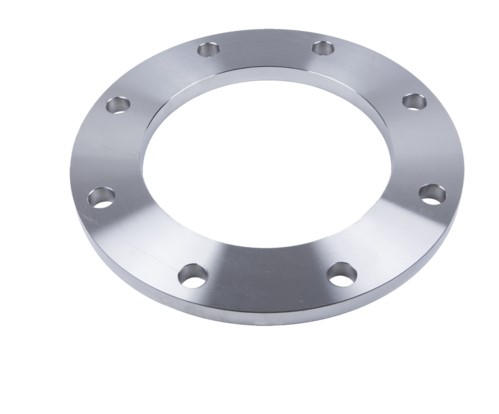
Stainless Steel Flat Flange
Tesco Steel & Engineering manufactures flat flanges in the full range of materials and standards. Explore related flange types such as plate flanges, slip-on flanges, blind flanges, and the flange dimension charts.
The full-face gasket and flat seating give a reliable, even seal between pipes and equipment.
No raised face means no concentrated bolt load — safe to bolt to cast-iron or bronze pumps, valves and vessels.
Bolted flat-face joints are simple to break and remake, easing inspection and repairs.
Available in carbon steel, stainless and alloy steel to suit a wide range of fluids and conditions.
| Flat Flanges are available in the following specifications: | |
|---|---|
| Size | 1/2″ NB to 56″ NB (DN 15 to DN 1400) |
| Class / Rating | 150#, 300#, 3000#, 6000#, 9000# |
| Pressure Ratings | PN 1 – PN 400 |
| Face Type | Flat Face (FF) — full-face gasket |
| Stainless Steel Flat Flanges | ASTM A182 F304 / 304H / 304L / 316 / 316H / 316L / 316Ti, 309, 310, 317L, 321, 347, 904L |
| Duplex Steel Flat Flanges | ASTM A182 F51, F53, F55 |
| Alloy Steel Flat Flanges | ASTM A182 F5, F9, F11, F21, F22 & F91 |
| Carbon Steel Flat Flanges | ASTM A105 |
| Low Temp. Carbon Steel (LTCS) Flat Flanges | A350 LF2 |
| Copper Nickel (Cu-Ni) Flat Flanges | C70600 (90/10), C71500 (70/30), C71640 |
| Nickel Flat Flanges | UNS N02200, UNS N02201 |
| Monel Flat Flanges | UNS N04400, UNS N05500, Alloy 20 |
| Inconel Flat Flanges | UNS N06600, UNS N06601, UNS N06625, UNS N08800, UNS N08810, UNS N08825 |
| Hastelloy Flat Flanges | UNS N10276, UNS N06022, UNS N10665, UNS N06455 |
| Titanium Flat Flanges | Gr. 1, Gr. 2, Gr. 3, DTH 3.7035, DTH 3.7055 |
| Other Services | Hot Dip Galvanizing (GI) · Sand Blasting · Shot Peening · Epoxy Coating · FBE Coating |
| Feature | Flat Face (FF) | Raised Face (RF) |
|---|---|---|
| Seating surface | Entire face on one plane | Gasket area raised above bolt circle |
| Gasket | Full-face (out to OD, holes for bolts) | Ring gasket inside the bolt circle |
| Bolt load on face | Low / evenly spread | Concentrated on the raised seat |
| Best for | Low pressure; mating cast-iron / bronze | Higher-pressure steel-to-steel joints |
| Caution | — | Do not bolt RF directly to flat-faced cast iron |
The most common — affordable, durable and easy to work with. Used in low-pressure applications where corrosion resistance is not a primary concern (A105).
Highly corrosion-resistant for food & beverage, pharma and water treatment; withstands high temperature and pressure (304/316/321).
For high-pressure, high-temperature and harsh environments — superior durability and strength (F11/F22/F91).
Select a standard and pressure rating below for its detailed flat-flange dimension table — outside diameter, bolt-circle diameter, number and size of bolt holes, and flange thickness:
| STAS 8012-84 NP 6 Flat Flange → | STAS 8013-84 NP 10 Flat Flange → |
| STAS 8014-84 NP 16 Flat Flange → | STAS 8015-84 NP 25 Flat Flange → |
| Industry | Typical Application |
|---|---|
| Oil & Gas | Pipeline and utility piping connections |
| Chemical Processing | Process & secondary lines, equipment connections |
| Water & Wastewater | Pump and valve connections (cast-iron equipment), treatment plant piping |
| Food & Beverage | Process lines and hygienic equipment connections (stainless) |
| Pharmaceutical | Manufacturing process piping connections |
| Power & General | Pumps, valves, heat exchangers & flanged equipment |
Flat-flange prices depend on standard/rating, size, material, thickness and quantity. Tesco Steel & Engineering offers competitive factory-direct pricing backed by ISO-certified quality and keeps ready stock of standard items for fast delivery and export. Click Ask for Quote or message us on WhatsApp at +91 92233 66922 for an updated price list with stock availability against your requirement.
A complete flat flange specification has five elements — remember that FF describes the facing, so also state the construction type:
Example of a complete line item: “Slip On Flange, Flat Face, 6″ NB, ASME B16.5 Class 150, ASTM A105, EN 10204 3.1 — 16 pcs (mating to cast iron valve).”
Q1. What is a flat flange?
A flat flange (flat face, abbreviated FF) is a flange whose gasket-seating face is machined completely flat, with no raised face or ring-joint groove. The flat surface lets the gasket contact the entire mating face, which eliminates the bending moment placed on the flange when the bolts are torqued — important when mating to cast-iron or non-metallic equipment that could crack under a raised-face load.
Q2. What is the difference between a flat face (FF) and raised face (RF) flange?
A flat-face flange has its entire face on one plane and uses a full-face gasket, while a raised-face flange has the gasket surface raised above the bolt circle and uses a ring gasket. FF flanges are used at low pressure and when mating to cast iron or bronze; RF flanges concentrate bolt load for higher-pressure sealing. Never bolt an RF flange directly to a flat-faced cast-iron flange.
Q3. When should a flat-face flange be used?
Flat-face flanges are used in low-pressure piping and, critically, when mating to equipment with flat faces such as cast-iron or bronze pumps, valves and vessels. The full-face gasket and flat seating surface avoid the concentrated bolt load of a raised face, which could crack a brittle cast component.
Q4. What gasket is used with a flat flange?
Flat-face flanges use a full-face gasket that covers the entire flange face out to the outside diameter, with holes for every bolt. This contrasts with the ring gasket (inside the bolt circle) used on raised-face flanges, and ensures even, low-stress sealing against flat-faced mating equipment.
Q5. What materials are flat flanges made from?
Flat flanges are made from carbon steel (A105), stainless steel (ASTM A182 F304/316/321/347/904L), duplex (F51/F53/F55), alloy steel (F5/F9/F11/F22/F91), LTCS (A350 LF2), Monel, Inconel, Hastelloy, Titanium and Copper Nickel — selected to match the operating temperature, pressure and fluid.
Q6. What standards cover flat flanges?
Flat flanges are made to ASME B16.5 / B16.47 (flat-face option) and to European/regional standards including EN 1092-1, DIN, Romanian STAS 8012-8015, Swiss VSM 18703 and Norwegian NS — with full dimension tables for each pressure rating.
Q7. Where are flat flanges used?
Flat flanges are used in oil & gas, chemical processing, water and wastewater treatment, and food & beverage piping — connecting pipes, pumps, valves and heat exchangers, especially where the mating equipment has a flat cast-iron or non-metallic face.
Q8. Are flat flanges supplied with material test certificates?
Yes. Every flat flange is supplied with EN 10204 3.1 (or 3.2) mill test certificates with heat/lot traceability, dimensional inspection, and PMI and third-party inspection on request.
Q9. Can a raised face flange be bolted directly to a flat face flange?
It should not be — and most codes prohibit it against cast iron. The raised face concentrates the bolt load on a narrow ring, which bends the unsupported rim of the flat-face mate; on brittle cast iron or GRP that bending cracks the flange. The correct practices are either to use a flat face flange with a full-face gasket on both sides, or to machine the raised face off the steel flange (permissible on most forged flanges, with the rating re-checked). Tesco supplies flat-face versions of every construction so the joint can be designed right from the start.
Q10. What is the difference between a flat flange and a plate flange?
The terms overlap but describe different things. 'Flat face (FF)' describes the facing — any construction (slip-on, weld neck, blind, threaded) can be supplied flat-faced. 'Plate flange' describes the construction — a flat ring cut from plate, which happens to be flat-faced almost by definition. So a plate flange is one kind of flat flange, but an SOFF or WNFF forged flange is a flat flange too. State both the construction and the facing in your enquiry and there is no ambiguity.
Q11. How much does a flat flange weigh?
Marginally less than the raised-face version of the same flange — removing the raised ring takes off only a little metal, so slip-on weights are a good guide: a 2" Class 150 about 2 kg, a 6" Class 150 about 8 kg, a 12" Class 150 about 24 kg for carbon steel. Plate-type flat flanges weigh less again. Every quotation states the exact unit weight for the construction and rating ordered.
Q12. What bolting is used with flat face flanges?
Standard stud bolts and nuts per the flange standard — but tightening practice matters more than hardware: because the full-face gasket spreads load across the whole face, bolts are pulled up evenly in a star pattern to moderate torque, and against cast iron the torque limits of the iron flange govern, not the steel one. Where the mate is a lined or GRP flange, washers and controlled torque protect the liner. State the mating equipment and we can advise gasket and torque guidance with the quotation.
Q13. What details are needed to get an accurate flat flange quotation?
Five elements plus commercial terms: (1) size and standard — e.g. 6" NB ASME B16.5 or DN150 EN 1092-1; (2) pressure class or PN rating; (3) construction — SOFF, plate, BLFF, WNFF or threaded FF, with pipe schedule where a bore matters; (4) the mating equipment — cast iron, GRP or lined — which confirms the facing and finish; (5) material grade and certification — e.g. ASTM A105, A182 F316L, with EN 10204 3.1 or 3.2 stated. Add the quantity and destination and we return price, weight and delivery — normally within 24 hours.
Q14. Who manufactures flat flanges in India?
Tesco Steel & Engineering is an ISO 9001:2015 certified flange manufacturer based in Mumbai, India, producing flat face flanges in every construction — slip-on, plate, blind, weld neck and threaded — to ASME B16.5, B16.1 mating patterns, EN 1092-1, DIN, BS and AWWA C207, in carbon steel, galvanized, stainless, duplex and nickel alloy grades. Flanges ship with EN 10204 3.1/3.2 certification and are exported to more than 50 countries.
Countries We Export Flat Flanges To: Kuwait, UAE, Germany, Saudi Arabia, West Africa, Dubai, Iraq, Congo, Mexico, Bahrain, Canada, Philippines, Thailand, Kenya, Oman, Malaysia, Turkey, Qatar, Sudan, Netherlands, Nigeria, Muscat, Russia, Vietnam, Angola, Indonesia, UK, Yemen, Italy, United States, Venezuela, Kazakhstan, Algeria, Jordan, Colombia, Libya, China, Peru, Iran, South Africa, Afghanistan, Israel, Zambia, Tanzania, Somalia, Pakistan.
Domestic Supply — Flat Flanges in India: Mumbai, Delhi, Bangalore, Hyderabad, Ahmedabad, Chennai, Kolkata, Surat, Pune, Jaipur, Lucknow, Kanpur, Nagpur, Visakhapatnam, Indore, Thane, Bhopal, Pimpri-Chinchwad, Patna, Vadodara, Ghaziabad, Ludhiana, Coimbatore, Agra, Andhra Pradesh, Assam, Bihar, Chhattisgarh, Goa, Gujarat, Haryana, Jharkhand, Karnataka, Kerala, Madhya Pradesh, Maharashtra, Odisha, Punjab, Rajasthan, Tamil Nadu, Telangana, Uttar Pradesh, Uttarakhand, West Bengal.