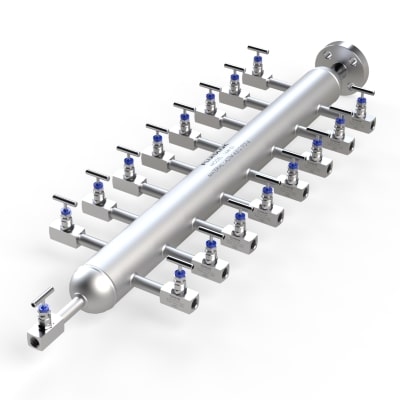
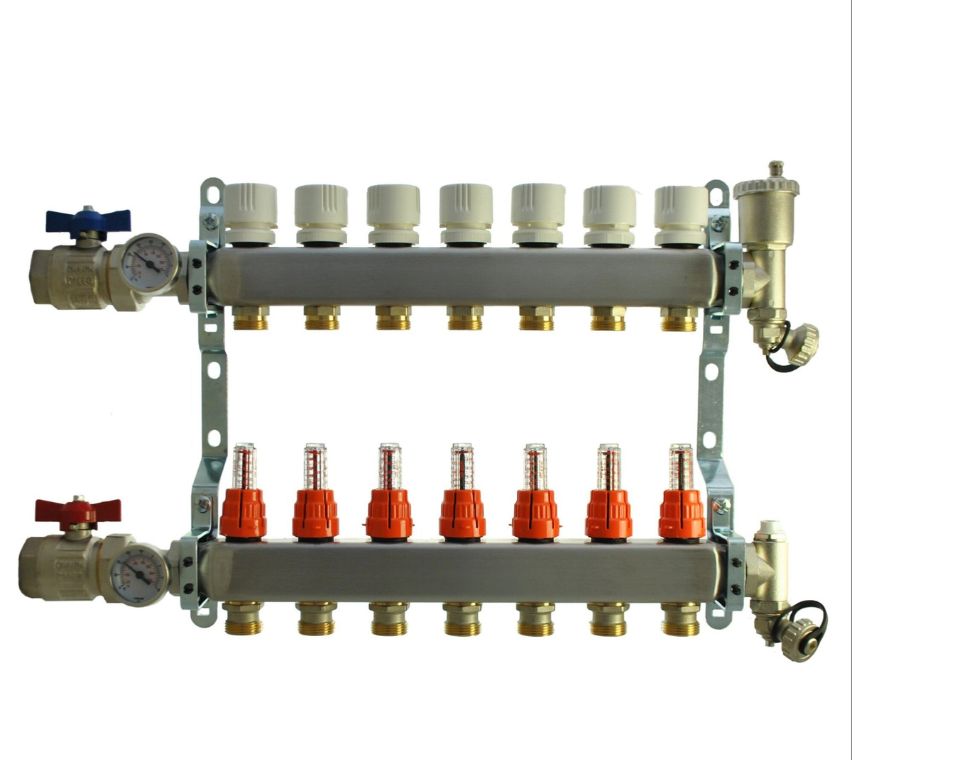
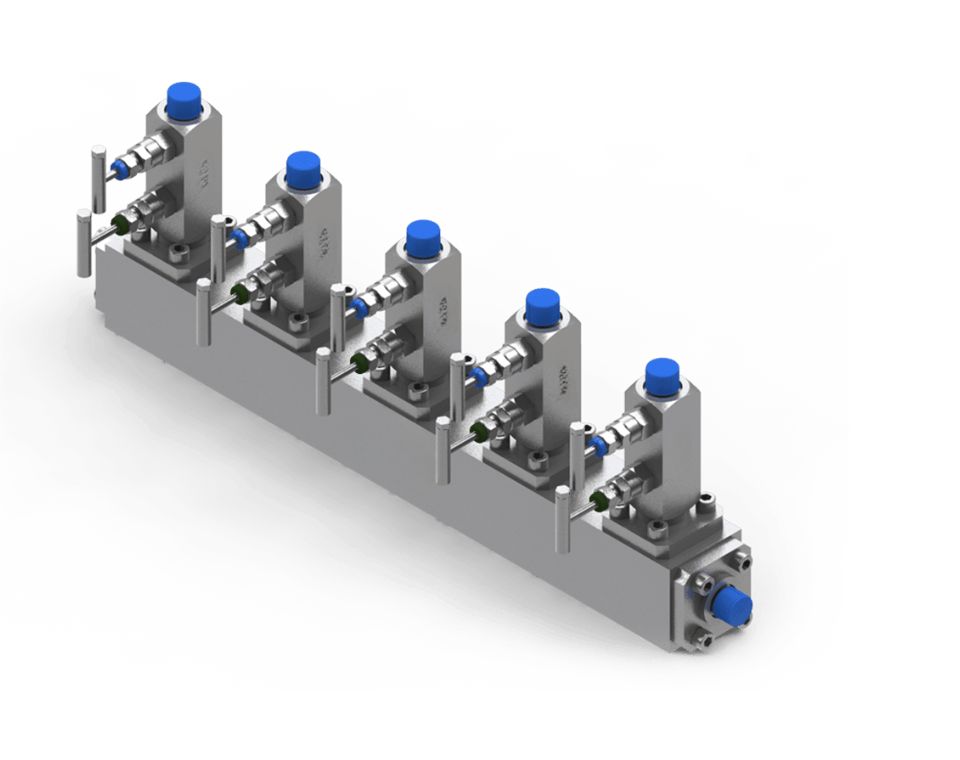
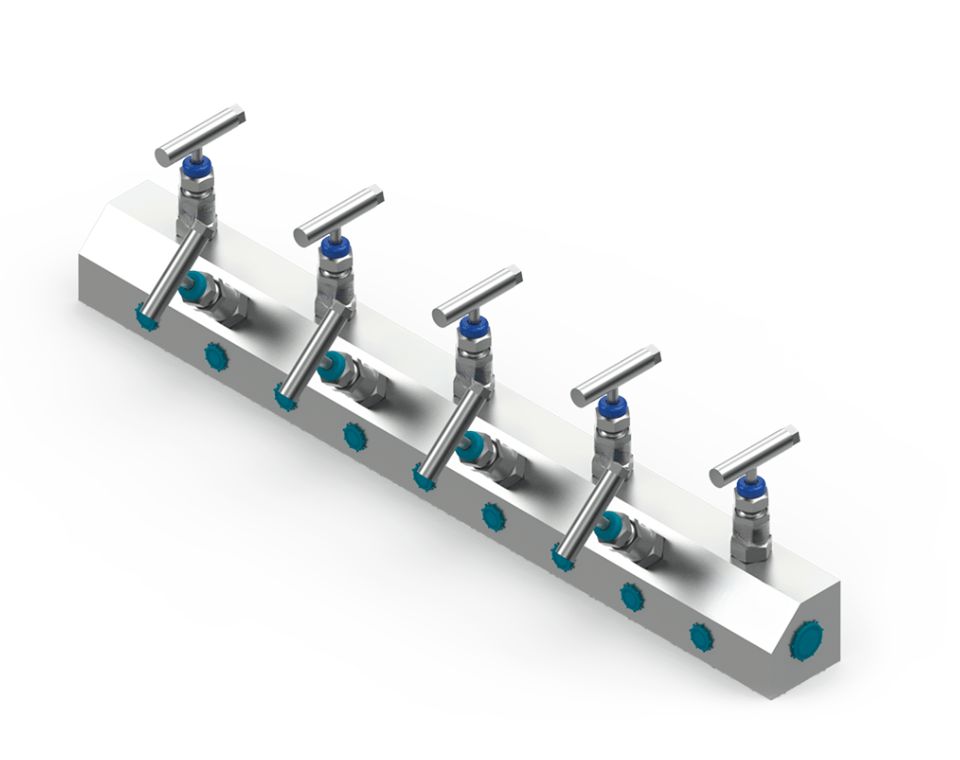
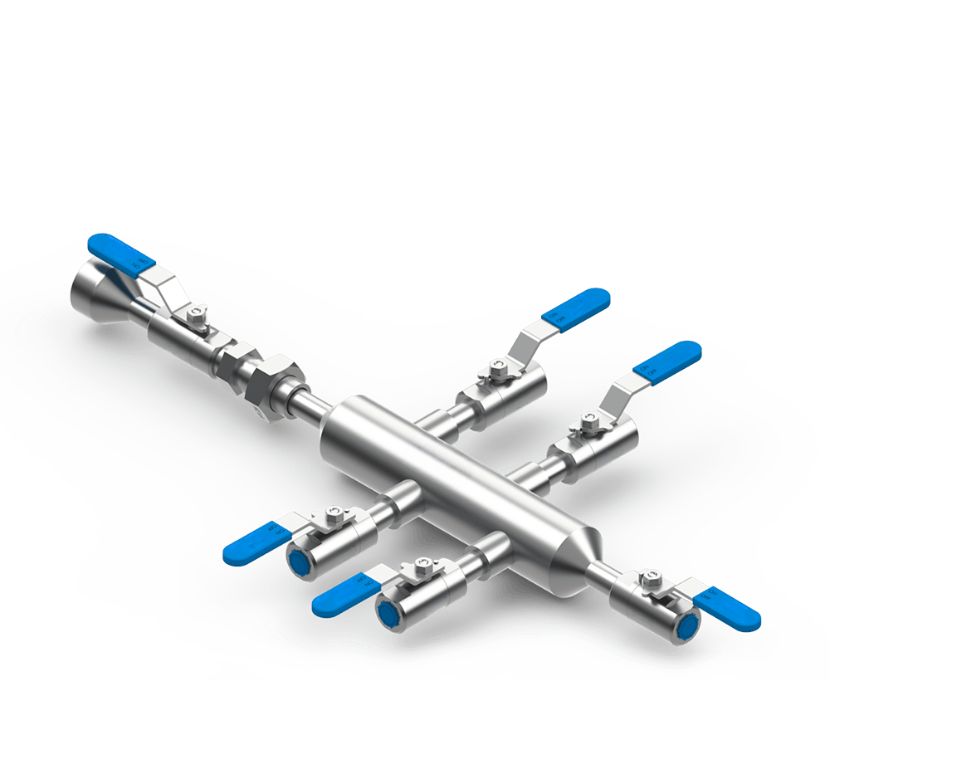
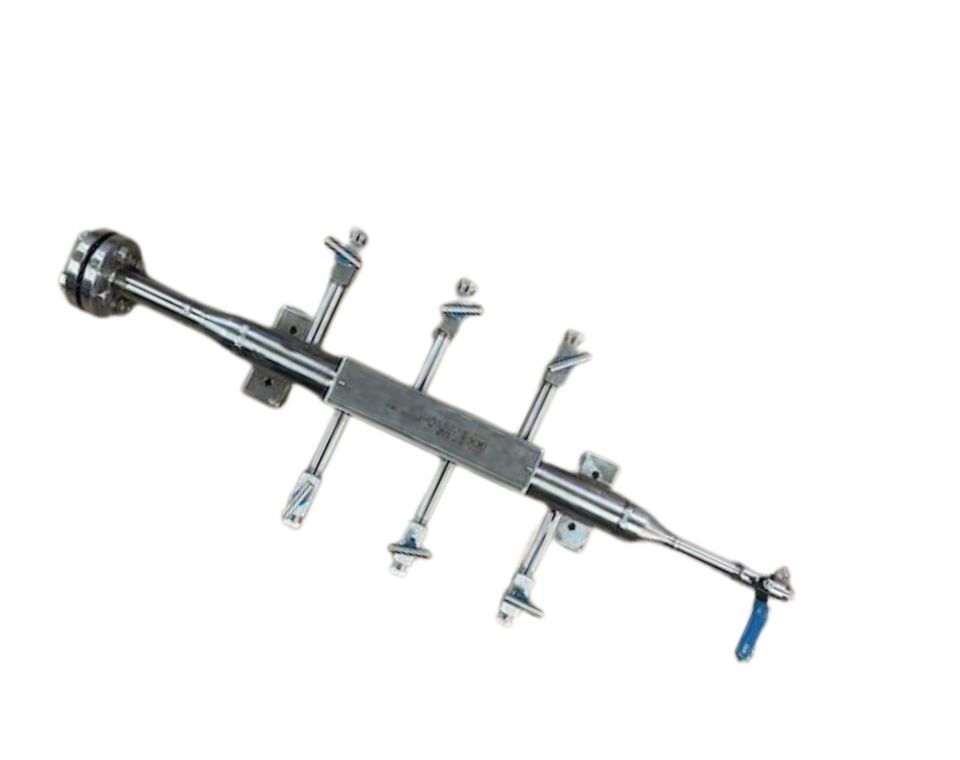
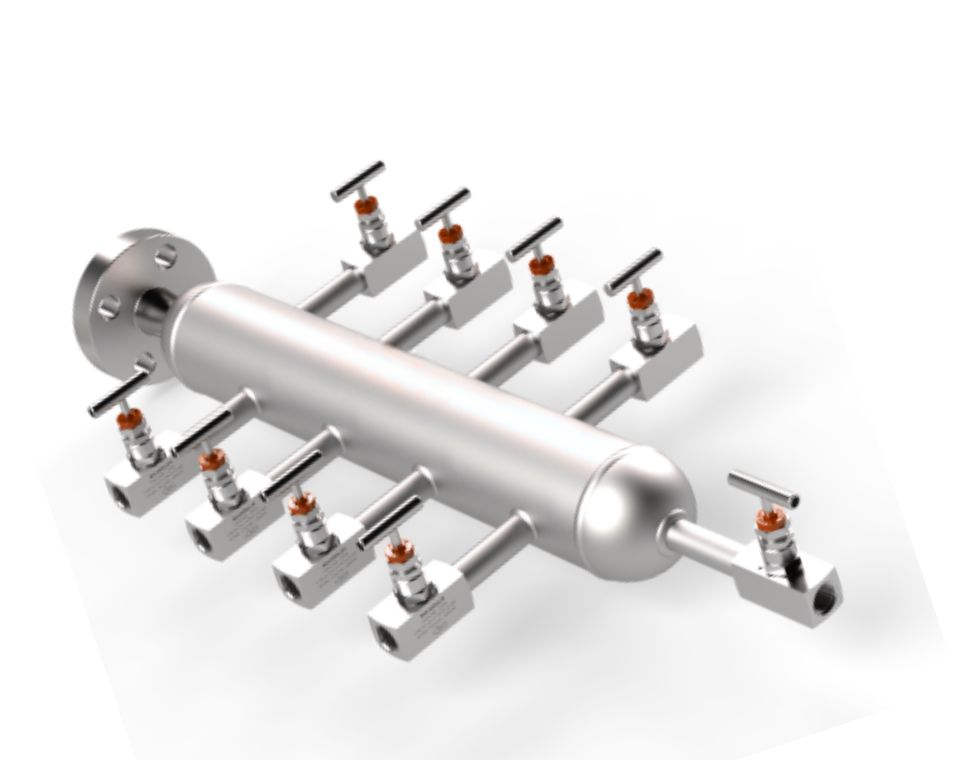
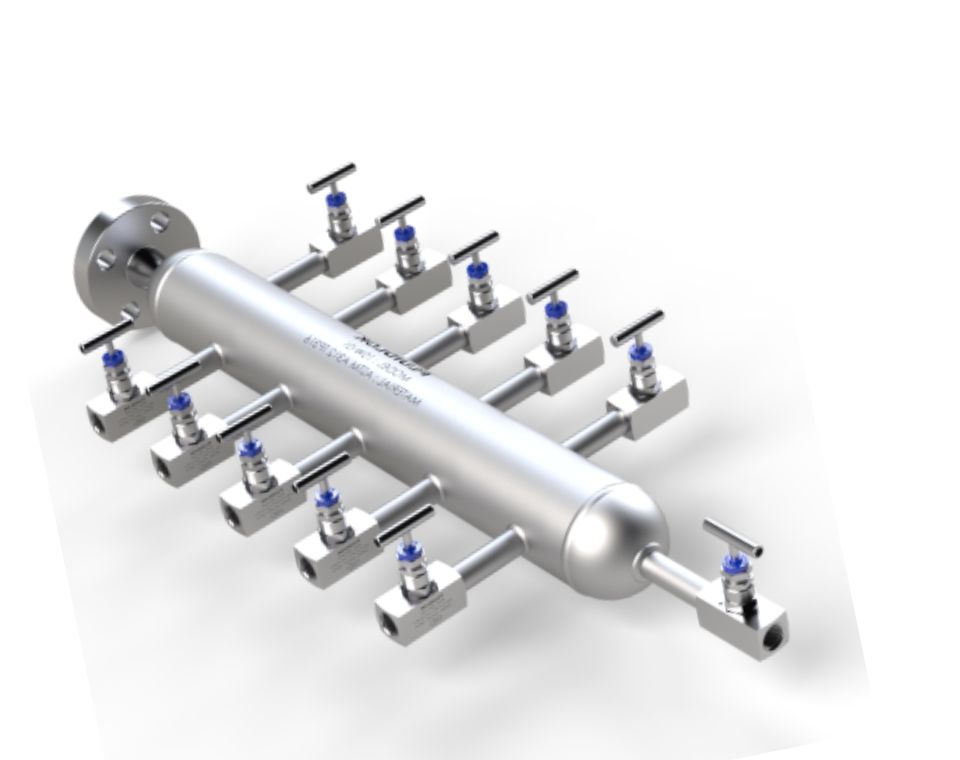
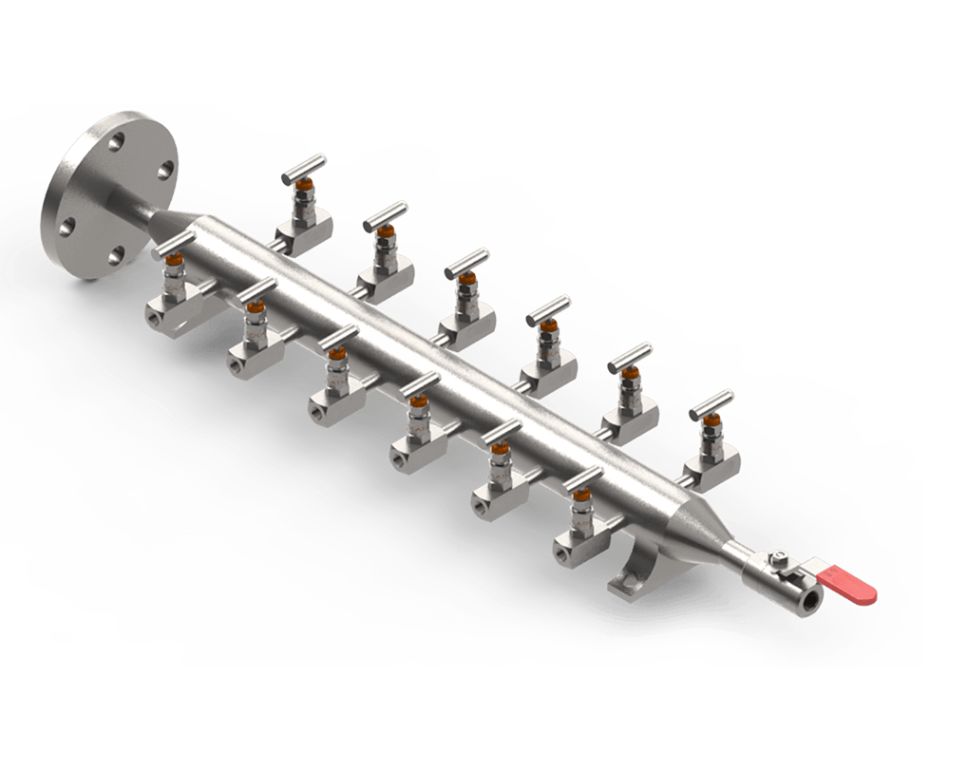
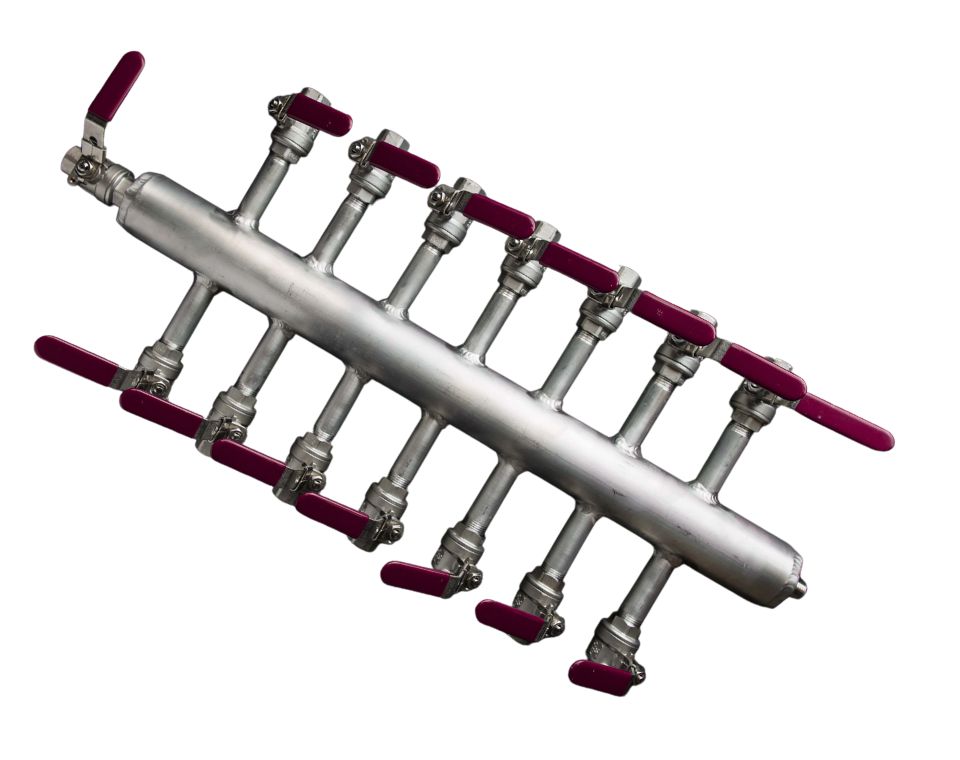
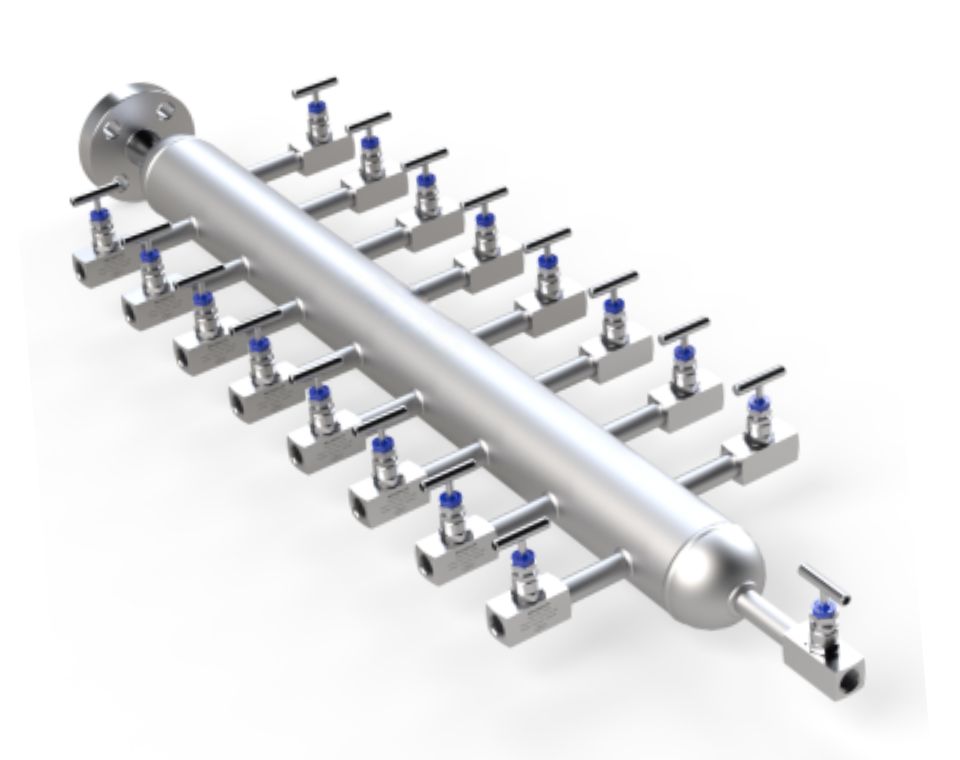
An instrument air header is a precision-machined manifold assembly that distributes compressed air, instrument air, or inert gases from a single supply line to multiple pneumatic instruments, control valves, and actuators simultaneously. Unlike individual point-to-point tubing runs, an air header consolidates all distribution outlets into one compact body — typically machined from bar stock or forged billets — fitted with a common inlet and a row of individually valved or open outlets ranging from 4-way through to 16-way configurations. Tesco Steel & Engineering manufactures air headers with inlet connections from ½″ to 1″ NPT/BSP and outlet ports in ¼″ or ½″ NPT/BSP, built to withstand instrument air pressures up to 150 psi (10 bar) in continuous service across petrochemical, refinery, offshore, and pharmaceutical environments.
Tesco Steel & Engineering produces air header manifolds in a comprehensive range of materials — Stainless Steel 304 (UNS S30400), Stainless Steel 316 (UNS S31600), Brass, Monel 400, Inconel 625, Hastelloy C-276, Duplex 2205, Super Duplex 2507, and Titanium Grade 2 — ensuring the correct corrosion resistance for every service environment from dry instrument air to sour gas and seawater. Each air header is CNC-machined to tight dimensional tolerances, hydrostatically or pneumatically tested per project requirements, and supplied with full material test reports (MTRs), test certificates, and documentation packages. Our air headers are exported to 96 countries and are in service in oil and gas installations, chemical plants, LNG terminals, offshore platforms, and pharmaceutical clean rooms across six continents.
Air headers are manufactured in several distinct design configurations, each suited to specific installation requirements, pressure classes, and instrument loop layouts. Tesco Steel & Engineering produces all major types — from compact bar-stock machined manifolds to heavy-duty flanged distribution headers — in a full range of materials and way configurations.
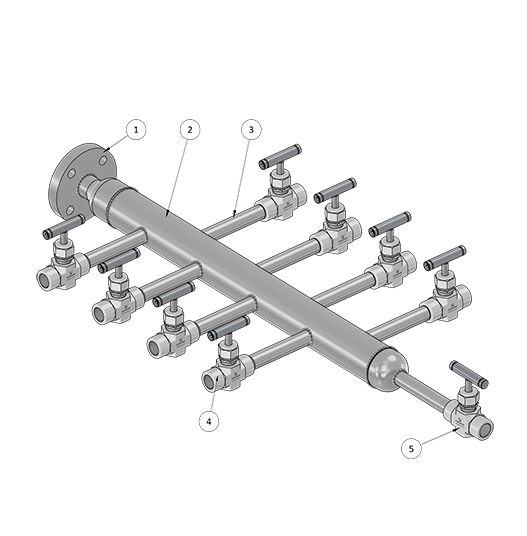
| Parameter | Details |
|---|---|
| Product Name | Instrument Air Header / Compressed Air Distribution Manifold |
| Configurations (Ways) | 4-Way, 6-Way, 8-Way, 10-Way, 12-Way, 14-Way, 16-Way (custom beyond 16-way on request) |
| Inlet Connection Size | ½″, ¾″, 1″ |
| Outlet Connection Size | ¼″, ⅜″, ½″ |
| Thread Standard | NPT (ASME B1.20.1), BSP/BSPT (BS 21 / ISO 7), BSPP (BS 2779 / ISO 228) |
| Pressure Rating | Up to 150 psi (10 bar) standard; higher ratings on request |
| Test Pressure | 1.5× working pressure (hydrostatic); pneumatic leak test available |
| Materials Available | SS304, SS316, Brass, Monel 400, Inconel 625, Hastelloy C-276, Duplex 2205, Super Duplex 2507, Titanium Gr.2 |
| Manufacturing Method | CNC-machined from bar stock or forged billet |
| Surface Finish | Machined (Ra ≤ 3.2 μm); Electropolished available for pharma/food grade |
| End Plugs | Hex head plug or ball valve on each unused outlet (optional) |
| Applicable Standards | ASME B16.11, BS 3799, MSS SP-83, ANSI B1.20.1, BS 21 |
| Documentation | Mill TC, Hydro test certificate, PMI report, Dimensional report, NABL-accredited lab reports |
| Delivery | Ready stock for standard sizes; custom orders in 2–4 weeks |
An instrument air header — also called a compressed air distribution manifold, pneumatic header, or air header manifold — is a drilled and threaded body with one common inlet port and multiple outlet ports arrayed along its length. In an instrumentation system, a single compressed air supply (typically 80–120 psi clean, dry, oil-free instrument air or nitrogen) is piped into the header's inlet; the outlet ports then individually supply air to each field instrument, control valve positioner, pneumatic actuator, or analyser. The result is a centralised, compact distribution point that eliminates the complexity of running individual supply lines from a remote header box directly to each instrument.
The key functional distinction between an air header and a standard pipe tee or cross is precision machined ports with leak-tight NPT or BSP threads, consistent bore geometry for equal pressure distribution to all outlets, and the ability to individually isolate outlets with needle valves or ball valves — allowing maintenance of a single instrument without shutting down the entire supply. In large instrumentation panels and marshalling cabinets, air headers are mounted on DIN rails or instrument supports, making them an essential component of orderly, safe, and serviceable pneumatic system design.
| Configuration | Number of Outlets | Typical Body Length | Common Application |
|---|---|---|---|
| 4-Way Air Header | 4 outlets | ~150 mm | Small instrument panels, local junction boxes |
| 6-Way Air Header | 6 outlets | ~220 mm | Control valve skids, compact marshalling cabinets |
| 8-Way Air Header | 8 outlets | ~290 mm | Instrument racks, DCS/ESD panel air supply |
| 10-Way Air Header | 10 outlets | ~360 mm | Large control panels, offshore instrument enclosures |
| 12-Way Air Header | 12 outlets | ~430 mm | Analyzer shelters, multi-loop process trains |
| 14-Way Air Header | 14 outlets | ~500 mm | Complex process units, petrochemical central air supplies |
| 16-Way Air Header | 16 outlets | ~570 mm | Large refinery panels, FPSO topsides instrument air systems |
| Custom (18+ Way) | On request | To order | Bespoke skid packages, vendor package units |
Note: All configurations available with individual outlet isolation valves (needle valve or ball valve) and end plugs. Mounting brackets and support channels supplied on request.
| Material | UNS / Standard | Key Properties | Recommended Service |
|---|---|---|---|
| Stainless Steel 304 | UNS S30400 / ASTM A276 | Good corrosion resistance, cost-effective | General instrument air, clean utilities, indoor panels |
| Stainless Steel 316 | UNS S31600 / ASTM A276 | Mo addition (2–3%) — superior chloride resistance | Offshore, coastal, marine instrument air systems |
| Brass | CW617N / CZ122 | Low cost, easy machining, good for dry air | Non-corrosive instrument air, HVAC, water utilities |
| Monel 400 | UNS N04400 / ASTM B164 | Excellent seawater corrosion resistance | Marine platforms, seawater cooling, saltwater service |
| Inconel 625 | UNS N06625 / ASTM B446 | High-temp oxidation resistance, fatigue strength | High-temperature air/gas distribution, subsea |
| Hastelloy C-276 | UNS N10276 / ASTM B574 | Best resistance to reducing and oxidising acids | Chemical plants, acid gas service, FGD systems |
| Duplex 2205 | UNS S32205 / ASTM A276 | High strength + pitting resistance (PREN ~35) | Offshore, subsea, high-chloride environments |
| Super Duplex 2507 | UNS S32750 / ASTM A276 | Highest pitting resistance (PREN ~42), SCC resistant | Deep water, highly corrosive gas/process service |
| Titanium Grade 2 | UNS R50400 / ASTM B348 | Excellent corrosion resistance, lightweight | Chlorinated water, bleach service, pharmaceutical |
Tesco air headers are available with the following connection standards on both inlet and outlet ports:
| Connection Type | Standard | Description | Common Regions |
|---|---|---|---|
| NPT (Tapered) | ASME B1.20.1 | National Pipe Tapered Thread — seals on thread taper | USA, Canada, Middle East |
| BSPT (Tapered) | BS 21 / ISO 7-1 | British Standard Taper Pipe Thread — seals on thread taper | UK, Europe, Asia, Australia |
| BSPP (Parallel) | BS 2779 / ISO 228 | British Standard Parallel Thread — seals on face with bonded seal or O-ring | UK, Europe, hydraulic systems |
| Compression Tube | Swagelok / Parker compatible | ¼″ or ½″ OD tube compression fitting ports | Instrumentation panels, analysers |
| Material | Max Working Pressure | Max Temperature | Test Pressure (Hydro) |
|---|---|---|---|
| SS304 / SS316 | 150 psi (10 bar) | 400°C | 225 psi (1.5× WP) |
| Brass | 150 psi (10 bar) | 120°C | 225 psi |
| Monel / Inconel / Hastelloy | 150–300 psi | 500°C | 1.5× WP |
| Duplex / Super Duplex | 200–300 psi | 300°C | 1.5× WP |
| Titanium Gr.2 | 150 psi | 260°C | 1.5× WP |
Higher pressure ratings (Class 3000, 6000) available for special applications. Contact us with your process conditions for a custom design.
| Standard | Scope |
|---|---|
| ASME B16.11 | Forged fittings — socket-welding and threaded; governs dimensions, tolerances, and pressure ratings for threaded connections |
| ASME B1.20.1 | Pipe threads (NPT) — general purpose, tapered and straight |
| BS 21 / ISO 7-1 | Pipe threads for pressure-tight joints (BSPT) |
| BS 2779 / ISO 228 | Pipe threads where pressure-tight joints are not made on the thread (BSPP) |
| BS 3799 | Specification for steel pipe fittings — screwed and socket-welding |
| MSS SP-83 | Class 3000 and 6000 stainless steel pipe unions — socket-welding and threaded |
| ASTM A276 / A479 | Stainless steel bars and shapes used for machined components |
| ASTM B164 / B446 / B574 | Monel, Inconel, and Hastelloy bar stock standards for machined fittings |
| PED 2014/68/EU | Pressure Equipment Directive — for EU-bound equipment |
| ISO 9001:2015 | Quality management system — Tesco's manufacturing QMS certification |
| Benefit | Technical Explanation |
|---|---|
| Centralised Air Distribution | One common inlet feeds multiple instruments from a single point, eliminating long individual supply runs and reducing total tubing inventory by up to 60–70% in dense instrument clusters. |
| Individual Outlet Isolation | Each outlet port can be fitted with a needle valve or ball valve, allowing a single instrument to be shut off for maintenance without interrupting air supply to the remaining instruments on the header. |
| Leak Reduction | Consolidating connections into a single machined body with precision-threaded ports reduces the total number of joints compared to individual Tee fittings — fewer joints means fewer potential leak paths. |
| Space Efficiency | A 16-way header occupies approximately 570 mm × 30 mm of rail space — far less than the equivalent 16-point piping network. Critical in congested offshore topsides and instrument enclosures. |
| Consistent Pressure Distribution | The drilled common bore ensures equal supply pressure to all outlets — important for pneumatic instruments that are sensitive to pressure variation (e.g., DP transmitters, positioners). |
| Simplified Commissioning | A single connection point for the supply line simplifies pressure testing, loop checking, and commissioning compared to individually routed supply tubes. |
| Material Flexibility | Available in nine material grades (SS304 through Titanium), air headers can be matched exactly to the process environment — from clean utility air to sour gas and chlorinated seawater service. |
| Industry / Plant Type | Specific Application | Recommended Material |
|---|---|---|
| Oil & Gas — Onshore | Instrument air supply to control valve positioners, ESD valve actuators, pressure transmitters | SS316, Duplex 2205 |
| Offshore Platforms / FPSOs | Topsides instrument air distribution for safety systems, HIPPS actuators, Christmas tree controls | Duplex 2205, Super Duplex 2507, Monel 400 |
| Refineries | Air headers in control rooms for pneumatic loop supply; analyzer shelter air distribution | SS316, Duplex 2205 |
| Petrochemical Plants | Instrument air to multi-valve control stations, reactor control systems, distillation column instruments | SS316, Hastelloy C-276 |
| LNG / Gas Processing | Inert gas (N₂) distribution headers for purging, blanketing, and instrument supply in cold service | SS316, Super Duplex 2507 |
| Chemical Plants | Compressed air/N₂ supply to pneumatic control valves handling acids, caustic, solvents | Hastelloy C-276, SS316, Titanium Gr.2 |
| Pharmaceutical / Biotech | Clean, sterile instrument air distribution in process areas; electropolished finish for CIP/SIP compatibility | SS316 (electropolished), Titanium Gr.2 |
| Power Generation | Instrument air to turbine control systems, boiler feed valve actuators, combustion management | SS304, SS316 |
| Water & Wastewater | Actuator air supply for automated isolation valves, dosing system controls, aeration systems | SS304, Brass, SS316 |
| Food & Beverage | Hygienic compressed air distribution for packaging lines, filling machines, clean room pneumatics | SS316 (electropolished), Brass |
An instrument air header is a machined manifold body with a single inlet and multiple outlets used to distribute compressed air or instrument air from one supply point to multiple pneumatic instruments, control valves, and actuators simultaneously. It eliminates the need for individual supply runs to each instrument, simplifying piping layouts and reducing leak points in instrumentation systems.
The terms are used interchangeably in most industries. Strictly speaking, "air header" refers to the whole assembly including the body, outlet ports, and any fitted valves or plugs, while "manifold" describes the drilled body itself. In practice, both terms refer to the same type of component — a multi-outlet distribution block for compressed air or inert gas supply to instruments.
"Way" refers to the number of outlet ports on the air header. A 4-way air header has four individual outlet connections feeding four separate instruments from one common inlet. An 8-way has eight outlets, a 16-way has sixteen, and so on. The "way" count determines how many instruments can be supplied from one header assembly.
NPT (National Pipe Taper) is the American standard (ASME B1.20.1) where the thread taper itself creates a pressure-tight seal, usually with thread sealant (PTFE tape or pipe dope). BSP (British Standard Pipe) comes in two variants: BSPT (tapered — BS 21/ISO 7-1), which seals on the thread taper like NPT, and BSPP (parallel — BS 2779/ISO 228), which seals on the face using a bonded seal or O-ring. NPT and BSP threads are not interchangeable — specify the correct standard for your system at order stage.
Standard Tesco air headers are rated to 150 psi (10 bar) working pressure for instrument air service. This covers the full operating range of typical pneumatic instrument systems (20–120 psi). For higher pressures — such as pneumatic actuator supply or gas purging systems — Class 3000 (720 psi / 50 bar) or Class 6000 (1440 psi / 100 bar) air headers are available in SS316 and alloy grades. Contact Tesco with your design pressure and temperature for the appropriate rating.
For general indoor instrument air service in non-corrosive environments, SS304 is perfectly adequate and more cost-effective. Specify SS316 when the installation is outdoor, coastal, offshore, or subject to chloride-containing atmospheres, or when the air header may come into contact with chlorinated water or chemical splashes. SS316 contains 2–3% molybdenum which significantly improves pitting and crevice corrosion resistance compared to SS304.
For offshore topsides and FPSO instrument air systems, Duplex 2205 (UNS S32205) is the most widely specified material due to its high pitting resistance equivalent number (PREN ~35), stress corrosion cracking (SCC) resistance in chloride environments, and excellent mechanical strength. For the most severe environments — deep water, warm seawater, or high-chloride process areas — Super Duplex 2507 (PREN ~42) or Monel 400 is recommended.
Pharmaceutical and biotech plants require SS316L air headers with an electropolished internal bore (Ra ≤ 0.5 μm) to eliminate microbial harborage points and ensure compliance with USP, FDA, and EHEDG guidelines. Electropolishing also improves corrosion resistance of the bore surface, which is important in clean-in-place (CIP) and steam-in-place (SIP) service. BSPP (parallel thread with O-ring face seal) connections are preferred in pharma service to avoid PTFE tape contamination risk.
Yes. Air headers are frequently used for distributing nitrogen (N₂) for instrument supply, purging, blanketing, or analysers in hazardous areas where instrument air is not permitted. The same body designs, materials, and pressure ratings apply. Ensure the material is compatible with the specific gas composition if trace contaminants are present (e.g., moisture, H₂S in sour gas blanketing systems).
Tesco supplies air headers with or without individual outlet valves depending on the application. Options include: no valve (open port with plug), needle valve (for precise manual throttling/isolation), or miniature ball valve (for fast quarter-turn isolation). Needle valves are standard for instrument panel installations; ball valves are preferred for quick maintenance isolation on actuated control valves. Specify your preference at order stage.
Yes. Tesco Steel & Engineering manufactures custom air headers in any configuration beyond the standard 4–16 way range. Custom designs can include mixed inlet/outlet sizes, dual-inlet headers, headers with integrated pressure gauge connections, custom body lengths and mounting patterns, and non-standard thread combinations. Provide your P&ID requirements or instrument list and our engineering team will design the appropriate assembly.
Air header manifold prices depend on the number of ways (configuration), material grade, connection type (NPT/BSP), pressure class, and optional valve fittings. Stainless Steel 304/316 headers in standard 4–16 way sizes are available ex-stock for fast delivery. Alloy grades (Monel, Inconel, Hastelloy, Duplex, Super Duplex, Titanium) are manufactured to order with a typical lead time of 2–4 weeks.
For a competitive price quotation, please share the following with your inquiry:
Global Export: Tesco Steel & Engineering exports air header manifolds to 96 countries including the USA, UK, Germany, France, Netherlands, Saudi Arabia, UAE, Qatar, Kuwait, Oman, Bahrain, Singapore, Malaysia, Thailand, Indonesia, Vietnam, Japan, South Korea, Australia, Canada, Brazil, Mexico, South Africa, Nigeria, Kenya, Egypt, Turkey, India, and across the EU, Southeast Asia, Middle East, Africa, and the Americas. All shipments are supported by full documentation including mill test reports, inspection certificates, and country-of-origin declarations.