

Tesco Steel & Engineering manufactures tube shields — protective half-round, saddle, and wrap-around covers fitted over the outside of boiler and heat-exchanger tubes to shield them from external erosion by high-velocity flue gas, fly-ash, and soot-blower jets. Acting as a sacrificial, replaceable wear surface, the shield takes the abrasion in place of the tube wall, preventing thinning and tube failures and extending tube life. SS 304, 316, 310, 410, Duplex 2205/2507, Monel 400/500, Hastelloy C22/C276/B2/B3, and Inconel. Clamp or snap-ring fixing. ISO 9001:2015 certified. Made in India.
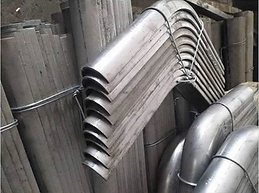
Tube Shields
Tube shields target the external erosion of tubes, complementing tube ferrules (which protect tube inlets internally) and tube sheets. Tesco Steel & Engineering manufactures shields to the tube OD, arc coverage, and fixing method needed, in heat- and erosion-resistant alloys.
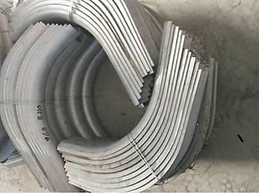
Erosion Protection on Tube Bends
| Type | Coverage | Fixing |
|---|---|---|
| Half-Round Shield | 180° over the gas-facing side | Clamps, straps, or snap rings |
| Saddle / Part-Arc Shield | Partial arc on the worn side | Snap-ring or strap clips |
| Wrap-Around Shield | Near-full wrap of the tube | Snap rings / spot tack |
| Bend / Elbow Shield | Contoured to tube bends | Clamped / tack-welded |
| Soot-Blower Shield | Facing the blower lane | Strap / snap ring |
Snap-ring and clamp fixings let shields be installed and replaced quickly at an outage, often without welding to the pressure part.
| Criterion | Tube Shield | Tube Ferrule |
|---|---|---|
| Protects | Outside of the tube (gas side) | Inside the tube inlet |
| Attack guarded against | External fly-ash & soot-blower erosion | Inlet erosion & thermal shock |
| Form | Half-round / saddle / wrap over the tube | Sleeve inside the tube bore |
| Where used | Boiler banks, bends, soot-blower lanes | Heat-exchanger / boiler tube inlets |
Shields and ferrules are complementary: shields guard the outside of tubes, ferrules guard the inlet ends — both as sacrificial, replaceable parts.
| Material | Properties | Typical Use |
|---|---|---|
| SS 304 / 316 | Good corrosion resistance, general purpose | Moderate-temperature boiler banks |
| SS 310 | Excellent high-temperature & scaling resistance | Hot superheater & high-temp zones |
| SS 410 | Hard, wear-resistant martensitic | Heavy fly-ash erosion areas |
| Duplex 2205 / Super Duplex 2507 | High strength & corrosion resistance | Corrosive flue-gas service |
| Monel 400 / 500 | Excellent in reducing & marine media | Corrosive & marine boilers |
| Hastelloy C22 / C276 / B2 / B3 | Superior acid & high-temperature resistance | Aggressive flue-gas & chemical service |
| Inconel | Outstanding high-temperature strength | Highest-temperature superheater zones |
| Parameter | Details |
|---|---|
| Product | Tube shields / boiler tube erosion-protection shields |
| Types | Half-round, saddle/part-arc, wrap-around, bend/elbow, soot-blower shields |
| Coverage Arc | Part-arc to near-full wrap — to suit the eroded zone |
| Fixing | Clamps, straps, snap rings, or tack-weld — as specified |
| Made To | Tube OD, length, arc & thickness required |
| Material | SS 304/316/310/410, Duplex 2205/2507, Monel 400/500, Hastelloy C22/C276/B2/B3, Inconel |
| Service | Boilers, economizers, superheaters, air pre-heaters, heat exchangers |
| Function | Sacrificial external wear surface — protects tube from erosion |
| Certifications | ISO 9001:2015 | EN 10204 3.1 MTC on request |
Takes fly-ash and soot-blower erosion on the gas-facing side so the pressure-part tube stays at full thickness and avoids leaks.
The shield wears in place of the tube and is replaced at an outage — far cheaper and faster than re-tubing the boiler.
SS 310, 410, Duplex, Monel, Hastelloy, and Inconel matched to the flue-gas temperature and abrasiveness.
Manufactured to the tube OD, arc coverage, length, and thickness, with the fixing method (clamp, strap, snap-ring) you need.
Clamp and snap-ring shields install and replace fast at outages, often without welding to the pressure part.
Contoured bend shields and soot-blower shields protect the highest-erosion areas — bends, leading rows, and blower paths.
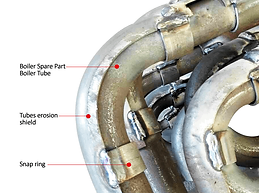
Snap-Ring Shield Installation
| Industry | Typical Use | Why Tube Shields |
|---|---|---|
| Power Generation | Boiler, economizer & superheater tube banks | Resist fly-ash & soot-blower erosion |
| Waste-to-Energy | Incinerator & waste-heat boilers | Heavy abrasive ash protection |
| Sugar & Cement | Bagasse & kiln-gas boilers | High dust-load erosion zones |
| Refinery & Petrochemical | Fired heaters & heat-recovery units | Alloy shields for hot, corrosive gas |
| Steel & Metals | Recuperators & heat recovery | High-temperature scaling resistance |
| Chemical Plants | Process boilers & exchangers | Hastelloy / Monel for corrosive gas |
| Pulp & Paper | Recovery & power boilers | Protects against ash erosion |
| Marine & Boilers | Ship & package boilers | SS / Monel corrosion resistance |
Q1. What is a tube shield?
A tube shield is a protective half-round, saddle, or wrap-around cover fitted over the outside of a boiler or heat-exchanger tube to protect it from external erosion by fly-ash-laden flue gas and soot-blower jets. It is a sacrificial, replaceable wear surface that takes the abrasion in place of the tube wall, preventing thinning and tube failures.
Q2. Why do boiler tubes need shields?
High-velocity flue gas carrying fly-ash and soot, plus the direct blast of soot-blower jets, scours the gas-facing side of boiler tubes and thins the wall, eventually causing leaks and forced outages. Shields cover the worn areas — especially bends, leading tube rows, and soot-blower lanes — so the tube stays at full thickness.
Q3. What is the difference between a tube shield and a tube ferrule?
A tube shield protects the outside of the tube from external (gas-side) erosion, while a tube ferrule is a sleeve inside the tube inlet that protects against internal inlet erosion and thermal shock. They are complementary, both sacrificial and replaceable — shields guard the tube exterior, ferrules guard the inlet ends.
Q4. What types of tube shield are available?
Half-round (180°) shields, saddle/part-arc shields, near-full wrap-around shields, contoured bend/elbow shields, and soot-blower shields. The type and arc coverage are chosen for where and how badly the tube is eroding, and the fixing (clamp, strap, snap-ring, or tack-weld) for the installation.
Q5. What materials are tube shields made from?
SS 304, 316, 310, and 410; Duplex 2205 and Super Duplex 2507; Monel 400/500; Hastelloy C22, C276, B2, and B3; and Inconel. SS 310 and Inconel suit the hottest superheater zones, hard 410 suits heavy erosion, and nickel alloys suit corrosive flue gas. The grade is matched to the temperature and abrasiveness.
Q6. How are tube shields fixed to the tubes?
By clamps, straps, snap rings, or light tack-welds, depending on the design and whether welding to the pressure part is permitted. Clamp and snap-ring fixings allow quick installation and replacement at outages without welding the tube, which is often preferred for pressure-part protection.
Q7. How often should shields be replaced?
Shields are sacrificial, so they are inspected at every boiler outage and replaced when worn. Replacing a shield is far cheaper and faster than replacing a pressure-part tube, so timely replacement keeps the protected tubes in service much longer and avoids unplanned outages.
Q8. Can tube shields be made to our tube sizes?
Yes. Tube shields are manufactured to your tube OD, length, arc coverage, and thickness, in the alloy and with the fixing method suited to your boiler zone. Send your tube details, the erosion zone, and flue-gas conditions for a recommendation and quote.