

TES-LOK bite-type (cutting ring) tube fittings to DIN 2353 / ISO 8434-1 — single-ferrule compression fittings whose hardened cutting ring bites into the tube OD to form a strong, vibration-proof mechanical grip and metal-to-metal seal. Available in L (light) and S (heavy) series. SS 316, Carbon Steel, Brass. Tube 6 mm to 42 mm OD. Pressures up to 630 bar. ISO 9001:2015 certified. Made in India.
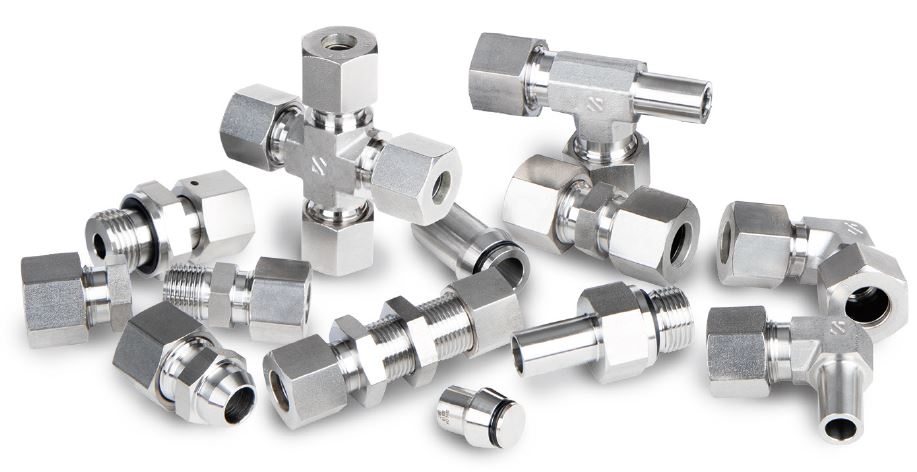
TES-LOK DIN 2353 Bite-Type Fitting
JIS B2351 Bite-Type (Related)
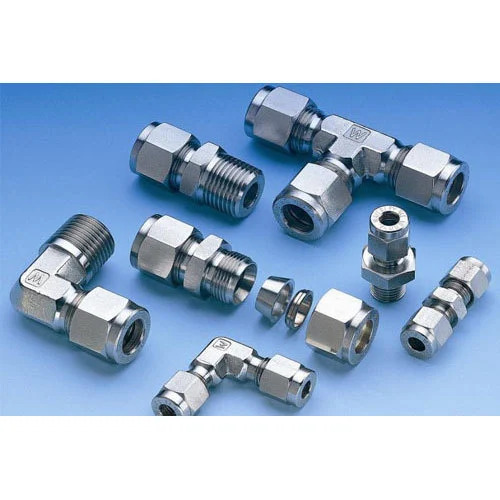
Double-Ferrule Compression (Related)
Because the ring physically cuts into the tube, bite-type fittings require relatively heavy-wall tube and give a positive visual indication of correct assembly (the raised collar of cut material). They are governed by DIN 2353 (the original German standard) and ISO 8434-1 (its international successor), and are supplied in two pressure series — L (light, "leicht") and S (heavy, "schwer").
| Criterion | L Series (Light / Leicht) | S Series (Heavy / Schwer) |
|---|---|---|
| Pressure range | Up to ~315 bar (size dependent) | Up to ~630 bar (size dependent) |
| Wall thickness / body | Lighter section | Heavier section, thicker tube wall |
| Tube OD range | 6 mm to 42 mm | 6 mm to 38 mm |
| Bite / grip | Standard cutting ring bite | Deeper, more robust bite for HP service |
| Typical use | Medium-pressure hydraulic & instrument lines | High-pressure hydraulic power & press circuits |
| Criterion | Bite-Type / Cutting Ring (DIN 2353) | Double-Ferrule Compression |
|---|---|---|
| Standard | DIN 2353 / ISO 8434-1 | Instrument tube fitting standard (twin ferrule) |
| Ferrules | Single cutting ring | Front + back ferrule (two) |
| Grip mechanism | Ring cuts/bites into tube OD | Front ferrule seals, back ferrule grips (no deep cut) |
| Tube wall | Needs heavier-wall tube (to resist the bite) | Works on thinner-wall instrument tube |
| Region / market | Dominant in European hydraulics | Dominant in instrumentation & process |
| Best use | High-pressure hydraulic pipe/tube, mobile & industrial | Instrument, analyser, gas, fine-control tube |
| Shape | Configuration | Use |
|---|---|---|
| Straight Union | Tube to tube, in-line | Joining two tubes of the same OD |
| Male Stud Coupling | Tube to male thread (metric / BSPP / NPT) | Tube to threaded port |
| Female Stud Coupling | Tube to female thread | Tube to male-threaded port |
| Elbow / 90° & 45° | Tube to tube or tube to thread at an angle | Direction change in tube routing |
| Tee / Cross | Three / four-way branch | Branching tube lines |
| Bulkhead Union | Tube to tube through a panel | Panel / wall pass-through connection |
| Reducer Union | Two different tube ODs | Changing tube size in a run |
| Parameter | Details |
|---|---|
| Brand | TES-LOK (Tesco Steel & Engineering) |
| Standard | DIN 2353 / ISO 8434-1 (24° cone cutting ring) |
| Series | L (Light) and S (Heavy) |
| Tube OD Range | 6 mm to 42 mm (L series) | 6 mm to 38 mm (S series) | inch sizes on request |
| Pressure Rating | L series: up to ~315 bar | S series: up to ~630 bar (size dependent) |
| Thread Options | Metric parallel, BSPP (G), BSPT, NPT, UNF — male & female stud couplings |
| Body Material | SS 316 / 316L, SS 304, Carbon Steel (zinc/zinc-nickel plated), Brass |
| Cutting Ring Material | Hardened steel (case-hardened) or SS 316 — matched to body |
| Working Temperature | Up to 427°C (800°F) — material and seal dependent |
| Seal Options | Metal-to-metal (standard) | soft-seal (FKM / NBR) ring for higher leak-tightness on request |
| Certifications | ISO 9001:2015 | EN 10204 3.1 MTC on request |
Body cone angle, cutting ring geometry, and thread dimensions are manufactured to DIN 2353 / ISO 8434-1, so TES-LOK bodies, rings, and nuts interchange with standard DIN 2353 components from other compliant makers in the same series and size.
The cutting ring is precision-hardened so its edge reliably bites into the tube OD without deforming — giving a consistent, repeatable bite and a strong anti-blow-out grip on every assembly.
The S (heavy) series carries high-pressure hydraulic service up to around 630 bar, while the L (light) series covers medium-pressure lines to ~315 bar — one fitting family for the full hydraulic pressure range.
The raised collar of cut tube material ahead of the ring gives a positive visual check that the bite has formed correctly — easy inspection and quality assurance at every joint.
Once the ring has bitten the tube, the joint can be disconnected and remade many times — the nut simply re-tightens onto the formed bite, making maintenance and re-routing straightforward.
SS 316, SS 304, Carbon Steel, and Brass bodies with metric, BSPP, BSPT, NPT, and UNF threads — plus optional soft-seal rings for higher leak-tightness. EN 10204 3.1 MTC available on request.
| Industry | Typical Use Point | Why DIN 2353 Bite-Type Preferred |
|---|---|---|
| Industrial Hydraulics | High-pressure hydraulic pipe/tube on power units, presses, manifolds | S series to 630 bar; strong anti-blow-out bite resists pressure surge |
| Mobile & Construction Equipment | Excavator, crane, loader hydraulic tube connections | Vibration-proof bite; reusable joints for field service |
| Machine Tools | Hydraulic and lubrication tube on CNC and forming machines | European DIN 2353 standard fit; compact reliable connections |
| Oil & Gas | Hydraulic control and HP small-bore tube on skids | SS 316 bodies for corrosion; high-pressure grip and seal |
| Marine & Offshore | Deck machinery and steering gear hydraulic tube | SS 316 corrosion resistance; vibration-proof bite under wave loads |
| Steel & Metals | Rolling mill and casting HP hydraulic tube | S series carries intense cyclic high pressure |
| Agriculture & Forestry | Tractor and harvester hydraulic tube | Robust, reusable field-serviceable connections |
| Power Generation | Turbine governing and lube oil hydraulic tube | High-pressure metal-to-metal seal; SS for hot oil service |
Q1. What is a bite-type tube fitting?
A bite-type (cutting ring) tube fitting is a single-ferrule compression fitting to DIN 2353 / ISO 8434-1. A hardened cutting ring is driven by the body's 24° cone so its edge bites into the tube OD, cutting a collar of material that locks the tube against pull-out and forms a metal-to-metal seal. It is the dominant tube-fitting type in European hydraulics, available in L (light) and S (heavy) pressure series.
Q2. What is the difference between DIN 2353 and ISO 8434-1?
DIN 2353 is the original German standard for 24° cone cutting-ring tube fittings; ISO 8434-1 is the international standard that superseded and is harmonised with it. Fittings made to DIN 2353 and ISO 8434-1 share the same 24° cone, cutting-ring geometry, and L/S series, so they are functionally equivalent and interchangeable. TES-LOK manufactures to both.
Q3. What is the difference between the L and S series?
L (light / leicht) series fittings have a lighter section and cover medium pressure up to about 315 bar; S (heavy / schwer) series have a heavier section, deeper bite, and need heavier-wall tube, covering high pressure up to about 630 bar. They are not interchangeable — the body, ring, nut, and tube wall must all match the chosen series.
Q4. How is a bite-type fitting different from a double-ferrule compression fitting?
A bite-type fitting uses a single cutting ring that physically cuts into the tube OD, requiring heavier-wall tube — it dominates European hydraulics. A double-ferrule fitting uses two ferrules (front seals, back grips) without deeply cutting the tube, and works on thinner-wall instrument tube — it dominates instrumentation and process. Choose bite-type for high-pressure hydraulic tube and double-ferrule for instrument/analyser tube.
Q5. Why is pre-assembly recommended for bite-type fittings?
Pre-assembly — forming the bite in a hardened pre-assembly tool or body before final installation — guarantees the cutting ring bites correctly and consistently, especially on larger sizes and S-series fittings. It avoids under- or over-tightening during final assembly and lets you inspect the bite before the joint goes into service. For small L-series sizes, direct assembly is often acceptable.
Q6. What tube should I use with DIN 2353 bite-type fittings?
Use precision seamless hydraulic tube of the correct OD and wall thickness for the series — S series needs heavier-wall tube than L series. The tube must be within OD tolerance, reasonably hard (not soft annealed), and cut square and deburred. Soft, thin-wall, or out-of-tolerance tube will not form a reliable bite. Cold-drawn seamless steel or SS 316 hydraulic tube to EN 10305 is typical.
Q7. Can bite-type fittings be reused?
Yes. Once the cutting ring has bitten the tube, the joint can be disconnected and remade many times — the nut re-tightens onto the already-formed bite. This makes bite-type fittings convenient for maintenance and re-routing. The cutting ring itself stays on the tube; only inspect that the bite and seal faces remain undamaged on reassembly.
Q8. Do you supply soft-seal (O-ring) cutting rings for better leak-tightness?
Yes. In addition to standard metal-to-metal cutting rings, TES-LOK offers soft-seal cutting rings with an FKM (Viton) or NBR elastomer element that improves leak-tightness, especially on gas and low-viscosity media. Specify the soft-seal option and elastomer when ordering. Standard metal-seal rings remain the choice for the highest temperatures.