ISO 9001:2015 Certified

'SHAPING INDUSTRIES WITH THE FINEST STEEL'

ASTM A182 F9 Alloy Steel Flanges Manufacturer in India


9Cr-1Mo | UNS K90941 | DIN 1.7386 | ASME SA182 | Max 649°C | Extreme Sulfidation Resistance | McConomy Relative Rate 0.01–0.03 | Class 150–2500

ASTM A182 F9 alloy steel flanges manufacturer India
A182 F9 9Cr-1Mo flanges supplier India

What is ASTM A182 F9 Alloy Steel?


ASTM A182 F9 is a 9Cr-1Mo ferritic/martensitic alloy steel covered under ASME/ASTM A182 — the standard specification for forged or rolled alloy-steel pipe flanges, fittings, and valves for high-temperature service. Designated UNS K90941 and equivalent to DIN 1.7386 (X12CrMo9-1), F9 contains 8.00–10.00% chromium and 0.90–1.10% molybdenum, placing it at the top of the standard Cr-Mo steel family.

The 9% chromium content gives F9 outstanding sulfidation resistance — the highest of any standard Cr-Mo grade below the modified P91 steel — and excellent oxidation resistance up to and beyond 650°C. This makes F9 the material of choice in refinery circuits where F5 (5Cr-0.5Mo) corrosion allowances are exceeded by severe sulfur-laden streams at elevated temperatures.

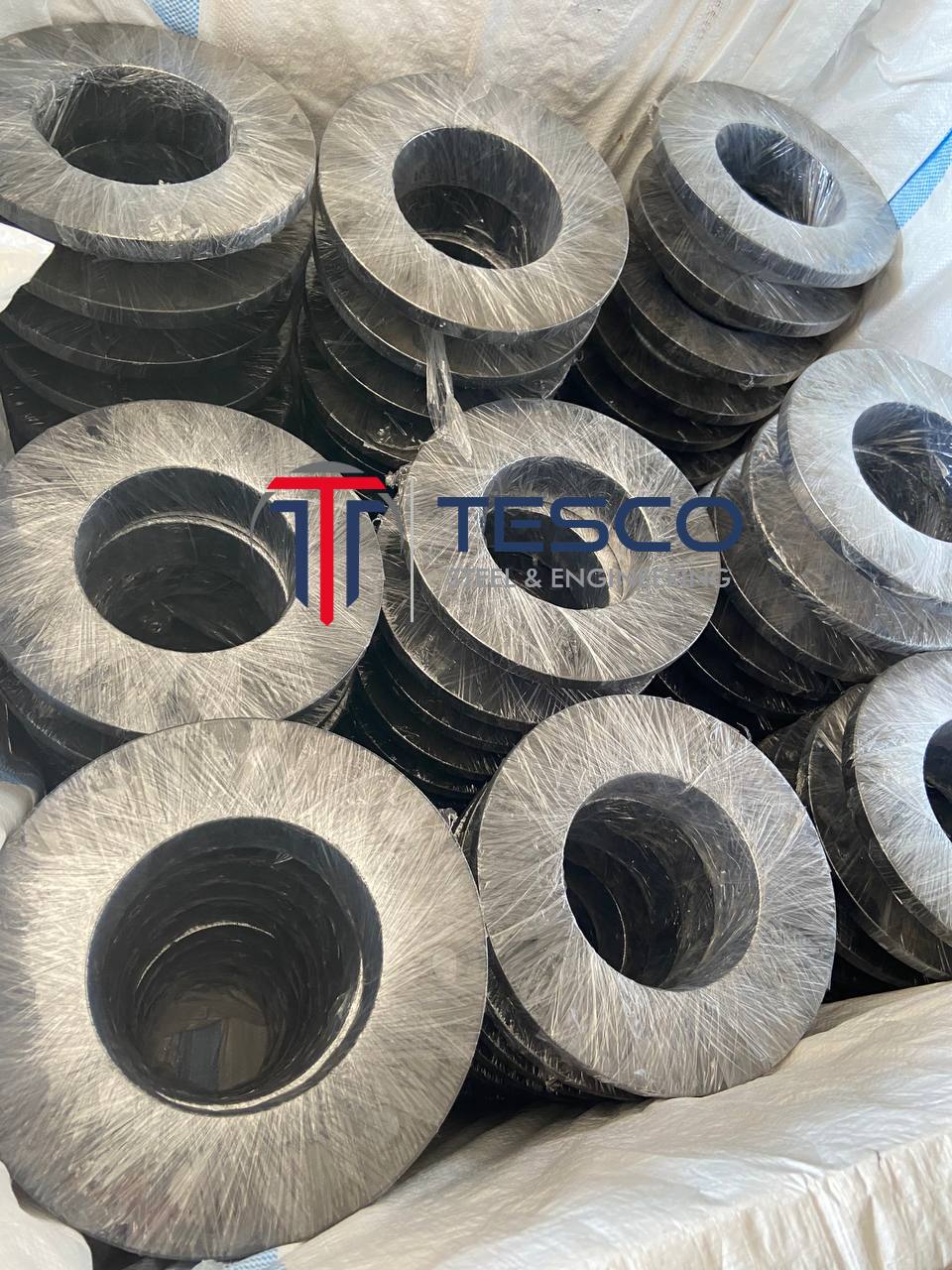
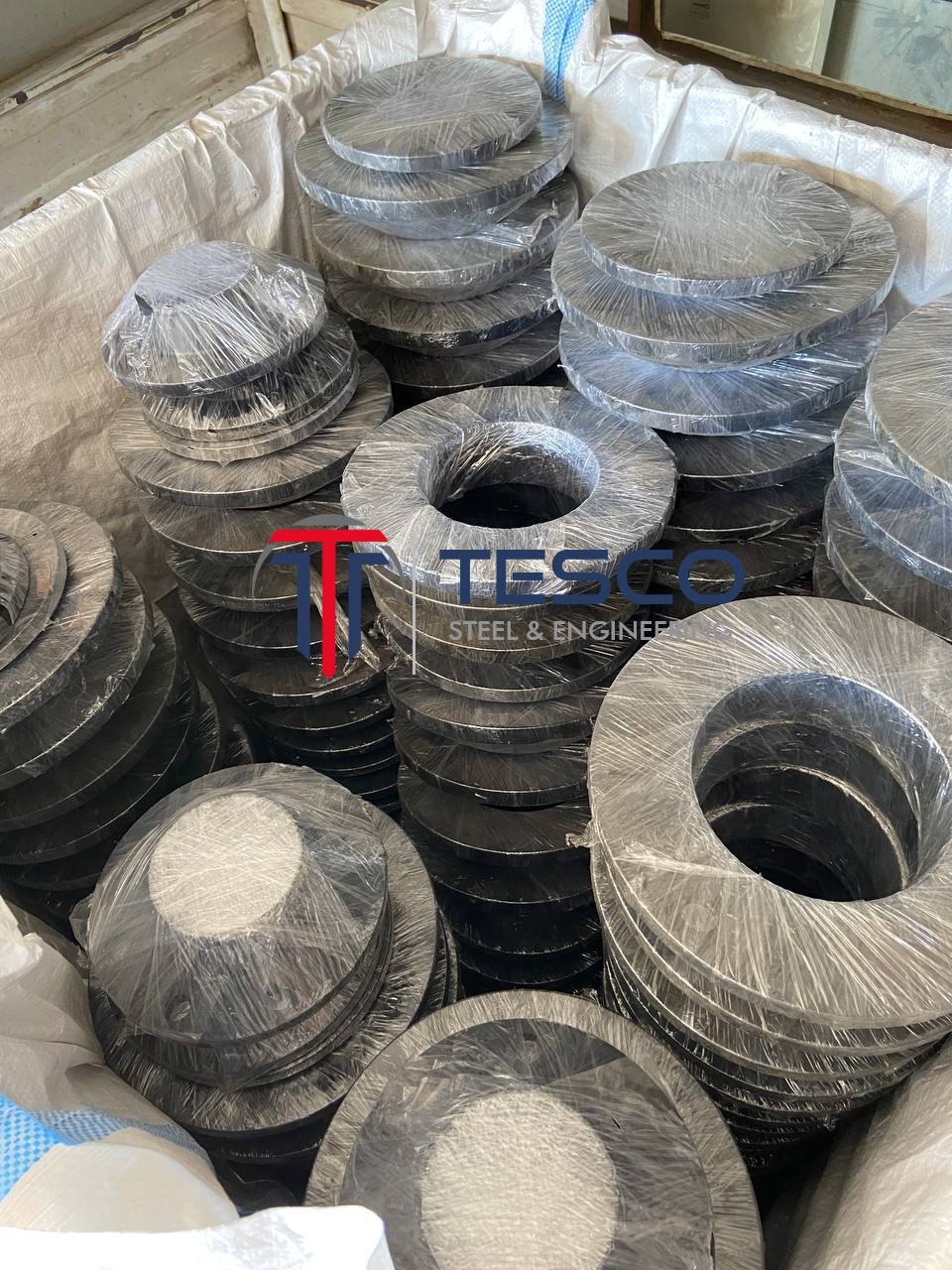
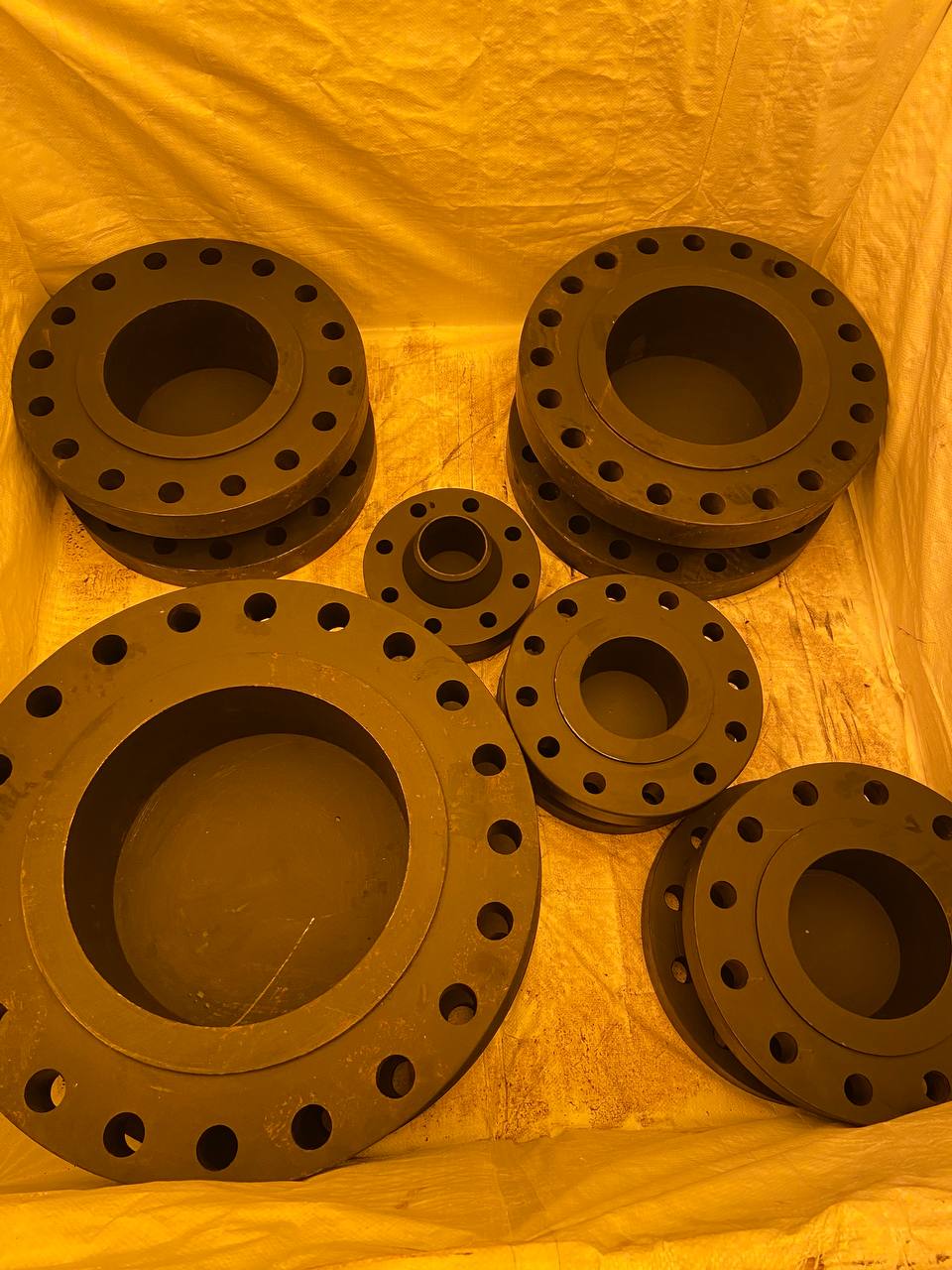
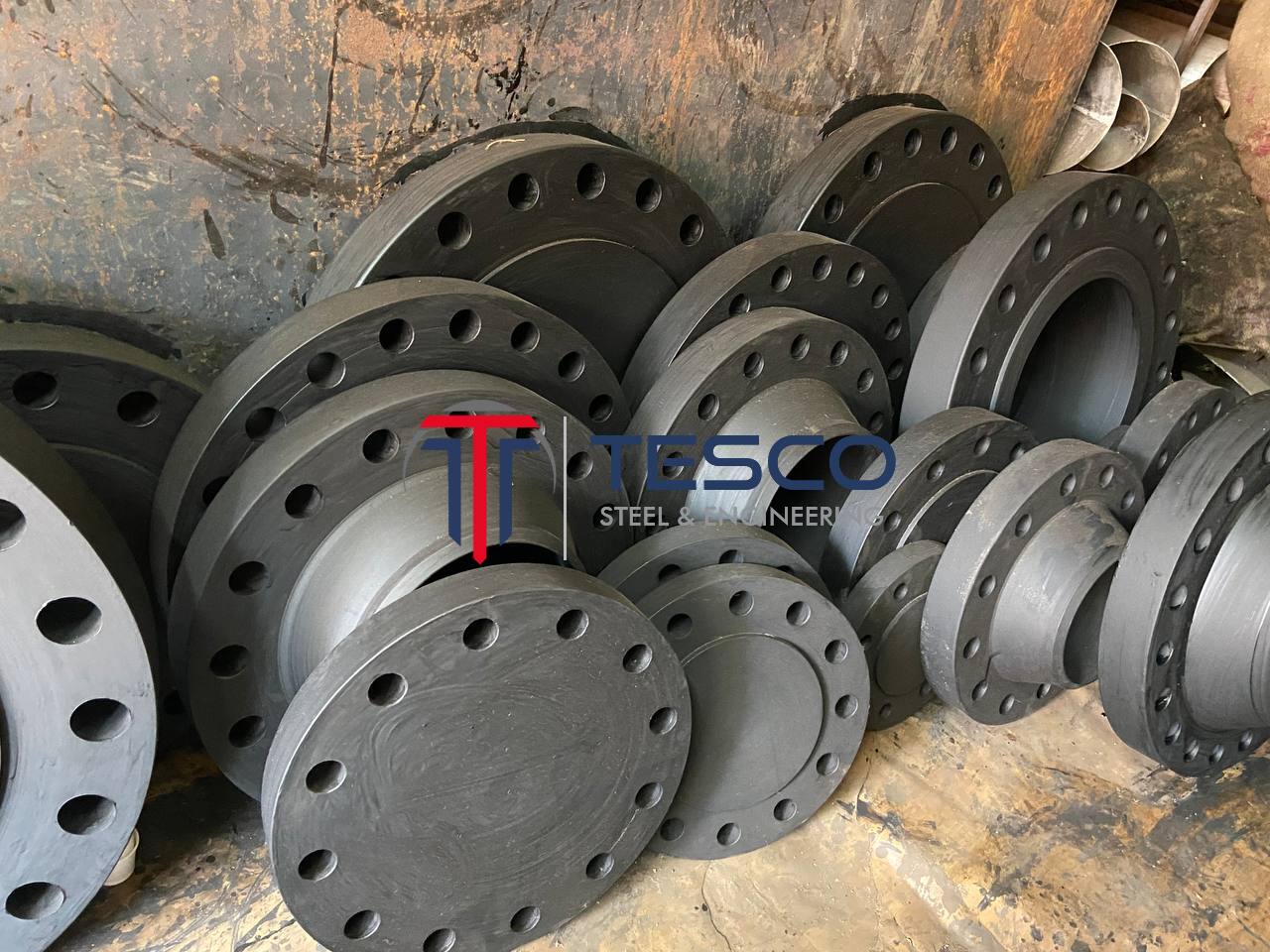
F9 flanges are supplied in the normalized and tempered (N&T) condition per ASTM A182, delivering minimum UTS 585 MPa and YS 380 MPa — substantially higher than F5 (415 MPa / 205 MPa) while maintaining the full service temperature capability of 649°C. They are manufactured and supplied by Tesco Steel & Engineering across ASME B16.5 (NPS ½–24, Class 150–2500) and ASME B16.47 (NPS 26–60) in all standard face types and schedules.

F9 in the Chromium-Molybdenum Alloy Steel Family


Understanding where F9 sits in the Cr-Mo family is essential for correct material selection. The family spans from ASTM A105 carbon steel (no alloying) through to the advanced F91 (modified 9Cr-1Mo-V), with F9 occupying the highest-chromium standard grade:

F5
5Cr-0.5Mo
Moderate–heavy sulfur
Max 649°C
UTS 415 MPa
McConomy rate ~0.05–0.10
Use when F11 insufficient
F9 ★
9Cr-1Mo
Extreme sulfur service
Max 649°C
UTS 585 MPa
McConomy rate ~0.01–0.03
Sulfidation champion
● Selected Grade ●
F91
9Cr-1Mo-V-Nb
Ultra-high-temp creep
Max 650°C+
UTS 585 MPa (higher creep)
Similar McConomy rate
When creep is limiting
When to specify F9 vs F91: Specify F9 when sulfidation/oxidation resistance is the primary design driver and ambient/low-cycle fatigue strength at 649°C is sufficient. Specify F91 when creep-rupture strength above 550°C is the limiting factor (e.g., main steam piping, hydrocracker reactors). F9 is simpler to weld and generally lower cost than F91.

ASTM A182 F9 Chemical Composition


The following composition limits apply per ASTM A182 / ASME SA182 for Grade F9:

ElementMin %Max %Significance
Carbon (C)0.15Kept low to avoid carbide embrittlement; governs weldability
Manganese (Mn)0.300.60Deoxidiser; lower than F11 to control hardenability
Silicon (Si)0.501.00Deoxidation; contributes to oxidation resistance
Phosphorus (P)0.030Controlled for temper embrittlement resistance
Sulfur (S)0.030Low sulfur for weld toughness and cleanliness
Chromium (Cr)8.0010.00Primary sulfidation and oxidation resistance element
Molybdenum (Mo)0.901.10Elevated Mo (vs F5's 0.44–0.65%) for high-temp strength & corrosion resistance

Note: P + Sn + Sb + As (temper embrittlement elements) should be specified ≤ 0.020% aggregate for critical service flanges to resist step-cool embrittlement during slow cooling through 375–575°C.

Mechanical Properties — F9 vs Other Cr-Mo Grades


ASTM A182 F9 is supplied normalized and tempered (N&T) only. The higher Cr and Mo content compared to F5 translates to improved strength at both ambient and elevated temperatures:

Property F9 (9Cr-1Mo) F5 (5Cr-0.5Mo) F22 (2.25Cr-1Mo) F11 Cl.2 (1.25Cr-0.5Mo) A105 (C Steel)
UTS (min) 585 MPa 415 MPa415 MPa485 MPa485 MPa
YS (min) 380 MPa 205 MPa205 MPa275 MPa250 MPa
Elongation (min) 20% 20%20%20%22%
Hardness (max) 241 HBW 241 HBW241 HBW207 HBW187 HBW
Heat Treatment N&T N&TN&TN&T or AN or N&T
Max Service Temp 649°C 649°C649°C593°C538°C
ASME B16.5 Group 5.2 5.13.33.11.1

F9's UTS 585 MPa significantly exceeds F5's 415 MPa at ambient. Combined with its superior high-temperature strength retention, F9 delivers higher allowable stresses across the full temperature range up to 649°C.

Sulfidation Resistance: F9 and the Modified McConomy Curves


Sulfidation — the reaction of steel with sulfur compounds (primarily H₂S) at elevated temperatures — is the primary corrosion mechanism in refinery processing units handling crude oil and its derivatives. API 939-C (Modified McConomy curves) is the industry reference for predicting sulfidation corrosion rates as a function of chromium content and temperature.

F9's 9% chromium content places it in the highest-resistance tier among standard Cr-Mo carbon steels. The following table shows relative sulfidation rates at a representative refinery operating temperature:

Material Cr Content Relative Sulfidation Rate
(API 939-C; carbon steel = 1.00)
Typical Application
Carbon Steel (A105)None1.00 (baseline) Low-temp, low-sulfur only
A182 F11 (1.25%Cr)1.25%~0.30 Mild sulfur <260°C
A182 F22 (2.25%Cr)2.25%~0.15 Moderate sulfur; hydrocracker duty
A182 F5 (5%Cr)5%~0.05–0.10 Heavy sulfur; vacuum columns, cokers
A182 F9 (9%Cr) ★9%~0.01–0.03 Extreme sulfur; highest Cr standard Cr-Mo grade
316L Stainless Steel16–18%Minimal Aqueous / mild high-temp sulfur

At 370°C in a stream with moderate H₂S partial pressure, F9 corrodes at approximately 3–5 times slower than F5 and 10–30 times slower than carbon steel. This dramatic improvement — driven purely by the additional 4% chromium over F5 — is what justifies the use of F9 when corrosion rate calculations based on F5 exceed the design corrosion allowance for the projected equipment life.

Design Rule: Specify F9 when the operating temperature exceeds 370°C in a sulfur-bearing stream and the McConomy-predicted corrosion rate for F5 exceeds the calculated corrosion allowance (wall thickness ÷ equipment design life). This threshold is commonly reached in heavy sulfur crude processing at temperatures above 450°C, in FCC regenerator circuits, and in the fired heater sections of crude vacuum units.

ASTM A182 F9 Flange Face Types and Configurations


F9 flanges are manufactured in all ASME B16.5-recognised face types. In high-temperature refinery service, the face type selection is driven by the gasket type and the operating conditions:

Face TypeCodeGasketTypical F9 Application
Raised FaceRFSpiral wound (SS + graphite filler)Standard refinery piping; most common for F9
Ring Type JointRTJOval / octagonal ring (same material or softer)High-pressure Class 600–2500; FCC, hydrocracker
Flat FaceFFFull-face gasketNon-metallic lined equipment; low-pressure utility
Large Male / FemaleLM/FFlat ring / spiral woundVessel nozzle connections requiring alignment
Large Tongue / GrooveLT/GFlat ring enclosedHeat exchangers; containment-critical joints
Small Tongue / GrooveST/GFlat ring enclosedHigh-pressure compact piping systems
NubbinSoft gasketSpecial applications per purchaser specification

RTJ flanges are standard for Class 900 and above in critical F9 service. The ring groove finish for F9 flanges should be 1.6 μm Ra (63 μin) or smoother per ASME B16.5. Ring material should be AISI 316 stainless steel or Alloy 625 for hydrogen-bearing streams.

Grade Cross-Reference — ASTM A182 F9 International Equivalents


StandardDesignationNotes
ASTM / ASME (Flanges)A182 / SA182 Grade F9Forged flanges, fittings, valves
UNSK90941Unified Numbering System
ASTM (Pipe)A335 Grade P9Seamless ferritic alloy steel pipe
ASTM (Fittings)A234 Grade WP9Wrought alloy steel fittings
ASTM (Castings)A217 Grade C12Alloy steel castings for pressure service
DIN / EN1.7386 / X12CrMo9-1German/European standard
ASME B16.5 GroupGroup 5.2Pressure-temperature ratings table
Weld Filler — GTAWER80S-B8AWS A5.28 — 9Cr-1Mo matching wire
Weld Filler — SMAWE8018-B8AWS A5.5 — 9Cr-1Mo low-hydrogen electrode
Weld Filler — FCAWE91T1-B8AWS A5.29 — for positional welding

ASTM A182 F9 Flange Dimensions — ASME B16.5 Class 150 WNRF


Flange dimensions are set by ASME B16.5 regardless of material. The table below gives Class 150 Weld Neck Raised Face (WNRF) dimensions for standard NPS sizes. Full dimensional tables for all classes (150–2500) and face types are available on our Flange Dimensions page.

NPSOD (mm)BC (mm)Bolts (no.)Bolt ⌀ (mm)Flange Thick. (mm)Approx. Wt. (kg)
½"88.960.3415.79.70.4
¾"98.469.8415.711.20.6
1"107.979.4415.712.70.8
1½"127.098.4415.714.31.3
2"152.4120.6419.015.92.2
3"190.5152.4419.019.04.0
4"228.6190.5819.022.47.0
6"279.4241.3822.225.413.0
8"342.9298.4822.228.621.0
10"406.4362.01225.431.836.0
12"482.6431.81225.435.054.0
14"533.4476.21228.638.175.0
16"596.9539.71628.641.4105.0
18"635.0577.81631.744.4135.0
20"698.5635.02031.747.6165.0
24"812.8749.32035.050.8270.0

Larger sizes NPS 26–60 available per ASME B16.47 Series A & B. Custom sizes, special bores and non-standard schedules on request. Request dimensional drawings.

Welding Guidelines for ASTM A182 F9 Flanges


⚠ PWHT is MANDATORY for ALL pressure-containing welds on F9 flanges — no thickness exemption applies. The high hardenability of 9Cr-1Mo produces a fully martensitic HAZ upon cooling. Without PWHT, hardness exceeds 350 HV, far above the NACE MR0175 limit of 250 HBW, and hydrogen-induced cracking risk is severe. Allow to cool to 80–100°C before commencing PWHT.
ParameterRequirement / Value
Filler — GTAW (TIG)ER80S-B8 (AWS A5.28) — 9Cr-1Mo matching
Filler — SMAW (Stick)E8018-B8 (AWS A5.5) — low-hydrogen, dry before use
Filler — FCAWE91T1-B8 (AWS A5.29) — for flat/horizontal
Minimum Preheat175°C (350°F); 200°C (390°F) for t > 25 mm or high restraint
Interpass Temperature175–320°C — maintain throughout; do not allow to cool
PWHT Temperature730–790°C (1350–1455°F)
PWHT Hold TimeMinimum 1 hour per 25 mm wall thickness, minimum 1 hour total
PWHT Heating / Cooling Rate≤ 150°C/hour above 427°C; slow cooling through 575–375°C critical for temper embrittlement prevention
Pre-PWHT cool-downAllow weld to cool to 80–100°C before starting PWHT (martensite transformation must complete)
Hardness after PWHT≤ 22 HRC (≤ 250 HBW) per NACE MR0175 for sour (H₂S) service
Temper Embrittlement RiskControl P + Sn + Sb + As; avoid slow cooling through 375–575°C in service
Dissimilar-metal weld to A105 or A335 P22Use Alloy 82/182 buttering or ER90S-B3 transition; seek metallurgical engineering review

ASME B16.5 Pressure–Temperature Ratings — Group 5.2 (F9)


ASTM A182 F9 belongs to ASME B16.5 Material Group 5.2. Its pressure-temperature ratings are higher than both Group 5.1 (F5) and Group 3.1 (F11) at temperatures above 450°C, reflecting the superior high-temperature strength of the 9Cr-1Mo composition. Representative Class 150 ratings are shown below; full tables for all pressure classes are available from ASME B16.5:

Temperature Class 150 (psi) Class 300 (psi) Class 600 (psi) Class 900 (psi) Class 1500 (psi) Class 2500 (psi)
–20 to 50°C2757201440216036006000
100°C2506551310196532755455
200°C2306001200180030005000
300°C2155601120168028004665
400°C2005201040156026004335
500°C175455910136522753790
593°C145380760114019003165
649°C11530060090015002500

Values are indicative. Always verify against ASME B16.5 Table 2-1.1 Group 5.2 for your specific design code edition. Group 5.2 ratings at 649°C are substantially higher than Group 1.1 (A105 carbon steel), which is derated to near-zero above 538°C.

Applications of ASTM A182 F9 Flanges


F9 flanges are specified wherever extreme sulfur content, very high temperatures, or both simultaneously exceed the capability of lower-chromium Cr-Mo grades. Key applications include:

  • Vacuum Column Bottoms: Heavy sulfur residue streams above 400°C where F5 rates exceed corrosion allowance
  • Crude Unit Fired Heaters: Heater outlet piping at 450–540°C with high-sulfur crude slates
  • Delayed Coking Units: Hot feed transfer lines and fractionator bottoms
  • FCC Regenerators: High-temperature flue gas circuits (600–650°C) with sulfur compounds
  • Hydrodesulfurization (HDS): Reactor effluent and separator circuits at high temperature and pressure
  • Atmospheric Residue Desulfurization (ARDS): Transfer lines and charge heater piping
  • Sulfur Recovery Units (SRU): Inlet piping and Claus unit interconnects at elevated temperature
  • Visbreaker Heaters: High-temperature, high-fouling service circuits
  • Power Generation: High-temperature steam piping where sulfur is present from fuel combustion
  • Petrochemical Cracking Furnaces: Transfer line flanges in ethylene and propylene plants

Applicable Standards for A182 F9 Flanges


StandardScope
ASTM A182 / ASME SA182Specification for forged alloy steel flanges — material standard for F9
ASME B16.5Pipe flanges and flanged fittings, NPS ½–24, Classes 150–2500
ASME B16.47Large diameter steel flanges, NPS 26–60
ASME B16.20Metallic gaskets including ring joint gaskets for F9 RTJ flanges
ASME B16.25Butt-welding ends geometry for F9 weld neck and similar flanges
ASME Section IXWelding qualification — WPS/PQR requirements for F9 welds
ASME B31.3Process piping design code referencing F9 P-T ratings
API 939-CAvoiding environmental cracking; Modified McConomy curves for sulfidation
NACE MR0175 / ISO 15156Hardness limits (≤ 22 HRC) for sour H₂S service after PWHT
ASTM A335Seamless ferritic alloy steel pipe — P9 (companion grade to F9 flange)
ASTM A234Wrought alloy steel fittings — WP9 (companion grade)
ASTM A217Alloy steel castings — C12 (companion casting grade)
EN 10204 / 3.1 / 3.2Mill test report requirements — 3.1 standard, 3.2 for critical service
MSS SP-44Steel pipeline flanges — alternative standard for large-bore F9 flanges

ASTM A182 F9 Flange Product Range


ParameterRange / Options
SizeNPS ½" to NPS 60" (½–24 per B16.5; 26–60 per B16.47)
Pressure Class150, 300, 600, 900, 1500, 2500 (ASME B16.5); PN 6–PN 400 (EN)
Flange TypesWeld Neck (WN), Slip-On (SO), Blind (BL), Socket Weld (SW), Threaded (TR), Lap Joint (LJ), Long Weld Neck (LWN), Reducing, Spectacle Blind, Paddle Blind
Face TypesRaised Face (RF), Ring Type Joint (RTJ), Flat Face (FF), Large/Small Tongue & Groove, Large/Small Male & Female
Schedule / WallSch 40, 80, 120, 160, XS, XXS; custom bore to order
Heat TreatmentNormalized and Tempered (N&T) — mandatory for F9
TestingHydrostatic test, PMI, hardness survey (post-PWHT), UT, RT, MPT, Charpy impact on request
DocumentationEN 10204 3.1 MTR standard; 3.2 available; NACE / PED / ATEX certificates on request
Surface FinishRaised face: 3.2–6.3 μm Ra (125–250 μin) ASME B16.5 serrated; RTJ groove: ≤ 1.6 μm Ra

For a custom quote or to request our F9 stock list, please submit an inquiry or contact us via WhatsApp at +91-9223366922.

Frequently Asked Questions — ASTM A182 F9 Flanges


Questions sourced from AI search platforms, engineering procurement queries, and refinery materials-engineering practice.

Q1: What is ASTM A182 F9 alloy steel and how does it differ from F5?

ASTM A182 F9 is a 9Cr-1Mo alloy steel (UNS K90941) while F5 is 5Cr-0.5Mo (UNS K41545). The additional ~4% chromium in F9 roughly doubles its oxidation resistance and reduces sulfidation corrosion by a further 3–5 times over F5 per API 939-C Modified McConomy curves. F9 also has significantly higher ambient-temperature strength (UTS 585 MPa vs 415 MPa for F5), higher molybdenum (1.0% vs 0.5%), and correspondingly better high-temperature creep resistance. The trade-off is higher preheat requirements and more stringent PWHT control.

Q2: Is PWHT mandatory for ASTM A182 F9 flanges regardless of wall thickness?

Yes — PWHT at 730–790°C is mandatory for ALL pressure-containing welds on F9 with no thickness exemption. The high hardenability of the 9Cr-1Mo composition produces a nearly fully martensitic HAZ upon air cooling, regardless of weld size. The as-welded HAZ hardness commonly exceeds 350–400 HV, far above the 250 HBW NACE limit and highly susceptible to hydrogen-induced cracking. Pre-weld cooling to 80–100°C before commencing PWHT is also required to ensure full martensite transformation.

Q3: What is the maximum service temperature for F9 flanges per ASME B16.5?

ASME B16.5 Group 5.2 rates ASTM A182 F9 to a maximum temperature of 649°C (1200°F). At 649°C, Class 150 F9 flanges are rated at approximately 115 psi; Class 600 at approximately 460 psi. Above 649°C, F9 enters the range where oxidation and creep rates accelerate significantly and the specification no longer provides ratings.

Q4: What is the difference between F9 and F91 (9Cr-1Mo-V) alloy steel flanges?

F9 is the "classic" 9Cr-1Mo (UNS K90941). F91 is the "modified" 9Cr-1Mo-V-Nb-N (UNS K91560), developed in the 1970s to achieve dramatically higher creep strength through vanadium carbide and MX-type precipitate strengthening. Both grades have similar ambient UTS (~585 MPa) and similar sulfidation/oxidation resistance (same ~9% Cr). F91's advantage emerges above 500°C in creep-limited designs — power plant steam headers, hydrocracker reactors — where its allowable stress is 2–3× higher than F9. F9 remains preferred for sulfidation-dominated applications where creep is not the critical factor, and it is simpler and less costly to weld, inspect and PWHT correctly.

Q5: Which filler metal is used for welding ASTM A182 F9 flanges?

The matching filler metals are ER80S-B8 (GTAW/GMAW, AWS A5.28) and E8018-B8 (SMAW, AWS A5.5) — both contain nominally 9Cr-1Mo chemistry matching the base metal. FCAW equivalent is E91T1-B8. Do NOT use B6 (F5 matching) or B9 (F91 matching) consumables for F9 welds without metallurgical engineering review. Hydrogen-controlled (low-hydrogen) electrodes must be dried at 300–350°C for a minimum 1 hour before use.

Q6: What is the ASME B16.5 material group for ASTM A182 F9?

ASTM A182 F9 is classified under ASME B16.5 Material Group 5.2. This group provides pressure-temperature ratings that are higher than Group 5.1 (F5) at temperatures above approximately 450°C, reflecting F9's superior elevated-temperature strength. At ambient temperature, Group 5.2 Class 150 rates at 275 psi — the same as most other Cr-Mo groups since ambient strength governs the bolt/flange combination at low temperature.

Q7: What preheat temperature is required for welding F9 flanges, and why is it higher than F5?

F9 requires a minimum preheat of 175°C (350°F), with 200°C (390°F) for sections over 25 mm or highly restrained joints. This is the same minimum as F5 but in practice F9 often demands the higher 200°C value more frequently due to its greater hardenability and martensite start temperature. The high Cr + Mo content of F9 produces a hard, brittle martensitic HAZ unless the cooling rate is slowed by adequate preheat and the weld is immediately PWHT'd before ambient hydrogen diffusion can trigger HAZ cracking.

Q8: Can ASTM A182 F9 be used in H₂S (sour) service per NACE MR0175?

Yes, F9 is permitted for sour service under NACE MR0175 / ISO 15156 provided the finished hardness (base metal + HAZ + weld) does not exceed 22 HRC (250 HBW). This hardness requirement is only reliably met after correct PWHT at 730–790°C. The relatively high as-tempered hardness of 9Cr-1Mo means that inadequate PWHT frequently produces hardness above 250 HBW in the HAZ, causing non-conformance. Full hardness survey across weld + HAZ + base metal is mandatory for sour service F9 welds.

Q9: What are the international equivalents of ASTM A182 F9?

The principal equivalents are: UNS K90941 (Unified Numbering System); DIN 1.7386 / X12CrMo9-1 (German/European); ASTM A335 P9 (companion pipe); ASTM A234 WP9 (companion fittings); ASTM A217 C12 (castings). Japanese JIS equivalent is SFVA F9 under JIS B 2220. Always verify chemical composition limits independently as equivalents are not always identical in minor element ranges.

Q10: How does temper embrittlement affect ASTM A182 F9 in service?

Like all ferritic Cr-Mo steels, F9 is susceptible to temper embrittlement — a loss of toughness resulting from segregation of trace impurities (P, Sn, Sb, As) to grain boundaries during slow cooling through 375–575°C. In service, this appears as a shift of the ductile-to-brittle transition temperature (DBTT) to higher values, increasing the risk of brittle fracture during cold startups. Mitigation: specify low-impurity heats (P + Sn + Sb + As ≤ 0.020%), avoid planned slow cooling through the critical range, and conduct a step-cool embrittlement susceptibility assessment (Bruscato X factor or J factor calculation) for critical service. The step-cool test per API 934-A provides direct verification.

A182 F9 Quick Specs

GradeA182 F9
UNSK90941
DIN1.7386
Alloy9Cr-1Mo
UTS (min)585 MPa
YS (min)380 MPa
Max Temp649°C
Hardness (max)241 HBW
Heat TreatmentN&T
ASME B16.5 Grp5.2
Preheat (min)175°C
PWHT Range730–790°C
Filler (GTAW)ER80S-B8
Filler (SMAW)E8018-B8
Cr Content8.00–10.00%
Mo Content0.90–1.10%

Sulfidation Performance

McConomy Relative Rate

Carbon Steel: 1.00 (baseline)
F11 (1.25Cr): ~0.30
F5 (5Cr): ~0.05–0.10
F9 (9Cr): ~0.01–0.03 ★
Per API 939-C (Modified McConomy)

  Ask for Quote   WhatsApp Inquiry

Related Alloy Steel Grades

Key Standards

  • ASTM A182 / ASME SA182
  • ASME B16.5 Group 5.2
  • ASME B16.47
  • API 939-C (McConomy)
  • NACE MR0175 / ISO 15156
  • ASME Section IX
  • DIN 1.7386

Need full dimensional drawings for F9 flanges?

  View Flange Dimensions