

'SHAPING INDUSTRIES WITH THE FINEST STEEL'
'SHAPING INDUSTRIES WITH THE FINEST STEEL'
Tesco Steel & Engineering manufactures flanges to the API 6A (ISO 10423) Type 6B dimensional requirements at the top rating of the 6B family — 5,000 psi rated working pressure — in 2-1/16″ to 11″, sealing on R or RX ring gaskets with the classic standoff makeup. This page is the complete reference: the full dimension chart in mm with R/RX ring numbers, drilling and stud counts, the 6B vs 6BX distinction, the ASME Class 1500 heritage, and API 6A’s material classes, temperature classes and PSL levels explained. ISO 9001:2015 certified, made in Mumbai, India — exported worldwide.
API 6A flanges terminate surface pressure-control equipment — wellheads, Christmas trees, spools and manifolds — where the rating is the real working pressure and the sealing is metal-to-metal. The 6B design is the ring-joint classic: an R or RX gasket seats in a machined groove and carries the joint compression, leaving a deliberate standoff gap between the faces that crews use to judge makeup. The RX variant is a pressure-energized redesign that drops into the same groove as its R counterpart.
At 5,000 psi the 6B family reaches its ceiling — conventional wells whose shut-in pressures fit within it run their wellheads, trees and manifolds on these flanges, with a dimensional heritage shared with ASME B16.5 Class 1500 ring-joint flanges. We machine them from certified alloy forgings (4130/4140, F22 and stainless/duplex grades per the API material classes). The lower 6B ratings — 2,000 and 3,000 psi — and the high-pressure 6BX family are charted on their own pages.
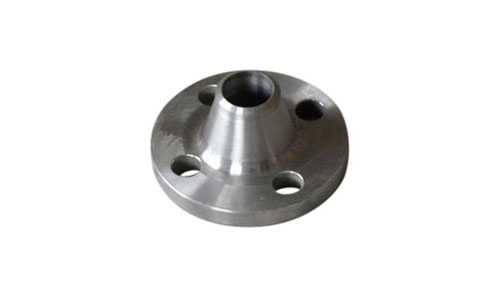
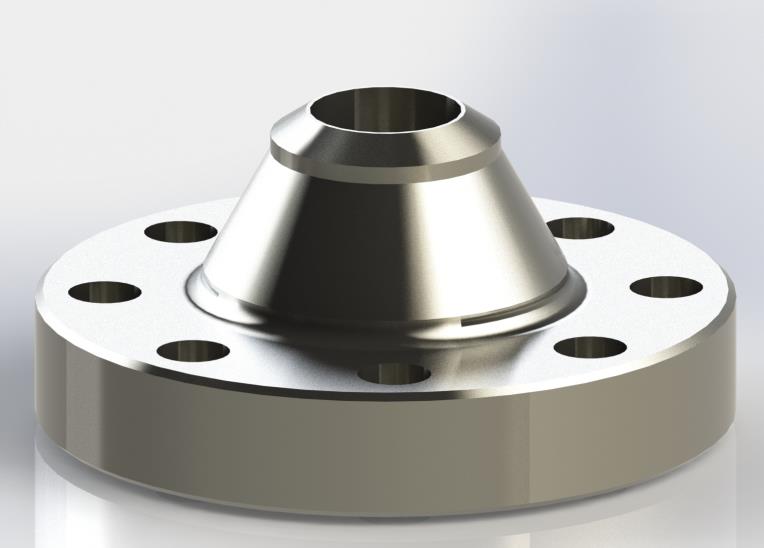
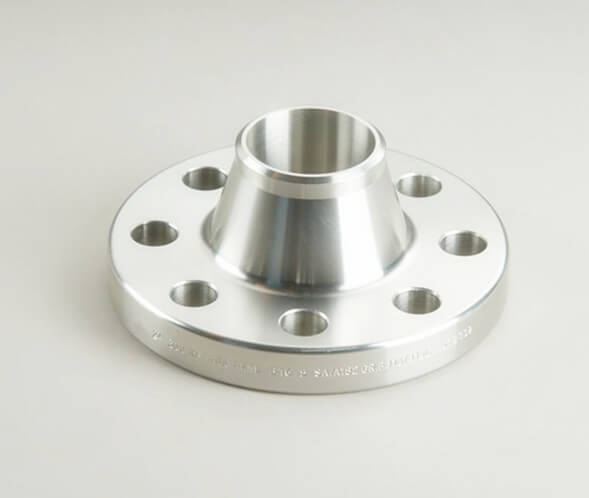
API 6A ratings are actual rated working pressures; 5,000 psi is the top of the Type 6B family, which spans 2,000 / 3,000 / 5,000 psi. Three facts every 6B buyer should know:
All dimensions in mm (nominal size in inches). The last column gives the R/RX gasket ring number per size. Weld-end preparation is machined to your pipe or spool wall — state it with your order.
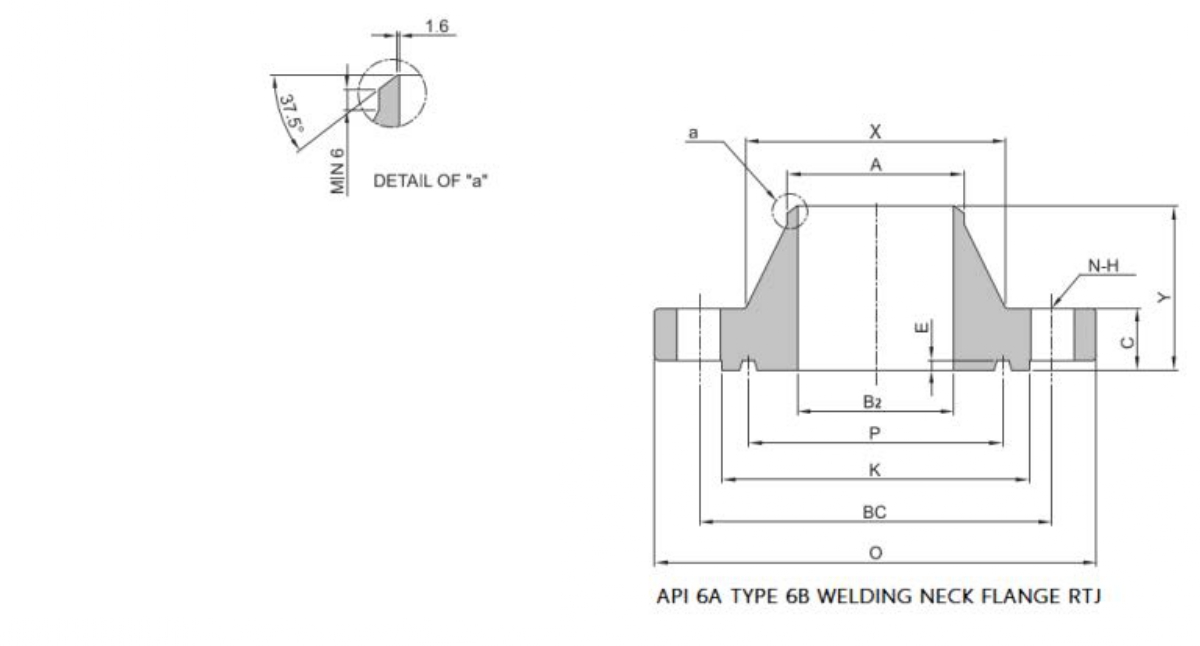
API 6A Type 6B Weld Neck Flange — Dimension Reference
| Size: Nominal Size (in) O: Flange Outside Diameter C: Flange Thickness K: Raised Face Diameter Y: Length Through Hub |
P: Ring-Groove Pitch Diameter E: Groove Depth X: Hub Diameter A: Weld-End OD (matches pipe OD) B2: Bore |
BC: Bolt Circle N: Number of Studs H: Bolt Hole Size Ring No.: R / RX Gasket per Size |
| Size (in) | O | C | K | P | E | X | BC | N | H | Y | A | B2 | Ring No. |
|---|---|---|---|---|---|---|---|---|---|---|---|---|---|
| 2 1/16″ | 215 | 46.1 | 124 | 95.25 | 7.9 | 104.8 | 165.1 | 8 | 26 | 109.6 | 60.3 | 43.7 | R/RX-24 |
| 2 9/16″ | 245 | 49.3 | 137 | 107.95 | 7.9 | 123.8 | 190.5 | 8 | 29 | 112.7 | 73 | 54.9 | R/RX-27 |
| 3 1/8″ | 265 | 55.6 | 168 | 136.53 | 7.9 | 133.3 | 203.2 | 8 | 32 | 125.4 | 88.9 | 67.5 | R/RX-35 |
| 4 1/16″ | 310 | 62 | 194 | 161.93 | 7.9 | 161.9 | 241.3 | 8 | 35 | 131.8 | 114.3 | 88.1 | R/RX-39 |
| 5 1/8″ | 375 | 81 | 229 | 193.68 | 7.9 | 196.8 | 292.1 | 8 | 42 | 163.5 | 141.3 | 110.3 | R/RX-44 |
| 7 1/16″ | 395 | 92.1 | 248 | 211.15 | 9.7 | 228.6 | 317.5 | 12 | 39 | 181 | 168.3 | 132.6 | R/RX-46 |
| 9″ | 485 | 103.2 | 318 | 269.88 | 11.2 | 292.1 | 393.7 | 12 | 45 | 223.8 | 219.1 | 173.8 | R/RX-50 |
| 11″ | 585 | 119.1 | 371 | 323.85 | 11.2 | 368.3 | 482.6 | 12 | 51 | 265.1 | 273 | 216.7 | R/RX-54 |
API 6A selects materials by class letters, not free choice — the class sets strength, impact and (for sour classes) NACE hardness limits. Typical assignments we manufacture to:
| API 6A Class | Service | Typical Materials |
|---|---|---|
| AA | General service — carbon/low-alloy | AISI 4130 / 4140 low-alloy steel |
| BB | General service — stainless trim | 4130/4140 body, 410 / 17-4PH trim |
| CC | General service — stainless | 410, 17-4PH, F6NM |
| DD | Sour service — carbon/low-alloy (NACE) | 4130/4140 hardness-controlled per NACE MR0175 |
| EE | Sour service — stainless trim (NACE) | Low-alloy body, NACE-compliant SS trim |
| FF | Sour service — stainless (NACE) | 410 / F6NM hardness-controlled |
| HH | Severe sour service (NACE) | Duplex F51/F53, Inconel 718 & CRAs |
Wellhead flanges are produced to order from certified alloy forgings — use the Ask for Quote button or the inquiry form for current lead times and pricing.
| Rating | 6B Weld Neck | 6B Blind | 6BX Weld Neck |
|---|---|---|---|
| 2000 psi | 6B 2000 psi Weld Neck | 6B 2000 psi Blind | 6BX 2000 psi Weld Neck |
| 3000 psi | 6B 3000 psi Weld Neck | 6B 3000 psi Blind | 6BX 3000 psi Weld Neck |
| 5000 psi | 6B 5000 psi Weld Neck (this page) | 6B 5000 psi Blind | 6BX 5000 psi Weld Neck |
| 10000 psi | — | — | 6BX 10000 psi Weld Neck |
| 15000 psi | — | — | 6BX 15000 psi Weld Neck |
| 20000 psi | — | — | 6BX 20000 psi Weld Neck |
Related references: API Flanges overview · API 605 Weld Neck Charts · ASME B16.5 Class 1500 Chart · RTJ / Ring Gasket Size Chart · All Flange Dimension Charts.
R and RX gaskets in machined grooves, standoff makeup, ring numbers shared with ASME B16.20 — the joint conventional wellheads and trees have run on for decades.
5,000 psi is where Type 6B peaks — with a dimensional heritage shared with ASME Class 1500 ring joints, and the 6BX family taking over at 10,000 psi and beyond.
Machined from certified 4130/4140, F22, stainless or duplex forgings per the API material class, with hardness, impact and NACE controls to suit — full heat-number traceability throughout.
Wellheads and Christmas trees for conventional wells, tubing and casing spools, production and test manifolds, flowline tie-ins — the broad middle of surface pressure-control duty.
What is API 6A?
API Specification 6A (aligned with ISO 10423) is the American Petroleum Institute's specification for wellhead and Christmas tree equipment. Among much else it defines the two flange families used on wellheads and trees — Type 6B and Type 6BX — with rated working pressures from 2,000 up to 20,000 psi. This page covers the Type 6B weld neck flanges rated 5,000 psi, the top rating of the 6B family.
What does the 5,000 psi rating mean?
Unlike an ASME class number, an API 6A rating is the actual rated working pressure: a 5,000 psi (≈345 bar) flange is designed to operate at that pressure within its temperature class. 5,000 psi is the highest rating in the Type 6B family — above it, API 6A moves entirely to the Type 6BX design with its pressure-energized BX gaskets.
What is a Type 6B flange?
6B is API 6A's ring-joint flange family in the tradition of the ASME RTJ: it seals on an R or RX metal ring gasket seated in a machined groove, and after makeup a standoff gap remains between the flange faces — the gasket, not the faces, carries the joint compression. Type 6B covers rated working pressures of 2,000, 3,000 and 5,000 psi in the regular wellhead bores.
What is the difference between Type 6B and Type 6BX?
Type 6B (2,000–5,000 psi) uses R or RX ring gaskets with a standoff gap between the faces after makeup. Type 6BX (2,000–20,000 psi) uses the pressure-energized BX gasket and makes up face-to-face, giving a stiffer, more compact joint — and it is the only type specified at 10,000 psi and above. At 5,000 psi both exist: 6B in the regular bores on this page, 6BX in its own size family.
What is the difference between R and RX ring gaskets?
Both fit the same flange groove, which is why the chart column reads 'R or RX'. The R ring is the classic oval or octagonal cross-section, compressed by bolt load. The RX ring is a pressure-energized redesign of the same nominal number — its asymmetric profile uses internal pressure to improve the seal, at the cost of a taller standoff. An RX-24 replaces an R-24 in the same groove without re-machining.
What does the standoff gap mean in practice?
Because a 6B joint compresses the ring rather than the faces, a deliberate gap remains between the raised faces after correct makeup — closing it fully would mean the gasket is over-compressed or the wrong ring is fitted. Crews use the standoff to judge makeup, and it is why re-tightening a leaking 6B joint has limits: once the ring has yielded, it should be replaced, not crushed further.
What sizes does the 6B 5,000 psi series cover?
Eight sizes: 2-1/16, 2-9/16, 3-1/8, 4-1/16, 5-1/8, 7-1/16, 9 and 11 inches — the regular wellhead bore family at this rating. Ring numbers run R/RX-24 through R/RX-54 as tabulated. For larger bores or higher pressures the specification moves to the Type 6BX family.
What do the letters in the dimension chart mean?
Size is the nominal bore in inches; all other values are millimetres. O is the flange outside diameter, C the thickness, K the raised face diameter, P the ring-groove pitch diameter, E the groove depth, X the hub diameter, BC the bolt circle, N the number of studs, H the bolt hole size, Y the length through hub, A the weld-end outside diameter (matching the pipe OD) and B2 the bore. The last column gives the R/RX gasket number.
How do API 6B flanges relate to ASME B16.5 ring-joint flanges?
They share a dimensional heritage: the 6B ratings correspond to the classic ASME ring-joint series — 2,000 psi with Class 600, 3,000 psi with Class 900 and 5,000 psi with Class 1500 — and the R-ring numbering is common with ASME B16.20. In overlapping sizes the flanges generally mate, but API 6A and ASME B16.5 are separate specifications with their own tolerances and requirements: confirm dimensions ring-for-ring and hole-for-hole before mixing systems on a joint.
What materials are API 6A flanges made in?
API 6A defines material classes AA through HH: AA–CC for general service (carbon, low-alloy and stainless steels) and DD–HH for sour service in line with NACE MR0175 — the class sets minimum yield, impact and hardness requirements. Typical weld neck flange materials are AISI 4130/4140 low-alloy steel, F22, 410 and 17-4 stainless, and duplex grades, selected to the well's pressure, temperature and H2S conditions.
What are API 6A PSL levels and temperature classes?
PSL — Product Specification Level, 1 through 4 — sets the depth of quality control: material testing, NDE, weld examination, traceability and documentation increase with each level; PSL 2 and 3 are the common wellhead specifications. Temperature classes (K through Y) define the design temperature envelope and drive the impact-test temperatures for the material. Both are order-level requirements alongside the material class.
Are these flanges suitable for sour (H2S) service?
Yes, when ordered in the sour-service material classes (DD, EE, FF or HH), which invoke NACE MR0175/ISO 15156 — controlled hardness, qualified materials and impact requirements. Sour-service production equipment commonly pairs a sour material class with PSL 2 or 3; we supply accordingly with full certification.
What bolting do 6B 5,000 psi flanges use?
The N and H columns give the stud count and hole size per flange — the 2-1/16 in flange takes 8 studs in 26 mm holes and the 11 in flange 12 studs in 51 mm holes — on the bolt circle BC. High-strength stud bolts with heavy hex nuts are used; even preload matters on ring joints, since the gasket rather than the faces carries the compression.
Why are API 6A flanges weld neck?
On a wellhead joint the connection must be as strong and as inspectable as the pipe or spool it terminates. The weld neck's integral tapered hub and full-penetration butt weld deliver that — the weld is volumetrically examined and the whole load path is forged, with no threads or seal welds. Threaded and other end connections are limited to the low-pressure end of the API 6A range.
Where are 6B 5,000 psi flanges used?
On wellheads and Christmas trees for conventional wells, tubing and casing spools, production and test manifolds, and flowline tie-ins — the broad middle of surface pressure-control duty where 5,000 psi covers the shut-in pressure. Above it, equipment steps to the 6BX 10,000/15,000/20,000 psi sizes further up the stack.
What comes above 5,000 psi in API 6A?
The Type 6B family ends at 5,000 psi. Higher ratings — 10,000, 15,000 and 20,000 psi — exist only as Type 6BX, with pressure-energized BX gaskets and face-to-face makeup. If your project mixes ratings, note that 6B and 6BX flanges of the same nominal size do not mate: the types have different dimensions, grooves and gaskets.
How are your API 6A dimension flanges tested and certified?
We manufacture to the API 6A Type 6B dimensional requirements from certified forgings, with dimensional inspection against the specification, EN 10204 3.1 mill certificates, heat-number traceability, PMI, hardness testing (including NACE limits for sour classes) and UT/MPI examination on request. Third-party witness inspection by LR, BV, DNV, SGS or TÜV is welcomed; project-specific PSL documentation is quoted case-by-case.
What information should I send with an enquiry?
Size and quantity, type (6B) and rated working pressure (5,000 psi), end connection (weld neck — with pipe/spool wall for the weld prep), gasket preference (R or RX), API 6A material class (AA–HH), temperature class, PSL level, any NACE/sour requirement, and the certification and inspection you need. Tesco Steel & Engineering is an ISO 9001:2015 certified manufacturer and exporter in Mumbai, India.