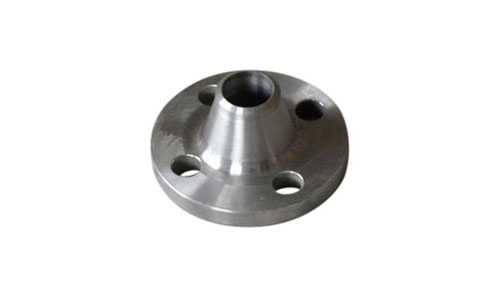
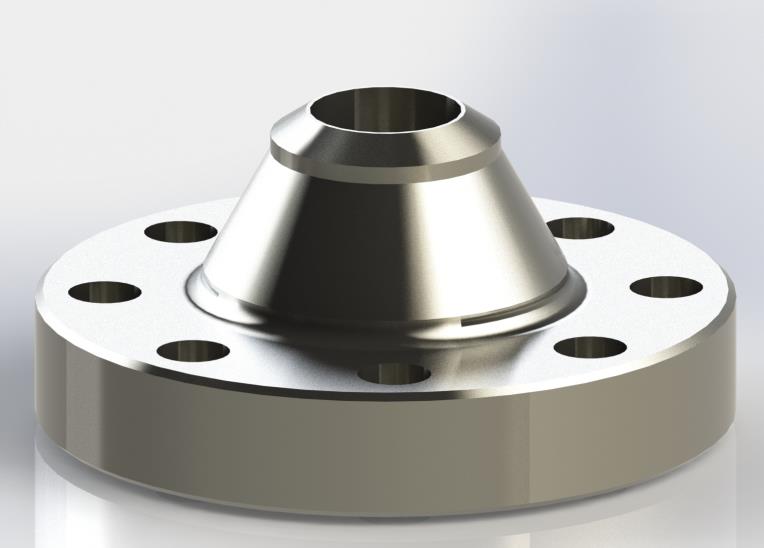
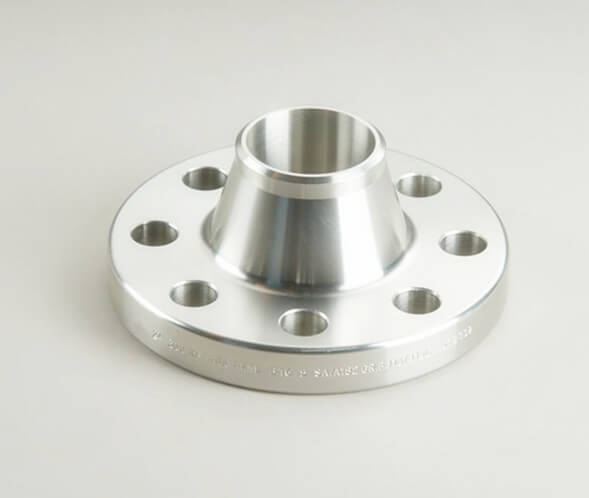
Dimensions · Bolt Chart · Weight · Materials | NPS 26 to NPS 60
API 605 Class 400 Weld Neck Flanges are large-bore, high-integrity flanges covering Nominal Pipe Sizes (NPS) 26 through 60, manufactured to the pressure class that sits between Class 300 and Class 600 in the API 605 rating system. API 605 — originally published as the American Petroleum Institute Standard for Large Diameter Carbon Steel Flanges — governed flanges too large for ASME B16.5 (which tops out at NPS 24). The standard has since been withdrawn and its dimensional requirements absorbed into ASME B16.47 Series A, but API 605 remains deeply embedded in older piping specifications, procurement documents, and replacement-part orders for existing plant — making it an active commercial designation. Class 400 carries an approximate working pressure of 990 psi (68 bar) at ambient temperature for carbon steel ASTM A105 material, providing a useful intermediate rating for transmission pipelines, large-bore crude oil headers, and offshore separation systems where Class 300 is marginal and Class 600 is over-specified.
Tesco Steel & Engineering manufactures API 605 Class 400 Weld Neck Flanges in the full NPS 26–60 size range across all three face types — Raised Face (WNRF), Flat Face (WNFF), and Ring Type Joint (WNRTJ) — in carbon steel ASTM A105, low-temperature carbon steel ASTM A350 LF2, alloy steels ASTM A182 F11/F22, stainless steels ASTM A182 F304/F316/F321/F347, duplex UNS S32205, super duplex UNS S32750, and nickel alloys (Monel 400, Inconel 625, Hastelloy C-276). Every flange is CNC-machined to API 605 and ASME B16.47 Series A dimensional tolerances, hydrostatically tested, and supplied with full material test reports (MTRs), dimensional inspection reports, and third-party inspection (TPI) clearance as required. Tesco exports API 605 Class 400 weld neck flanges to oil and gas operators, EPC contractors, and piping distributors in 96 countries.
| Parameter | Details |
|---|---|
| Standard | API 605 (withdrawn — dimensions adopted by ASME B16.47 Series A) |
| Pressure Class | Class 400 (#400 / 400 lbs) |
| Size Range | NPS 26 to NPS 60 (API 605 covers large bore only; NPS 26 and above) |
| Working Pressure (CS, ambient) | ~990 psi / 68 bar (ASTM A105, 100°F) |
| Face Types | Raised Face (RF), Flat Face (FF), Ring Type Joint (RTJ) |
| Materials | ASTM A105 (CS), A350 LF2 (LTCS), A182 F304/F316/F321/F347 (SS), F51 (Duplex), F53 (Super Duplex), ASTM B564 (Monel, Inconel, Hastelloy) |
| Manufacturing Method | Forged & CNC-machined; plate flanges available for large bore |
| Dimensional Equivalent | ASME B16.47 Series A (same bolt pattern and dimensions) |
| Applicable Design Codes | ASME B31.3 (Process Piping), ASME B31.4 (Pipeline), ASME B31.8 (Gas Transmission) |
| Testing | Hydrostatic pressure test, PMI, UT/RT/MT/PT NDT per project specification |
| Documentation | EN 10204 3.1 Mill TC, Hydro test certificate, Dimensional report, Heat treatment certificate |
| Third-Party Inspection | SGS, Bureau Veritas, Lloyd's Register, TÜV, DNV accepted |
All dimensions in millimetres (mm) unless otherwise noted. Dimensions per API 605 / ASME B16.47 Series A.
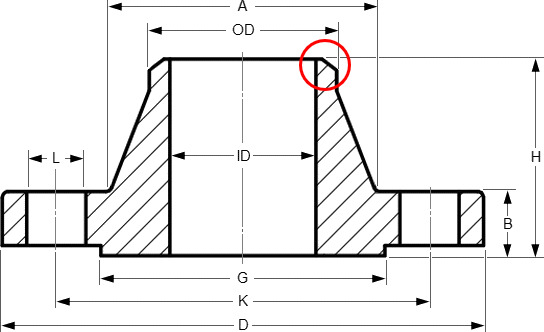
| NPS | OD (mm) | D (mm) | B (mm) | H (mm) | A (mm) | G (mm) | K (mm) | L (mm) | No. of Bolts | Stud Bolt Dia | Stud Bolt L (mm) |
|---|---|---|---|---|---|---|---|---|---|---|---|
| 26 | 660.4 | 850 | 95.25 | 155.35 | 698 | 711 | 781 | 38.1 | 28 | 1-3/8″ | 279 |
| 28 | 711.2 | 915 | 101.65 | 165.35 | 740 | 762 | 838.2 | 41.3 | 24 | 1-1/2″ | 298 |
| 30 | 762 | 970 | 107.95 | 176.35 | 794 | 819 | 895.4 | 41.3 | 28 | 1-1/2″ | 311 |
| 32 | 812.8 | 1035 | 114.35 | 185.35 | 845 | 873 | 952.5 | 44.5 | 28 | 1-5/8″ | 330 |
| 34 | 863.6 | 1085 | 117.55 | 193.35 | 899 | 927 | 1003.3 | 44.5 | 32 | 1-5/8″ | 337 |
| 36 | 914.4 | 1155 | 125.45 | 206.35 | 952 | 981 | 1066.8 | 47.6 | 28 | 1-3/4″ | 356 |
| 38 | 965.2 | 1205 | 130.25 | 212.35 | 1003 | 1035 | 1117.6 | 47.6 | 32 | 1-3/4″ | 368 |
| 40 | 1016 | 1270 | 136.55 | 222.35 | 1054 | 1092 | 1174.8 | 50.8 | 32 | 1-7/8″ | 387 |
| 42 | 1066.8 | 1320 | 139.75 | 230.35 | 1108 | 1143 | 1225.6 | 50.8 | 32 | 1-7/8″ | 394 |
| 44 | 1117.6 | 1385 | 146.05 | 239.35 | 1159 | 1200 | 1282.7 | 54 | 32 | 2″ | 413 |
| 46 | 1168.4 | 1440 | 152.45 | 250.35 | 1213 | 1257 | 1339.8 | 54 | 36 | 2″ | 425 |
| 48 | 1219.2 | 1510 | 158.75 | 263.35 | 1267 | 1308 | 1403.4 | 60.3 | 28 | 2-1/4″ | 451 |
| 50 | 1270.2 | 1570 | 163.55 | 274.35 | 1321 | 1362 | 1460.5 | 60.3 | 32 | 2-1/4″ | 457 |
| 52 | 1320.8 | 1620 | 168.35 | 282.35 | 1372 | 1413 | 1511.3 | 60.3 | 32 | 2-1/4″ | 470 |
| 54 | 1371.6 | 1700 | 176.25 | 295.35 | 1426 | 1470 | 1581.2 | 66.7 | 28 | 2-1/2″ | 502 |
| 56 | 1422.4 | 1755 | 181.05 | 304.35 | 1480 | 1527 | 1632 | 66.7 | 32 | 2-1/2″ | 508 |
| 58 | 1473.2 | 1805 | 184.15 | 312.35 | 1530 | 1578 | 1682.8 | 66.7 | 32 | 2-1/2″ | 514 |
| 60 | 1524 | 1885 | 192.15 | 325.35 | 1584 | 1635 | 1752.6 | 73 | 32 | 2-3/4″ | 546 |
API Standard 605, Large Diameter Carbon Steel Flanges (26 through 60 inch Nominal Pipe Size), was published by the American Petroleum Institute to address flanges that exceeded the NPS 24 upper limit of ASME B16.5. It defined six pressure classes — Class 75, 150, 300, 400, 600, and 900 — with dimensional tables covering NPS 26 through NPS 60.
API 605 was withdrawn as a standalone standard after its bolt patterns and dimensions were incorporated into ASME B16.47 Series A. The two are dimensionally identical: if a project specification calls for API 605 Class 400 flanges, the correct supply standard is ASME B16.47 Series A Class 400, and these flanges are interchangeable with legacy API 605 components.
| Feature | API 605 | ASME B16.47 Series A | ASME B16.47 Series B (MSS SP-44) |
|---|---|---|---|
| Status | Withdrawn (legacy) | Active (current) | Active (current) |
| NPS Range | 26–60 | 26–60 | 26–60 |
| Pressure Classes | 75, 150, 300, 400, 600, 900 | 75, 150, 300, 400, 600, 900 | 150, 300, 400, 600, 900 |
| Bolt Pattern | Same as Series A | Same as API 605 | Different (fewer, larger bolts) |
| Flange OD | Larger | Same as API 605 | Smaller than Series A |
| Typical Application | Oil & gas pipelines (legacy specs) | Oil & gas pipelines (current specs) | Petrochemical, power generation |
| Interchangeable? | Yes (with Series A) | Yes (with API 605) | No — not interchangeable with Series A |
Important: ASME B16.47 Series A and Series B flanges are NOT interchangeable. Never mix Series A (API 605 pattern) and Series B (MSS SP-44 pattern) flanges in the same joint — the bolt hole patterns and flange ODs differ.
Pressure ratings decrease with increasing temperature. The table below shows Class 400 working pressures across the most common material groups per ASME B16.47 (equivalent to API 605).
| Temperature | Carbon Steel A105 (Group 1.1) | SS 316 / A182 F316 (Group 2.2) | Duplex 2205 / F51 (Group 3.3) |
|---|---|---|---|
| –20°F to 100°F (–29°C to 38°C) | 990 psi (68 bar) | 1040 psi (72 bar) | 1170 psi (81 bar) |
| 200°F (93°C) | 950 psi (65 bar) | 960 psi (66 bar) | 1130 psi (78 bar) |
| 300°F (149°C) | 910 psi (63 bar) | 910 psi (63 bar) | 1085 psi (75 bar) |
| 400°F (204°C) | 875 psi (60 bar) | 870 psi (60 bar) | 1015 psi (70 bar) |
| 500°F (260°C) | 845 psi (58 bar) | 845 psi (58 bar) | 960 psi (66 bar) |
| 600°F (316°C) | 800 psi (55 bar) | 800 psi (55 bar) | 905 psi (62 bar) |
| 700°F (371°C) | 740 psi (51 bar) | 755 psi (52 bar) | — |
Values are indicative per ASME B16.47. Consult the applicable code and material group for final design. Duplex 2205 ratings drop significantly above 300°C — consult your materials engineer for elevated-temperature duplex service.
| Material Category | ASTM / UNS Grade | Key Properties | Typical Service |
|---|---|---|---|
| Carbon Steel | ASTM A105 (forged) / ASTM A694 F52–F65 (high yield) | Good strength, weldable, cost-effective | Oil & gas pipelines, refineries, general process |
| Low-Temp Carbon Steel (LTCS) | ASTM A350 LF2 Cl.1 / LF3 | Impact tested to –46°C (LF2) / –101°C (LF3) | Cryogenic and cold service pipelines, LNG, arctic |
| Alloy Steel — Cr-Mo | ASTM A182 F11 (1¼Cr-½Mo) / F22 (2¼Cr-1Mo) | High-temperature strength, oxidation resistance | Hydrocracking, reforming, high-temp refinery service |
| Stainless Steel 304 / 304L | ASTM A182 F304 / F304L (UNS S30400 / S30403) | Austenitic, general corrosion resistance | Chemical, food, pharmaceutical, water |
| Stainless Steel 316 / 316L | ASTM A182 F316 / F316L (UNS S31600 / S31603) | 2–3% Mo; superior chloride & pitting resistance | Marine, offshore, chemical, pharmaceutical |
| Stainless Steel 321 / 347 | ASTM A182 F321 / F347 (UNS S32100 / S34700) | Ti/Nb stabilised; sensitisation-free in weld HAZ | High-temp service 425–870°C, refinery, power |
| Duplex 2205 | ASTM A182 F51 (UNS S32205) | PREN ~35, high strength, SCC resistant | Offshore, seawater, sour gas, chloride service |
| Super Duplex 2507 | ASTM A182 F53 (UNS S32750) | PREN ~42, highest corrosion resistance in duplex family | Subsea, deep-water, highly corrosive environments |
| Monel 400 | ASTM B564 (UNS N04400) | Excellent seawater and HF acid resistance | Marine, HF alkylation, seawater desalination |
| Inconel 625 | ASTM B564 (UNS N06625) | High strength, oxidation resistance to 980°C | Subsea, high-temp flue gas, chemical injection |
| Hastelloy C-276 | ASTM B564 (UNS N10276) | Best all-around resistance to reducing and oxidising acids | Chemical plants, FGD, acid gas, pulp & paper |
| Titanium | ASTM B381 Grade 2 (UNS R50400) | Lightweight, excellent corrosion resistance | Chlorinated services, bleach, seawater, pharmaceutical |
| Face Type | Designation | Gasket Used | When to Specify |
|---|---|---|---|
| Raised Face (RF) | WNRF | Spiral wound, ring joint, soft full-face | Most common. Standard for Class 400 steel flanges. Gasket contact area is raised 2 mm above the bolt face, concentrating bolt load on the sealing surface. |
| Flat Face (FF) | WNFF | Full-face gasket (entire face) | Specified when mating against cast iron or lined (PTFE/rubber) flanges to avoid cracking brittle counter-flanges under bending loads. |
| Ring Type Joint (RTJ) | WNRTJ | Octagonal or oval API ring gasket (R or RX type) | High-pressure, high-temperature or high-cycle applications where a metal-to-metal seal is required. Common in subsea wellheads and high-pressure gas transmission. |
| Standard | Scope |
|---|---|
| API 605 | Original standard for large-diameter (NPS 26–60) carbon steel flanges; withdrawn — dimensions now in ASME B16.47 Series A |
| ASME B16.47 Series A | Current active standard covering large-diameter flanges equivalent to API 605; Classes 75–900, NPS 26–60 |
| ASME B16.5 | Pipe flanges NPS ½″ to 24″ — does not cover NPS 26 and above (API 605 / B16.47 range) |
| ASME B16.20 | Metallic gaskets for pipe flanges — ring-joint, spiral-wound, and jacketed |
| ASME B16.21 | Nonmetallic flat gaskets for pipe flanges |
| ASTM A105 | Carbon steel forgings for piping applications (standard material for CS flanges) |
| ASTM A350 | Low-temperature carbon and low-alloy steel forgings (LF2, LF3) |
| ASTM A182 | Forged stainless steel and alloy steel flange and fitting material grades |
| ASME B31.3 | Process piping design code — governs flange selection in chemical plant and refinery piping |
| ASME B31.4 | Pipeline transportation systems for liquid hydrocarbons |
| ASME B31.8 | Gas transmission and distribution piping systems |
| MSS SP-44 | Steel pipeline flanges — equivalent to ASME B16.47 Series B (different bolt pattern — not interchangeable with Series A) |
| Advantage | Technical Explanation |
|---|---|
| Highest Integrity Pipe Joint | The weld neck's long, tapered hub distributes pipeline stresses — axial, bending, and thermal — gradually from the flange body into the pipe wall, eliminating the stress concentration that occurs at the abrupt shoulder of a slip-on flange. This is critical on large-bore Class 400 pipelines where cyclic loads and thermal expansion are significant. |
| Full-Penetration Butt Weld | The weld neck attaches to the pipe by a single full-penetration butt weld that is radiographable (RT/UT) for weld quality verification — essential for oil and gas transmission pipelines operating under ASME B31.4 and B31.8. |
| Bore Matched to Pipe ID | The weld neck bore is machined to match the pipe inside diameter exactly, eliminating turbulence-causing steps inside the flow path. On large-bore NPS 26–60 transmission lines, this significantly reduces pressure drop and erosion at the joint. |
| Suitable for All Services | Weld neck flanges are the preferred type for Class 400 service: high pressure, elevated temperature, cyclic loading, cryogenic service, and hazardous fluids. Slip-on flanges are generally limited to non-critical utilities service and are not recommended above Class 300 in most codes. |
| Wide Material Availability | Available in the full range from carbon steel (A105) through exotic nickel alloys (Hastelloy C-276), providing a solution for every corrosion environment from ambient air to polythionic acid, seawater, and reducing acids. |
| Industry / System | Specific Application | Typical Material |
|---|---|---|
| Crude Oil Transmission | Large-bore (26–48″) cross-country crude oil pipelines; pump station manifolds and headers | ASTM A105 / A694 F52–F65 |
| Natural Gas Transmission | High-pressure gas pipelines, compressor station headers, gas metering stations | ASTM A105 / A694 F65 |
| Offshore Platforms / FPSOs | Topsides export risers, subsea pipeline tie-ins, large-bore production separators | Duplex F51, Super Duplex F53, Inconel 625 |
| LNG Plants | Cryogenic transfer lines, liquefaction train headers, LNG loading arms | ASTM A350 LF2 / LF3, SS 316L |
| Petroleum Refineries | Crude distillation unit (CDU) pipework, vacuum residue lines, hydrocracker feed | ASTM A105, A182 F11/F22, F347 |
| Petrochemical Plants | Large-bore ethylene, propylene, and polymerisation reactor piping | ASTM A182 F316L, F321, Hastelloy C-276 |
| Power Generation | Main steam and hot reheat lines in thermal power plants; feedwater headers | ASTM A182 F22 (Cr-Mo alloy steel) |
| Water Treatment / Desalination | Large-bore seawater intake and brine discharge pipelines | Duplex F51, Titanium Gr.2, Super Duplex F53 |
| Slurry & Mining Pipelines | Ore slurry and tailings disposal pipeline flanged joints; large-bore pump connections | ASTM A105, Duplex F51 |
| Standard & Class | Pressure Rating (CS, ambient) | Typical Application |
|---|---|---|
| API 605 Class 75 Weld Neck Flange | ~190 psi | Low-pressure large-bore water and utility lines |
| API 605 Class 150 Weld Neck Flange | ~285 psi | General oil & gas service, low-pressure gas transmission |
| API 605 Class 300 Weld Neck Flange | ~740 psi | Gas pipelines, process plants, pump manifolds |
| API 605 Class 400 Weld Neck Flange (this page) | ~990 psi | Crude oil headers, gas transmission, offshore production |
| API 605 Class 600 Weld Neck Flange | ~1480 psi | High-pressure gas, compressor stations, HIPPS systems |
| API 605 Class 900 Weld Neck Flange | ~2220 psi | Very high-pressure transmission, injection lines |
| API 6A Type 6B 2000 PSI Weld Neck Flange | 2000 psi WP | Wellhead and Christmas tree equipment |
| API 6A Type 6B 3000 PSI Weld Neck Flange | 3000 psi WP | Wellhead and tree connecting flanges |
| API 6A Type 6B 5000 PSI Weld Neck Flange | 5000 psi WP | High-pressure wellheads, subsea trees |
| API 6A Type 6BX 2000 PSI Weld Neck Flange | 2000 psi WP | Ring-joint seal wellhead flanges |
| API 6A Type 6BX 3000 PSI Weld Neck Flange | 3000 psi WP | Metal-to-metal seal, wellhead & tree |
| API 6A Type 6BX 5000 PSI Weld Neck Flange | 5000 psi WP | High-integrity subsea wellhead flanges |
| API 6A Type 6BX 10000 PSI Weld Neck Flange | 10000 psi WP | Deep-water wellheads, HPHT systems |
| API 6A Type 6BX 15000 PSI Weld Neck Flange | 15000 psi WP | Ultra-HPHT wells |
| API 6A Type 6BX 20000 PSI Weld Neck Flange | 20000 psi WP | Extreme pressure HPHT wellhead completions |
An API 605 Class 400 flange is a large-bore pipe flange (NPS 26 to NPS 60) rated to approximately 990 psi working pressure at ambient temperature in carbon steel ASTM A105 material. Class 400 is the intermediate pressure class in the API 605 standard, sitting between Class 300 (~740 psi) and Class 600 (~1480 psi). API 605 has been withdrawn as a standalone standard; its dimensions were absorbed into ASME B16.47 Series A, which is the current equivalent standard.
API 605 and ASME B16.47 Series A are dimensionally identical — same bolt patterns, same flange ODs, same pressure classes, same NPS range (26–60). API 605 was an API-published standard that was withdrawn after its content was incorporated into ASME B16.47 Series A. If a legacy piping spec calls for API 605 Class 400, supply ASME B16.47 Series A Class 400 — the flanges are fully interchangeable.
ASME B16.47 Series A (derived from API 605) and Series B (derived from MSS SP-44) are NOT interchangeable. Series A has a larger flange OD and a different bolt hole pattern than Series B for the same NPS and pressure class. Always verify which series is specified before ordering — mixing Series A and Series B flanges in the same bolted joint is a serious engineering error.
At ambient temperature (–20°F to 100°F), an API 605 Class 400 weld neck flange in ASTM A105 carbon steel is rated to approximately 990 psi (68 bar). This decreases at elevated temperatures — approximately 845 psi at 500°F (260°C) and 740 psi at 700°F (371°C). For stainless steel grades, ratings may be slightly different; always consult the ASME B16.47 pressure-temperature tables for your specific material group.
API 605 — and its equivalent ASME B16.47 Series A — covers Nominal Pipe Sizes NPS 26 through NPS 60. This is specifically the large-bore range that begins where ASME B16.5 ends (at NPS 24). For NPS 24 and below, Class 400 weld neck flanges fall under ASME B16.5, not API 605 / B16.47.
Weld neck flanges are preferred for Class 400 large-bore pipelines because their long, tapered hub distributes bending and axial loads gradually from the flange body into the pipe wall — avoiding the stress concentrations inherent in slip-on or socket weld flanges. The single full-penetration butt weld is also fully radiographable (RT) for quality verification, which is mandatory under ASME B31.4 (liquid pipelines) and B31.8 (gas transmission) for high-pressure large-bore lines.
API 605 Class 400 weld neck flanges are available in: carbon steel (ASTM A105), low-temperature carbon steel (ASTM A350 LF2/LF3), Cr-Mo alloy steel (ASTM A182 F11, F22), stainless steel (ASTM A182 F304, F316, F316L, F321, F347), duplex (F51/UNS S32205), super duplex (F53/UNS S32750), and nickel alloys including Monel 400, Inconel 625, and Hastelloy C-276 per ASTM B564. The material choice depends on the fluid service, temperature, and corrosion environment.
Specify RTJ face (WNRTJ) when a metal-to-metal seal is required — typically for high-pressure gas service, high-temperature service above 450°C, cyclic or pulsating pressure systems, or subsea applications where gasket blowout is a critical risk. RTJ uses API ring gaskets (octagonal or oval profile, R or RX type) seated in machined grooves. The RTJ joint is more leak-resistant than a spiral-wound raised face gasket but requires more precise flange alignment and is harder to disassemble in the field.
Choose Class 400 when your design pressure exceeds the Class 300 rating (~740 psi for A105 at ambient) but doesn't justify the weight and cost penalty of Class 600 (~1480 psi). Class 400 is most commonly used in crude oil and gas pipelines where pump or compressor discharge pressures fall in the 800–950 psi design pressure range. If your design pressure is close to the Class 300 limit, Class 400 provides the necessary safety margin without the significant added weight of Class 600 large-bore flanges.
Yes. Duplex 2205 (ASTM A182 F51, UNS S32205) and Super Duplex 2507 (F53, UNS S32750) are fully available in API 605 / ASME B16.47 Series A Class 400 weld neck flanges for offshore, subsea, and high-chloride service. Duplex F51 has a higher ambient pressure rating (~1170 psi at ambient) than carbon steel A105 (~990 psi) due to its higher yield strength. Important caveat: duplex steel should not be used above ~280–300°C as sigma phase embrittlement becomes a risk.
Tesco Steel & Engineering manufactures API 605 Class 400 weld neck flanges by forging pre-cut billets on hydraulic presses followed by solution annealing (for stainless and alloy grades), CNC rough turning, bore drilling and facing, CNC finish machining to API 605 / B16.47 Series A tolerances, hydrostatic pressure testing at 1.5× working pressure, and dimensional and visual inspection. All flanges are supplied with EN 10204 3.1 mill test reports, hydrostatic test certificates, heat treatment records, and dimensional inspection reports. Third-party inspection by SGS, Bureau Veritas, or Lloyd's Register is arranged on request.
Pricing for API 605 Class 400 weld neck flanges depends on the NPS size, material grade, face type, and quantity. Carbon steel ASTM A105 flanges in standard sizes (NPS 26–42) are available from stock for fast delivery. Larger sizes (NPS 44–60) and alloy or stainless steel grades are manufactured to order with typical lead times of 3–6 weeks depending on size and material.
To receive a competitive quotation, please share:
Global Export: Tesco Steel & Engineering exports API 605 Class 400 Weld Neck Flanges to 96 countries including the USA, UK, Germany, France, Netherlands, Italy, Saudi Arabia, UAE, Qatar, Kuwait, Oman, Bahrain, Iraq, Singapore, Malaysia, Thailand, Indonesia, Vietnam, South Korea, Japan, Australia, Canada, Brazil, Mexico, South Africa, Nigeria, Kenya, Egypt, Turkey, Kazakhstan, Russia, and across the EU, Middle East, Southeast Asia, Africa, and the Americas. All exports are supported by full documentation: EN 10204 3.1 mill test reports, hydrostatic test certificates, dimensional inspection reports, and country-of-origin declarations.