

Tesco Steel & Engineering manufactures RFWN flanges — Raised Face Weld Neck flanges that combine a weld-neck (butt-weld) pipe connection with a raised face (RF) gasket seat. The long tapered hub is butt-welded to the pipe, transferring stress smoothly and allowing full radiographic inspection of the weld, while the raised seating surface concentrates bolt load on a smaller gasket area for a leak-tight seal at high pressure and high temperature. ASTM A105, SS 304/316/321, Duplex, Monel, Inconel, Hastelloy, Titanium and Copper Nickel. ASME B16.5 / B16.47, Class 150 to 2500, PN6 to PN400. ISO 9001:2015 certified. Made in India.
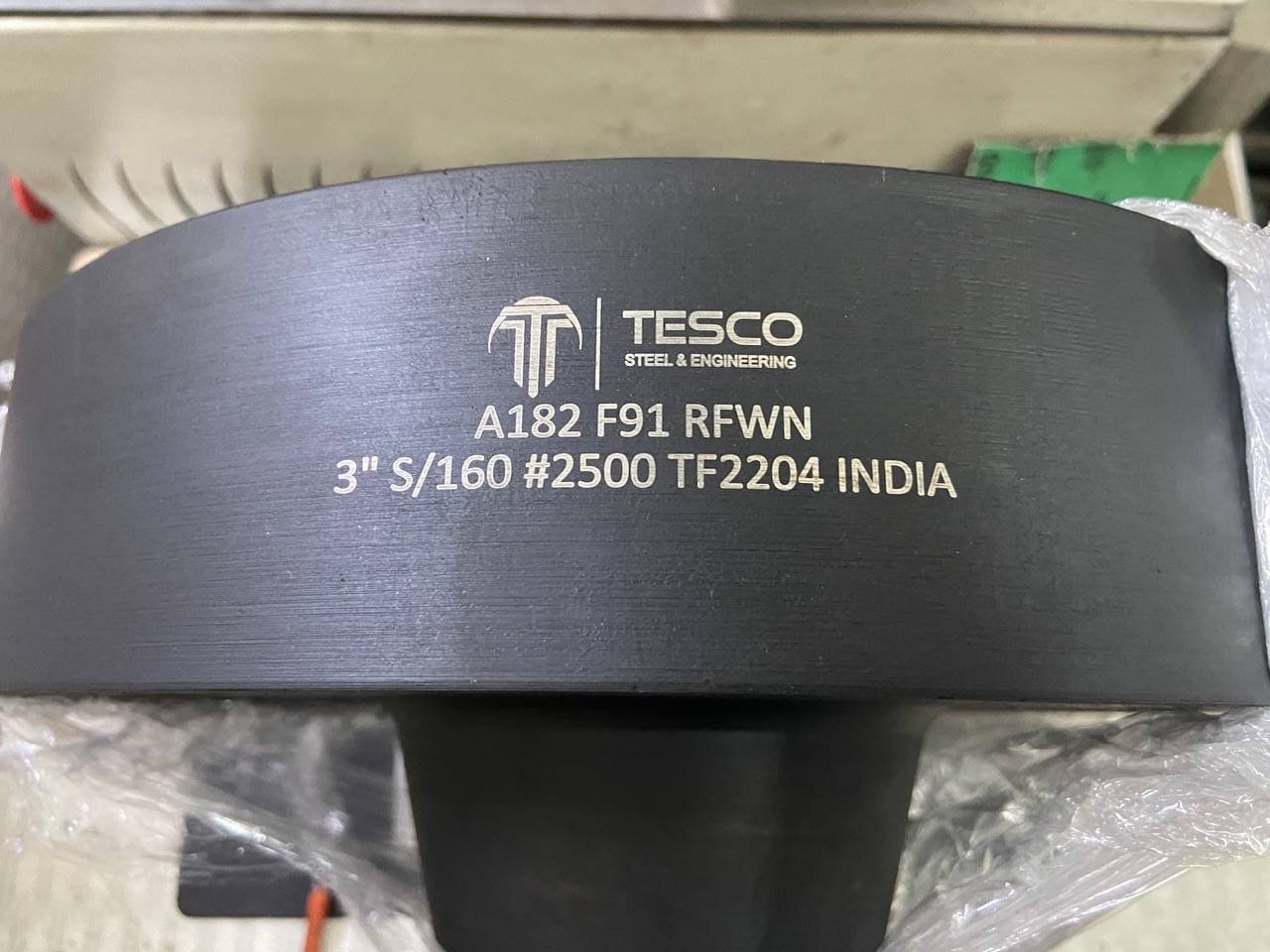
RFWN Flange — Alloy Steel A182 F91, 3″ Sch 160, Class 2500
RFWN flanges pair the strength and inspectability of a weld-neck joint with a versatile raised-face seat for spiral-wound and Kammprofile gaskets. Tesco Steel & Engineering manufactures them to ASME B16.5 / B16.47 in the full material range — see our weld-neck flanges, WNRTJ (ring-joint) flanges, the flange dimension charts, and the flange weight chart.
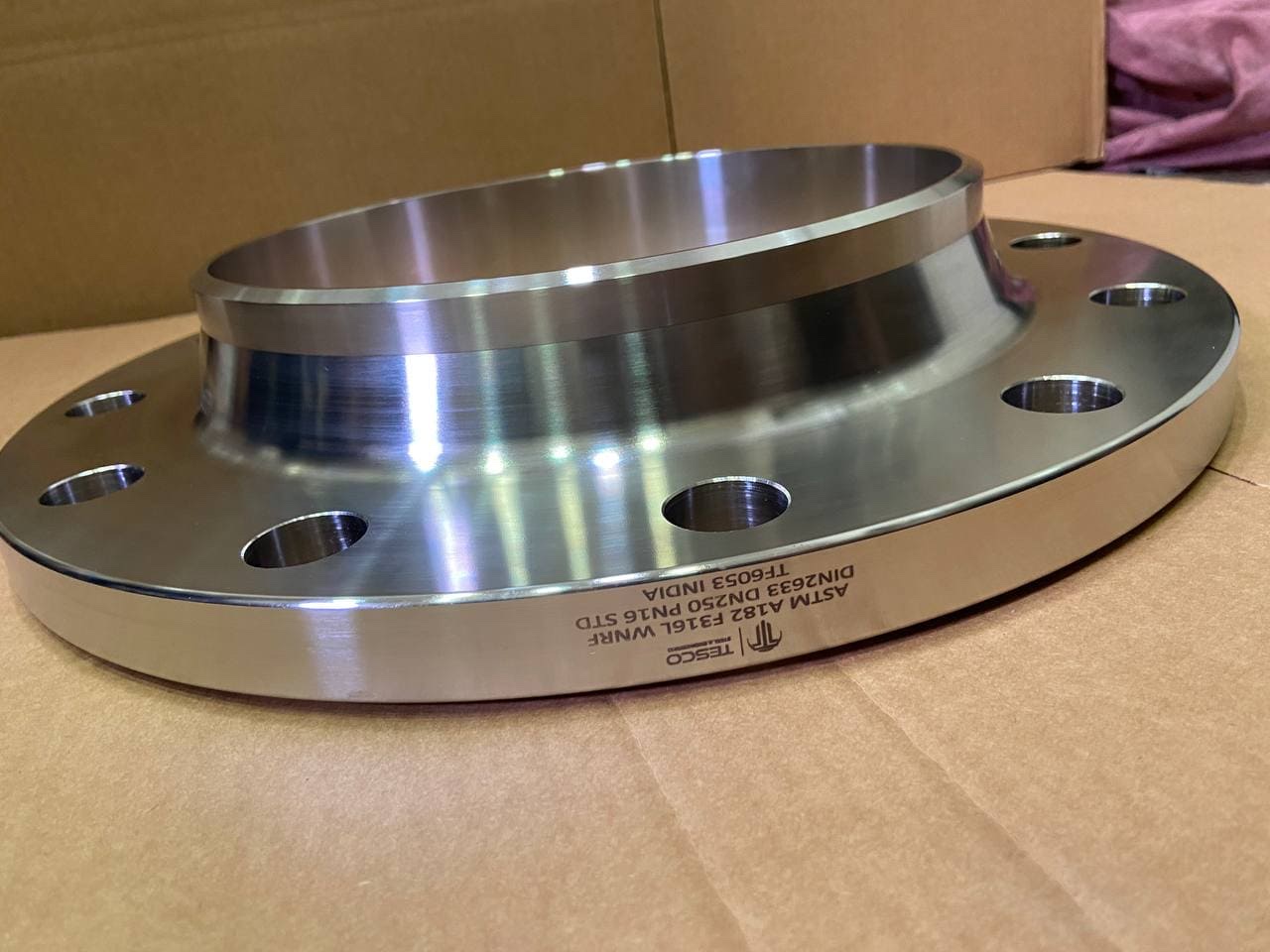
Tapered Weld-Neck Hub & Raised Face — Stainless Steel A182 F316L, DN250 PN16
| Face Type | Gasket Surface | Typical Application |
|---|---|---|
| RFWN (Raised Face Weld Neck) | Raised above bolt circle; spiral-wound / Kammprofile gasket | Refineries, upstream oil & gas, power generation — high pressure / temp |
| FFWN (Flat Face Weld Neck) | Flush with bolt circle; full-face soft gasket | Mating cast-iron or bronze equipment; low-pressure water / utility |
| RJWN / WNRTJ (Ring Joint Weld Neck) | Machined groove for oval or octagonal metal ring gasket | API wellheads, high-pressure subsea and sour-service piping |
RFWN is the most widely specified weld-neck face. For metal-to-metal sealing at the highest pressures and temperatures, see our WNRTJ ring-joint flanges; for low-pressure mating to flat-faced equipment, FFWN is used.
| RFWN Flanges — Full Material & Dimensional Range | |
|---|---|
| Standards | ASME B16.5, ASME B16.47 (Series A & B), MSS SP-44, API 605, DIN EN 1092-1, BS 4504 |
| Size Range | 1/2″ NB to 60″ NB (DN 15 to DN 1500) |
| Pressure Classes | Class 150, 300, 400, 600, 900, 1500, 2500 (ASME) · PN 6, 10, 16, 25, 40, 64, 100, 160, 250, 320, 400 (DIN/EN) |
| Schedule / Wall Thickness | SCH 10, 20, 40, STD, 60, 80, XS, 100, 120, 140, 160, XXS |
| Face Finish | Raised Face (RF), Flat Face (FF), Ring Type Joint (RTJ), Tongue & Groove (T&G), Male & Female (M&F) |
| Stainless Steel RFWN Flanges | ASTM A182 F304, F304L, F304H, F316, F316L, F316H, F316Ti, F309, F310, F317L, F321, F347, F904L |
| Duplex & Super Duplex RFWN Flanges | ASTM A182 F51 (S31803/S32205), F53 (S32750), F55 (S32760), F60 (S32101) |
| Alloy Steel RFWN Flanges | ASTM A182 F5, F5a, F9, F11, F12, F21, F22, F91, F92 |
| Carbon Steel RFWN Flanges | ASTM A105, ASTM A694 F42–F70 |
| LTCS RFWN Flanges | ASTM A350 LF1, LF2, LF3 (low-temperature carbon steel, tested to −46 °C) |
| Nickel Alloy RFWN Flanges | UNS N02200 (Ni 200), UNS N02201 (Ni 201) |
| Monel RFWN Flanges | ASTM B564 — UNS N04400 (Monel 400), UNS N05500 (Monel K500), Alloy 20 (N08020) |
| Inconel RFWN Flanges | ASTM B564 — N06600 (600), N06601 (601), N06625 (625), N08800 (800), N08810 (800H), N08825 (Incoloy 825) |
| Hastelloy RFWN Flanges | ASTM B564 — N10276 (C276), N06022 (C22), N10665 (B2), N10675 (B3), N06455 (C4) |
| Titanium RFWN Flanges | ASTM B381 — Gr. 1, Gr. 2, Gr. 5 (Ti-6Al-4V), Gr. 7; DIN 3.7035, 3.7055 |
| Copper Nickel RFWN Flanges | ASTM B151 / B564 — UNS C70600 (90/10 Cu-Ni), UNS C71500 (70/30 Cu-Ni), UNS C71640 |
| Special Coatings & Surface Treatments | Hot-Dip Galvanizing (GI) · Sand Blasting (Sa 2.5) · Shot Peening · Epoxy Coating · FBE · PTFE Coating · Electropolishing |
Select a pressure class below for the complete RFWN flange dimension table — outside diameter, bolt-circle diameter, number and size of bolt holes, hub length and bore — for every NPS from 1/2 to 24 (ASME B16.5) and up to 60″ (ASME B16.47):
| Standard | Dimension Table |
|---|---|
| ANSI / ASME Class 150 RFWN Flange | View Class 150 RFWN Dimensions → |
| ANSI / ASME Class 300 RFWN Flange | View Class 300 RFWN Dimensions → |
| ANSI / ASME Class 400 RFWN Flange | View Class 400 RFWN Dimensions → |
| ANSI / ASME Class 600 RFWN Flange | View Class 600 RFWN Dimensions → |
| ANSI / ASME Class 900 RFWN Flange | View Class 900 RFWN Dimensions → |
| ANSI / ASME Class 1500 RFWN Flange | View Class 1500 RFWN Dimensions → |
| ANSI / ASME Class 2500 RFWN Flange | View Class 2500 RFWN Dimensions → |
The bore is machined to match the pipe ID, eliminating the internal step found in slip-on flanges and preventing turbulence, erosion and crevice corrosion at the joint.
The full-penetration groove weld at the neck lies in a straight section, allowing 100% RT or UT — meeting the strictest NDE of ASME VIII, B31.3 and offshore specs.
Elevating the seat concentrates bolt load on the gasket, raising unit seating stress for a tighter seal with spiral-wound gaskets (ASME B16.20) at high pressure.
The gradual hub taper distributes bending and pressure stress over more metal, lowering peak stress at the weld toe — ideal for fatigue and vibration-critical lines.
Routinely specified from Class 150 through 2500 (PN420 equivalent) — the go-to flange for critical high-pressure service.
A105, SS 304/316/321, Duplex 2205/2507, Monel, Inconel, Hastelloy, Titanium and Copper Nickel for any process fluid.
The raised face accepts spiral-wound, Kammprofile and compressed-fibre gaskets across a wide pressure/temperature range.
The tapered hub reduces cyclic stress at the weld — preferred for compressor, pump and vibrating piping systems.
Made to ASME B16.5 / B16.47, DIN EN 1092-1, BS 4504 and JIS B 2220 — acceptable to project specs worldwide.
Made to ASME B16.5 or your drawing — class, schedule/bore and material — certified with EN 10204 3.1 MTC.
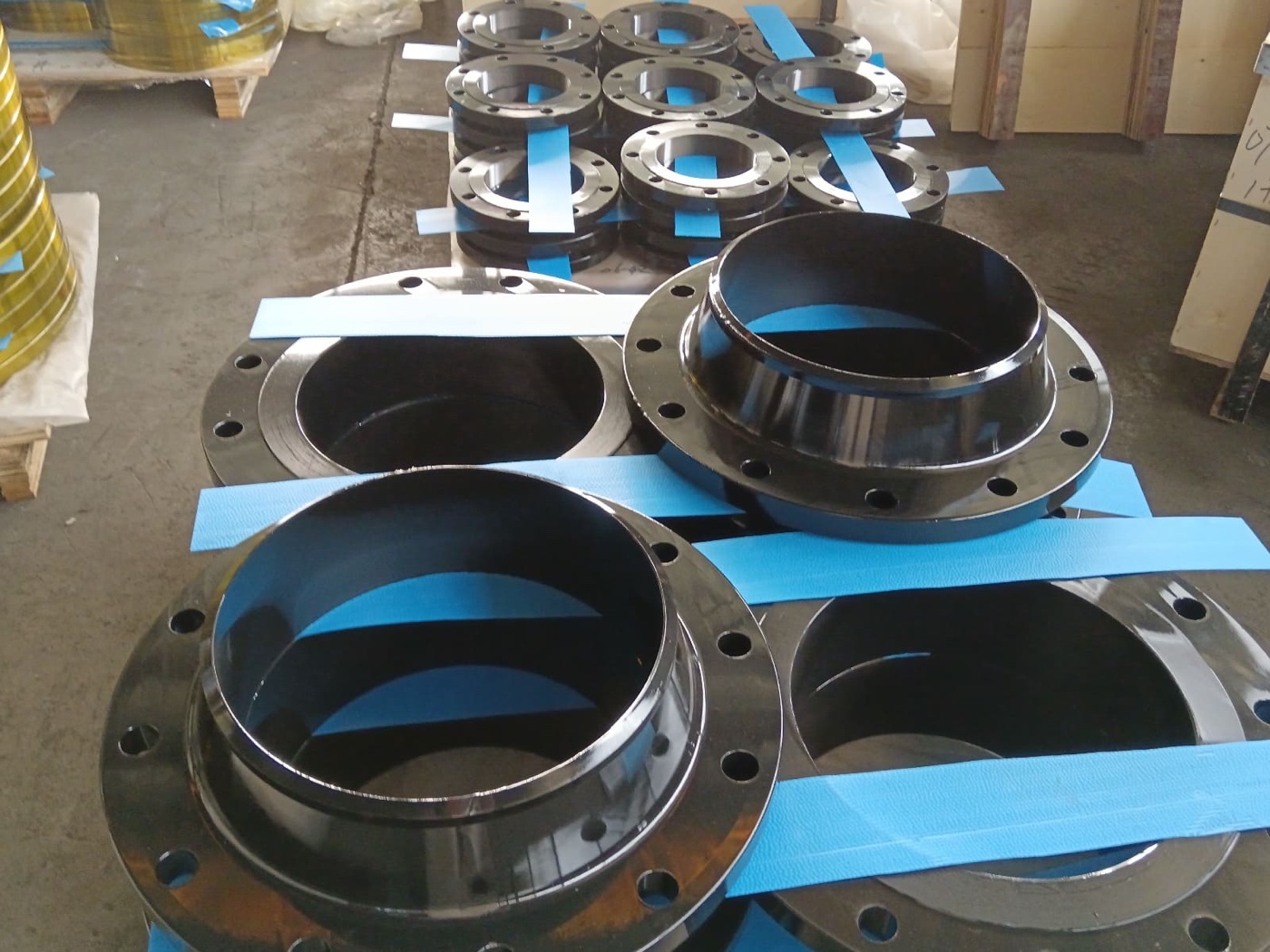
Carbon Steel RFWN Flanges — Ready Stock
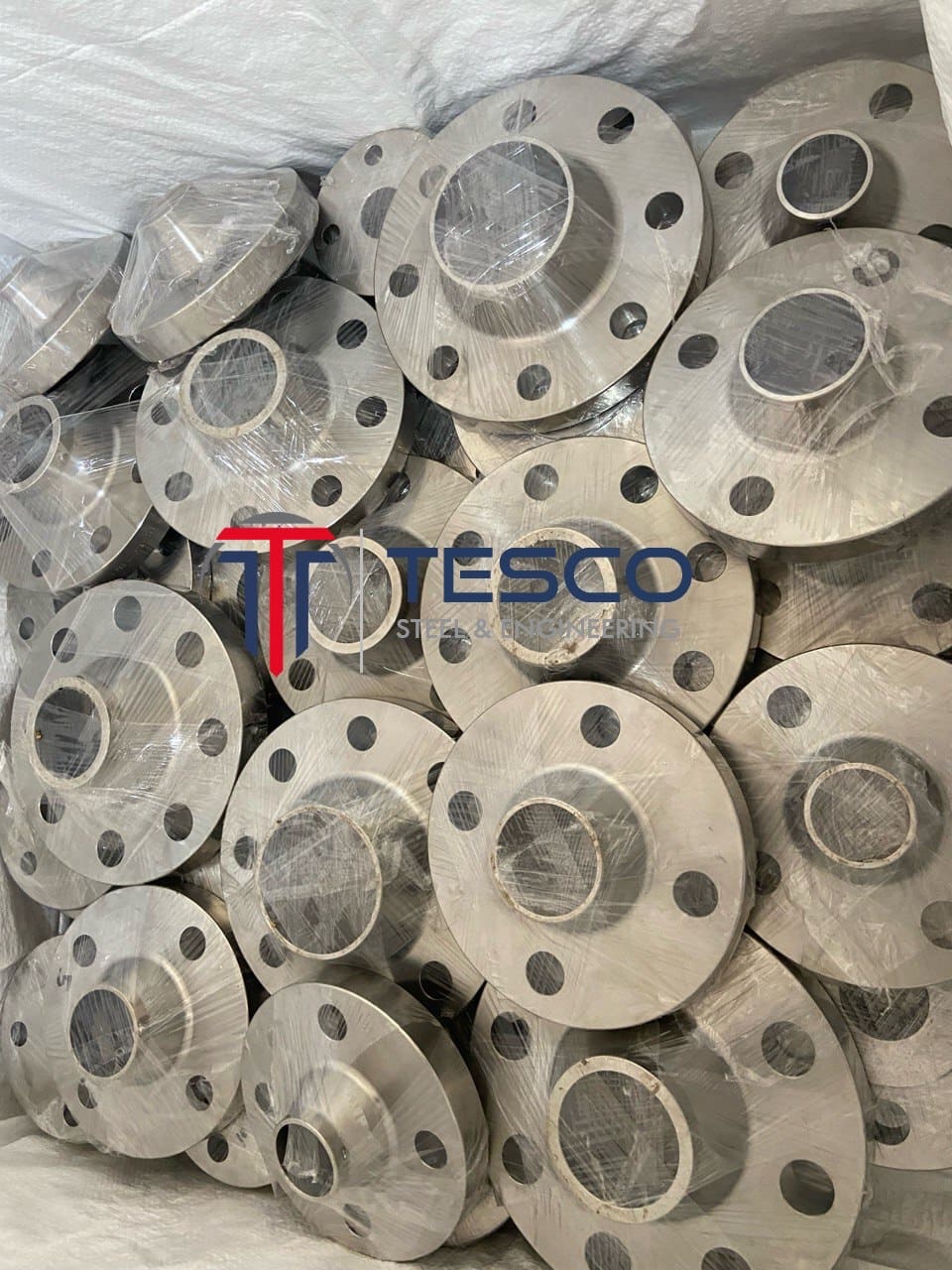
Stainless Steel RFWN Flanges — Ready for Dispatch
| Material | Properties | Typical Use |
|---|---|---|
| Carbon Steel A105 / LTCS A350 LF2 | Strong, economical; LF2 impact-tested to −46 °C | General utility & low-temperature HP lines, LNG loading |
| Alloy Steel F11 / F22 / F91 | Cr-Mo creep resistance to ~593–620 °C | High-temperature steam, supercritical power boilers |
| SS 304 / 316L / 321 | Good corrosion resistance; 321 high-temp stabilised | Chemical, food & pharma, high-temperature process |
| Duplex 2205 / Super Duplex 2507 | High strength & chloride resistance (PREN > 40) | Seawater injection, offshore produced water, FGD |
| Inconel 625 / Monel 400 | Outstanding aqueous & HF / marine corrosion resistance | Subsea, flare systems, scrubbers, seawater |
| Hastelloy C276 / Titanium Gr. 2 | Superior acid & oxidising-media resistance | Wet chlorine, HCl, bleach, aggressive chemical service |
| Industry | Service / Fluid | Typical Grade |
|---|---|---|
| Oil & Gas Upstream | Crude oil, sour gas (H₂S), produced water, wellheads | A182 F316L, F51 (Duplex), F53 (Super Duplex) |
| Refineries & Petrochemical | Hydrocarbons, hydrogen, HF acid, hot oil, amine | A182 F11, F22, F91, F316L, Alloy 20 |
| Power Generation | High-pressure steam, feedwater, supercritical boilers | A182 F91, F92, F22 |
| Chemical Processing | Chlorine, sulphuric acid, caustic, chlor-alkali | A182 F316L, Hastelloy C276, Titanium Gr. 2 |
| LNG & Cryogenic | LNG, liquid nitrogen, liquid oxygen | A350 LF3, A182 F304L, F316L |
| Desalination & Marine | Seawater, brine, SWRO high-pressure piping | Super Duplex F53/F55, Copper Nickel C71500 |
| Offshore & Subsea | Risers, flowlines, manifolds, FPSO topsides | Super Duplex F53, Inconel 625 |
| Food, Beverage & Pharma | Sanitary process lines, CIP/SIP, dairy, brewing | A182 F316L (electropolished), F304L |
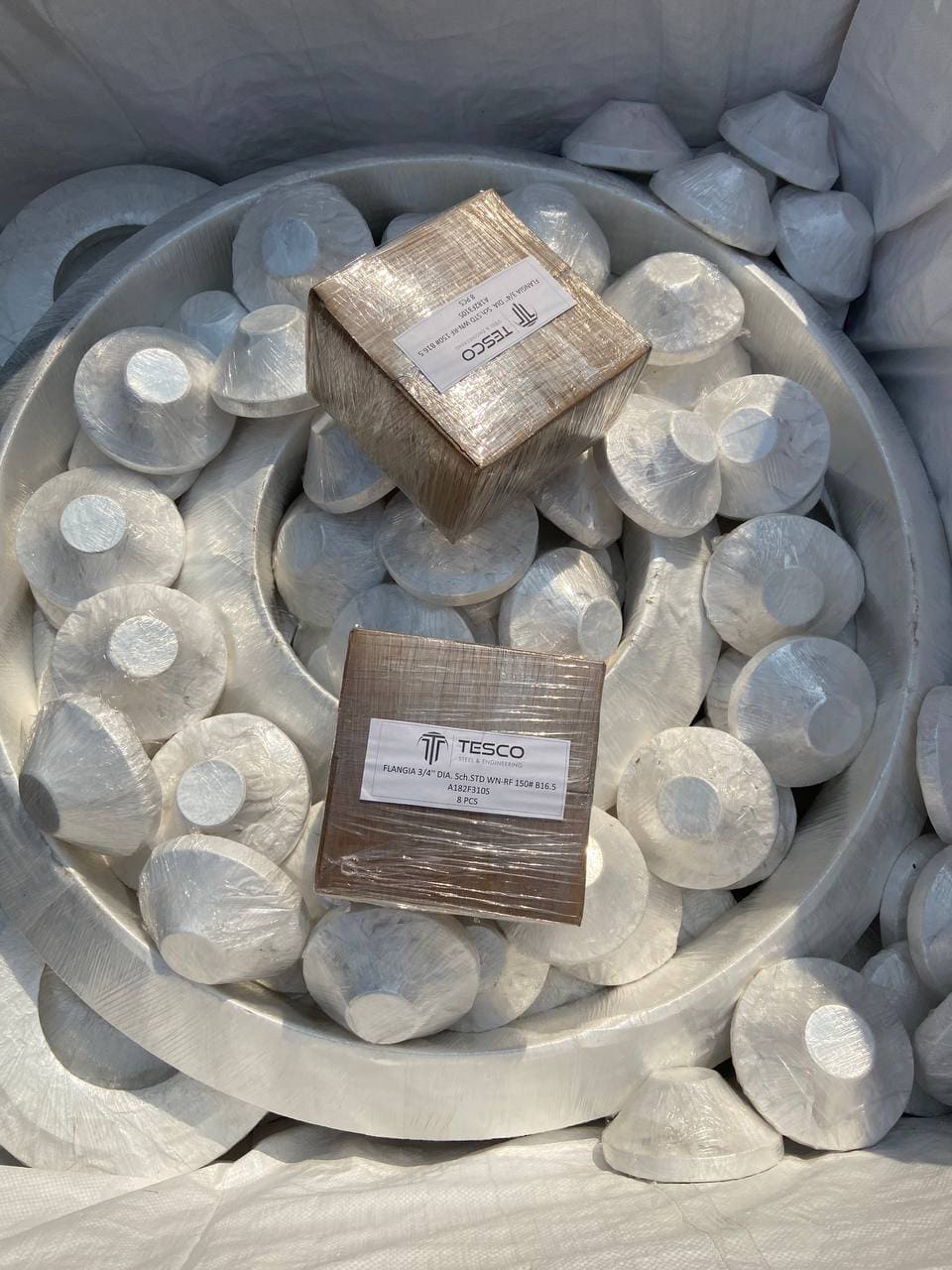
3/4″ Class 150 F310S RFWN Flanges — Wrapped & Boxed
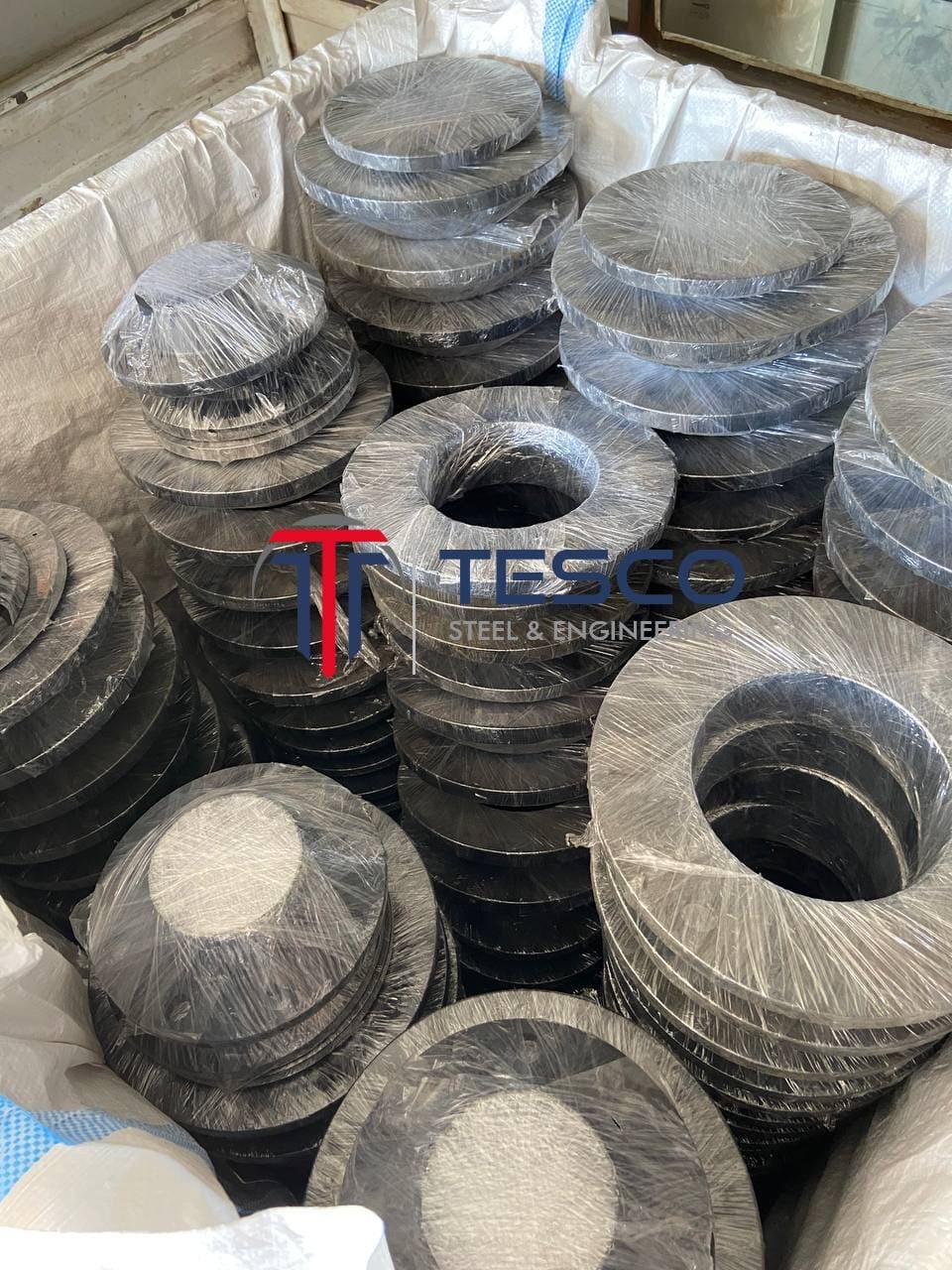
Black-Coated RFWN Flanges — Export Packing
Q1. What does RFWN stand for in flanges?
RFWN stands for Raised Face Weld Neck. It is a weld neck flange whose gasket contact surface is raised above the bolting circle face, per ASME B16.5. The weld-neck hub is butt-welded to the pipe and the raised face concentrates bolt load on the gasket for a tighter seal at high pressure.
Q2. What is the difference between an RFWN and a plain weld neck flange?
A "plain" weld neck flange is the hub-and-bore design; the face type (RF, FF, RTJ, T&G) is a separate designation. RFWN specifies a Raised Face — the most commonly used finish. A weld neck flange ordered without a face designation defaults to RF in most project specifications.
Q3. What is the raised face height on an RFWN flange?
Per ASME B16.5, the raised face height is 1/16″ (1.6 mm) for Class 150 and Class 300, and 1/4″ (6.4 mm) for Class 400, 600, 900, 1500 and 2500. The face is usually serrated to a 125–250 AARH finish to grip the gasket.
Q4. What gasket should I use with an RFWN flange?
Spiral-wound metallic gaskets (SWG) with an outer guide ring, conforming to ASME B16.20, are the standard choice for Class 150–2500. Compressed non-asbestos fibre (CNAF) gaskets suit Class 150 utility service, while Kammprofile gaskets are used for very high pressure or temperature.
Q5. Which standard covers RFWN flange dimensions?
RFWN dimensions are governed by ASME B16.5 (NPS 1/2 to 24, Class 150–2500) and ASME B16.47 Series A (MSS SP-44) and Series B (API 605) for large-diameter flanges up to NPS 60. Select a class from the dimension table above for full details.
Q6. Are RFWN flanges available in sour service (H₂S) compliance?
Yes. RFWN flanges for sour service are supplied with hardness controlled to HRC ≤ 22 (HB ≤ 237) per ISO 15156-2 / NACE MR0175. A105 must meet NACE hardness limits; SS 316L, Duplex and Super Duplex are inherently NACE-compliant at typical service hardness.
Q7. What is the maximum temperature for an RFWN flange?
It depends on material: A105 to ~400 °C, F22 to ~593 °C, F91 to ~620 °C, SS 316H to ~870 °C (with creep de-rating), and Inconel 625 above 1,000 °C in oxidising atmospheres. Always consult the ASME B16.5 temperature-pressure rating table for the exact material group and class.
Q8. Can RFWN flanges be supplied to our drawing and certified?
Yes. We supply RFWN flanges to ASME B16.5 / B16.47 or your drawing — size, schedule/bore, class, face finish and material — with EN 10204 3.1 material test certificates and the specified NDT (RT/UT, PMI, hardness, hydro-test) on request. Send your line details for a quote.
Countries We Export RFWN Flanges To: UAE, Saudi Arabia, Kuwait, Qatar, Bahrain, Oman, Iraq, Iran, Jordan, Israel, Yemen, Afghanistan, Pakistan, Germany, Netherlands, UK, Italy, France, Spain, Russia, Turkey, Kazakhstan, Algeria, Libya, Egypt, Sudan, Nigeria, South Africa, Kenya, Tanzania, Zambia, Angola, Congo, Ghana, Ethiopia, Uganda, Mozambique, Zimbabwe, India (domestic), Singapore, Malaysia, Thailand, Vietnam, Indonesia, Philippines, China, Japan, South Korea, Australia, New Zealand, Canada, USA, Mexico, Venezuela, Colombia, Peru, Brazil, Chile, Argentina.
Domestic Supply — RFWN Flanges in India: Mumbai, Delhi, Bangalore, Hyderabad, Ahmedabad, Chennai, Kolkata, Surat, Pune, Jaipur, Lucknow, Kanpur, Nagpur, Visakhapatnam, Indore, Thane, Bhopal, Pimpri-Chinchwad, Patna, Vadodara, Ghaziabad, Ludhiana, Coimbatore, Agra, Andhra Pradesh, Assam, Bihar, Chhattisgarh, Goa, Gujarat, Haryana, Jharkhand, Karnataka, Kerala, Madhya Pradesh, Maharashtra, Odisha, Punjab, Rajasthan, Tamil Nadu, Telangana, Uttar Pradesh, Uttarakhand, West Bengal.