

Cu-Ni 90/10 (C70600) & 70/30 (C71500) grades. ASTM B564 / ASME SB564, ASME B16.5 / B16.47. The gold standard for seawater piping, marine systems, and desalination — outstanding corrosion resistance, biofouling resistance, and erosion resistance in the most demanding wet environments. Exporting to 65+ countries for 30+ years.
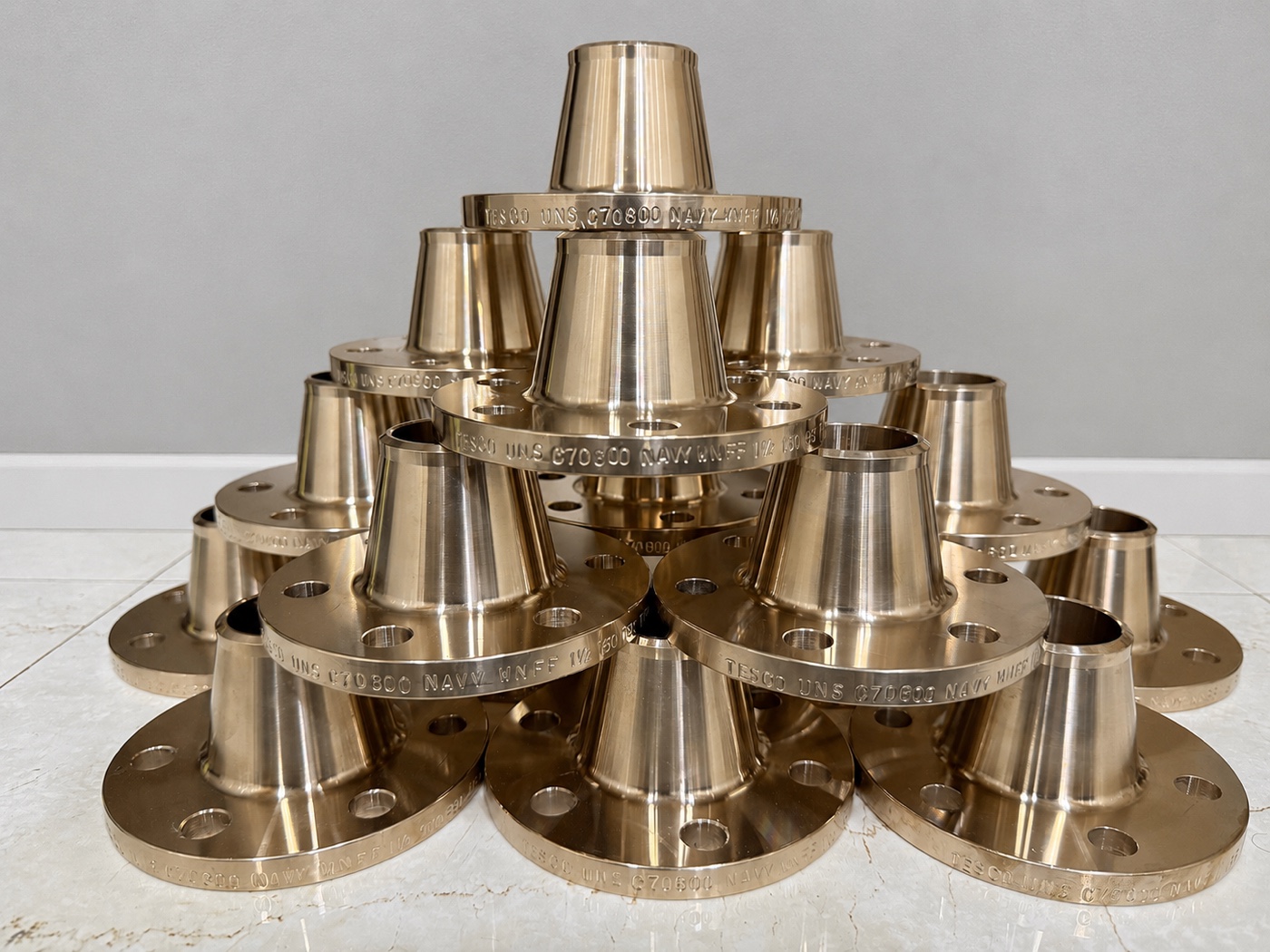
Copper nickel (Cu-Ni) flanges are copper-nickel alloy piping components engineered for one of the most demanding service environments in the world: seawater. Used across marine, offshore, desalination, naval, and coastal power generation industries, Cu-Ni flanges are the universal specification for seawater cooling, firewater, ballast, and produced-water piping systems where carbon steel or stainless steel would fail prematurely.
Tesco Steel & Engineering manufactures copper nickel flanges in 90/10 (UNS C70600) and 70/30 (UNS C71500) grades — as well as the high-iron variant UNS C71640 — to ASTM B564 / ASME SB564, dimensioned per ASME B16.5, B16.47, EN 1092-1, and DIN standards. Available in all types: weld neck, blind, slip-on, socket weld, lap joint, threaded, long weld neck, and spectacle blind.
Every Cu-Ni flange is supplied with EN 10204 3.1 material test certificates, chemical & mechanical test reports, and optional third-party inspection. Weld qualification records using ERCuNi (AWS A5.7) filler are available on request.
90% copper, 10% nickel. The most widely used Cu-Ni grade for seawater piping. Excellent general seawater corrosion resistance, good biofouling resistance, and outstanding value. UTS ~275 MPa, YS ~100 MPa. Rated for seawater velocities up to ~1.5 m/s.
View 90/10 Flanges →70% copper, 30% nickel. Higher strength (UTS ~380 MPa), better elevated-temperature performance, and superior resistance in high-velocity seawater (up to ~3.5 m/s). Preferred for demanding offshore, naval, and desalination applications.
View 70/30 Flanges →Enhanced iron content (1.7–2.3% Fe) dramatically improves erosion-corrosion resistance in high-velocity seawater beyond what standard 70/30 achieves. Ideal for pump casings, condenser water box connections, and high-flow desalination headers.
View C71640 Flanges →The key to copper nickel's exceptional seawater performance lies in its composition — particularly the iron and manganese additions, which are critical for erosion-corrosion resistance and formation of the protective surface film.
| Element | 90/10 — C70600 | 70/30 — C71500 | Role in Performance |
|---|---|---|---|
| Copper (Cu) | Balance (≥ 86.5%) | Balance (≥ 63.0%) | Base metal; provides natural seawater corrosion resistance and biofouling inhibition |
| Nickel (Ni) | 9.0 – 11.0% | 29.0 – 33.0% | Primary alloying element; increases strength, seawater resistance, and elevated-temperature performance with increasing content |
| Iron (Fe) | 1.0 – 1.8% | 0.40 – 1.0% | Critical — dramatically improves erosion-corrosion resistance in flowing seawater; strengthens protective oxide film |
| Manganese (Mn) | ≤ 1.0% | ≤ 1.0% | Improves hot workability during forging; strengthens the protective corrosion film |
| Lead (Pb) | ≤ 0.02% | ≤ 0.02% | Strictly controlled — even trace Pb causes dezincification-type attack in seawater |
| Zinc (Zn) | ≤ 0.50% | ≤ 0.50% | Kept low — zinc additions reduce seawater corrosion resistance |
| Carbon (C) | ≤ 0.05% | ≤ 0.05% | Very low — prevents carbide precipitation and preserves ductility |
| Sulfur (S) | ≤ 0.02% | ≤ 0.02% | Minimised — sulfur contamination causes hot cracking during welding |
| Property | Cu-Ni 90/10 (C70600) ✦ | Cu-Ni 70/30 (C71500) | Cu-Ni C71640 |
|---|---|---|---|
| Tensile Strength (UTS) | ≥ 275 MPa (40 ksi) | ≥ 380 MPa (55 ksi) | ≥ 415 MPa (60 ksi) |
| Yield Strength (0.2% offset) | ≥ 100 MPa (15 ksi) | ≥ 125 MPa (18 ksi) | ≥ 170 MPa (25 ksi) |
| Elongation (min) | ≥ 30% | ≥ 30% | ≥ 20% |
| Hardness (approx) | ~65 HRB | ~70 HRB | ~75 HRB |
| Density | ~8.9 g/cm³ | ~8.95 g/cm³ | ~8.9 g/cm³ |
| Melting Range | ~1100–1145°C | ~1170–1240°C | ~1170–1230°C |
| Max Service Temp (B16.5) | ~232°C (450°F) | ~260°C (500°F) | ~260°C (500°F) |
| Seawater Velocity Limit | ~1.2–1.8 m/s | ~2.5–3.5 m/s | ~3.5–4.5 m/s |
| Primary Application | General marine seawater piping | High-velocity seawater, naval, desalination | High-erosion seawater, condenser connections |
No other engineering alloy at comparable cost combines all five seawater performance properties that Cu-Ni delivers simultaneously:
Cu-Ni alloys develop a thin, stable, self-repairing cuprous oxide–hydroxychloride protective film in seawater within hours. This film is strongly adherent, electrically resistive, and naturally resistant to chloride attack — the corrosion mechanism that destroys carbon steel and stress-corrodes austenitic stainless steel.
The copper ion release from Cu-Ni surfaces is naturally toxic to marine organisms — barnacles, mussels, tube worms, and biofilm cannot colonise Cu-Ni piping. This eliminates biological fouling that causes flow restriction, accelerated corrosion under deposits (MIC), and blockage in seawater systems. No biocide injection needed.
The iron addition in Cu-Ni (1.0–1.8% Fe in 90/10; higher in C71640) is the critical design feature for flow resistance. Iron enters the protective film and dramatically increases its resistance to mechanical erosion by high-velocity seawater, sand, and entrained particles — the primary failure mode in seawater pumping systems.
Cu-Ni 90/10 and 70/30 are readily welded with ERCuNi (AWS A5.7) filler wire by GTAW, GMAW, or SMAW processes without preheat. Welds maintain the same seawater corrosion resistance as the base metal — a critical requirement for marine piping systems where weld zones are often the first point of attack in lesser alloys.
Properly designed Cu-Ni seawater piping systems routinely achieve 30–50 year service lives with no coating, no cathodic protection, and no chemical injection. The total life-cycle cost is far lower than carbon steel (which requires painting, CP, and periodic replacement) or even titanium (higher initial cost).
Cu-Ni 90/10 has a thermal conductivity of ~50 W/m·K — significantly higher than austenitic stainless steel (~15 W/m·K). This makes it particularly effective for heat exchanger shell connections, condenser water boxes, and seawater cooling system headers where heat transfer efficiency matters.
| Parameter | Cu-Ni 90/10 (C70600) | Cu-Ni 70/30 (C71500) | Titanium Gr. 2 | SS 316L |
|---|---|---|---|---|
| Seawater Corrosion | Excellent | Excellent + | Outstanding | Good (risk of crevice/pitting) |
| Biofouling Resistance | Excellent (natural) | Excellent (natural) | Poor | Poor |
| Erosion-Corrosion | Good (to ~1.5 m/s) | Very Good (to ~3.5 m/s) | Outstanding | Moderate |
| Tensile Strength | ~275 MPa | ~380 MPa | ~345 MPa | ~515 MPa |
| Max Service Temp | ~232°C | ~260°C | ~315°C | ~450°C |
| Weldability | Excellent | Excellent | Requires inert gas chamber | Good |
| Relative Material Cost | Moderate | Moderate-High | Very High | Moderate |
| Stress Corrosion Cracking | Immune in seawater | Immune in seawater | Immune | Risk in warm chloride-rich seawater |
| Primary Use Case | General marine seawater piping | High-velocity seawater, naval | Aggressive brine, high-temp saline | Chemical process, non-chloride service |
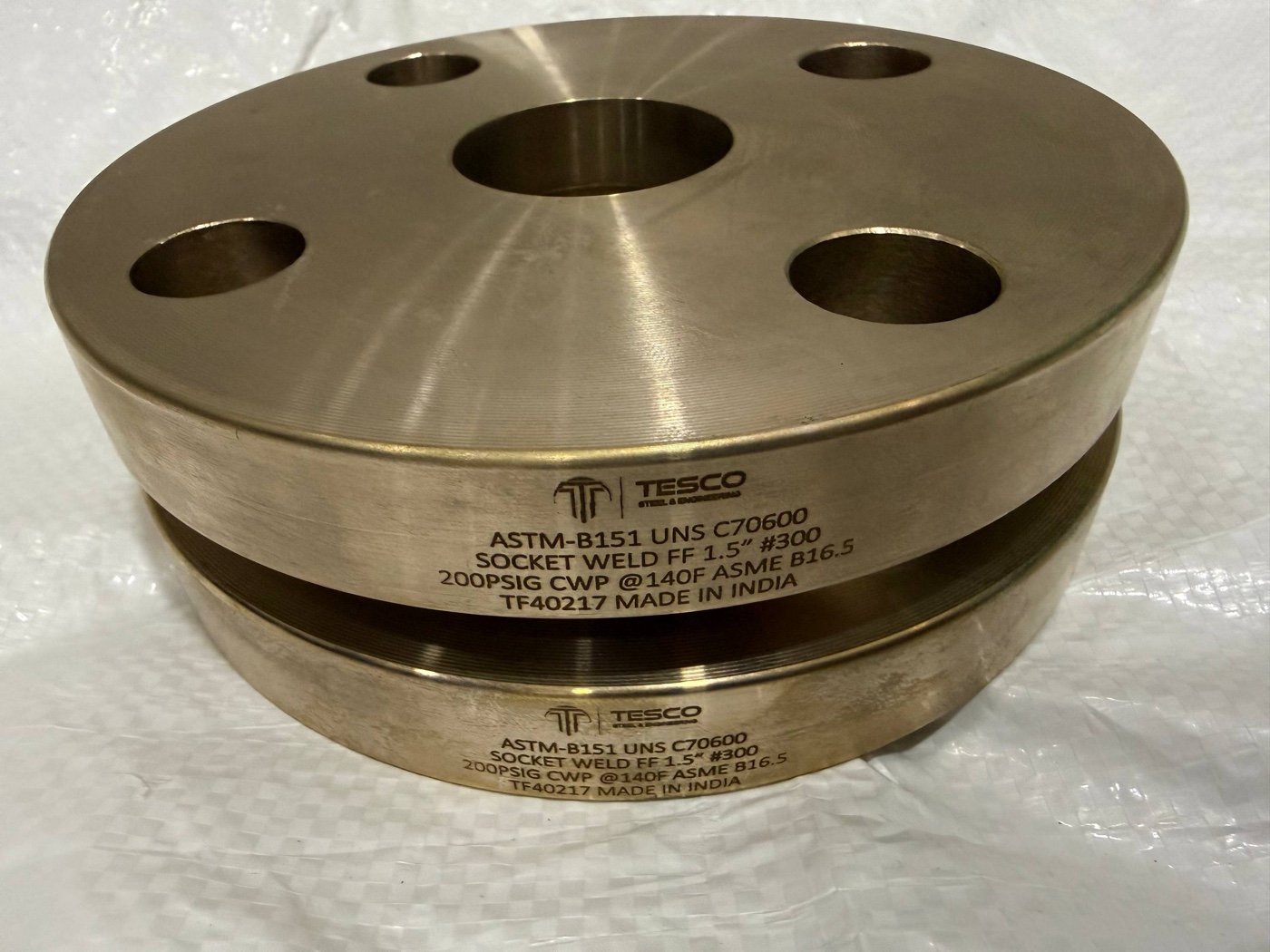
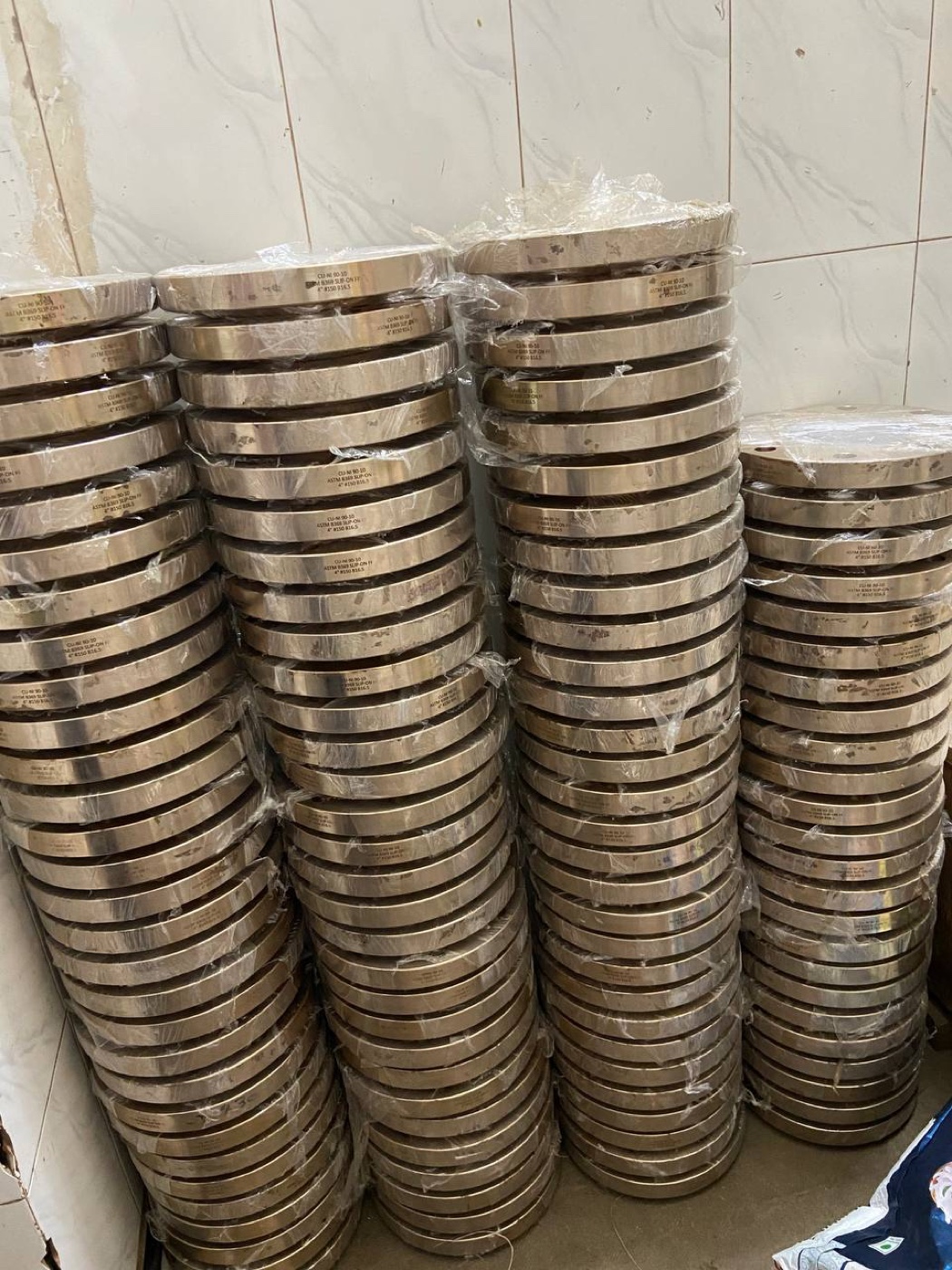
| Flange Type | Marine / Seawater Application Notes | Standard |
|---|---|---|
| Weld Neck (WNRF) | Preferred for high-pressure seawater headers, firewater mains, and pump discharge lines. Smooth bore transition minimises turbulence and erosion-corrosion at the flange bore. | ASME B16.5 / B16.47 |
| Slip-On (SORF) | Seawater cooling system headers, ballast piping, and non-critical utility connections. Double fillet weld. More economical than weld neck for moderate-pressure service. | ASME B16.5 |
| Blind Flange | End closures on seawater systems for maintenance, expansion ports on cooling headers, and isolation of vessel nozzles during dry-docking. | ASME B16.5 / B16.47 |
| Socket Weld (SWRF) | Small-bore seawater instrument connections, chemical injection lines, and instrument take-offs (NPS ½″–2″). Single fillet weld; no crevice concerns in low-flow service. | ASME B16.5 |
| Lap Joint (LJRF) | Used with Cu-Ni stub ends for systems requiring frequent dismantling — common at heat exchanger water box connections in marine power plants and desalination units. | ASME B16.5 |
| Threaded Flange | Low-pressure seawater utility connections where no welding is possible or practical. Sealant recommended to prevent crevice corrosion at thread roots. | ASME B16.5 |
| Long Weld Neck (LWN) | Nozzle connections on Cu-Ni-lined vessels, seawater heat exchanger shells, and desalination plant pressure vessels where a single forging provides both nozzle and flange. | ASME B16.5 / MSS SP-44 |
| Spectacle Blind / Spade | Positive isolation of seawater sections during vessel dry-docking, overhaul, and maintenance. Essential for offshore platforms during intervention operations. | ASME B16.48 |
| Material Standard | ASTM B564 / ASME SB564 — UNS C70600 (90/10), C71500 (70/30), C71640 |
| Material Standards (by product form) | ASTM B151 (rod & bar), ASTM B122 (plate & sheet), ASTM B369 (castings) |
| Naval / Military Standards | MIL-C-15726 (wrought Cu-Ni), MIL-C-24679 (cast Cu-Ni) |
| Offshore & Shipbuilding Standards | EEMUA Publication 145 (offshore Cu-Ni flanges), DIN 86037 (shipbuilding Cu-Ni flanges) |
| Size Range | ½″ NB to 24″ NB (DN 15 to DN 600) — larger sizes on request |
| Pressure Classes (ASME B16.5) | Class 150, 300, 600, 900, 1500, 2500 |
| Large Diameter (ASME B16.47) | Class 75, 150, 300, 400, 600, 900 — Series A & B |
| Dimensional Standards | ASME B16.5, ASME B16.47, MSS SP-44, EN 1092-1, DIN 2631–2638, BS 4504 |
| Facing Types | Raised Face (RF), Flat Face (FF), Ring Type Joint (RTJ), Tongue & Groove (T&G) |
| Testing & Inspection | Chemical analysis, tensile testing, hardness, PMI (XRF), dimensional inspection (100%), visual per MSS SP-55 |
| Material Certification | EN 10204 Type 3.1 (standard) / Type 3.2 (third-party witnessed) |
| Third-Party Inspection | Bureau Veritas, Lloyds Register, TÜVR, SGS, Intertek — on request |
| Welding Filler (GTAW/GMAW) | ERCuNi (AWS A5.7 / SFA 5.7) |
| Welding Electrode (SMAW) | ECuNi coated electrode |
| Client Specifications | Shell DEP, Norsok M-630, Lloyd's Register Type Approval, Naval MIL-SPEC |
| Grade | UNS Number | Alternate Designations | Sub-Page |
|---|---|---|---|
| Copper Nickel 90/10 | C70600 | CuNi10Fe1Mn (EN), CN 102 (BS), 2.0872 (DIN) | 90/10 Flanges → |
| Copper Nickel 70/30 | C71500 | CuNi30Mn1Fe (EN), CN 107 (BS), 2.0882 (DIN) | 70/30 Flanges → |
| Cu-Ni High-Iron | C71640 | CuNi30Fe2Mn2 (EN), 2.0883 (DIN) | C71640 Flanges → |
Seawater piping is one of the most tightly specified areas in marine and offshore engineering, and copper nickel sits right at the centre of it. The catch is that a naval dockyard, a North Sea operator and a Gulf desalination contractor will each call out a different specification for what is essentially the same 90/10 or 70/30 flange. Rather than work to a single standard and hope it satisfies everyone, we manufacture and certify our Cu-Ni flanges against the full set of governing specifications below — so the documentation lines up with whatever your project, client or class society actually asks for.
Which one applies usually comes down to two things: the product form the flange is cut or forged from, and the sector it is going into. Here is the family of standards we routinely supply against, and where each fits:
| Standard | Scope / Product Form | How We Apply It |
|---|---|---|
| MIL-C-15726 | Wrought copper-nickel — rod, bar, plate and forgings (90/10 & 70/30) | US Navy and defence seawater systems; forged and machined Cu-Ni flanges for warship and submarine service |
| MIL-C-24679 | Cast copper-nickel components | Cast Cu-Ni flanges and fittings for shipboard seawater piping where a casting is called for instead of a forging |
| ASTM B151 / B151M | Copper-nickel rod and bar (C70600, C71500) | Bar feedstock for small- and medium-bore flanges machined from solid |
| ASTM B122 / B122M | Copper-nickel plate, sheet, strip and rolled bar | Plate-cut blinds, ring blanks and larger flanges profiled from Cu-Ni plate |
| ASTM B369 | Copper-nickel alloy castings (C96200 cast 90/10, C96400 cast 70/30) | Cast flange bodies and heavier fittings offered as an alternative to forgings |
| DIN 86037 | Copper-nickel welding and composite flanges for shipbuilding | German and European naval and merchant-marine seawater systems built to DIN/EN practice |
| EEMUA Publication 145 | Copper-nickel flanges (solid & composite) for offshore applications | Offshore platform firewater and seawater service, paired with EEMUA 144 pipe and 146 fittings |
In day-to-day work most of our offshore enquiries are driven by EEMUA 145 — often the composite flange version, where a copper-nickel collar is backed by a coated carbon-steel ring to cut both weight and cost without giving up the seawater-wetted Cu-Ni face. Shipyard packages, on the other hand, usually follow DIN 86037 or the relevant navy's MIL standard. When a client just specifies an ASTM material grade, we machine from B151 bar or B122 plate, or pour to B369 when a casting suits the geometry better, and the heat is recorded on an EN 10204 3.1 certificate — upgraded to 3.2 with third-party witness whenever the contract demands it. If you are not certain which standard your line should be built to, send across the piping or material spec and we will tell you what the end user and class society will be looking for.
| Industry / Sector | Typical Copper Nickel Flange Applications |
|---|---|
| Marine & Naval Vessels | Seawater cooling systems, fire main piping, bilge and ballast systems, hull fittings, seawater service headers on cargo vessels, tankers, and naval warships |
| Offshore Oil & Gas Platforms | Seawater lift pump discharge piping, firewater mains, seawater injection headers, cooling water systems, produced water treatment connections, deluge systems |
| Desalination Plants | Seawater intake and distribution headers, brine recirculation piping, multi-stage flash (MSF) heat exchanger connections, SWRO pre-treatment systems |
| Coastal & Marine Power Plants | Seawater-cooled steam condenser connections, cooling water intake and outfall headers, heat exchanger water box nozzles, circulating water pump flanges |
| Shipbuilding | All seawater service piping systems — cooling, firefighting, ballast, bilge, hull penetrations, sea chest connections, and salt water ballast valves |
| LNG & FPSO Vessels | Seawater cooling for LNG reliquefaction units, firewater mains, hull-integrated cooling systems, seawater service pumps on floating production vessels |
| Marine Aquaculture | Seawater intake and distribution piping for fish farms, shellfish hatcheries, and marine research facilities where biofouling control is critical |
| Process | Filler / Electrode | Key Requirements |
|---|---|---|
| GTAW / TIG | ERCuNi (AWS A5.7) | Argon back-purge on root pass; keep interpass temp ≤150°C; no preheat required |
| GMAW / MIG | ERCuNi (AWS A5.7) | Argon or Ar/He shielding gas; spray transfer preferred; clean joint surfaces essential |
| SMAW / Stick | ECuNi (coated electrode) | Dry electrodes (stored at 60–70°C); short arc; avoid weaving; chip slag between passes |
| Critical Precautions |
1. Joint must be absolutely free of oil, grease, paint, and moisture — any contamination causes porosity or hot cracking. 2. Sulfur is highly detrimental — do not weld near sulfur-containing materials or use sulfur-bearing marking pens on Cu-Ni. 3. Do not use carbon steel brushes or grinding discs on Cu-Ni surfaces — iron contamination promotes pitting. |
|
| Test / Inspection | Standard / Method | Frequency |
|---|---|---|
| Chemical Analysis | ASTM E1251 / OES Spectroscopy | Per heat |
| Tensile Testing | ASTM E8 / ASTM B564 | Per lot |
| Hardness Testing | ASTM E18 / E10 | Per piece (if required) |
| Positive Material Identification (PMI) | XRF / OES — confirms Ni, Cu, Fe content | Per piece (if required) |
| Dimensional Inspection | ASME B16.5 / B16.47 | 100% per piece |
| Visual Inspection | MSS SP-55 | 100% per piece |
| Hydrostatic / Pressure Test | ASME B16.5 / API 598 | As specified |
| Radiographic Testing (RT) | ASME Section V Art. 2 | As specified |
A complete cupronickel flange specification has five elements — with the dimensional standard doing extra work in marine projects:
Example of a complete line item: “Weld Neck Flange, 3″ NB, ASME B16.5 Class 150, FF, Sch 40 bore, ASTM B151 UNS C70600, EN 10204 3.1 — 30 pcs.”
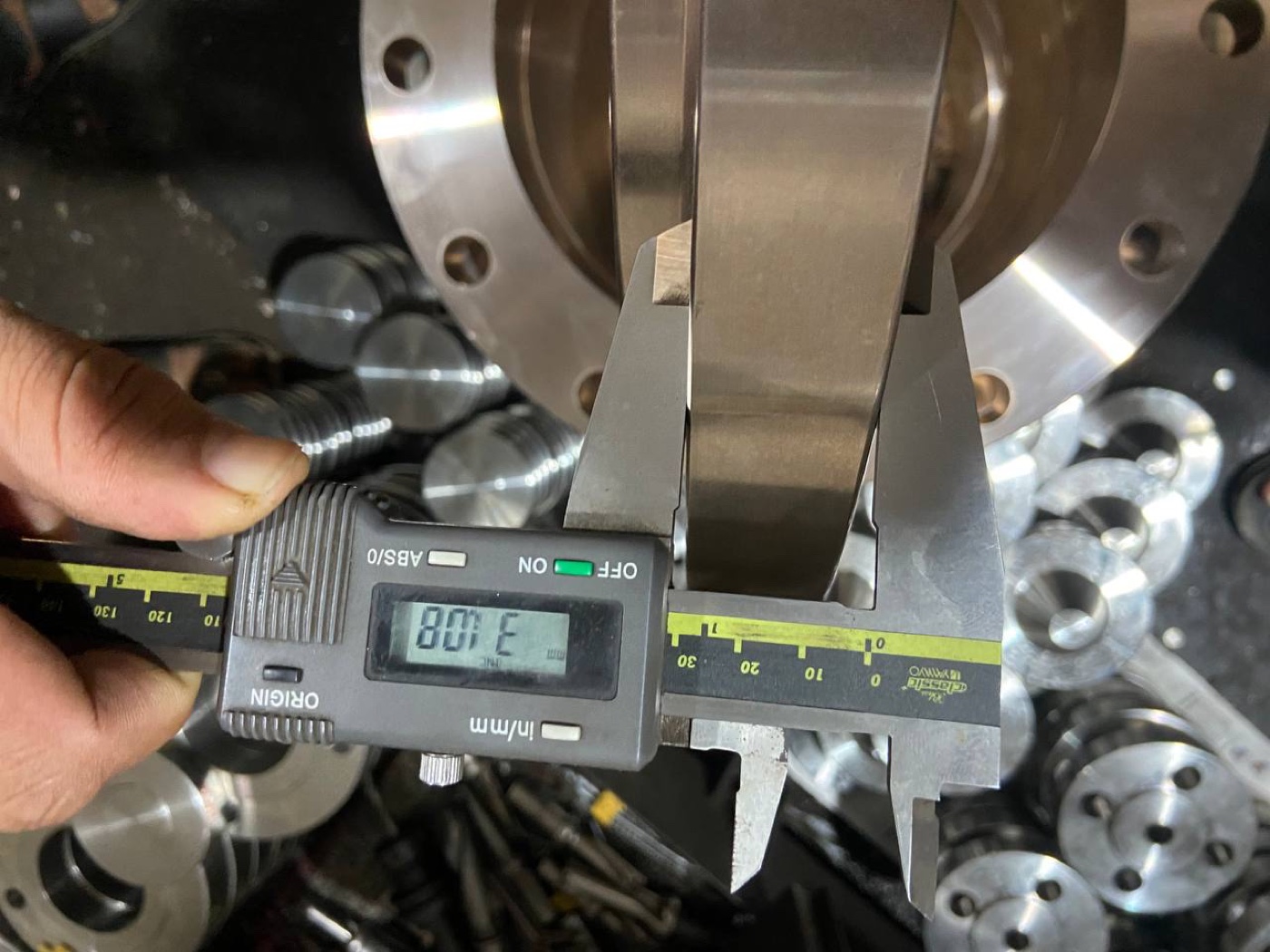
Every Tesco Steel & Engineering copper nickel flange order is backed by rigorous in-house quality control — from CNC machining and bore-dimension inspection through Positive Material Identification (PMI/XRF) verification to final export packaging. Flanges are individually wrapped in moisture-barrier plastic film, heat-marked with colour-coded batch tags, and packed in heavy-duty wooden export crates lined with bubble wrap or straw cushioning. All crates are heat-treated and ISPM 15 compliant, bearing full shipping details for safe, damage-free delivery to any port worldwide.
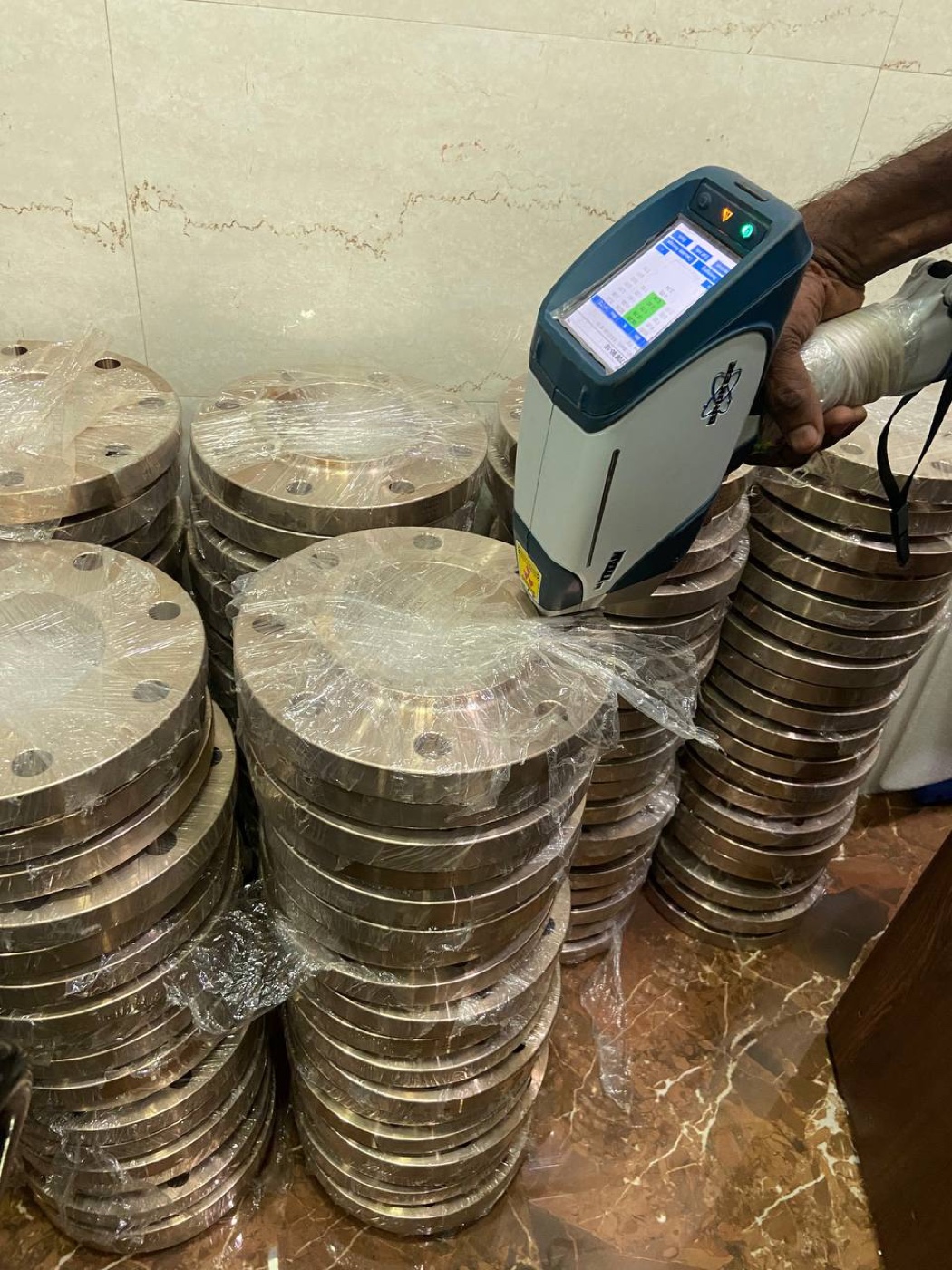
Cu-Ni 90/10 (C70600), 70/30 (C71500), C71640 — all types, all sizes, ASTM B564 & ASME SB564. Ready stock for immediate export to 65+ countries.