

'SHAPING INDUSTRIES WITH THE FINEST STEEL'
'SHAPING INDUSTRIES WITH THE FINEST STEEL'
Tesco Steel & Engineering manufactures ASME B16.5 Class 400 weld neck flanges in NPS 1/2 to 24 (DN 15–600), raised face or ring type joint, with the bore matched to your pipe schedule. This page is the complete reference for the class: the full dimension chart in mm with approximate weights in kg and lbs, the stud & bolt chart, pressure-rating guidance and every material grade we produce — from A105 and A350 LF2 to SS 316, duplex and Inconel. ISO 9001:2015 certified, made in Mumbai, India — exported worldwide.
Class 400 occupies the useful middle ground between Class 300 and Class 600: when a line's design pressure just exceeds the Class 300 rating, a Class 400 flange carries it without the extra thickness, weight and bolting cost of Class 600. The weld neck design — a long tapered hub ending in a butt-weld bevel — transfers pipe stresses gradually through the hub, which is why weld necks are specified for pressure cycling, elevated temperature and critical service ahead of slip-on or threaded types.
The tables below are the working data for the class: flange dimensions in millimetres against the lettered diagram, our calculated weight per size in kg and lbs, and the stud/bolt chart with PCD and hole sizes. All values follow ASME B16.5; bores are finished to the pipe schedule you specify.
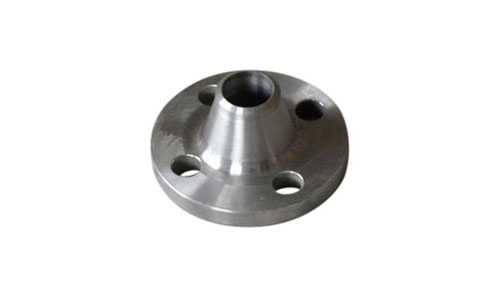
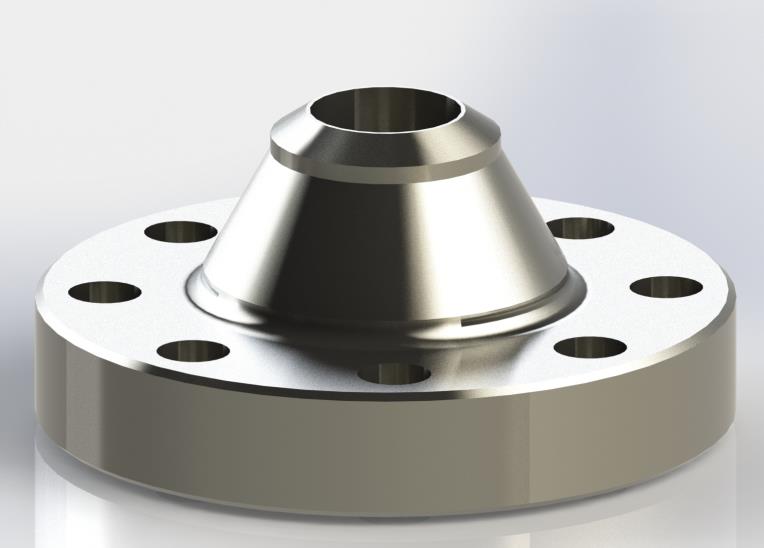
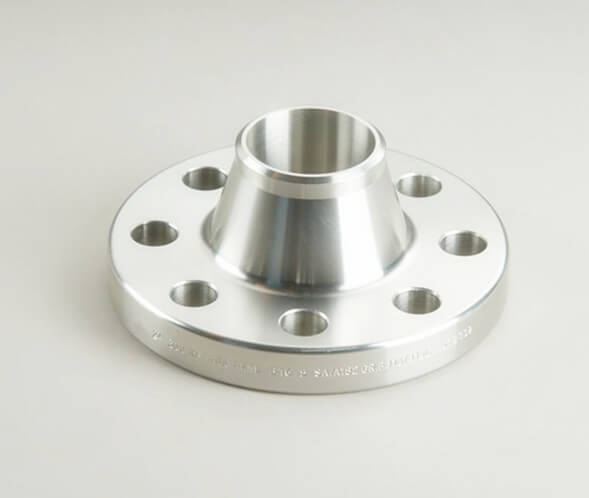
“Class 400” (also written #400 or 400 lb) is a pressure–temperature rating class, not a fixed working pressure. ASME B16.5 tabulates, for every material group, the maximum allowable working pressure at each temperature. Two useful anchors for Group 1.1 carbon steel (A105):
All dimensions in mm. Letters refer to the diagram: A = outer diameter, B = flange thickness, C = hub OD, D = weld neck OD, E = length through neck, F = bore, G = raised face diameter, H = raised face height, I = bolt circle (PCD), J = weld face. The two right-hand columns give the approximate weight per flange in kg and lbs (carbon steel, standard bore).

Weld Neck Flange Dimension Reference — ANSI / ASME B16.5
| Size in Inch | Size in mm | Outer Diameter | Flange Thickness | Hub OD | Weld Neck OD | Welding Neck Length | Bore | RF Diameter | RF Height | PCD | Weld Face | Approx Weight (kg) | Approx Weight (lbs) |
|---|---|---|---|---|---|---|---|---|---|---|---|---|---|
| A | B | C | D | E | F | G | H | I | J | ||||
| 1/2 | 15 | 95 | 14.3 | 38 | 21.3 | 52 | According to Schedule | 34.9 | 7 | 66.7 | 1.6 | 1.0 | 2.2 |
| 3/4 | 20 | 115 | 15.9 | 48 | 26.7 | 57 | 42.9 | 7 | 82.6 | 1.6 | 1.6 | 3.5 | |
| 1 | 25 | 125 | 17.5 | 54 | 33.4 | 62 | 50.8 | 7 | 88.9 | 1.6 | 2.0 | 4.4 | |
| 1 1/4 | 32 | 135 | 20.7 | 64 | 42.2 | 67 | 63.5 | 7 | 98.4 | 1.6 | 2.8 | 6.2 | |
| 1 1/2 | 40 | 155 | 22.3 | 70 | 48.3 | 70 | 73 | 7 | 114.3 | 1.6 | 3.8 | 8.4 | |
| 2 | 50 | 165 | 25.4 | 84 | 60.3 | 73 | 92.1 | 7 | 127 | 1.6 | 4.8 | 10.6 | |
| 2 1/2 | 65 | 190 | 28.6 | 100 | 73 | 79 | 104.8 | 7 | 149.2 | 1.6 | 7.1 | 15.7 | |
| 3 | 80 | 210 | 31.8 | 117 | 88.9 | 83 | 127 | 7 | 168.3 | 1.6 | 9.3 | 20.5 | |
| 3 1/2 | 90 | 230 | 35 | 133 | 101.6 | 86 | 139.7 | 7 | 184.2 | 1.6 | 12 | 26 | |
| 4 | 100 | 255 | 35 | 146 | 114.3 | 89 | 157.2 | 7 | 200 | 1.6 | 15 | 33 | |
| 5 | 125 | 280 | 38.1 | 178 | 141.3 | 102 | 185.7 | 7 | 235 | 1.6 | 19 | 42 | |
| 6 | 150 | 320 | 41.3 | 206 | 168.3 | 103 | 215.9 | 7 | 269.9 | 1.6 | 25 | 56 | |
| 8 | 200 | 380 | 47.7 | 260 | 219.1 | 117 | 269.9 | 7 | 330 | 1.6 | 39 | 86 | |
| 10 | 250 | 445 | 54 | 321 | 273 | 124 | 323.8 | 7 | 387.4 | 1.6 | 56 | 124 | |
| 12 | 300 | 520 | 57.2 | 375 | 323.8 | 137 | 381 | 7 | 450.8 | 1.6 | 79 | 175 | |
| 14 | 350 | 585 | 60.4 | 425 | 355.6 | 149 | 412.8 | 7 | 514.4 | 1.6 | 109 | 241 | |
| 16 | 400 | 650 | 63.5 | 483 | 406.4 | 152 | 469.9 | 7 | 571.5 | 1.6 | 136 | 300 | |
| 18 | 450 | 710 | 66.7 | 533 | 457 | 165 | 533.4 | 7 | 628.6 | 1.6 | 165 | 364 | |
| 20 | 500 | 775 | 69.9 | 587 | 508 | 168 | 584.2 | 7 | 685.8 | 1.6 | 197 | 434 | |
| 24 | 600 | 915 | 76.2 | 702 | 610 | 175 | 692.2 | 7 | 812.8 | 1.6 | 285 | 628 |
Stud quantities, UNC sizes, recommended raised-face stud lengths (mm), bolt hole sizes and metric equivalents for each flange size. See also our fastener weight & count chart and RTJ gasket size chart.
| Size in Inch | Size in mm | No of Bolts | Bolt Size UNC | RF Stud Length | Hole Size | ISO Stud Size |
|---|---|---|---|---|---|---|
| 1/2 | 15 | 4 | 1/2 | 75 | 5/8 | M14 |
| 3/4 | 20 | 4 | 5/8 | 90 | 3/4 | M16 |
| 1 | 25 | 4 | 5/8 | 90 | 3/4 | M16 |
| 1 1/4 | 32 | 4 | 5/8 | 95 | 3/4 | M16 |
| 1 1/2 | 40 | 4 | 3/4 | 110 | 7/8 | M20 |
| 2 | 50 | 8 | 5/8 | 110 | 3/4 | M16 |
| 2 1/2 | 65 | 8 | 3/4 | 120 | 7/8 | M20 |
| 3 | 80 | 8 | 3/4 | 125 | 7/8 | M20 |
| 3 1/2 | 90 | 8 | 7/8 | 140 | 1 | M24 |
| 4 | 100 | 8 | 7/8 | 140 | 1 | M24 |
| 5 | 125 | 8 | 7/8 | 145 | 1 | M24 |
| 6 | 150 | 12 | 7/8 | 150 | 1 | M24 |
| 8 | 200 | 12 | 1 | 170 | 1 1/8 | M27 |
| 10 | 250 | 16 | 1 1/8 | 190 | 1 1/4 | M30 |
| 12 | 300 | 16 | 1 1/4 | 205 | 1 3/8 | M33 |
| 14 | 350 | 20 | 1 1/4 | 210 | 1 3/8 | M33 |
| 16 | 400 | 20 | 1 3/8 | 220 | 1 1/2 | M36 |
| 18 | 450 | 24 | 1 3/8 | 230 | 1 1/2 | M36 |
| 20 | 500 | 24 | 1 1/2 | 240 | 1 3/4 | M39 |
| 24 | 600 | 24 | 1 3/4 | 265 | 1 7/8 | M45 |
Class 400 weld neck flanges are produced in every material family from our range — each supplied with EN 10204 3.1 mill certificates, heat-number traceability and PMI on request:
| Material Family | Typical Flange Grades | Best suited to |
|---|---|---|
| Carbon Steel | ASTM A105, A694 F42–F65 | General & high-pressure hydrocarbon service |
| LTCS | ASTM A350 LF2 / LF3 | Low-temperature service, impact tested |
| Stainless Steel | A182 F304/L, F316/L, F310, F321, F347, F410 | Corrosive process & hygienic service |
| 254 SMO | A182 F44 (UNS S31254) | Seawater & high-chloride service |
| 904L | A182 F904L (UNS N08904) | Sulphuric & phosphoric acid service |
| Duplex / Super Duplex | A182 F51 (2205), F53/F55 (2507) | High strength + chloride resistance, offshore |
| Alloy Steel | A182 F1, F5, F9, F11, F22, F91 | High-temperature steam & refinery lines |
| Monel | 400 / K500 (B564 N04400) | Seawater, HF acid, marine |
| Inconel | 600 / 601 / 625 / 825 | High temperature, sour & oxidising media |
| Hastelloy | C276 / C22 / B2 | Severely corrosive chemical service |
| Titanium | Gr. 2 / Gr. 5 (B381) | Chlorides, seawater; ≈42% lighter |
| Copper Nickel | 90/10 (C70600), 70/30 (C71500) | Marine & seawater cooling systems |
| Bimetal / Clad | CS base + SS/alloy overlay | Corrosion resistance at carbon-steel cost |
Prices are competitive and standard sizes are held in ready stock — use the Ask for Quote button or the inquiry form for today’s price list and stock position.
| Pressure Class | Dimension Chart | Approx. A105 Rating @ 38 °C |
|---|---|---|
| Class 150 | Class #150 Weld Neck Flange | ≈285 psig |
| Class 300 | Class #300 Weld Neck Flange | ≈740 psig |
| Class 400 | Class #400 Weld Neck Flange (this page) | ≈990 psig |
| Class 600 | Class #600 Weld Neck Flange | ≈1480 psig |
| Class 900 | Class #900 Weld Neck Flange | ≈2220 psig |
| Class 1500 | Class #1500 Weld Neck Flange | ≈3705 psig |
| Class 2500 | Class #2500 Weld Neck Flange | ≈6170 psig |
Related references: Weld Neck Flanges overview · Long Weld Neck Flanges · All Flange Dimension Charts · Flange Weight Chart.
The tapered hub and full-penetration butt weld give the joint the strength and fatigue life of the pipe itself — the reason weld necks dominate critical, cyclic and high-temperature lines.
The schedule-matched bore removes turbulence and erosion at the joint — no crevice, no flow step, easy radiography of the butt weld.
From NPS 4 up, Class 400 carries pressures beyond Class 300 while staying meaningfully lighter and cheaper than Class 600 — compare 79 kg vs ≈122 kg for a 12″ weld neck.
Oil & gas transmission, refinery and petrochemical units, chemical plants, power station steam and feedwater, water treatment, offshore and shipbuilding — on pumps, compressors, exchangers, manifolds and vessel nozzles.
What is an ASME B16.5 Class 400 weld neck flange?
It is a weld neck flange manufactured to the ANSI/ASME B16.5 dimension standard in pressure class 400. The long tapered hub is butt-welded to the pipe, transferring stress smoothly from flange to pipe, which makes weld neck flanges the preferred choice for higher pressures, temperature cycling and critical service. Class 400 sits between Class 300 and Class 600 in the B16.5 rating structure and covers sizes NPS 1/2 to 24.
What pressure can a Class 400 flange handle?
The rating depends on material and temperature, not the class number alone. For Group 1.1 materials such as A105 carbon steel, ASME B16.5 allows roughly 990 psig (about 68 bar) at 38 °C for Class 400, and the allowable pressure falls as temperature rises. Stainless and alloy grades have their own pressure-temperature tables. Always confirm the rating for your material group and design temperature.
What does the "Class 400" designation actually mean?
Class 400 (also written #400 or 400 lb) is a pressure-temperature rating class, not a working pressure of 400 psi. Each class maps to a table in ASME B16.5 giving the maximum allowable working pressure at each temperature for each material group. A Class 400 A105 flange, for example, is good for roughly 990 psig when cold, but only a few hundred psi at high temperature.
Why do small Class 400 flanges use Class 600 dimensions?
ASME B16.5 assigns Class 400 flanges in NPS 1/2 through 3-1/2 the same dimensions as Class 600 — you can see identical outside diameters and thicknesses in the chart above. Because the dimensions are the same, small-bore Class 400 flanges are usually supplied and stocked as Class 600, and demand for Class 400 concentrates in NPS 4 and larger where it saves weight and cost versus Class 600.
What sizes does ASME B16.5 cover?
ASME B16.5 covers pipe flanges from NPS 1/2 to NPS 24 (DN 15 to DN 600) in classes 150, 300, 400, 600, 900, 1500 and 2500. Flanges larger than 24 inches are covered by ASME B16.47 (Series A and B). Our Class 400 weld neck chart on this page lists all twenty standard sizes with dimensions in millimetres.
How much does a Class 400 weld neck flange weigh?
As a guide from the weight column in our chart: a 2 inch Class 400 weld neck flange weighs about 4.8 kg (11 lbs), a 6 inch about 25 kg (56 lbs), a 12 inch about 79 kg (175 lbs) and a 24 inch about 285 kg (628 lbs). These are approximate carbon-steel weights with a standard bore — the exact weight varies with the bore schedule and material density.
What is the raised face height on a Class 400 flange?
Class 400 and higher classes use the taller raised face — approximately 7 mm (nominal 1/4 inch) as shown in the RF Height column of our chart — whereas Class 150 and 300 use a 2 mm (1/16 inch) raised face. This matters for stud length calculations and for gasket selection, and it is one of the details estimators most often miss when switching between classes.
What bore should I specify for a weld neck flange?
The bore of a weld neck flange is machined to match the inside diameter of the pipe it will be welded to, so you must state the pipe schedule (for example Sch 40, Sch 80, Sch 160 or XXS) with your order. A matched bore gives a smooth, unrestricted flow path and a clean butt-weld joint. That is why the Bore column in our chart reads "as per pipe schedule".
What materials and grades are available for Class 400 weld neck flanges?
We manufacture Class 400 weld neck flanges in carbon steel A105, low-temperature carbon steel A350 LF2/LF3, stainless steel A182 F304/L, F316/L, F310, F321, F347 and F410, 254 SMO (F44), 904L, duplex 2205 (F51), super duplex 2507 (F53/F55), alloy steel F1/F5/F9/F11/F22/F91, Monel 400/K500, Inconel 600/625/825, Hastelloy C276/C22, titanium, copper nickel 90/10 and 70/30, and bimetal/clad construction — each with EN 10204 3.1 mill certificates.
How many bolts does a Class 400 flange take?
It varies by size — the stud and bolt chart on this page lists it per size. For example, a 2 inch Class 400 flange takes 8 studs of 5/8 inch UNC, a 6 inch takes 12 studs of 7/8 inch, and a 24 inch takes 24 studs of 1-3/4 inch. The chart also gives the recommended raised-face stud lengths, bolt hole sizes and metric (ISO) stud equivalents.
Which gasket is used with Class 400 raised face flanges?
The most common choice is a spiral wound gasket to ASME B16.20 with an outer centering ring, sized for Class 400. Sheet and kammprofile gaskets are also used depending on the service. Where a ring type joint (RTJ) facing is specified instead of a raised face, an oval or octagonal metallic ring gasket to B16.20 is used in the machined ring groove.
Can Class 400 flanges be supplied RTJ or flat face?
Yes. Raised face (RF) is the default for Class 400, but we also machine ring type joint (RTJ) facings with the standard ring groove for high-pressure, high-temperature sealing, and flat face (FF) on request for mating with flat-faced equipment. Serrated, smooth and special surface finishes are machined to your gasket supplier's recommendation.
Why choose a weld neck flange over a slip-on flange?
The weld neck's tapered hub and full-penetration butt weld give the joint essentially the same strength and fatigue resistance as the pipe itself, with a smooth bore and no crevice. Slip-on flanges are cheaper and easier to fit but are weaker in bending and fatigue and are generally limited to lower classes. At Class 400 pressures, weld neck is the standard engineering choice for critical lines.
What is the difference between Class 300, Class 400 and Class 600 flanges?
They are successive pressure-temperature classes in ASME B16.5: for A105 at 38 °C the allowable working pressures are roughly 740, 990 and 1480 psig respectively. Class 400 flanges are thicker and heavier than Class 300 but lighter than Class 600 from NPS 4 upward (below that they share Class 600 dimensions). Class 400 is chosen when Class 300 is not quite enough and Class 600 would be over-specified.
How are your Class 400 flanges tested and certified?
Every batch is dimensionally inspected against ASME B16.5, marked per MSS SP-25 and supplied with EN 10204 3.1 mill test certificates traceable by heat number. We offer PMI (positive material identification), ultrasonic and magnetic particle examination, impact testing for low-temperature grades, NACE MR0175 compliance for sour service, and third-party inspection by LR, BV, DNV, SGS, TÜV or IBR on request.
Do you make custom or non-standard Class 400 flanges?
Yes. Besides standard B16.5 dimensions we machine special bores, hub modifications, long weld neck versions, special facings and finishes, and flanges to customer drawings. Long weld neck (LWN) flanges — with an extended neck used as a nozzle on vessels and columns — are a regular custom item. Send a drawing or datasheet and we will quote to it.
Which industries use Class 400 weld neck flanges?
Oil and gas gathering and transmission, refineries and petrochemical plants, chemical processing, power generation (steam and feedwater), water treatment, offshore platforms and shipbuilding — anywhere line pressures exceed a Class 300 rating but do not justify Class 600. They are specified for pumps, compressors, manifolds, heat exchangers and vessel nozzles in these plants.
What information should I send with a Class 400 flange enquiry?
To quote quickly we need: size (NPS) and quantity, pressure class (400) and standard (B16.5), type (weld neck), facing (RF or RTJ), bore schedule of the mating pipe, material grade, any impact-test or NACE requirement, and certification and inspection needs. Tesco Steel & Engineering is an ISO 9001:2015 certified flange manufacturer and exporter based in Mumbai, India, shipping worldwide with sea-worthy packing.