

'SHAPING INDUSTRIES WITH THE FINEST STEEL'
'SHAPING INDUSTRIES WITH THE FINEST STEEL'
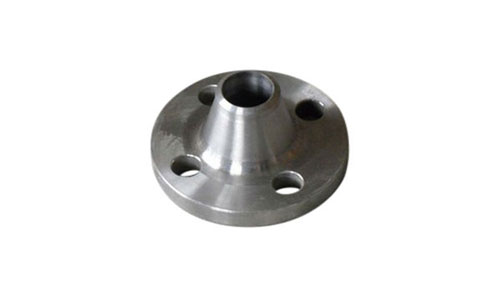
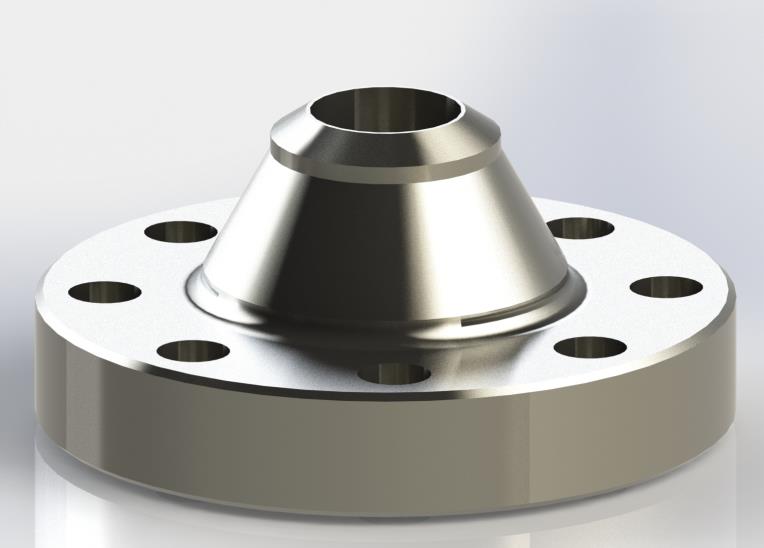
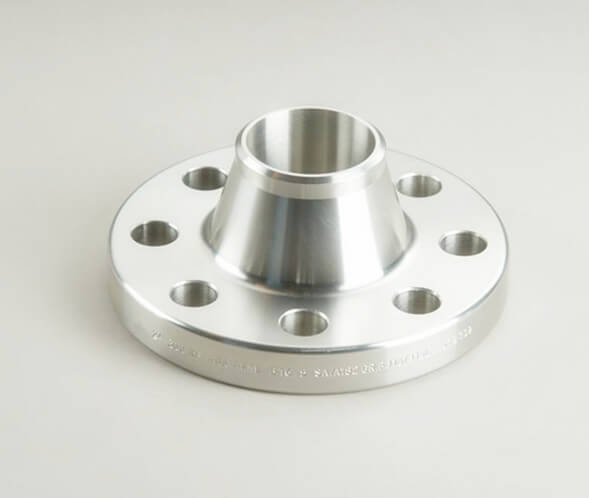
Tesco Steel & Engineering manufactures ANSI / ASME B16.1 Class 250 weld neck flanges — forged steel welding necks with a 2 mm raised face and the Class 250 cast-iron bolt pattern, the flange that connects steel pipe to Class 250 cast-iron valves, pumps, strainers and AWWA C207 Class E/F piping. Sizes NPS 1–24, 30 and 36 (42 and 48 to drawing), bored to your pipe schedule. This page is the complete reference: full dimension charts in mm with bolt circles, hole counts, hole sizes and weights, the cast-iron pressure–temperature table and the material grades we produce — from A105 and A350 LF2 to SS 316 and duplex. ISO 9001:2015 certified, made in Mumbai, India — exported worldwide.
Like its Class 125 sibling, this product carries a small paradox in its name: ASME B16.1 is the standard for grey cast iron flanges — and cast iron cannot be butt-welded. A “B16.1 Class 250 weld neck flange” is therefore always forged steel: a welding neck in A105 or stainless, with a raised face and the cast-iron Class 250 drilling, so a welded steel line can bolt straight onto Class 250 cast-iron gate, globe, check and butterfly valves, pump casings, strainers and AWWA C207 Class E/F piping. High-pressure fire-water, HVAC and cooling-water systems are its daily work.
The dimensional logic mirrors the Class 125 page one class up: to NPS 24 the Class 250 drilling coincides exactly with ASME B16.5 Class 300, so the body is a standard Class 300 weld neck; at NPS 30 and 36 it matches B16.47 Series A Class 300. One rule matters above all here: against cast iron, raised face to raised face, keep the bolting gentle — a ring gasket no thicker than 1.6 mm with low-strength A307 Gr. B bolts — and rate the joint by the cast-iron side. Both points are covered in detail below, next to the charts.
“Class 250” (also written 250 lb or 250#) is the heavier cast-iron pressure class of ASME B16.1 — and because the weaker side governs, the assembled joint is rated by the cast-iron valve or fitting, not by the steel flange. Ratings below are for the cast-iron mating part in ASTM A126 Class B material:
| Temperature °C (°F) | NPS 1–12 | NPS 14–24 * |
|---|---|---|
| −29 to 66 (−20 to 150) | 500 psig (34.5 bar) | 300 psig (20.7 bar) |
| 93 (200) | 460 psig (31.7 bar) | 280 psig (19.3 bar) |
| 121 (250) | 415 psig (28.6 bar) | 260 psig (17.9 bar) |
| 149 (300) | 375 psig (25.9 bar) | 240 psig (16.5 bar) |
| 177 (350) | 335 psig (23.1 bar) | 220 psig (15.2 bar) |
| 204 (400) | 290 psig (20.0 bar) | 200 psig (13.8 bar) |
| 232 (450) | 250 psig (17.2 bar) | — |
Ratings per ASME B16.1 Class 250 for A126 Class B cast iron. * NPS 14–24: liquid service, flanges only. NPS 30–48, refer to ASME B16.1. The steel weld neck itself carries the full B16.5 / B16.47 Class 300 rating (A105: ≈51.1 bar at 38 °C) — it is never the weak link.
All dimensions in mm. Letters follow the figure: O = outer diameter, C = flange thickness (including the 2 mm raised face), X = hub diameter at base, A = hub diameter at the weld bevel, V = length through hub, B = bolt circle (PCD), H = bolt hole diameter — B and H to the B16.1 Class 250 pattern, which for these sizes coincides with B16.5 Class 300. Bore shown for STD pipe; supplied to the schedule ordered. Prefer it on paper? Download the full B16.1 Class 250 drilling datasheet (PDF) — both charts with the drawing, ratings, materials and ordering notes, ready for the workshop.
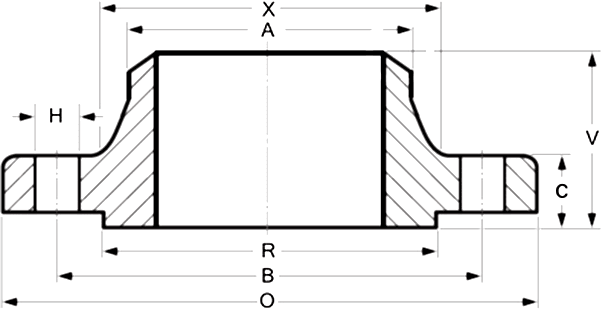
Weld Neck Flange Dimension Reference — B16.1 Class 250 Drilling (RF 2 mm standard)
| Size in Inch | Size in mm | Outer Diameter | Flange Thickness | Hub OD | Weld Neck OD | Bore (STD) | Length Through Hub | PCD | No. of Bolts | Hole Ø | Bolt Size | Approx Weight (kg) |
|---|---|---|---|---|---|---|---|---|---|---|---|---|
| O | C | X | A | — | V | B | — | H | — | |||
| 1 | 25 | 125 | 17.5 | 54 | 33.4 | 26.6 | 62 | 88.9 | 4 | 19.1 | 5/8 | 1.8 |
| 1 1/4 | 32 | 135 | 19.1 | 64 | 42.2 | 35.1 | 65 | 98.4 | 4 | 19.1 | 5/8 | 2.3 |
| 1 1/2 | 40 | 155 | 20.7 | 70 | 48.3 | 40.9 | 68 | 114.3 | 4 | 22.2 | 3/4 | 3.2 |
| 2 | 50 | 165 | 22.4 | 84 | 60.3 | 52.5 | 70 | 127.0 | 8 | 19.1 | 5/8 | 4.1 |
| 2 1/2 | 65 | 190 | 25.4 | 100 | 73 | 62.7 | 76 | 149.2 | 8 | 22.2 | 3/4 | 5.4 |
| 3 | 80 | 210 | 28.6 | 117 | 88.9 | 77.9 | 79 | 168.3 | 8 | 22.2 | 3/4 | 6.8 |
| 3 1/2 | 90 | 230 | 30.2 | 133 | 101.6 | 90.1 | 81 | 184.2 | 8 | 22.2 | 3/4 | 8.2 |
| 4 | 100 | 255 | 31.8 | 146 | 114.3 | 102.3 | 86 | 200.0 | 8 | 22.2 | 3/4 | 11.3 |
| 5 | 125 | 280 | 35.0 | 178 | 141.3 | 128.2 | 98 | 235.0 | 8 | 22.2 | 3/4 | 14.5 |
| 6 | 150 | 320 | 36.6 | 206 | 168.3 | 154.1 | 98 | 269.9 | 12 | 22.2 | 3/4 | 19.1 |
| 8 | 200 | 380 | 41.3 | 260 | 219.1 | 202.7 | 111 | 330.2 | 12 | 25.4 | 7/8 | 30.4 |
| 10 | 250 | 445 | 47.7 | 321 | 273.1 | 254.5 | 117 | 387.4 | 16 | 28.6 | 1 | 41.3 |
| 12 | 300 | 520 | 50.8 | 375 | 323.9 | 303.2 | 130 | 450.8 | 16 | 31.8 | 1 1/8 | 63.5 |
| 14 | 350 | 585 | 54.0 | 425 | 355.6 | 336.5 | 143 | 514.4 | 20 | 31.8 | 1 1/8 | 81.6 |
| 16 | 400 | 650 | 57.2 | 483 | 406.4 | 387.4 | 146 | 571.5 | 20 | 35.0 | 1 1/4 | 113 |
| 18 | 450 | 710 | 60.4 | 533 | 457.2 | 438.2 | 159 | 628.6 | 24 | 35.0 | 1 1/4 | 145 |
| 20 | 500 | 775 | 63.5 | 587 | 508.0 | 489.0 | 162 | 685.8 | 24 | 35.0 | 1 1/4 | 181 |
| 24 | 600 | 915 | 69.9 | 702 | 609.6 | 590.6 | 168 | 812.8 | 24 | 41.3 | 1 1/2 | 263 |
Above NPS 24 the Class 250 drilling matches ASME B16.47 Series A (MSS SP-44) Class 300, so these flanges use the B16.47 Series A weld neck body. All dimensions in mm; bored to the pipe schedule or ID ordered.
| Size in Inch | Size in mm | Outer Diameter | Flange Thickness | Hub OD | Weld Neck OD | Length Through Hub | PCD | No. of Bolts | Hole Ø | Bolt Size | Approx Weight (kg) |
|---|---|---|---|---|---|---|---|---|---|---|---|
| O | C | X | A | V | B | — | H | — | |||
| 30 | 750 | 1090 | 92.1 | 827 | 762.0 | 209.6 | 997.0 | 28 | 47.6 † | 1 3/4 | 395 |
| 36 | 900 | 1270 | 104.8 | 991 | 914.4 | 241.6 | 1168.4 | 32 | 54.0 † | 2 | 578 |
B16.1 Class 250 weld neck flanges are produced in the material families below — each supplied with EN 10204 3.1 mill certificates, heat-number traceability and PMI on request:
| Material Family | Typical Flange Grades | Best suited to |
|---|---|---|
| Carbon Steel | ASTM A105 / A105N (most common); A694 F42–F65 | Fire water, HVAC, cooling & process water, general plant |
| LTCS | ASTM A350 LF2 Cl.1 / Cl.2 | Low-temperature service, impact tested |
| Stainless Steel | A182 F304/L, F316/L, F321 | Corrosive process & effluent service |
| Duplex / Super Duplex | A182 F51 (2205), F53 (2507) | High strength + chloride resistance, seawater systems |
| Copper Nickel | 90/10 (C70600) composite or solid — on request | Seawater cooling & marine piping |
| EN Equivalents | P250GH (1.0460), 1.4301, 1.4404 — on request | European specifications |
Use the Ask for Quote button or the inquiry form for today’s price and delivery position.
| Chart | Standard & Class | Notes |
|---|---|---|
| B16.1 Class 125 Weld Neck | ASME B16.1 · 125 lb | Steel WN, FF, drilling matches B16.5 Class 150 |
| B16.1 Class 250 Weld Neck (this page) | ASME B16.1 · 250 lb | Steel WN, RF, drilling matches B16.5 Class 300 |
| B16.1 Class 125 Slip On | ASME B16.1 · 125 lb | Slip-on body, same drilling |
| B16.1 Class 250 Slip On | ASME B16.1 · 250 lb | Slip-on body, same drilling |
| B16.5 Class 300 Weld Neck | ASME B16.5 · Class 300 | Same drilling NPS 1–24, RF steel flange |
Related references: Weld Neck Flanges overview · Flange Face Types · All Flange Dimension Charts · Flange Weight Chart.
A forged steel weld neck carries the full Class 300 steel rating and a butt-weldable hub, while the Class 250 drilling bolts straight onto Class 250 cast-iron valves, pumps and AWWA C207 Class E/F flanges — no adaptor spools.
For NPS 1–24 the drilling is identical to B16.5 Class 300, so the same flange stock and bolting layouts serve both patterns — only the gasket and bolting rules change at the cast-iron joint.
The thin ring gasket and low-strength bolting rule keeps bending moments off the cast-iron rim — the configuration B16.5 itself prescribes for raised faces on cast iron.
Both charts from a single works — B16.5-bodied sizes to NPS 24 and B16.47 Series A bodies at 30 and 36, with 42 and 48 against a drawing — in carbon, low-temp, stainless and duplex grades.
What is an ANSI B16.1 Class 250 weld neck flange?
A forged steel welding neck flange — not cast iron — with a raised face, drilled to the ASME B16.1 Class 250 bolt pattern used by cast-iron flanges. B16.1 itself is the grey cast iron standard, and cast iron cannot be butt-welded, so when a line needs a weld neck that bolts to a Class 250 cast-iron valve, pump or fitting, the flange is produced in steel with the cast-iron drilling. Body dimensions follow ASME B16.5 Class 300 up to NPS 24 and B16.47 Series A at 30 and 36 in.
What are the dimensions of a B16.1 Class 250 weld neck flange?
They are tabulated in full in the two charts above: NPS 1 to 24 uses the ASME B16.5 Class 300 weld neck body, whose drilling is identical to B16.1 Class 250, and NPS 30 and 36 use the B16.47 Series A body. A 6 in flange, for example, is 320 mm OD and 36.6 mm thick on a 269.9 mm bolt circle with twelve 3/4 in bolts, at about 19 kg; a 24 in is 915 mm OD on an 812.8 mm circle with twenty-four 1-1/2 in bolts, at about 263 kg.
Is a B16.1 Class 250 flange the same as a B16.5 Class 300 flange?
The bolt pattern is — for NPS 1 to 24 the bolt circle, hole count and hole size coincide exactly, so the two bolt together. The differences are everything else: B16.1 Class 250 covers cast iron with a 1.6 mm raised face and much lower ratings, while B16.5 Class 300 covers steel with a 2 mm raised face. In practice a steel Class 300 weld neck is what the market calls a Class 250 weld neck — which is exactly what this page describes.
Why is the bolting limited when mating cast iron?
Because cast iron is brittle. With raised faces bearing on raised faces, over-torqued high-strength studs put a bending moment on the unsupported cast-iron rim and can crack it — so ASME B16.5 restricts RF-to-RF joints against cast iron to low-strength ASTM A307 Grade B bolting with a thin ring gasket. The steel flange tolerates far more than the joint is allowed to see; the limits exist to protect the iron side.
Which gasket and bolts should be used with Class 250 flanges?
Raised face to raised face: a ring gasket no thicker than 1.6 mm, extending to the bolt holes, with ASTM A307 Grade B machine bolts. If the piping class demands A193 B7 studs, order the steel flange flat-faced instead and use a full-face gasket against a flat-faced cast-iron flange — that configuration spreads the bolt load and permits the stronger bolting. Hole counts, hole sizes and bolt sizes per flange size are in the charts above.
What pressure can a B16.1 Class 250 joint handle?
The joint is limited by the cast-iron side, not the steel flange. For ASTM A126 Class B cast iron, B16.1 Class 250 allows 500 psig (34.5 bar) up to 66 °C for NPS 1-12 and 300 psig (20.7 bar) for NPS 14-24 — the larger sizes rated for liquid service, flanges only — derating with temperature per the table on this page. The steel weld neck itself carries its B16.5 Class 300 rating (A105: about 51.1 bar at 38 °C), so it is never the weak link in the joint.
What sizes do B16.1 Class 250 weld neck flanges come in?
ASME B16.1 tabulates Class 250 in NPS 1 to 24 continuously, then 30, 36, 42 and 48. We supply NPS 1-24, 30 and 36 from the charts on this page. NPS 26 and 28 are not B16.1 sizes and are supplied to B16.47 Series A Class 300, the same drilling family; NPS 42 and 48 (B16.1: 36 holes for 2 in bolts on a 1340 mm circle, and 40 on 1543 mm) have no matching steel-flange standard and are made against a drawing.
The steel RF is 2 mm and the cast-iron RF is 1.6 mm — do they mate?
Yes. Class 250 cast iron carries a 1.6 mm raised face and the steel flange a 2 mm one; both are simply gasket seats on the same bolt pattern, and the 0.4 mm difference is absorbed by the gasket. Note that our chart values for thickness C and length through hub V include the 2 mm raised face, following the B16.5 Class 300 convention for these bodies.
What is special about the bolt holes on NPS 30 and 36?
A genuine quirk: ASME B16.1 Class 250 specifies 2 in (50.8 mm) holes at NPS 30 and 2-1/4 in (57.2 mm) at NPS 36, while B16.47 Series A — whose body the flange uses — drills 47.6 and 54.0 mm for the same bolts. We drill per B16.47 by default, which suits both patterns, and drill the full B16.1 holes when the order says so. It is the one place in the range where the two standards disagree.
Where are B16.1 Class 250 weld neck flanges used?
Wherever steel pipe meets the heavier class of cast-iron equipment: Class 250 cast-iron gate, globe, check and butterfly valves, pump casings, strainers and expansion joints, AWWA C207 Class E and F and C110 250 psi ductile-iron fittings, and the high-pressure fire-water, HVAC, cooling-water and process-water lines built around them.
What materials are available for Class 250 weld neck flanges?
Carbon steel ASTM A105/A105N is the usual choice, with A694 F42-F65 for pipeline service and A350 LF2 for low temperature. Stainless A182 F304/L, F316/L and F321, duplex F51 and super duplex F53 cover corrosive duty, and copper-nickel 90/10 composite or solid flanges are made for seawater on request. EN equivalents such as P250GH, 1.4301 and 1.4404 are available — all with EN 10204 3.1 mill certificates.
What bore should I specify?
The bore of a weld neck flange is machined to match the inside diameter of the pipe it will be welded to. The chart shows the bore for standard-weight (STD) pipe, but we bore to whatever schedule you order — state the schedule or the exact ID with the enquiry so the butt weld lines up without a step.
How much does a Class 250 weld neck flange weigh?
From the weight column in our charts: a 6 inch weighs about 19 kg, a 12 inch about 64 kg, a 24 inch about 263 kg and a 36 inch about 578 kg. These are approximate carbon-steel weights with a standard bore; the exact weight varies with the bore schedule and material.
Can these flanges be supplied flat-faced?
Yes — flat face is available on request, and it is the right choice whenever the piping class requires A193 B7 studs: a flat-faced steel flange with a full-face gasket against a flat-faced cast-iron flange spreads the bolt load and permits the stronger bolting. With the standard raised face, keep to the A307 Grade B ring-gasket rule.
What is the difference between B16.1 Class 125 and Class 250 drilling?
Class is pressure family: Class 125 matches the B16.5 Class 150 pattern, runs flat-faced and tops out at 200 psig on the cast-iron side, while Class 250 matches the Class 300 pattern, carries a raised face and reaches 500 psig. The two are not interchangeable — different bolt circles, counts and hole sizes at every size. Our B16.1 Class 125 weld neck page carries the full companion chart.
How are your Class 250 flanges tested and certified?
Forged from certified billets, normalised or solution annealed per the material specification, dimensionally inspected to B16.5/B16.47 tolerances with the drilling template-checked against B16.1 Class 250, face finish per MSS SP-6 and marking per MSS SP-25 including "B16.1 CL250 DRILLING". Every batch ships with EN 10204 3.1 mill test certificates traceable by heat number; UT/MPI/DPT, PMI, NACE MR0175 and 3.2 third-party endorsement are available on request.
What other names does this flange go by?
ANSI B16.1 250 lb RF weld neck, Class 250 WN, 250# WNRF and "steel flange with Class 250 cast-iron drilling" all describe the same product — a steel welding neck flange carrying the Class 250 cast-iron bolt pattern. ANSI B16.1 and ASME B16.1 are also the same standard; custodianship moved from ANSI to ASME decades ago but the old name persists on drawings.