

Tesco Steel & Engineering manufactures weldo flanges (weldoflange / flangeolet) — a one-piece, self-reinforced branch outlet that combines a weldolet and a flange in a single forging. Welded onto the run pipe like a weldolet, it presents a ready flanged face for the branch, so a flanged branch connection is made in one fitting and one weld instead of a weldolet plus a separate welded flange. Its integral reinforcement carries the branch loads. A105, SS 304, 316, Monel, Inconel, and Incoloy. Class 150 to 2500 and PN6 to PN400. ISO 9001:2015 certified. Made in India.
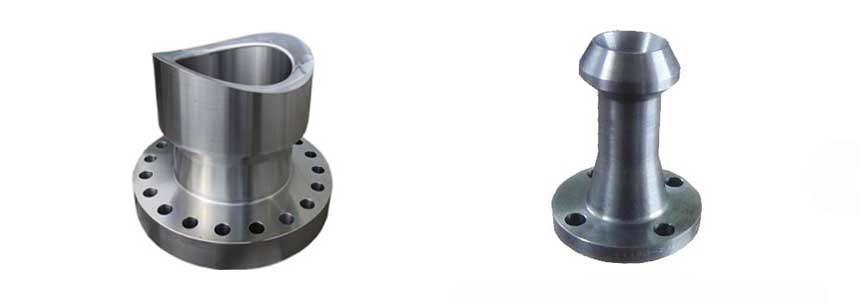
Weldo Flange (Weldoflange)
Weldo flanges save a weld, a stub, and fabrication time on branch and instrument connections off headers. Tesco Steel & Engineering supplies weldo flanges (flangeolets) with the same facings and ratings as standard flanges — see our flangeolet page and the flange dimensions charts, and compare with long weld neck flanges.
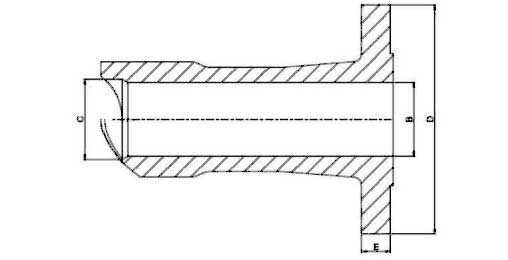
Weldo Flange Dimensions
| NPS | A | B | C | D |
|---|---|---|---|---|
| 1/2 | 3/4 19.05 | 1.3/8 34.93 | 15/16 23.81 | 5/8 15.88 |
| 3/4 | 7/8 22.23 | 1.5/8 41.28 | 1.3/16 30.16 | 13/16 20.64 |
| 1 | 1.1/16 26.99 | 2 50.80 | 1.7/16 36.51 | 1.1/32 26.19 |
| 1.1/4 | 1.1/4 31.75 | 2.3/8 60.3 | 1.3/4 44.45 | 1.3/8 34.93 |
| 1.1/2 | 1.5/16 33.34 | 2.7/8 73 | 2 50.80 | 1.5/8 41.28 |
| 2 | 1.1/2 38.10 | 3.1/2 88.90 | 2.9/16 65.09 | 2.1/16 52.39 |
| 2.1/2 | 1.5/8 41.28 | 4.1/16 103.19 | 3 76.20 | 2.7/16 61.91 |
| 3 | 1.3/4 44.45 | 4.13/16 122.24 | 3.11/16 93.66 | 3.1/16 77.79 |
| 3.1/2 | 2 50.80 | 5.3/8 136.53 | 3.7/8 98.43 | 3.9/16 90.49 |
| 4 | 2 50.80 | 6 152.40 | 4.3/4 120.65 | 4 101.60 |
| 5 | 2.1/4 57.15 | 7.1/8 180.98 | 5.9/16 141.29 | 5.1/16 128.59 |
| 6 | 2.3/8 60.3 | 8.1/2 215.90 | 6.11/16 169.86 | 6.1/16 153.99 |
| 8 | 2.3/4 69.85 | 10.3/8 263.53 | 8.11/16 220.66 | 7.15/16 201.61 |
| 10 | 3.1/16 77.79 | 12.9/16 319.09 | 10.13/16 274.64 | 10 254.00 |
| 12 | 3.3/8 85.73 | 14.7/8 377.83 | 12.13/16 325.44 | 12 304.80 |
| 14 | 3.1/2 88.90 | 16.1/8 409.58 | 14.1/16 357.19 | 13.1/4 336.55 |
| 16 | 3.11/16 93.66 | 18.1/4 463.55 | 16.1/16 407.99 | 15.1/4 387.35 |
| 18 | 4.1/16 103.19 | 20.3/4 527.05 | 18.5/8 473.08 | 17.1/4 438.15 |
| 20 | 4.5/8 117.48 | 23.1/16 585.79 | 20.1/16 509.59 | 19.1/4 488.95 |
| 24 | 5.3/8 136.53 | 27.7/8 708.03 | 25.1/8 638.18 | 23.1/4 590.55 |
| Criterion | Weldo Flange (one piece) | Weldolet + Welded Flange |
|---|---|---|
| Components | Single fitting | Weldolet + pipe stub + flange |
| Welds to make | One (to the run pipe) | Multiple (olet, stub, flange) |
| Reinforcement | Integral / self-reinforced | Olet reinforced; extra welds |
| Fabrication | Faster, fewer joints | More time & inspection |
| Leak paths | Fewer welds = fewer leak points | More welds = more potential leaks |
The weldo flange replaces a weldolet, a stub pipe, and a flange with one fitting and one weld — quicker, with fewer joints to inspect and fewer potential leak paths.
| Parameter | Details |
|---|---|
| Product | Weldo flange / weldoflange / flangeolet (self-reinforced branch outlet) |
| Function | Flanged branch connection off a run/header pipe in one fitting |
| Pressure Class | 150, 300, 600, 900, 1500, 2500 lbs; PN6–PN400 |
| Facing | RF (raised face), RTJ, FF — to ASME B16.5 |
| Run / Branch Size | Made to the header (run) OD and the branch size required |
| Reinforcement | Integral / self-reinforced — no separate pad |
| End to Pipe | Contoured base for fillet/groove weld to the run pipe |
| Material | A105 carbon steel, SS 304/316, SS 321, Monel, Inconel, Incoloy, special alloys |
| Standards | ASME B16.5 facing; MSS SP-97 / B31.3 branch design basis |
| Certifications | ISO 9001:2015 | EN 10204 3.1 MTC on request |
| Material | Properties | Typical Use |
|---|---|---|
| A105 Carbon Steel | Strong, economical | Non-corrosive gas, steam & liquid headers |
| SS 304 / 316 / 316L | Good corrosion resistance | Process, chemical & hygienic branches |
| SS 321 | Stabilised for high temperature | High-temperature steam & gas lines |
| Monel 400 | Excellent in HF & marine media | HF, seawater & reducing media |
| Inconel / Incoloy | High-temperature & corrosion resistance | High-temperature & corrosive branches |
Replaces a weldolet, stub, and flange with a single fitting and a single weld — faster fabrication and fewer joints to inspect.
The built-up body reinforces the branch opening and carries branch & bending loads without a separate reinforcing pad.
Fewer welds mean fewer potential leak points and less NDT, improving the integrity of branch and instrument connections.
A finished RF/RTJ flange face to ASME B16.5 bolts up directly to standard mating flanges and gaskets.
A105, SS 304/316/321, Monel, Inconel, and Incoloy for gas, steam, and corrosive or high-temperature headers.
Contoured to your header OD and branch size, in the class and facing required, certified with EN 10204 3.1 MTC.
| Industry | Typical Use | Why Weldo Flange |
|---|---|---|
| Oil & Gas | Flanged branches off headers & manifolds | One-weld branch; self-reinforced |
| Refinery & Petrochemical | Branch & instrument connections | Fewer welds; full material range |
| Power Generation | Steam-header branches | SS 321 high-temperature service |
| Chemical Plants | Corrosive-header branches | Monel / Inconel / Incoloy |
| Pipelines | Take-off & vent/drain branches | High-class reinforced outlets |
| Fertilizer & Process | Header branch connections | Fast, code-compliant branches |
| Shipbuilding & Offshore | Topside & utility headers | SS / alloy corrosion resistance |
| Water & Utilities | Branch & instrument tappings | Economical one-piece branch |
Q1. What is a weldo flange?
A weldo flange (also called a weldoflange or flangeolet) is a self-reinforced branch outlet fitting that combines a weldolet and a flange in one forging. It welds onto a run pipe like a weldolet and presents a finished flange face for the branch, so a flanged branch connection is made with one fitting and one weld.
Q2. Is a weldo flange the same as a flangeolet?
Yes — "weldo flange," "weldoflange," and "flangeolet" all refer to the same product: a one-piece branch outlet that integrates a weldolet-type reinforced connection with a flange face. See our flangeolet page for the same fitting.
Q3. How is a weldo flange better than a weldolet plus a separate flange?
The weldo flange replaces a weldolet, a stub pipe, and a separate welded flange with a single fitting and a single weld. That means faster fabrication, fewer welds and inspections, fewer potential leak paths, and integral reinforcement of the branch opening — all in one component.
Q4. Does a weldo flange need a reinforcing pad?
No. A weldo flange is self-reinforced — its built-up body provides the area replacement needed at the branch opening, so a separate reinforcing pad is not required (subject to the branch design check per the applicable code).
Q5. What classes, facings, and materials are available?
Class 150 to 2500 and PN6 to PN400, with RF, RTJ, or FF facings to ASME B16.5, in A105 carbon steel, SS 304/316/321, Monel, Inconel, and Incoloy. The class, facing, and material are chosen for the header service and the mating branch flange.
Q6. How is a weldo flange attached to the pipe?
An opening is cut in the run (header) pipe, the fitting's contoured saddle base is seated over it to match the pipe curvature, and a single attachment weld joins it to the run pipe per a qualified welding procedure. The other end is then bolted to the branch line's flange.
Q7. Why must the contour match the run pipe size?
The base of a weldo flange is contoured (saddle-shaped) to fit a specific run-pipe outside diameter. If used on a different header size, it will not seat properly and the weld will be poor. So the run-pipe OD and schedule must be specified along with the branch size when ordering.
Q8. Can weldo flanges be supplied to our drawing and certified?
Yes. We supply weldo flanges to ASME B16.5 facings and the branch design standard, or to your drawing — run OD, branch size, class, facing, and material — with EN 10204 3.1 material test certificates on request. Send your header and branch details for a recommendation and quote.