

Tesco Steel & Engineering manufactures male and female (M&F) flanges — a matched pair of flanges in which one flange has a raised male face that seats into a matching female recess on the other, locating the joint and confining the gasket for a more secure seal than a flat raised face. Made in Large M&F and Small M&F facings per ASME B16.5, in weld-neck, blind, slip-on, and threaded styles. A105, SS 304/316/321, Duplex, Monel, Inconel. Class 150 to 2500, PN1 to PN400. ISO 9001:2015 certified. Made in India.
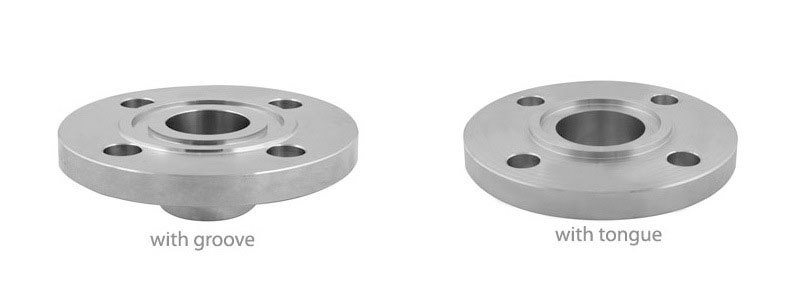
Male & Female Face Flanges
M&F flanges are one of the confined/located gasket face types, alongside tongue-and-groove. Tesco Steel & Engineering manufactures Large and Small M&F flanges to ASME B16.5 in the full material range — dimensioned per the tables below; compare with our groove and tongue flanges and see the flange dimensions charts.
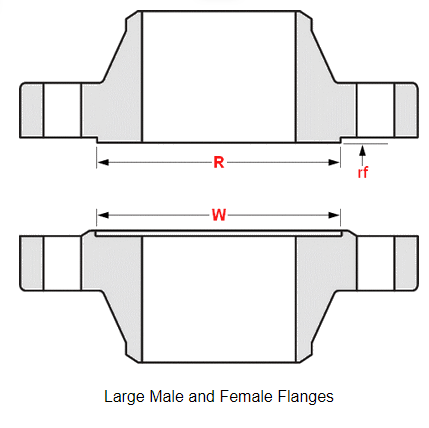
Large Male & Female Face
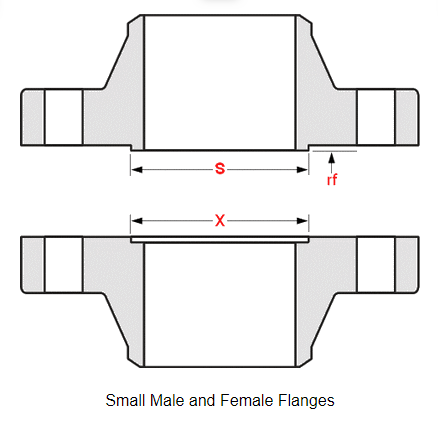
Small Male & Female Face
| Type | Face Width | Gasket Seating | Typical Use |
|---|---|---|---|
| Large Male & Female | Wider male face & female recess | Larger gasket seating area | Standard process-piping flanges — most common |
| Small Male & Female | Narrower face & recess | Smaller seating area | Compact joints, nozzle & cover connections |
| Face Type | Construction | Gasket Confinement |
|---|---|---|
| Male & Female (M&F) | Raised male into recessed female; gasket on the male face | Confined on the outer edge (OD) |
| Tongue & Groove (T&G) | Tongue ring into a groove; gasket in the groove | Fully confined (inner & outer) |
| Raised Face (RF) | Flat raised faces | Unconfined (can blow out) |
M&F confines the gasket on its outer edge (better than RF); tongue & groove confines it on both edges (the highest confinement). M&F is common on pipe flanges, T&G on nozzle and heat-exchanger connections.
| Male Female Flanges are available in the following specifications: | |
|---|---|
| Size | 1/2"NB to 56"NB |
| Class | 150#, 300#, 3000#, 6000#, 9000# |
| Sch (Schedule) | XS, XXS, STD & Schedule 20, 40, 80, 160 |
| Pressure Ratings | PN 1 - PN 400 |
| Stainless Steel Male Female Flanges | ASTM A 182 F - 304 / 304H / 304L / 316 / 316H / 316L / 316Ti, 309, 310, 317L, 321, 347, 904L |
| Duplex Steel Male Female Flanges | ASTM A 182 - F 51, F 53, F 55 |
| Alloy Steel Male Female Flanges | ASTM A 182 - F5, F9, F11, F21, F22 & F91 |
| Carbon Steel Male Female Flanges | ASTM A 105 |
| Low Temp. Carbon Steel Male Female Flanges (LTCS Male Female Flanges Flanges) | A 350 LF2 |
| Copper Nickel (Cu-Ni) Male Female Flanges | C70600, 90/10, C71500, 70/30, C71640 |
| Nickel Male Female Flanges | UNS N02200, UNS N02201 |
| Monel Male Female Flanges | UNS N04400, UNS N05500, Alloy 20 |
| Inconel Male Female Flanges | UNS N06600, UNS N06601, UNS N06625, UNS N08800, UNS N08810, UNS N08825 |
| Hastelloy Male Female Flanges | UNS N10276, UNS N06022, UNS N10665, UNS N06455 |
| Titanium Male Female Flanges | Gr. 1, Gr. 2, Gr. 3, DTH 3.7035, DTH 3.7055 |
| Other Services | Hot Dip Galvanized (GI) Male Female Flanges Sand Blasting on Male Female Flanges Shot Peening on Male Female Flanges Epoxy Coating on Male Female Flanges FBE Coating on Male Female Flanges |
| NPS | R | W |
| 1/2 | 35.05 | 36.57 |
| 3/4 | 42.92 | 44.45 |
| 1 | 50.8 | 52.32 |
| 1¼ | 63.5 | 65.02 |
| 1½ | 73.15 | 74.67 |
| 2 | 91.94 | 93.72 |
| 2½ | 104.64 | 106.42 |
| 3 | 127 | 128.52 |
| 3½ | 139.7 | 141.22 |
| 4 | 157.22 | 158.75 |
| 5 | 185.67 | 187.45 |
| 6 | 215.9 | 217.42 |
| 8 | 269.74 | 271.52 |
| 10 | 323.85 | 325.37 |
| 12 | 381 | 382.52 |
| 14 | 412.75 | 414.27 |
| 16 | 469.9 | 471.42 |
| 18 | 533.4 | 534.92 |
| 20 | 584.2 | 585.72 |
| 24 | 692.15 | 693.67 |
| NPS | S | X |
| 1/2 | 18.28 | 19.81 |
| 3/4 | 23.87 | 25.4 |
| 1 | 30.22 | 31.75 |
| 1¼ | 38.1 | 39.62 |
| 1½ | 44.45 | 45.97 |
| 2 | 57.15 | 58.67 |
| 2½ | 68.32 | 69.85 |
| 3 | 84.07 | 85.85 |
| 3½ | 96.77 | 98.55 |
| 4 | 109.47 | 111.25 |
| 5 | 136.65 | 138.17 |
| 6 | 162.05 | 163.57 |
| 8 | 212.85 | 214.37 |
| 10 | 266.7 | 268.22 |
| 12 | 317.5 | 319.02 |
| 14 | 349.25 | 350.77 |
| 16 | 400.05 | 401.57 |
| 18 | 450.85 | 452.37 |
| 20 | 501.65 | 503.17 |
| 24 | 603.25 | 604.77 |
The male face seats into the female recess, centring the joint and confining the gasket OD for a more secure seal than RF.
Both ASME B16.5 facings — Large M&F for standard piping and Small M&F for compact joints.
Supplied as correctly matched male & female pairs of the same NPS, class, and facing for a perfect fit.
A105, LTCS, SS 304/316/321, Duplex, Monel, Inconel, and more for corrosive and high-temperature service.
Weld-neck, blind, slip-on, and threaded flanges machined with male or female faces.
Made to ASME B16.5 or your drawing, certified with EN 10204 3.1 MTC.
| Material | Properties | Typical Use |
|---|---|---|
| A105 Carbon Steel / A350 LF2 (LTCS) | Strong, economical; LF2 for low temp | Non-corrosive & low-temperature lines |
| SS 304 / 316 / 321 | Good corrosion resistance; 321 high-temp | Process, chemical & high-temperature service |
| Duplex 2205 / Super Duplex 2507 | High strength & chloride resistance | Seawater & offshore service |
| Monel 400 / Inconel | Excellent in HF, marine & high-temp | HF, seawater & high-temperature service |
| Alloy Steel (F5/F9/F11/F22/F91) | High-temperature strength | Power & refinery high-temp lines |
| Industry | Typical Use | Why Male & Female |
|---|---|---|
| Oil & Gas | Higher-integrity pipe joints | Located, confined-OD gasket |
| Refinery & Petrochemical | Process & equipment flanges | Better seal than RF; full material range |
| Power Generation | Steam & high-temperature lines | SS 321 / alloy-steel M&F |
| Chemical Plants | Corrosive-service joints | Monel / Inconel / Duplex |
| Pumps & Equipment | Casing & cover connections | Self-locating, repeatable assembly |
| Heat Exchangers | Channel & nozzle joints | Confined gasket; Small M&F |
| Offshore & Marine | Topside higher-integrity joints | Duplex / alloy corrosion resistance |
| Water & Utilities | Plant & utility flanges | Economical located joint |
Q1. What are male and female flanges?
Male and female (M&F) flanges are a matched pair in which one flange has a raised male face that seats into a matching female recess on the other. The interlocking faces locate the joint and partly confine the gasket on its outer edge, giving a more secure seal than a flat raised face. They are defined in ASME B16.5 in Large and Small M&F sizes.
Q2. What is the difference between Large and Small Male & Female?
Both use the same principle but differ in face width. Large M&F has a wider male face and female recess, giving a bigger gasket seating area — the standard for process piping. Small M&F has a narrower face and recess for compact joints, nozzles, and covers. Both flanges of a pair must be the same size.
Q3. How is M&F different from tongue-and-groove?
In male & female, the gasket sits on the raised male face inside the female recess and is confined on its outer edge only. In tongue-and-groove, the gasket sits fully inside the groove and is confined on both inner and outer edges. T&G gives slightly higher confinement; M&F is more common on pipe flanges, T&G on nozzle and heat-exchanger joints.
Q4. Can a male flange be bolted to a raised-face flange?
No. A male flange must mate with its matching female flange of the same NPS, class, and M&F size. Bolted to a flat raised-face (RF) flange, the male face would not seat into a recess and the gasket would not be confined, giving uneven loading and almost certain leakage. M&F flanges are always used as a matched pair.
Q5. What gasket is used with male & female flanges?
A gasket sized to the M&F face — its outer diameter matches the male face / female recess so it is confined on the OD. Spiral-wound (with inner ring), ring, or soft gaskets are used depending on the service. A full-face RF gasket must not be used, as it would not fit the recessed face.
Q6. What flange types and classes are available?
Weld-neck, blind, slip-on, and threaded flanges with male or female faces, in Class 150 to 2500 and PN1 to PN400, sized 1/2" to 56", to ASME B16.5. The dimension tables on this page give the Large (R/W) and Small (S/X) M&F face dimensions by NPS.
Q7. What materials are male & female flanges made from?
A105/LTCS, SS 304/316/321, Duplex 2205/2507, Monel, Inconel, and alloy steels (F5/F9/F11/F22/F91). The grade is chosen for the fluid, pressure, and temperature — for example SS 321 or alloy steel for high temperature and Monel/Inconel/Duplex for corrosive service.
Q8. Can male & female flanges be supplied to our drawing and certified?
Yes. We supply matched male & female flange pairs to ASME B16.5 or your drawing — type, class, M&F size (Large/Small), facing, and material — with EN 10204 3.1 material test certificates on request. Send your joint details and service conditions for a quote.