Single Segmental Baffles | Double Segmental Baffles | Triple Segmental Baffles | Disc & Ring (Doughnut) Baffles | Orifice Baffles | Support Baffles | SS 304 / SS 316 Baffles | Duplex 2205 / 2507 Baffles | Inconel Baffles | TEMA Baffles
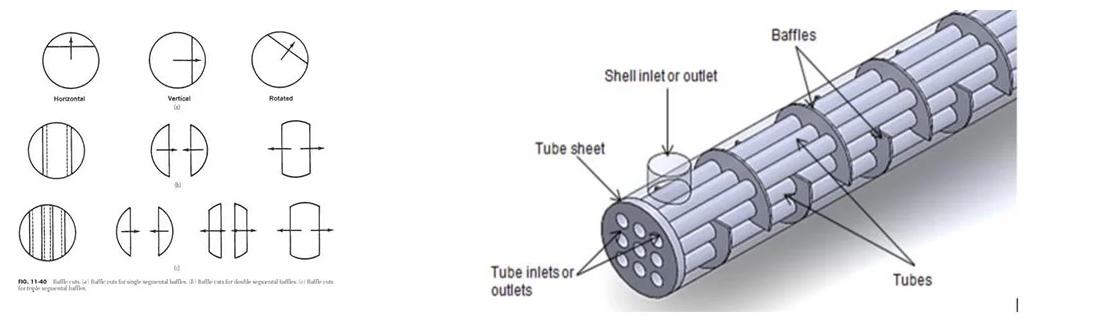
Heat exchanger baffles are internal plates or panels installed inside the shell of a shell-and-tube heat exchanger. They perform four critical functions: they support the tube bundle to prevent sagging and mechanical vibration, direct the shell-side fluid in a crossflow pattern across the tubes, create controlled turbulence to enhance the convective heat transfer coefficient, and eliminate stagnant dead zones where heat transfer would otherwise be negligible.
Tesco Steel & Engineering manufactures heat exchanger baffles per TEMA (Tubular Exchanger Manufacturers Association) standards — Class R, Class C, and Class B — as well as to customer-specific drawings and specifications. All baffles are supplied with full material traceability and test certificates in accordance with EN 10204 3.1 / 3.2.
Without baffles, shell-side fluid would flow in a straight path along the length of the shell — parallel to the tubes — producing a low heat transfer coefficient due to minimal turbulence. Baffles fundamentally change this flow behaviour:
Crossflow over the tubes raises the shell-side heat transfer coefficient by a factor of 3–10× compared to an unbaffled shell, dramatically reducing the required heat transfer area.
Baffles provide intermediate structural support, preventing tubes from sagging under their own weight and eliminating flow-induced vibration that could cause fatigue cracking near tube sheets.
The crossflow and directional reversals induced by baffles break the laminar boundary layer on tube surfaces, reducing thermal resistance and allowing more heat to transfer per unit area.
Strategically spaced baffles prevent the formation of stagnant zones — regions of near-zero velocity where heat transfer efficiency approaches zero and fouling deposits accumulate rapidly.
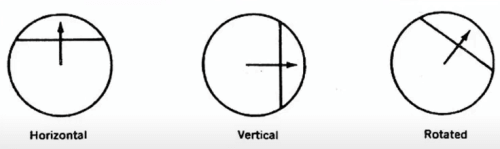
The most widely used baffle type. Each baffle is a single disc with a segment removed along one chord — the baffle cut. Shell-side fluid flows alternately over and under consecutive baffles in a serpentine zigzag path, producing high turbulence and excellent crossflow heat transfer. The baffle cut is typically 20–25% of the shell inside diameter.
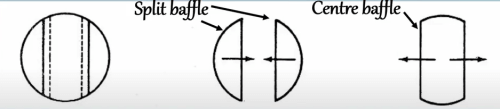
Each baffle is split into two pieces — a split baffle and a centre baffle — with a minimum one-tube-row overlap. Alternate baffles divide the shell-side flow into two parallel streams, halving the crossflow velocity. This significantly reduces pressure drop and shell-side vibration risk compared to single segmental design.
The baffle plate is divided into three pieces: two split baffles and one centre baffle. Shell-side flow is divided into three parallel streams, further reducing crossflow velocity, pressure drop, and tube vibration compared to double segmental baffles. All tubes are supported by every baffle set.

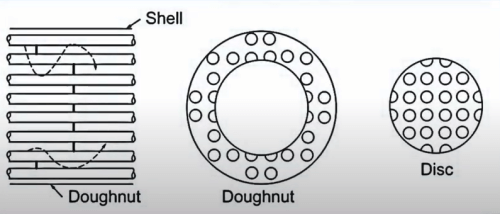
Also called disc and doughnut baffles. Alternating circular discs (solid central plates) and annular rings (outer doughnut-shaped plates) create a radial flow pattern: the disc forces flow radially outward; the ring forces flow back inward through the tube bundle. The disc diameter should be larger than the inner diameter of the doughnut ring.
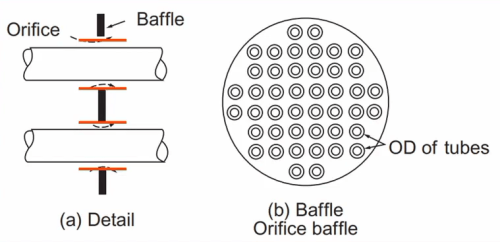
Shell-side fluid passes through the annular gap between the baffle hole and the tube outside diameter — not around the edge of the baffle. This creates a controlled pressure drop at each baffle without full crossflow. Orifice baffles are the least commonly used type because they are extremely difficult to clean once fouled, and the narrow orifice gap accelerates erosion and corrosion on tube surfaces.
Full circular plates with no cut — used solely for tube structural support in long heat exchangers, not for flow direction. Positioned at intermediate points between active (segmental) baffles to shorten unsupported tube span and raise the tube natural frequency above the vortex shedding frequency, preventing resonance vibration.
Baffle cut is the height of the segment removed from the baffle, expressed as a percentage of the shell inside diameter (ID). It is the single most influential design variable controlling the trade-off between heat transfer rate and pressure drop.
| Baffle Cut (%) | Shell-Side Velocity | Heat Transfer Coefficient | Pressure Drop | Typical Application |
|---|---|---|---|---|
| 15% | High | High | Very High | Low-viscosity liquids, fouling-resistant fluids |
| 20–25% | Moderate–High | Optimal | Moderate | Standard design — most shell-and-tube exchangers |
| 30–35% | Moderate | Good | Low–Moderate | Viscous liquids, pressure-drop limited service |
| 40–45% | Low | Reduced | Low | Gas coolers, condensers, very viscous fluids |
Baffle spacing (Bs) is the centre-to-centre distance between adjacent baffles.
| TEMA Limit | Value | Reason |
|---|---|---|
| Minimum spacing | Greater of: Shell ID ÷ 5 or 51 mm (2 in) | Prevents impractical maintenance access and excessive pressure drop |
| Maximum spacing | Shell inside diameter | Prevents excessive tube vibration due to long unsupported spans |
| Optimal range (typical) | 0.3 × Shell ID to 0.7 × Shell ID | Balances heat transfer against pressure drop for most services |
The inlet and outlet baffle spacing may differ from the central spacing — they are typically wider to accommodate nozzle connections and reduce inlet/outlet pressure drop.
| Baffle Type | Flow Pattern | Relative Pressure Drop | Heat Transfer | Tube Support | Cleanability |
|---|---|---|---|---|---|
| Single Segmental | Crossflow (zigzag) | High | Highest | Good | Good |
| Double Segmental | Split crossflow | Medium | High | Very Good | Good |
| Triple Segmental | 3-stream crossflow | Low | Good | Excellent | Moderate |
| Disc & Ring | Radial alternating | Low–Medium | Good | Good | Poor |
| Orifice | Axial through gap | Low | Low | Moderate | Very Poor |
| Support (Full Disc) | None (tube support only) | Negligible | None | Excellent | N/A |
Baffle material is selected to match the shell material and resist the shell-side fluid. Per TEMA, baffles should be compatible with both the shell-side and tube-side process environment to prevent galvanic corrosion.
| Material Group | Grade / Specification | Key Properties & Typical Service |
|---|---|---|
| Carbon Steel | IS 2062, ASTM A36 | General non-corrosive service, most economical; cooling water, steam, air |
| Stainless Steel 304 / 304L | ASTM A182 F304 / F304L | Mild corrosive service, food & beverage, dilute acids, clean water |
| Stainless Steel 316 / 316L | ASTM A182 F316 / F316L | Chloride-containing media, chemical process, marine environments |
| SS 310 / 321 / 347 | ASTM A182 F310 / F321 / F347 | High-temperature oxidation resistance (310), stabilised grades for sensitisation-prone service |
| Duplex 2205 | UNS S31803 / S32205 | Offshore seawater, sour gas, chloride stress corrosion cracking resistance |
| Super Duplex 2507 | UNS S32750 / S32760 | Highly aggressive chloride environments, subsea, deep offshore |
| Monel 400 / K500 | UNS N04400 / N05500 | HF acid, seawater, marine heat exchangers, reducing acids |
| Inconel 600 / 625 / 825 | UNS N06600 / N06625 / N08825 | High-temperature oxidation, sour gas H₂S service, nuclear, sulphuric acid |
| Hastelloy C276 / C22 | UNS N10276 / N06022 | Wet chlorine, FGD systems, mixed mineral acids, pharmaceutical reactors |
| Titanium Gr. 2 | UNS R50400 | Seawater coolers, chlorine, bleaching chemicals, desalination |
| Industry | Heat Exchanger Type | Baffle Selection | Typical Material |
|---|---|---|---|
| Oil & Gas — Upstream | Crude oil coolers, gas-gas exchangers | Single segmental, 25% cut | Carbon Steel, SS 316L |
| Refinery / Downstream | Overhead condensers, reboilers, feed-effluent exchangers | Single or Double segmental | CS, F11, F22, SS 321 |
| Petrochemical | Reactor feed-effluent, product coolers | Single segmental | SS 316L, Duplex 2205, Inconel 625 |
| Power Generation | Surface condensers, feed-water heaters, air preheaters | Double segmental (large bundles) | Carbon Steel, SS 304L |
| Chemical Processing | Acid coolers, solvent condensers, multi-pass exchangers | Single segmental, vertical cut | Hastelloy C276, Titanium, SS 316L |
| Offshore / Marine | Seawater coolers, jacket water coolers | Single segmental, disc & ring | Duplex 2205, Titanium, C70600 |
| Pharmaceutical | Product coolers, crystallisers | Single segmental (sanitary design) | SS 316L (EP/Ba finish) |
| HVAC / Building Services | Chilled water exchangers, boiler economisers | Single segmental | Carbon Steel, SS 304 |
| Desalination / Water Treatment | Brine heaters, flash evaporators | Disc & Ring, Single segmental | Titanium Gr.2, Duplex F51 |
| Standard | Scope |
|---|---|
| TEMA Class R | Severe refinery and related processes — most stringent baffle thickness, spacing, and tolerance requirements |
| TEMA Class C | General commercial and moderate process service — relaxed tolerances vs Class R |
| TEMA Class B | Chemical process service — intermediate between R and C |
| ASME Section VIII Div. 1 | Pressure vessel design code — governs shell, channel, tube sheet calculations |
| API 660 | Shell-and-tube heat exchangers for general refinery service — supplements TEMA R |
| API 661 | Air-cooled heat exchangers — governs baffle design for air-cooled bundles |
| ASTM A182 | Forged alloy and stainless steel flanges & fittings — covers material for SS and alloy baffles |
| EN 10204 3.1 / 3.2 | Material test certificate traceability — supplied with all Tesco Steel baffles |
| Heat Exchanger Baffles — Available Specifications | |
|---|---|
| Stainless Steel Baffles | ASTM A 182 F-304 / 304H / 304L / 316 / 316L / 316Ti / 321 / 347 / 310 / 310S / 904L |
| Duplex Steel Baffles | S31803 / S32205 (Duplex 2205) | UNS S32750 / S32760 (Super Duplex 2507 / 2507Cu) |
| Monel Baffles | Monel 400 (UNS N04400) | Monel K500 (UNS N05500) |
| Inconel Baffles | Inconel 600 (N06600) | Inconel 601 (N06601) | Inconel 625 (N06625) | Incoloy 825 (N08825) |
| Hastelloy Baffles | Hastelloy C276 (N10276) | Hastelloy C22 (N06022) | Hastelloy B2 (N10665) |
| Carbon Steel Baffles | IS 2062 Gr. B | ASTM A36 | ASTM A516 Gr. 60/70 |
| Titanium Baffles | Grade 1 (R50250) | Grade 2 (R50400) | Grade 5 (R56400) |
| Copper Nickel Baffles | C70600 (90/10 Cu-Ni) | C71500 (70/30 Cu-Ni) |
| Plate Thickness | As per TEMA Class R / C / B minimum baffle thickness tables (function of shell ID and baffle spacing) |
| Tube Hole Tolerance | TEMA: Baffle hole diameter = Tube OD + 0.79 mm (1/32") for Class R; + 1.59 mm for Class C/B |
| Surface Finish | Mill Finish, Electropolish (pharmaceutical), Sand Blasted, Painted (CS) |
| Test Certificates | EN 10204 3.1 (standard) | EN 10204 3.2 (third-party witness, on request) |
Every baffle leaves our facility with a documented quality trail — from raw material heat number to final dimensional inspection report.
We supply baffles to refineries, petrochemical plants, and offshore platforms across the Middle East, Europe, Southeast Asia, and the Americas.
We manufacture baffles to customer-supplied TEMA datasheets or drawings — any shape, any size, any material, any baffle cut angle or direction.
Standard stainless steel and carbon steel baffles for common shell diameters are maintained in stock for fast dispatch and short lead times.
Material Test Certificates per EN 10204 3.1 supplied as standard; third-party 3.2 inspection available on request with TPIA of your choice.
Direct manufacturer pricing with no middleman margin. Request a quote with your shell ID, baffle type, material, and quantity for the best rate.
Baffles are internal plates or discs installed inside the shell of a shell-and-tube heat exchanger. They serve four functions: (1) provide structural support to the tube bundle, preventing tube sagging and vibration; (2) direct the shell-side fluid across the tubes in a crossflow or mixed-flow pattern; (3) create turbulence in the shell-side flow, increasing the convective heat transfer coefficient; and (4) prevent formation of stagnant (dead) zones where heat transfer would be negligible. Baffles are designed and spaced per TEMA standards.
Single segmental baffles consist of a single semicircular plate with a cut along one chord. Shell-side fluid flows alternately over and under each successive baffle in a zigzag path, maximising turbulence and heat transfer but also pressure drop. Double segmental baffles split each baffle into two pieces, dividing the shell-side flow into two parallel streams. This halves the crossflow velocity, producing 40–60% lower pressure drop at comparable heat transfer performance — making them preferred for large tube bundles or pressure-drop-constrained services.
Baffle cut is the height of the segment removed from a baffle plate, expressed as a percentage of the shell inside diameter. The TEMA standard starting point is 25% baffle cut. A smaller cut (15–20%) produces higher velocity and better heat transfer but significantly increases pressure drop. A larger cut (35–45%) reduces pressure drop but lowers the heat transfer coefficient due to reduced turbulence. The 20–25% range is optimal for most liquid-to-liquid shell-and-tube heat exchangers.
Baffle spacing is the centre-to-centre distance between adjacent baffles. Per TEMA, minimum baffle spacing is the greater of shell ID ÷ 5 or 51 mm (2 inches). Maximum spacing equals the shell inside diameter. The optimal spacing for most services is 30–70% of the shell ID. Closer spacing increases heat transfer coefficient but raises pressure drop; wider spacing risks tube vibration due to longer unsupported tube spans.
Baffles are manufactured from the same material as the shell, selected based on shell-side fluid corrosivity: Carbon Steel (IS 2062, A36) for non-corrosive water and steam services; SS 316L for most chemical and marine services; Duplex 2205 / Super Duplex 2507 for offshore and chloride-rich streams; Monel 400 for HF acid and seawater; Inconel 625 for high-temperature and sour gas service; Hastelloy C276 for strong oxidising and reducing acids; Titanium Gr.2 for seawater coolers and bleaching chemicals. TEMA requires baffles to be compatible with both shell-side and tube-side fluids.
TEMA Class R applies to severe refinery and related process services — it specifies the most stringent baffle thickness, hole tolerances, and tie-rod requirements. TEMA Class B covers chemical process services with intermediate requirements. TEMA Class C applies to moderate commercial and general process applications with the most relaxed tolerances. Most oil and gas and petrochemical plants specify TEMA Class R; chemical plants typically use Class B or C. The relevant class is specified on the heat exchanger datasheet or purchase order.
Segmental baffles create a window-type crossflow where fluid zigzags alternately over and under each baffle, giving high turbulence but higher pressure drop and potential dead zones near the shell wall. Disc and doughnut (ring) baffles alternate a central disc with an outer annular ring, creating a radial inward-outward flow pattern with lower pressure drop and more uniform flow distribution across the full tube cross-section. Disc and ring baffles are preferred for gas service or when the bundle is large enough that segmental windows create unacceptable bypass zones.
As shell-side fluid flows across tubes, alternating vortices shed from each tube at a frequency proportional to the fluid velocity (Strouhal relationship). If this vortex shedding frequency matches the natural frequency of the unsupported tube span between baffles, resonance and rapid fatigue failure can occur. Prevention: (1) reduce baffle spacing to shorten tube spans and raise natural frequency; (2) add intermediate full-disc support baffles; (3) switch to double segmental baffles to lower cross-flow velocity; (4) use larger tube ODs or heavier wall schedules. TEMA Section 6 provides the mandatory vibration analysis methodology.
Key selection factors: (1) Allowable pressure drop — single segmental for high-ΔP tolerance, double/triple segmental or disc-and-ring for low ΔP; (2) Fluid viscosity — viscous fluids need larger cuts and wider spacing; (3) Fouling tendency — higher cuts and wider spacing reduce plugging risk; (4) Tube vibration risk — large shells at high velocity need closer spacing or double segmental baffles; (5) Shell-side fluid phase — condensers and reboilers often use vertical-cut baffles to prevent liquid/vapour accumulation. Share your TEMA datasheet with our engineering team for a material and geometry recommendation.
Heat Exchanger Baffles — Manufacturer / Supplier / Stockist in: Kuwait, UAE, Germany, Saudi Arabia, West Africa, Iraq, Congo, Mexico, Bahrain, Canada, Philippines, Thailand, Kenya, Oman, Malaysia, Turkey, Qatar, Sudan, Netherlands, Nigeria, Lithuania, Gabon, Russia, Vietnam, Angola, Bolivia, Indonesia, UK, Yemen, Italy, United States, Venezuela, Spain, Iran, Estonia, Kazakhstan, Algeria, Jordan, Ecuador, Portugal, Colombia, Libya, Chile, Peru, South Africa, Bangladesh, Morocco, Denmark, Taiwan, Norway, Belarus, Lebanon, Sri Lanka, Bulgaria, Ukraine, Belgium, Finland, Romania, France, Brazil, Trinidad & Tobago, Tunisia, Ghana, Egypt, Czech Republic, Poland, Greece, New Zealand, Croatia, Tanzania, Singapore, Australia, Japan, South Korea.
Major Exporting Cities: Dubai, Abu Dhabi, Sharjah, Riyadh, Jeddah, Al Jubail, Al Khobar, Dammam, Kuwait City, Manama, Doha, Muscat, Tehran, Ahvaz, Lagos, Nairobi, Johannesburg, Moscow, Atyrau, Istanbul, London, Houston, Los Angeles, New York, Dallas, Toronto, Calgary, Montreal, Singapore, Kuala Lumpur, Bangkok, Jakarta, Ho Chi Minh City, Hanoi, Mumbai, Chennai, Pune, Vadodara, Seoul, Busan, Tokyo, Sydney, Melbourne, Perth.