

Tesco Steel & Engineering manufactures anchor flanges — heavy double-hub forged flanges welded into a pipeline and embedded in a concrete or steel anchor block to lock the pipe in place and resist axial movement and thrust. By transferring pipeline loads from thermal expansion, internal pressure, and seismic activity into the anchor structure, they keep the line stable and protect connected equipment. Made to ASME/ANSI, EN 1092-2, and DIN 86029. A105, SS 304/316/310, Duplex, Monel, Inconel, Incoloy. Size 1/2" to 56", Class 150 to 9000, PN1 to PN400. ISO 9001:2015 certified. Made in India.
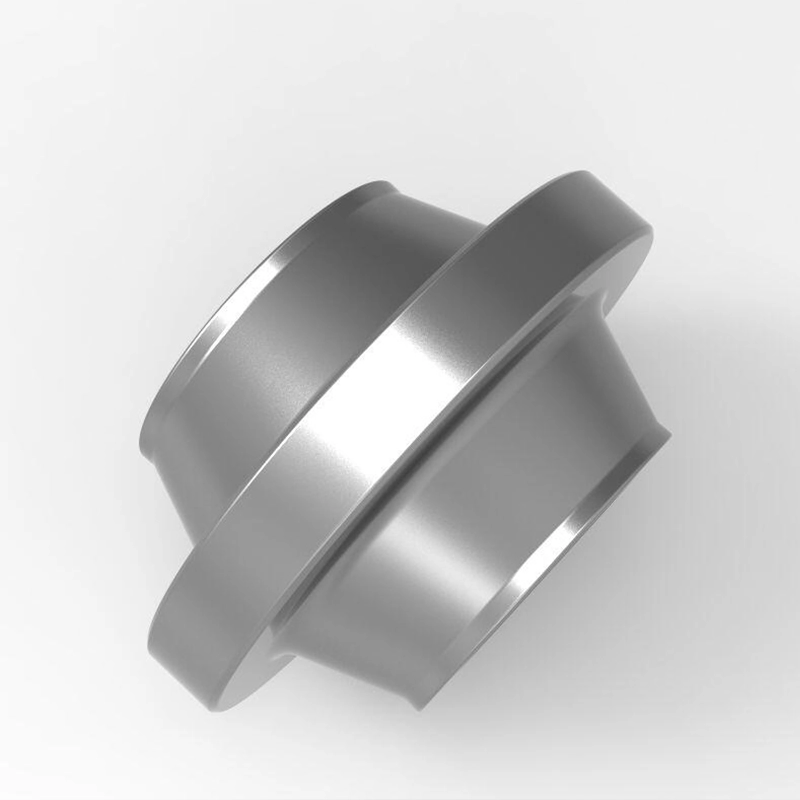
Anchor Flange (Double Hub)
Anchor flanges combat axial movement and stabilise the pipeline. Tesco Steel & Engineering forges anchor flanges to ASME/ANSI, EN 1092-2, and DIN 86029 in the full material range with coatings for buried service — dimensioned per the table below and compatible with our standard weld neck flanges; see the flange dimensions charts.
| Load / Need | How the Anchor Flange Helps |
|---|---|
| Thermal expansion | Fixes the pipe at a point so growth is directed to expansion loops/joints, not equipment |
| Internal pressure thrust | Resists the axial end-thrust that pressure creates, especially at bends & caps |
| Seismic / ground movement | Restrains the line against earthquake and soil-movement loads |
| Buried & crossing pipelines | Anchors the line at river/road crossings, risers, and entry/exit points |
| Equipment protection | Stops excess movement, vibration, and deflection reaching pumps & vessels |
| Parameter | Details |
|---|---|
| Size | 1/2" NB to 56" NB |
| Class | 150#, 300#, 3000#, 6000#, 9000# |
| Schedule | STD, XS, XXS & Sch 20, 40, 80, 160 |
| Pressure Ratings | PN1 to PN400 |
| Standards | ASME/ANSI B16.5, EN 1092-2, DIN 86029 |
| Carbon Steel | ASTM A105; LTCS A350 LF2 |
| Stainless Steel | A182 F304/304H/304L, F316/316H/316L/316Ti, 309, 310, 317L, 321, 347, 904L |
| Duplex Steel | A182 F51, F53, F55 |
| Alloy Steel | A182 F5, F9, F11, F22, F91 |
| Nickel Alloys | Monel 400/500, Inconel 600/601/625/800/825, Hastelloy C276/C22, Copper-Nickel 90/10 & 70/30, Titanium |
| Coatings / Finish | Hot-dip galvanized (GI), sand-blasted, shot-peened, epoxy & FBE coating for buried service |
| Certifications | ISO 9001:2015 | EN 10204 3.1 MTC on request |
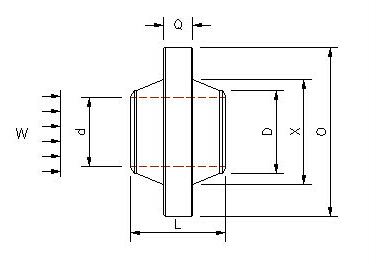
Anchor Flange Dimensions (Dim O, Q, L, X)
| Nom Pipe Size | Dia of Bore | Pre Beveled Hub Dia | For 40%F Temperature Change | For 90%F Temperature Change | ||||||
| Dim O | Dim Q | Dim L | Dim X | Dim O | Dim Q | Dim L | Dim X | |||
| 6 | According to customers' requirements. |
6.75 | 9.5 | 0.63 | 2.88 | 7 | 11.25 | 1.13 | 3.63 | 7 |
| 8 | 8.75 | 12.13 | 0.75 | 3 | 9 | 14.63 | 1.38 | 3.88 | 9 | |
| 10 | 11 | 14.88 | 0.88 | 3.13 | 11.13 | 17.13 | 1.5 | 4 | 11.13 | |
| 12 | 13 | 17.75 | 1 | 3.5 | 13.25 | 19.25 | 1.63 | 4.25 | 13.25 | |
| 14 | 14.25 | 19.63 | 1.13 | 3.75 | 14.5 | 20.5 | 1.75 | 4.5 | 14.5 | |
| 16 | 16.25 | 22.38 | 1.31 | 4.19 | 16.3 | 22.5 | 1.81 | 5 | 16.63 | |
| 18 | 18.25 | 24.63 | 1.38 | 4.63 | 18.63 | 24.63 | 1.94 | 5.5 | 78.63 | |
| 20 | 20.31 | 26.63 | 1.5 | 4.88 | 20.63 | 26.75 | 2 | 6 | 20.75 | |
| 22 | 22.31 | 28.63 | 1.63 | 5.13 | 22.63 | 28.75 | 2.13 | 6.25 | 22.75 | |
| 24 | 24.38 | 30.63 | 1.69 | 5.44 | 24.63 | 31 | 2.25 | 6.75 | 24.88 | |
| 26 | 26.38 | 32.75 | 1.75 | 5.88 | 16.75 | 32.88 | 2.31 | 7.13 | 26.88 | |
| 28 | 28.38 | 34.88 | 1.81 | 6.19 | 28.88 | 35 | 2.38 | 7.5 | 29 | |
| 30 | 30.44 | 36.88 | 1.94 | 6.56 | 30.88 | 37 | 2.5 | 8 | 31 | |
| 34 | 34.5 | 41 | 2.06 | 7.19 | 35 | 41 | 2.75 | 8.75 | 35 | |
| 36 | 36.5 | 43 | 2.13 | 8 | 37 | 43 | 2.88 | 9.63 | 37 | |
Heavy double-hub forging transfers high thermal, pressure-thrust, and seismic loads into the anchor block, holding the line firmly.
Designed to be cast into concrete or built into steel thrust foundations on buried lines, crossings, and risers.
Dimensioned for the design temperature change and pipe size so the anchor matches the calculated loads.
A105, LTCS, SS 304/316/321, Duplex, Monel, Inconel, Hastelloy, Copper-Nickel, and Titanium.
Galvanizing, epoxy, and FBE coating, plus sand-blasting and shot-peening, for long life underground.
ASME/ANSI, EN 1092-2, DIN 86029 or your drawing, certified with EN 10204 3.1 MTC.
| Industry | Typical Use | Why Anchor Flange |
|---|---|---|
| Oil & Gas Pipelines | Buried lines, river/road crossings, risers | Restrains thrust & expansion; coated for burial |
| Water & Wastewater | Large transmission mains | Anchors big-bore lines at bends & crossings |
| Power Generation | Station & cooling-water piping | Controls thermal movement; protects equipment |
| Refinery & Petrochemical | Hot & pressurised process lines | Takes pressure thrust & expansion loads |
| District Heating / Steam | Buried hot lines | Anchors expansion against the block |
| Pump & Compressor Stations | Suction/discharge headers | Restrains movement near rotating equipment |
| LNG & Cryogenic | Transfer & loading lines | Low-temperature alloys; load restraint |
| Marine & Offshore | Risers & subsea tie-ins | Corrosion-resistant alloys; anchoring |
Q1. What is an anchor flange?
An anchor flange is a heavy forged flange with a hub on both sides that is welded into a pipeline and embedded in a concrete or steel anchor block. Its purpose is structural: it fixes the pipe in position and resists axial movement caused by thermal expansion, internal pressure thrust, and seismic loads, transferring those forces into the anchor block.
Q2. How is an anchor flange different from a normal flange?
A normal flange joins two pipes or a pipe to equipment so they can be bolted and unbolted. An anchor flange is not a bolted joint — it has a hub on both sides, is welded into the line, and is cast into an anchor block to restrain the pipe structurally. Its job is to hold the line still and carry axial loads, not to make a removable connection.
Q3. Why does a pipeline need anchoring?
Pipelines move under thermal expansion, internal pressure thrust, and seismic or ground movement. If unrestrained, this movement can overload bends, valves, and equipment or buckle the line. Anchor flanges fix the pipe at chosen points so expansion is directed to loops or expansion joints and thrust is carried safely into the anchor structure.
Q4. What sizes, classes, and standards are available?
Size 1/2" to 56" NB, Class 150 to 9000 and PN1 to PN400, to ASME/ANSI B16.5, EN 1092-2, and DIN 86029. The anchor flange and its dimensions are matched to the pipe size and the design temperature change — see the dimension table above.
Q5. What materials are anchor flanges made from?
Carbon steel (A105) and LTCS (A350 LF2), stainless steels (304/316/321 and others), Duplex (F51/F53/F55), alloy steels, Monel, Inconel, Hastelloy, Copper-Nickel, and Titanium. The grade is chosen for the fluid, temperature, and environment, with coatings for buried service.
Q6. What do the dimensions for 40°F and 90°F temperature change mean?
Anchor flange sizing depends on how much the pipe will try to move, which is driven by the temperature change. The table gives dimensions (Dim O, Q, L, X) for a 40°F and a 90°F temperature change so the anchor can be selected for the expected thermal movement of the line. The bore is made to the customer's pipe requirement.
Q7. What coatings are available for buried anchor flanges?
Hot-dip galvanizing (GI), epoxy coating, and FBE (fusion-bonded epoxy), along with sand-blasting and shot-peening for surface preparation. These protect the flange against corrosion when it is embedded in concrete or buried underground for long service life.
Q8. Can anchor flanges be made to our drawing and certified?
Yes. We forge anchor flanges to ASME/EN/DIN standards or to your drawing — size, class, material, temperature-change basis, and coating — with EN 10204 3.1 material test certificates on request. Send your pipeline data and anchor-block design for a recommendation and quote.